Let It Go Lyrics – Idina Menzel
Soundtrack Album: Frozen
The snow glows white on the mountain night
Not a footprint to be seen
A kingdom of isolation
And it looks like I'm the queen
The wind is howling
Like this swirling storm inside
Couldn't keep it in
Heaven knows I've tried
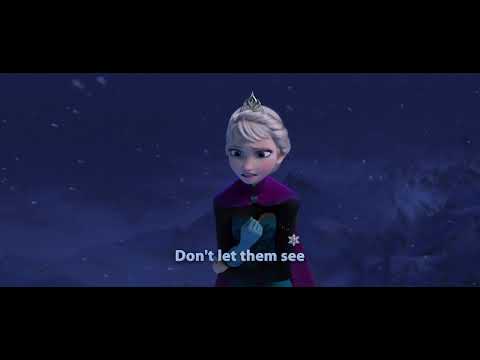
Don't let them in, don't let them see
Be the good girl you always have to be
Conceal, don't feel, don't let them know
Well, now they know
Let it go, let it go
Can't hold back anymore
Let it go, let it go
Turn away and slam the door
I don't care what they're going to say
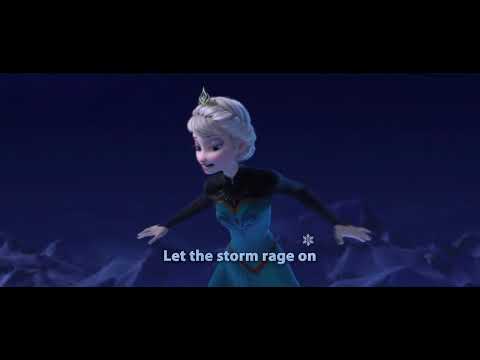
Let the storm rage on
The cold never bothered me anyway.
It's funny how some distance,
makes everything seem small,
and the fears that once controlled me,
can't get to me at all.
It's time to see what I can do.
To test the limits and break through.
No right, no wrong, no rules for me!
I'm free!
Let it go, let it go,
I'm one with the wind and sky!
Let it go, let it go,
you'll never see me cry!
Here I stand and here I'll stay!
Let the storm rage on!
My power flurries through the air into the ground!
My soul is spiraling in frozen fractals all around!
And one thought crystalizes like an icy blast!
I'm never going back,
the past is in the past.
Let it go, let it go,
And I'll rise like the break of dawn!
Let it go, let it go,
That perfect girl is gone!
Here I stand in the light of day!
Let the storm rage on,
the cold never bothered me anyway.
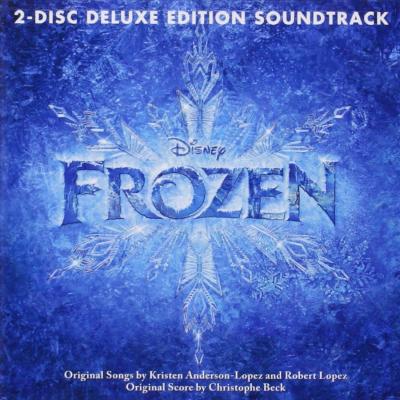
Frozen
Soundtrack Lyrics for Movie, 2013
Track Listing
Kristen Bell, Agatha LeeMonn and Katie Lopez
Kristen Bell and Idina Menzel
Kristen Bell and Santino Fontana
Idina Menzel
Jonathan Groff
Josh Gad
Kristen Bell and Idina Menzel
Maia Wilson
Demi Lovato
Christophe Beck
Christophe Beck
Christophe Beck
Christophe Beck
Christophe Beck
Christophe Beck
Christophe Beck
Christophe Beck
Christophe Beck
Christophe Beck
Christophe Beck
Christophe Beck
Christophe Beck
Christophe Beck
Christophe Beck
Christophe Beck
Christophe Beck
Christophe Beck
Christophe Beck
Christophe Beck
Christophe Beck and Frode Fjellheim
Christophe Beck
Song Overview
Idina Menzel's Let It Go lyrics from Disney's Frozen soundtrack follow Elsa as she stops hiding her ice powers and claims freedom after fleeing Arendelle. The recording moves from a restrained piano-led opening into orchestral scale and Menzel's high musical-theatre belt. Storm, cold, doors, daylight, and changing chorus words track Elsa's shift from concealment to open self-expression. The direct refrain carried the song beyond the 2013 film into radio, dance remixes, international dubbing, awards stages, and Broadway.

Review and Highlights
The song works because Elsa's musical expansion matches her physical transformation on North Mountain. Short commands dominate the early writing, while the melody opens into longer sustained notes as she builds the palace. Tunebat identifies a fast underlying pulse, yet Menzel's held phrases and Stephen Oremus's conducted orchestral setting preserve the scale of a theatrical ballad.
Key Takeaways
- Each chorus keeps the recognizable melodic frame while changing enough words to advance Elsa's decision.
- The first verse uses compressed commands and private fears before the later sections move toward longer declarations.
- Cold functions literally because Elsa controls ice, while the same image also describes the isolation imposed on her childhood.
- The arrangement grows with the scene, so Elsa's rising staircase and completed palace have direct musical counterparts.
Frozen (2013) - non-diegetic musical-theatre performance - IMDb prints the credit as "Written by Kristen Anderson-Lopez and Robert Lopez (uncredited)" and "Performed by Idina Menzel." Disney's official sequence places the number after Elsa's powers are exposed and she escapes Arendelle. Under the diegetic test, the scene is non-diegetic because no in-story audience hears a concert, radio performance, or staged number. Blu-ray dialogue timing places the opening at about 31:22; the 3:44 recording puts the endpoint near 35:06. The scene converts Elsa's private decision into visible action as she creates the staircase, dress, and ice palace.
Top 6 Facts About Let It Go
The song's development changed Frozen before audiences heard the finished recording. Interviews with Jennifer Lee, Kristen Anderson-Lopez, Robert Lopez, and Disney's music team document a working-title joke, a Brooklyn writing session, casting-driven vocal choices, and an international dubbing operation that expanded Elsa's solo far beyond the original English performance.
- Jennifer Lee told Vanity Fair that after the filmmakers heard the song, they knew Elsa could no longer remain the story's villain because the number made her sympathetic.
- Robert Lopez told the Recording Academy that the story outline once labeled this slot "Elsa's badass song" while the team was still defining her transformation.
- Kristen Anderson-Lopez explained that the title came from Elsa releasing both her past and the power she had been trained to suppress.
- Playbill reported that Robert Lopez improvised the opening idea while the couple walked through Prospect Park in Brooklyn and developed the song away from the studio.
- Playbill also reported that Idina Menzel's casting encouraged the writers to place vulnerability lower in her register before opening the chorus into the belt associated with her stage voice.
- NPR reported that Disney recorded the movie in 41 additional languages, while Disney later assembled 25 Elsa voices into one official multilingual performance clip.
Song Biography
The original soundtrack recording arrived during Frozen's November 2013 launch and became the film's principal Elsa solo. Shazam dates the Walt Disney Records release to November 25, 2013, while soundtrack listings place it at track five with a 3:44 runtime. Its later history includes club remixes, a separate Demi Lovato version, and a Broadway adaptation.
Shazam credits Idina Menzel on vocals, Stephen Oremus as conductor, Roger Wilkie as first violin, and Robert Lopez, Kristen Anderson-Lopez, and Earl Ghaffari as producers. Sound on Sound documented orchestral work for the Frozen songs at the Eastwood Scoring Stage, where the production expanded the piano-centered songwriting into a cinematic orchestral recording.
Apple Music lists Demi Lovato's 3:47 single version separately on the Frozen soundtrack. IMDb identifies that recording as the end-credit version and prints a Hollywood Records courtesy credit for Lovato, which distinguishes it from Menzel's in-story performance.
Billboard reported that Disney promoted dance remixes to club DJs in March 2014. The Papercha$er remix later reached No. 1 on Billboard's Dance Club Songs chart in June, giving the composition a second life outside its soundtrack arrangement.
Broadway changed the staging again in 2018. Playbill identified Caissie Levy's performance as the Act One finale of Frozen at the St. James Theatre, which opened March 22, 2018. The cast recording arrived digitally on May 11 and added ensemble writing plus an expanded studio orchestra around Levy's Elsa.
Lyricist Analysis
Kristen Anderson-Lopez and Robert Lopez use flexible speech rhythm rather than a strict repeated poetic foot. Verses usually organize around four audible stresses, while pickups, shortened declarations, and uneven syllable counts keep Elsa close to spoken thought. Perfect rhymes stabilize the choruses, and increasingly long phrases give the final sections more breath and physical scale.
Metric and Scansion Analysis
The verses mix iambic and trochaic tendencies inside an accentual four-beat frame. Natural speech remains more important than textbook scansion. A weak opening word such as "And" can work as an anacrusis before the stronger lexical stresses, while a compressed line such as "I'm free" acts like a catalectic break after longer surrounding phrases.
That compression matters because Elsa begins with sentences shaped by rules and prohibitions. The later bridge uses substantially longer clauses, so one breath must carry more language precisely when the character believes her powers have expanded beyond previous limits.
Rhyme Scheme and Quality
The verses use loose terminal rhyme rather than a fixed ABAB pattern. The choruses become cleaner: "more" and "door" form a perfect rhyme, as do "sky" and "cry." The bridge pairs "ground" with "around" and "blast" with "past," while "dawn" and "gone" form a near rhyme in many American pronunciations.
The repeated title phrase is an identical refrain instead of an end-rhyme solution. That choice makes the central command easy to retain, while the altered words surrounding each return prevent the chorus from resetting Elsa to the same dramatic point.
Phonetic Texture and Sound Devices
Sibilants recur around snow, isolation, sky, storm, and spiraling images, giving the lyric a continuous hiss that suits wind and ice. Hard plosives appear around commands involving doors, rules, breaking, and the past. Those consonants give Menzel clear attack points when the orchestration becomes denser.
Assonance also links several open vowel sounds in the choruses. Sustained vowels are practical for a singer because they carry pitch better than crowded consonant clusters, especially on the long notes that distinguish the refrain from the more conversational verse.
Prosodic Match
The title phrase places natural verbal stress on "let" and "go," so the musical accents do not fight ordinary English pronunciation. Verse phrases often begin with pickups before the stronger beat, creating forward motion without forcing unnatural stress. The chorus gives fewer words more note length, which lets Menzel move from speech-like narration into sustained belt.
Breath economy follows the same design. Early commands are short enough to sound controlled and rehearsed, while the bridge packs images into longer phrases that demand planned breaths. The final chorus returns to compact statements after that long verbal surge.
Structural Function
The song avoids a completely static chorus. Its melody returns, but important lines change as Elsa moves through separation, experimentation, commitment, and daylight. The bridge interrupts that loop with continuous imagery about power, air, ground, fractals, and crystallization before the last refrain states the character's new position in shorter language.
Song Meaning and Annotations
The central meaning is Elsa's decision to stop performing the controlled identity demanded by her childhood rules. Freedom initially means physical distance rather than reconciliation: she leaves Arendelle, isolates herself, and treats solitude as protection. The lyric therefore celebrates release while the film keeps showing that escape has consequences Elsa does not yet understand.
Plot
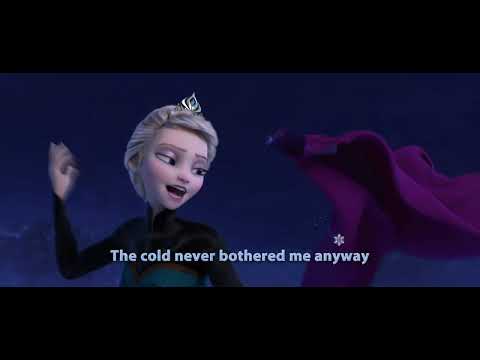
Elsa has fled Arendelle after exposing her powers during the coronation crisis. Alone on North Mountain, she first repeats the rules that governed her childhood, then rejects them. She experiments with magic, builds an ice palace, transforms her clothing, and decides that she will remain apart from the kingdom she left frozen below.
Song Meaning
The refrain describes release, but Elsa's solution is incomplete. She believes distance removes the danger because no one nearby can be hurt by her power. The film later challenges that assumption when Anna reaches the mountain and reveals that Arendelle remains trapped in winter.
Cold has two simultaneous meanings. It is Elsa's physical element, which cannot injure her, and it describes the isolation she has already endured inside the castle. The lyric turns that old deprivation into a chosen defense, which explains why the declaration feels liberating even though the story has not solved Elsa's conflict.
Annotations
A kingdom of isolation
Elsa is literally a queen without subjects on the mountain, but "isolation" also describes the childhood policy that separated her from Anna. The line condenses political status and private loneliness into one image before Elsa has decided whether solitude is freedom or another locked room.
Conceal, don't feel, don't let them know
The three commands repeat the discipline Elsa learned after accidentally injuring Anna. Their clipped grammar sounds memorized rather than newly invented, so the verse begins with the language of parental control before Elsa starts replacing it with her own rules.
Well, now they know
This four-word answer closes the secrecy phase. Elsa cannot restore anonymity after the coronation exposure, and the short line turns that irreversible fact into the reason she can stop attempting concealment.
Let it go, let it go
The repeated command changes its object across the song. Elsa releases secrecy, fear, obedience, and eventually the image of the "perfect" daughter and queen that she believes others required.
Turn away and slam the door
Doors recur throughout Frozen as markers of connection and refusal. Elsa has spent years behind a closed bedroom door, while Anna's separate "Love Is an Open Door" associates openness with immediate intimacy. Here Elsa chooses closure again, although she interprets that closure as freedom.
The cold never bothered me anyway
The joke works because ordinary cold cannot threaten a character who creates ice. Its second function is harsher: Elsa has lived with social coldness and isolation for years, so she convinces herself that permanent separation will cost nothing new.
No right, no wrong, no rules for me
Elsa mistakes the absence of nearby people for the absence of consequences. The line captures the temporary logic of the mountain scene, where freedom means testing magic without the restraints established after Anna's childhood injury.
My soul is spiraling in frozen fractals all around
The lyric borrows a mathematical term associated with repeating geometric structure. The animation answers it with branching snow and ice patterns around Elsa, connecting the internal "spiral" to visible forms generated by her magic.
The past is in the past
Elsa treats physical departure as a clean boundary between her former identity and her new one. Frozen later rejects that clean division because Anna, Arendelle, and the winter she created all remain tied to decisions made before the mountain escape.
That perfect girl is gone
"Perfect" refers to the obedient identity produced by years of concealment. Elsa removes the crown, alters her appearance, and uses magic openly, so the visual transformation makes the rejection concrete instead of leaving it as an internal declaration.
Style and Rhythm
The writing combines a Broadway transformation song with a pop-sized refrain. A fast 4/4 pulse sits beneath sustained vocal phrases, while the chorus reduces complicated thoughts to repeatable commands. That contrast lets the number function inside a narrative scene and still retain a radio-ready hook.
Themes and Symbols
Storms connect internal pressure with the uncontrolled winter outside. Doors represent access and exclusion. Height and distance give Elsa temporary safety, while dawn and daylight replace the opening night imagery once she has committed to the palace. The Snow Queen imagery also links her ice-based identity to the fairy-tale source behind Frozen.
Production and Instrumentation
The arrangement grows from piano-centered accompaniment into orchestra as Elsa tests larger forms of magic. Shazam names Roger Wilkie as first violin and Stephen Oremus as conductor, while its credits list Christophe Beck, Dave Metzger, Doug Besterman, and Oremus among the orchestrators. The expanding instrumental mass follows the expanding architecture on screen.
Cultural Context
The song uses the musical-theatre tradition of an internal transformation number, where a character states a new identity through escalating melody and staging. Its later Broadway placement as an Act One finale fits that function directly, although the stage production gives Elsa a different theatrical build around the same central declaration.
Technical Information
Shazam, Apple Music, Tunebat, MusicBrainz, and soundtrack documentation provide consistent core metadata for the original Idina Menzel recording. The soundtrack version runs 3:44, appears as track five, and belongs to Walt Disney Records. Tunebat analyzes it in A-flat major at 137 BPM in 4/4 time.
- Song: Let It Go.
- Artist: Idina Menzel.
- Composer: Kristen Anderson-Lopez and Robert Lopez.
- Producer: Robert Lopez, Kristen Anderson-Lopez, and Earl Ghaffari.
- Release Date: November 25, 2013, for the original Frozen soundtrack release.
- Genre: Soundtrack, musical theatre, power ballad.
- Instruments: Lead vocal, piano-led orchestral accompaniment, and strings including first violin.
- Label: Walt Disney Records.
- Length: 3:44.
- Track #: 5 on the original Frozen soundtrack.
- Language: English.
- Album: Frozen (Original Motion Picture Soundtrack).
- Music style: 4/4 power ballad in A-flat major at 137 BPM, with musical-theatre phrasing and an orchestral build.
- Poetic meter: Flexible accentual speech-rhythm with frequent four-stress lines, mixed iambic and trochaic movement, pickups, and shortened declarations.
Awards and Chart Positions
The recording crossed film, pop, and awards institutions during 2014 and 2015. Billboard measured a No. 5 Hot 100 peak, the Academy awarded the writers Original Song, and the Recording Academy later awarded them Best Song Written for Visual Media. Disney reported another sales milestone when the RIAA certified the recording Diamond in 2024.
| Honor or Chart | Organization | Result | Date |
|---|---|---|---|
| Academy Award for Music - Original Song | Academy of Motion Picture Arts and Sciences | Winner for Kristen Anderson-Lopez and Robert Lopez | 2014 |
| Billboard Hot 100 | Billboard | Peak position No. 5 | 2014 |
| Best Song Written for Visual Media | Recording Academy | Winner for Kristen Anderson-Lopez and Robert Lopez | February 8, 2015 |
| RIAA Diamond certification | Recording Industry Association of America, reported by The Walt Disney Company | 10 million certified units | Spring 2024 |
Key Contributors
| Type | Name | Contribution |
|---|---|---|
| People | Idina Menzel | Menzel performs Elsa's original English soundtrack vocal. |
| People | Kristen Anderson-Lopez | Anderson-Lopez co-wrote the music and words and co-produced the recording. |
| People | Robert Lopez | Lopez co-wrote the music and words and co-produced the recording. |
| People | Earl Ghaffari | Shazam credits Ghaffari with production and editing work. |
| People | Stephen Oremus | Oremus conducted and contributed orchestration. |
| Organizations | Walt Disney Records | The label released the Frozen soundtrack in November 2013. |
| Works | Frozen | The 2013 film places the performance during Elsa's North Mountain transformation. |
| Works | Frozen - Original Broadway Cast Recording | The 2018 stage adaptation gives Caissie Levy the song as its Act One finale. |
| Venues | Eastwood Scoring Stage | Sound on Sound identifies the Burbank stage as an orchestral recording location for Frozen. |
| Venues | St. James Theatre | The Broadway production opened at the New York theatre on March 22, 2018. |
How to Sing Let It Go
Tunebat analyzes the soundtrack recording in A-flat major at 137 BPM, while VoiceRangeFinder lists the song-specific span as F3 to E-flat5. Its Menzel profile describes that range estimate with medium source confidence, so singers should treat the endpoints as a rehearsal reference rather than a fixed requirement for every voice.
Range and Vocal Setup
The main technical problem is the move from lower conversational phrases into sustained upper-register singing. A singer who drags a heavy chest setup toward E-flat5 can create unnecessary strain. A balanced mix, stable vowel shape, and lower practice volume usually make the upper chorus easier to coordinate before performance intensity is added.
Breath planning matters most in the bridge, where longer lines contain fewer natural stopping points than the chorus. Mark breaths before practice, keep the inhalation quiet, and preserve air for the final stressed word instead of spending it at the start of each phrase.
Practice Steps
- Warm the melody on a lip trill or light vowel before adding full words, especially around the upper chorus notes.
- Use a metronome near 69 BPM to learn the half-time phrase shape, then restore Tunebat's 137 BPM pulse once the rhythm feels stable.
- Speak each verse in rhythm and preserve normal English stress before singing it, because the writing depends on conversational pickups.
- Mark breaths before the longer bridge phrases and avoid breaking a sentence simply because the orchestration becomes louder.
- Practice the chorus below performance volume and let the resonance shift toward a mixed coordination instead of forcing every high note with heavy chest pressure.
- Keep consonants concise on repeated title phrases so hard attacks do not shorten the sustained vowels carrying pitch.
- Rehearse the bridge separately because its longer text, larger interval changes, and rising intensity can consume breath before the last chorus.
- With a microphone, resist adding volume simply because the arrangement grows. Let amplification carry the sound while the vocal setup stays consistent.
- Transpose the accompaniment if F3 to E-flat5 sits outside a comfortable working range. The dramatic phrasing survives a lower or higher tonal center.
- Stop singing if a rehearsal produces pain, burning, or persistent hoarseness rather than ordinary muscular fatigue.
Practice Materials
- A piano or keyboard can establish A-flat major and provide reference pitches for the chorus.
- A metronome can alternate between a 69 BPM half-time practice pulse and the 137 BPM analyzed tempo.
- Licensed sheet music can help mark breathing points, rhythmic pickups, and any transposition needed for a different range.
- The original soundtrack recording is useful for checking diction, phrase length, and the transition between restrained verse singing and the larger chorus.
Sources
- Shazam - release date, label, language, performers, writers, producers, conductor, and orchestration credits
- Apple Music - original soundtrack listing and recording metadata
- Tunebat - A-flat major, 137 BPM, 4/4 meter, and 3:44 duration analysis
- VoiceRangeFinder - F3 to E-flat5 song range estimate and source-confidence context
- IMDb - Frozen soundtrack performance and songwriter credit lines
- Disney - official Frozen sequence and scene context
- Sound on Sound - Frozen recording and orchestral production context
- Playbill - songwriter interview covering the song's creation, Idina Menzel, and Prospect Park writing session
- Recording Academy - Lopez songwriter interview and early Elsa development
- Vanity Fair - Frozen oral history and Jennifer Lee's account of Elsa's character change
- NPR via KLCC - international dubbing and 41 additional languages
- Academy Awards - 2014 Original Song win
- Recording Academy - Best Song Written for Visual Media win
- Billboard - No. 5 Hot 100 peak
- Billboard - 2014 club-remix promotion and Dance Club Songs performance
- The Walt Disney Company - 2024 RIAA Diamond certification at 10 million units
- Playbill - Caissie Levy's Broadway version, Act One placement, and cast-recording details
- MusicBrainz - 3:44 recording entry and USWD11366376 ISRC
A-Z Lyrics Universe
Cynthia Erivo Popular
Ariana Grande Horsepower
Post Malone Ain't No Love in Oklahoma
Luke Combs Good Riddance (Time of Your Life)
Green Day Bye Bye Bye
*NSYNC You're the One That I Wan
John Travolta & Olivia Newton-John I Always Wanted a Brother
Braelyn Rankins, Theo Somolu, Kelvin Harrison Jr. and Aaron Pierre The Power of Love
Frankie Goes to Hollywood Beyond
Auli’i Cravalho feat. Rachel House MORE ›