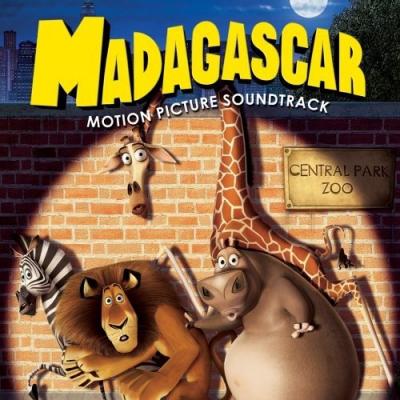
"Madagascar" Soundtrack Lyrics
Cartoon • 2005
Track Listing
Sacha Baron Cohen
The Ventures
Earth, Wind & Fire
James Dooley
Vangelis
"Madagascar (Original Motion Picture Soundtrack)" – Album Guide to Tracks and Key Scenes

Overview
What happens when a zoo comedy leans on disco anthems, choral epics, and Louis Armstrong instead of a single orchestral wall of sound? Madagascar answers that by turning its soundtrack into a collage of pop history and cartoon scoring. The album jumps from Earth, Wind & Fire to Bee Gees to Hans Zimmer cue in a few seconds, mirroring how the film itself ping-pongs between New York showbusiness and improvised island survival.
The core of the soundtrack is Hans Zimmer’s score, stitched with contributions from Ryeland Allison, Heitor Pereira, James Dooley, and James S. Levine. Around that, the film drops in pre-existing songs as punchlines: “Boogie Wonderland” to sell a fake “wild” experience at the Central Park Zoo, “Chariots of Fire” for a slow-motion reunion gag, “Stayin’ Alive” for a zebra’s doomed Manhattan nightlife. The music never hides that it’s quoting other movies and eras; that’s the joke.
What makes this album distinct inside early-2000s animation is how aggressively it foregrounds songs that already come with cultural baggage. “I Like to Move It” gets re-cast as a lemur national anthem. “Born Free” becomes both sincere and tongue-in-cheek at once. “What a Wonderful World” stops being a soft montage track and turns into a darkly funny predator meltdown cue. Underneath the jokes, Zimmer’s themes for friendship and escape give the chaos a spine, especially in cues like “Best Friends” and “Zoosters Breakout”.
In terms of genres, the soundtrack blends disco and funk (for spectacle and artificial happiness), classic rock-era themes (“Hawaii Five-O”, “Chariots of Fire” for parody and nostalgia), choral and film-score drama (“Born Free”, original orchestral cues for emotional weight), and jazz/pop standards (Louis Armstrong, Sammy Davis Jr. for irony). The pattern is clear: glossy disco = zoo showbusiness; big inspirational themes = spoofed heroism; classic pop standards = jokes about consumer comfort; the score ties it all back to the animals’ relationships and fear of the unknown.
How It Was Made
Hans Zimmer serves as the principal composer, with additional music by Heitor Pereira, James Dooley, James S. Levine, and Ryeland Allison. The score recording took place at AIR Lyndhurst in London, with large orchestra and choir to support both the sincere adventure beats and the parody of “big inspirational movie music”. Remote Control Productions handled the music production infrastructure, which is why the score has that tight, rhythmic Zimmer feel even in short comic stingers.
According to production credits, the soundtrack was released by Geffen Records and UMG Soundtracks in late May 2005, a few days before the film hit cinemas. The commercial album collects a handful of key score cues alongside licensed songs like “Boogie Wonderland”, “Stayin’ Alive”, and “Hawaii Five-O”, resulting in a relatively short, sampler-style disc rather than a complete score presentation. Fans often point out that much of the orchestral material heard in the movie never made it to the retail album.
Behind the scenes, there was at least one major change of plan: composer Harry Gregson-Williams was initially attached and left to score Kingdom of Heaven, after which Zimmer took over and brought in his usual team. Music executive Sunny Park coordinated the music department, while the score recording and mixing credits name Geoff Foster, Al Clay, and Alan Meyerson, all regulars on large Hollywood animation projects. The session musicians had to move quickly: many of the cues are short, tightly cut to fast gags, and were likely revised late in the animation process.

Tracks & Scenes
"Best Friends" — Hans Zimmer, Heitor Pereira, Ryeland Allison, James S. Levine
Where it plays: A gentle, lyrical version of this theme appears early as Alex and Marty’s zoo routine establishes their tight bond and the “King of New York” persona. Later, fragments return near the end on Madagascar as the four friends reaffirm that their relationship matters more than city fame or “the wild”. Mostly non-diegetic, it sits under montages and transitions, often around the opening ten minutes and again in the final reel.
Why it matters: This melody is the emotional glue of the film. Whenever the story threatens to turn into pure gag reel, this cue quietly reminds us that the plot is about friends dealing with change and fear of separation.
"Boogie Wonderland" — Earth, Wind & Fire
Where it plays: In the opening zoo sequence (roughly three minutes in), the Central Park statue monkeys ring a bell and “Boogie Wonderland” blasts over a montage of crowds streaming in, vendors hawking souvenirs, and the animals switching from sleepy to performance mode. The track is non-diegetic but the editing makes it feel like the zoo’s public-address soundtrack.
Why it matters: The song’s relentless disco groove underlines how the zoo functions like a theme park—bright, choreographed, and superficial. It sets up the contrast with Madagascar’s messy, unscored wildness later on.
"Hawaii Five-O" — The Ventures
Where it plays: After the crates wash ashore and the animals begin to explore the island, Marty eventually emerges on a makeshift surfboard, riding a wave toward the beach while the famous surf-rock theme powers the moment. The cue is non-diegetic but cut exactly like a TV opening, complete with grand entrance shots and slow-motion spray.
Why it matters: The track turns Marty’s first real taste of the wild into another piece of pop culture, suggesting that even in “nature” these characters filter everything through media they know. It also signals that Marty is enjoying the freedom Alex fears.
"Chariots of Fire" — Vangelis
Where it plays: When Alex and Marty reunite on the beach, they break into an exaggerated slow-motion run toward each other, and the “Chariots of Fire” theme swells in the background. The shot composition copies the classic running-on-the-sand imagery from the 1981 film, but with a lion and zebra instead of sprinters.
Why it matters: The cue works as both parody and sincere emotional release. It underlines how melodramatic the reunion feels to the characters, while the audience recognizes the reference and laughs at the overblown self-importance.
"Stayin' Alive" — Bee Gees
Where it plays: After Marty escapes the zoo at night, he struts through Manhattan streets, illuminated by neon and headlights. The soundtrack drops into “Stayin’ Alive”, echoing the iconic sidewalk walk from Saturday Night Fever. It is non-diegetic, but staged so strongly that it feels like Marty hears it in his head. The sequence lasts nearly the full opening verse, giving the joke room to breathe.
Why it matters: The track sells Marty’s temporary fantasy that life outside the zoo is glamorous and cool. The moment becomes funnier as the environment around him quickly gets colder and more threatening, undercutting the swagger the music promises.
"New York, New York" — (Tribute to Frank Sinatra; in-film performance and cover)
Where it plays: Later on Madagascar, when Marty sulks about staying on the island, Alex tries to cheer him up by invoking their old home. He sings snatches of “New York, New York” and the soundtrack answers with a Sinatra-style arrangement as they imagine skyscrapers and subway rides. It’s part diegetic (Alex’s singing) and part non-diegetic (the fuller arrangement swelling behind him).
Why it matters: The song cements New York as a shared dream rather than just a physical place. Its grand, Broadway-adjacent style makes the island seem even more remote, underlining how stranded they feel.
"Born Free" — John Barry, adapted by Hans Zimmer; performance by Mormon Tabernacle Choir
Where it plays: Over the opening titles and early daydream imagery, a choral version of “Born Free” plays while Marty imagines running on an African savannah instead of circling his pen at the zoo. The visuals cut between literal, cramped reality and sweeping imaginary plains, but the music stays huge and idealized.
Why it matters: Using a song so heavily associated with animal freedom is a cold, deliberate joke—the “free” image only exists in Marty’s head and in the marketing rhetoric humans use. Zimmer later weaves the melody into his score, so the irony follows Marty throughout the film.
"I Like to Move It" — Sacha Baron Cohen (as King Julien)
Where it plays: Around the mid-point, Alex, Marty, Gloria, and Melman stumble into the lemur colony’s all-night party. King Julien launches into “I Like to Move It” on a makeshift stage, turning the clearing into a strobe-lit rave. The performance is diegetic—the lemurs are explicitly singing and dancing to it—while the mix occasionally slips into full-on music-video mode.
Why it matters: This is the film’s signature music moment. The track establishes Julien as a chaotic, self-absorbed ruler and gives the franchise its recurring anthem. It also shows how quickly the newcomers are seduced by rhythm and community, even if they don’t fully trust their hosts yet.
"The Candy Man" — Sammy Davis Jr.
Where it plays: After the chaos in Grand Central Station, heavily tranquilized Alex drifts into a sugar-coated hallucination. As “The Candy Man” plays, the visuals turn into a kaleidoscopic vision of endless steaks, smiling humans, and idealized zoo pampering. When he jolts back toward waking, the same song returns, sped up and warped, as the sedatives wear off and reality crashes in.
Why it matters: The song’s original promise of a man who “makes the world taste good” becomes sinister in context. It represents Alex’s addiction to being hand-fed and adored, making his later hunger crisis on the island much darker than the jokes suggest.
"What a Wonderful World" — Louis Armstrong
Where it plays: Deep into the Madagascar stretch, Alex’s predator instincts overwhelm him. As he looks at his friends, the film slips into a stylized sequence where they appear as giant steaks and plump meat on plates. “What a Wonderful World” plays ironically over the transformation, its gentle brass and gravelly vocal clashing with Alex’s horror.
Why it matters: The cue is a textbook needle-drop irony: the world is “wonderful” only from Alex’s hungry subconscious, not morally. It marks the moment when the movie stops treating “lion who eats meat” as just a gag and shows the real danger.
"Zoosters Breakout" — Hans Zimmer
Where it plays: During the shipping sequence and crate chaos aboard the freighter, Zimmer’s action cue “Zoosters Breakout” drives the rhythm of sliding boxes, penguin sabotage, and the storm that eventually sends the animals overboard. Fast strings and pounding percussion sync with each tilt and impact, turning a fairly talky mid-film plot turn into a kinetic set-piece.
Why it matters: It’s one of the clearest examples of Zimmer doing straight-up adventure scoring in the film, without parody. The cue gives weight to what might otherwise be a transitional scene and helps justify the later circus-style musical bombast in the sequels.
"Holiday in My Head" — Smash Mouth (trailer-only)
Where it plays: Not in the feature itself, but in several theatrical and TV trailers, where it underscores quick-cut montages of the animals sliding on crates, partying with lemurs, and generally treating “Madagascar” as one long vacation. The song sits over marketing-driven gags rather than narrative scenes.
Why it matters: This is a good reminder that the Madagascar “soundtrack” experience extends beyond the album. Marketing leaned on a very early-2000s alt-pop sound that isn’t in the film proper, emphasizing that the studio wanted the movie to sit next to Shrek in the audience’s head.
Notes & Trivia
- Zimmer’s team adapted John Barry’s “Born Free” instead of writing a brand-new “freedom” theme, underlining the film’s habit of quoting cinema history instead of pretending to be original about it.
- “I Like to Move It” started as a 1993 club hit; the Madagascar films turned King Julien’s version into the most widely known incarnation for younger audiences.
- At least two prominent songs heard in the movie—“The Candy Man” and “Holiday in My Head”—are missing from the main commercial soundtrack album.
- The orchestral sessions used London players at AIR Lyndhurst, a regular recording base for Zimmer’s large-scale animation and action scores.
- Early plans reportedly had Harry Gregson-Williams attached as composer before the project switched to Zimmer and his Remote Control circle.
- Some soundtrack collectors criticize the album for including short score cues intercut with full-length songs, arguing that it plays more like a marketing sampler than a coherent listening experience.
Music–Story Links
The soundtrack constantly ties character psychology to familiar songs. When “Boogie Wonderland” powers the zoo intro, it frames Alex as a showman whose entire identity depends on performing a routine; the groove stops when the guests leave, and so does his sense of purpose. By contrast, “Hawaii Five-O” and the surf entrance tell us that Marty reads the island as a TV fantasy, not a survival situation, which explains why he is slower than the others to see the danger.
“Born Free” functions as Marty’s inner propaganda. Its soaring choir turns his vague itch for “something more” into a romantic destiny, a fantasy so strong he risks everything to chase it. Later, when Zimmer quotes the theme in quieter arrangements, we hear him trying to reconcile that fantasy with the messy reality of predators, foosa, and hunger.
Alex’s arc is practically scored in opposites. “The Candy Man” represents the zoo as pure indulgence: grooming, steak, applause. “What a Wonderful World” flips that indulgence into horror when every friend turns into meat in his mind’s eye. The shift from one standard to the other tells us Alex is no longer just addicted to comfort—he’s fighting his nature.
Friendship themes like “Best Friends” and the calmer parts of “Zoosters Breakout” hold the cast together musically. Whenever the group splinters or argues, the score either disappears into dry comedy or erupts into parody songs. When they reconcile, Zimmer’s melodic material returns and links them again, suggesting that the “real” emotional language of the film lies in the score, not in the quote-heavy songs.
Reception & Quotes
The film itself received mixed-to-positive reviews: critics praised the voice cast and visual energy but often compared it unfavorably to contemporary Pixar releases. The music drew more curiosity than outright acclaim; many reviewers treated the disco and classic-rock cues as fun but obvious choices, while acknowledging that Zimmer’s action writing gave the third act some real punch.
On the album side, outlets like AllMusic logged a mid-range rating and described the disc as a short, breezy set of highlights more than a deep score presentation. Specialty soundtrack sites tend to be harsher, arguing that the more substantial orchestral material remained unreleased, leaving collectors with an incomplete picture of Zimmer’s work on the film.
“Lively, funny, and retro-looking, but it never reaches the emotional heights of the very best animated features.”
Roger Ebert, Chicago Sun-Times (paraphrased)
“A colourful, song-driven album that kids will replay endlessly, even if score fans will wish for more orchestral material.”
Paraphrase of soundtrack-review summaries
Audience response to the music has been consistently stronger than the formal reviews suggest. “I Like to Move It” and “Boogie Wonderland” became staples at children’s parties and theme-park shows, while Zimmer’s “Zoosters Breakout” and “Best Friends” developed a low-key following among film-music fans who appreciate the mix of comedy and genuine emotion.

Interesting Facts
- The main commercial album runs just over half an hour, unusually short for a modern animated feature soundtrack.
- MusicBrainz and label data list Geffen Records as the primary label, with multiple CD and digital releases across regions.
- Streaming versions of the soundtrack sometimes appear under slightly different titles (“Madagascar: Motion Picture Soundtrack” vs. “Madagascar (Original Motion Picture Soundtrack)”), but carry the same 12-track core.
- “I Like to Move It” is credited to Sacha Baron Cohen on the album, but the original writing credits go to Erick Morillo and Mark Quashie.
- Louis Armstrong’s “What a Wonderful World” and the Bee Gees’ “Stayin’ Alive” brought 1960s and 1970s catalog licensing into a 2000s kids’ movie, helping parents lock into the jokes.
- “Chariots of Fire” and “Hawaii Five-O” both serve as direct film-history references, turning Zimmer’s score into a kind of connective tissue between famous needle-drops.
- The film’s eventual stage musical adaptation keeps “I Like to Move It” as a central number, proving how firmly that track is welded to the brand.
- Some collectors trade unofficial expansions that assemble isolated film cues from video game rip-s or DVD audio, trying to reconstruct a fuller Madagascar score experience.
Technical Info
- Title: Madagascar (Original Motion Picture Soundtrack) / Madagascar: Motion Picture Soundtrack
- Film: Madagascar (2005, DreamWorks Animation)
- Year of album release: 2005 (commercial releases dated late May)
- Type: Film soundtrack (songs + score)
- Primary composer: Hans Zimmer
- Additional music: Heitor Pereira, James Dooley, James S. Levine, Ryeland Allison
- Key licensed tracks: “I Like to Move It”, “Boogie Wonderland”, “Hawaii Five-O”, “Stayin’ Alive”, “Chariots of Fire”, “What a Wonderful World”, “Born Free” adaptation
- Label: Geffen Records / UMG Soundtracks
- Album length: ~31 minutes, 12 tracks on the standard edition
- Recording venue (score): AIR Lyndhurst Studios, London
- Notable omissions: “The Candy Man” and trailer song “Holiday in My Head” are not on the main album
- Availability: Widely available on streaming platforms and digital stores; physical CD editions remain in circulation via catalog and second-hand markets.
Canonical Entities & Relations
| Subject | Relation | Object |
|---|---|---|
| Hans Zimmer | composed | Score for Madagascar (2005 film) |
| Heitor Pereira | contributed additional music to | Madagascar score |
| James Dooley | contributed additional music to | Madagascar score |
| James S. Levine | contributed additional music to | Madagascar score |
| Ryeland Allison | contributed additional music to | Madagascar score |
| Geffen Records | released | Madagascar: Motion Picture Soundtrack album |
| DreamWorks Animation | produced | Feature film Madagascar (2005) |
| John Barry | composed original song | “Born Free” (adapted in the film’s score) |
| Louis Armstrong | performed | “What a Wonderful World” used in the film |
| Earth, Wind & Fire | performed | “Boogie Wonderland” used in the film and on album |
| Bee Gees | performed | “Stayin’ Alive” used in the film and on album |
| The Ventures | performed | “Hawaii Five-O” used in the film and on album |
| Sacha Baron Cohen | performed cover of | “I Like to Move It” as King Julien |
| UMG Soundtracks | co-released | Madagascar soundtrack with Geffen Records |
| Madagascar (2005 film) | features music by | Hans Zimmer and various recording artists |
Questions & Answers
- Who composed the score for Madagascar, and what does it sound like?
- Hans Zimmer wrote the main score, supported by several additional composers. It mixes bold, brassy adventure writing with playful rhythmic cues and softer friendship themes.
- Is every song from the movie on the official soundtrack album?
- No. “The Candy Man” and the trailer song “Holiday in My Head” are heard in the film’s world but do not appear on the main commercial album.
- What song plays during King Julien’s big party scene?
- The lemur rave runs on Sacha Baron Cohen’s version of “I Like to Move It”, performed in-character by King Julien and treated as a full diegetic performance.
- Which track underscores Marty surfing onto the island?
- That moment uses The Ventures’ “Hawaii Five-O”, turning his arrival into a tongue-in-cheek TV-style surf montage rather than a realistic shipwreck scene.
- Where can I listen to the Madagascar soundtrack today?
- The 12-track album is widely available on major streaming platforms and digital stores, with physical CD editions still circulating via catalog and second-hand sellers.
Sources: Wikipedia – Madagascar (2005 film); Wikipedia / Simple / non-English soundtrack pages; MusicBrainz – Madagascar: Motion Picture Soundtrack; AllMusic – Madagascar [Motion Picture Soundtrack]; SoundtrackINFO – Madagascar; Madagascar Wiki (transcript and movie references); IMDb – Madagascar (soundtracks and credits); Boogie Wonderland and other song-specific reference entries; contemporary reviews from Chicago Sun-Times and other outlets; Filmtracks and other soundtrack-review databases; trailer and clip analysis from official and curated YouTube playlists.
November, 14th 2025
A-Z Lyrics Universe
Cynthia Erivo Popular
Ariana Grande Horsepower
Post Malone Ain't No Love in Oklahoma
Luke Combs Good Riddance (Time of Your Life)
Green Day Bye Bye Bye
*NSYNC You're the One That I Wan
John Travolta & Olivia Newton-John I Always Wanted a Brother
Braelyn Rankins, Theo Somolu, Kelvin Harrison Jr. and Aaron Pierre The Power of Love
Frankie Goes to Hollywood Beyond
Auli’i Cravalho feat. Rachel House MORE ›