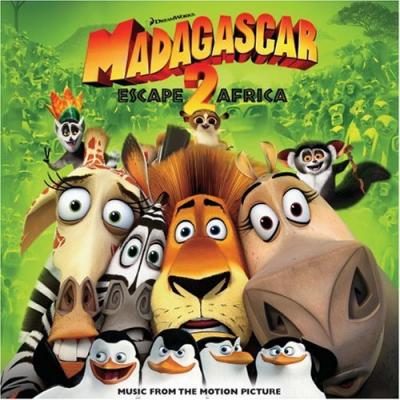
"Madagascar 2: Escape 2 Africa" Soundtrack Lyrics
Cartoon • 2008
Track Listing
Will.I.Am
Hans Zimmer
The Wild Animals
Boston
Will.I.Am
Barry Manilow
Will.I.Am
Hans Zimmer
"Madagascar: Escape 2 Africa (Music from the Motion Picture)" – Album Guide to Tracks and Key Scenes
Overview
Can a sequel juggle a hip-hop hippo ballad, arena-rock nostalgia, Manilow at the Copa, Boston guitars, and Hans Zimmer’s African choir and still feel coherent? Madagascar: Escape 2 Africa (Music from the Motion Picture) leans into that chaos and, surprisingly often, makes it work. The album expands the first film’s collage approach into a louder, more extroverted mix of score and songs, mirroring how the story itself widens from a single island to a whole savanna.
The backbone is Zimmer’s “Africa” material: rhythm-heavy, full of chanting and choir pads, but still built around clean, memorable themes like “Once Upon a Time in Africa” and “Rescue Me”. Around that spine, will.i.am co-writes and performs a run of character-driven songs: “The Traveling Song” to open the film and define the idea of “home”, “Big and Chunky” as Moto Moto’s meme-ready seduction anthem, and “Alex on the Spot” for the big lion dance. Add in parody cues like “The Good, the Bad and the Ugly (Polka Version)” and catalogue cuts like Boston’s “More Than a Feeling” and Barry Manilow’s “Copacabana”, and you get a soundtrack that feels more like a DJ set than a traditional score album.
Compared with the first Madagascar, the music here is more tightly welded to character and theme. “The Traveling Song” literally sings about being a lion out of place; “Big and Chunky” nails Gloria’s body-image plot in one goofy verse; “Alex on the Spot” is Alex trying to turn his Broadway-style routine into something that matters in Africa. At the same time, Zimmer threads little variations of the escape theme and family motif through cues like “Chums”, “Volcano”, and “Monochromatic Friends”, so underneath the jokes there is a surprisingly consistent emotional through-line.
Stylistically, the album swings between several clear zones. The Africa cues use choral writing, hand percussion, and film-score orchestration to signal heritage and community. The will.i.am songs sit in pop, R&B, and club territory: sub-heavy drums, chant hooks, call-and-response. Classic rock and disco placements (“More Than a Feeling”, “Copacabana”) stand in for tourist culture and borrowed glamour, often attached to the penguins or human intrusions. Parody polkas of “New York, New York” and “The Good, the Bad and the Ugly” mock both old Hollywood and the animals’ own overblown hero fantasies. In short: African textures = belonging and family; pop/R&B = identity and swagger; classic rock/disco = outsiders and spectacle.
How It Was Made
The soundtrack credits Hans Zimmer and will.i.am as the primary artists, with Zimmer handling the bulk of the score and will.i.am co-writing, producing, and performing several key songs. According to the official album notes and later interviews, the two traveled to Africa to collect musical ideas and record with local musicians, building percussion patterns and choral colors that could anchor the sequel more firmly to its setting rather than just reusing New York-flavored material from the first film.
As one Reuters piece reports, will.i.am framed “The Traveling Song” as a personal story about being uprooted and finding home through friends — a neat mirror of the zoo animals’ situation. He wrote multiple new tracks for the film, including “Big and Chunky” and “She Loves Me”, and recorded a new version of “I Like to Move It” for the end credits. Zimmer and will.i.am share soundtrack producer credits, with Interscope and will.i.am Music Group handling the commercial release and Universal/UMG credited on later digital editions.
Behind the scenes, the album draws on the usual deep bench of the Remote Control Productions circle: additional music from Lorne Balfe, Heitor Pereira, Geoff Zanelli, and Jim Dooley; choir work by the Purcell Singers; and engineering from Alan Meyerson, Geoff Foster, and others. Music supervisors and DreamWorks’ music executive Sunny Park again helped balance licensed songs with original score cues. The record clocks in at roughly 17 tracks, with database listings giving runtimes from about 40 minutes to just under 50 minutes depending on edition and territory.
Tracks & Scenes
"The Traveling Song" — will.i.am
Where it plays: This is the film’s opening vocal song. Over the stylized prologue and early montage we see baby Alex with his father Zuba, the kidnapping, and the crate journey that eventually lands him in New York. Later, the song returns in medley form as Alex performs for the zoo crowd, cutting between flashbacks of his African past and the showman he has become. It is non-diegetic in the prologue and semi-diegetic when Alex’s stage performance syncs with it.
Why it matters: Lyrically it spells out the sequel’s core idea: being a “lion out the jungle” searching for people who look and feel like you. For an animated family film, that is unusually on-the-nose, but it means that every time the melody or groove reappears, we are reminded that Alex’s home is a question, not a given.
"Once Upon a Time in Africa" — Hans Zimmer
Where it plays: This cue functions as the title theme. It opens on wide shots of the African plain and the watering hole community, with choir and brass tracing Alex’s family line and the sense of a community that existed long before the New York adventure. Later in the film, the same theme underpins the “sacrifice” sequence and the big third-act crisis around the dried-up watering hole, often with more urgent percussion and darker harmonies.
Why it matters: It is the musical glue between Alex’s royal lineage and his current identity as a performer. Whenever the story needs to remind us that this is about roots, not just gags, Zimmer drops back into this theme.
"Big and Chunky" — will.i.am (as Moto Moto)
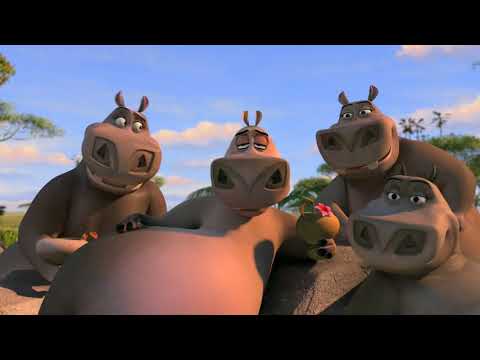
Where it plays: At the water hole, Gloria meets Moto Moto, the self-proclaimed connoisseur of curvy hippos. He emerges from the water in slow motion, the low-end groove of “Big and Chunky” kicking in as he circles Gloria, delivering lines about liking them “big” and “plumpy”. The song is diegetic — it is clearly tied to his performance and presence — but the mix plays it like a full-on music video, stretching over the flirting sequence with reaction shots from Melman and the other hippos.
Why it matters: The number instantly defines Moto Moto’s character and flips Gloria’s insecurity into something admired and desired. Outside the film, it became a meme clip; inside the narrative, it sets up Melman’s fear that he cannot compete and makes Gloria’s later choice between vanity and real connection more pointed.
"Alex on the Spot" — Hans Zimmer & will.i.am
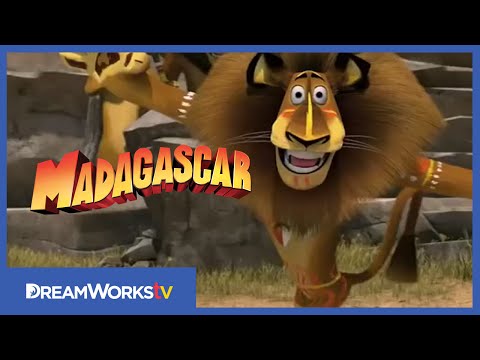
Where it plays: Near the climax, Alex tries to save the watering hole and the other animals by turning the crisis into a performance. He steps into the clearing, the horns and drums of “Alex on the Spot” blast in, and he launches into a frenetic dance routine, joined by his father Zuba. The camera cuts between their choreography and the onlooking herd, building toward the chaotic dam collapse. The cue is non-diegetic in the strict sense, but the staging treats it as if the animals are dancing to it.
Why it matters: This track bridges Alex’s two worlds: New York show lion and African prince. The groove feels like a club remix of his original “King of New York” routine, but the stakes are higher now. It also gives the soundtrack its most purely kinetic few minutes, something the album version preserves reasonably well.
"Rescue Me" — Hans Zimmer
Where it plays: “Rescue Me” scores the film’s central rescue sequence, when Alex, Marty, and the others pull off a desperate, multi-character plan to restore the water and stop the stampede. The cue runs under quick cutting between the dam, Marty’s herd, the plane approaching, and the collapsing infrastructure, with strings driving forward and choral stabs landing on the key heroic beats.
Why it matters: This is Zimmer in full action mode — urgent, harmonically clear, and structured to make a fairly busy climax feel like one continuous surge. For soundtrack listeners, it is one of the album’s most replayable pure-score moments, often cited by film-music fans as the highlight cue.
"More Than a Feeling" — Boston
Where it plays: The Boston classic appears in two comic contexts. First, it blasts from the radio when the penguins hijack tourists’ vehicles on the African reserve, turning grand theft auto into a classic-rock road-trip. Later, the song returns on the makeshift penguin airliner, playing for the human passengers as they relax mid-flight, oblivious to how ramshackle the plane really is.
Why it matters: The track acts as a musical badge for the penguins’ “we can drive anything” bravado. It also underlines the running joke that these birds see themselves less as animals and more as aging rock-road crew with wings.
"Copacabana (At the Copa)" — Barry Manilow
Where it plays: When the penguin plane is in the air, Skipper asks Private to “play something” to set the mood for their human guests. “Copacabana” kicks in over the cabin speakers while the tourists sip drinks and dance down the aisle, as if this patched-together plane were a cruise ship lounge instead of a deathtrap. The sequence cuts between the relaxed cabin and the chaotic cockpit.
Why it matters: Manilow’s melodramatic disco turns the tourist flight into a joke about manufactured glamour. The song is attached to human leisure culture, so hearing it in this setting highlights how completely the penguins have hijacked that culture for their own schemes.
"I Like to Move It" — will.i.am
Where it plays: A new version of the franchise anthem appears over the end credits, with will.i.am on vocals. The film sometimes teases the riff in quick snippets whenever the lemurs or party energy return, but its big showcase is that closing scroll, paired with dance clips and stylized graphics.
Why it matters: Keeping “I Like to Move It” in the sequel cements it as the Madagascar brand theme. The new version leans more into contemporary club production, nudging the franchise’s sound toward late-2000s pop rather than pure 90s Eurodance.
"New York, New York (Polka Version)" — Hans Zimmer
Where it plays: This deliberately cheesy arrangement turns up when Alex tries to re-create his Central Park Zoo act for the African animals. Instead of lush Broadway brass, we get oompah rhythms and cartoonish clarinets, underscoring how wrong the setting is and how outdated his old routine looks in this new world.
Why it matters: The cue mocks the idea that Alex can simply transplant his New York persona to Africa. Musically, it also shows Zimmer having fun with quotation and parody, something that runs through the entire series.
"Chums" — Heitor Pereira
Where it plays: “Chums” underscores several quieter bonding scenes between the four leads and their new African acquaintances — conversations by the water hole, Melman wrestling with his feelings for Gloria, Alex trying to connect with his parents. The cue favors gentle guitars, light percussion, and a warmer harmonic palette.
Why it matters: In an otherwise loud, gag-driven film, these few minutes of tenderness matter. The track gives space for the ensemble’s emotional beats and helps the album avoid being wall-to-wall bombast.
Notes & Trivia
- The official album is titled Madagascar: Escape 2 Africa (Music from the Motion Picture) and is credited to Hans Zimmer and will.i.am, even though it also includes Boston and Barry Manilow cuts.
- According to the soundtrack’s own development notes, Zimmer and will.i.am traveled to Africa and recorded with local musicians before shaping the final cues back in the studio.
- “The Traveling Song” is explicitly described in interviews as being about displacement and finding home in friendship, which neatly maps onto Alex’s story arc.
- “Big and Chunky” turned Moto Moto into a full-blown internet meme years after release, helped by the simplicity of its hook and the visual of the slow-motion hippo walk.
- The album mixes very short score cues with full-length songs, which some soundtrack reviewers argue makes it feel more like a promotional sampler than a cohesive listening experience.
- Despite mixed critical reaction, the album charted on several Billboard lists and later picked up a British certification, suggesting steady catalogue streaming and sales.
Music–Story Links
The sequel uses its songs to sharpen story beats about home and identity. “The Traveling Song” literally narrates the feeling of being a lion out of the jungle, which turns the opening montage into a musical thesis. Whenever Alex feels torn between his African heritage and New York persona, fragments of that song and “Once Upon a Time in Africa” drift in, reminding us that he is still trying to reconcile both worlds.
Gloria’s subplot lives inside “Big and Chunky”. The track celebrates exactly the traits she once worried about, turning her size into something desirable and confident. That re-framing matters when she later has to choose between shallow flattery and Melman’s awkward, genuine affection; the song shows why Moto Moto seems so tempting on the surface.
The penguins, by contrast, are scored almost entirely with human-era music: “More Than a Feeling” and “Copacabana”. They are always hijacking our culture — cars, planes, lounge music — so tying them to classic rock and disco keeps the joke running that they see themselves as human action heroes and cruise directors trapped in penguin bodies.
Finally, cues like “Rescue Me”, “Chums”, and “Alex on the Spot” carry the emotional legwork for family reconciliation. “Rescue Me” is the literal sound of the herd working together; “Chums” underscores the quieter conversations that make the group feel like found family; “Alex on the Spot” fuses showmanship with responsibility, showing that Alex can still be a performer without abandoning where he came from.
Reception & Quotes
Critics were split on the soundtrack. Mainstream outlets like AllMusic framed it as a light, pleasant companion to a music-heavy animated film, noting how often the movies weave songs directly into the plot. Some film-music specialists, especially at Filmtracks, praised the development of Zimmer’s main escape theme across the trilogy and singled this second score out as the best showcase of that material, while still criticizing the commercial album for favoring pop songs and parodies over pure score.
On the harsher end, one long-running soundtrack site (MovieMusicUK) famously called the album “easily the worst soundtrack written for any major animated film of recent years”, pointing to the reliance on pastiche and pre-existing songs. That view sits at the opposite extreme from fans who enjoy the wild stylistic mash-up and see the album as unapologetically fun.
“A lighthearted, pleasant album that benefits from how deeply the Madagascar films bake music into their storytelling.”
Paraphrase of AllMusic’s assessment
“The best development of Hans Zimmer’s catchy escape theme, even if the commercial album does the score few favors.”
Paraphrase of Filmtracks’ 2022 review
In practice, reception has settled somewhere in the middle. Score collectors still grumble about missing cues and short track lengths, but family audiences treat songs like “Big and Chunky” and “The Traveling Song” as nostalgic comfort listens. The soundtrack’s continued presence on streaming platforms and in meme culture suggests that, whatever its formal flaws, it hit the right nerve.
Interesting Facts
- The album blends score and songs from multiple decades: a 1970s disco hit, a 1976 rock single, new will.i.am tracks, and contemporary Zimmer cues all in one package.
- MusicBrainz and Wikidata list the release group under both “Madagascar: Escape 2 Africa – Music From the Motion Picture” and “Madagascar: Escape 2 Africa (Music from the Motion Picture)”, reflecting small title variations across regions.
- Interscope handled the original 2008 CD release, with digital versions later credited under UMG Recordings; some library catalogues list slightly different total runtimes for the same program.
- The soundtrack reached the lower half of the Billboard 200 and cracked the Top 20 on the U.S. soundtrack chart, a solid performance for a franchise second entry.
- The British Phonographic Industry awarded the album a certification years after release, driven by cumulative streaming and catalogue sales.
- “Big and Chunky” and the “Moto Moto likes you” scene exploded into meme culture around 2018–2019, long after the film’s theatrical run, keeping the soundtrack in youth internet circulation.
- Zimmer’s “escape theme”, introduced in the first film, arguably hits its tightest and most varied form here, something Filmtracks highlighted when revisiting the trilogy.
- A separate “complete score” has circulated among collectors via promos and fan assemblies, containing many cues and alternates absent from the commercial album.
Technical Info
- Title: Madagascar: Escape 2 Africa (Music from the Motion Picture)
- Film: Madagascar: Escape 2 Africa (2008, DreamWorks Animation / Paramount)
- Year of album release: 2008 (commercial release around November 4)
- Type: Film soundtrack (hybrid score + songs)
- Primary composers: Hans Zimmer; songs co-written and produced with will.i.am
- Additional score contributors: Lorne Balfe, Heitor Pereira, Geoff Zanelli, Jim Dooley and others (additional music and arrangements)
- Key original songs: “The Traveling Song”, “Big and Chunky”, “Alex on the Spot”, “She Loves Me”, “Party! Party! Party!”
- Key licensed songs: “More Than a Feeling” (Boston), “Copacabana (At the Copa)” (Barry Manilow), “I Like to Move It” (new version), plus parody arrangements of “New York, New York” and “The Good, the Bad and the Ugly”
- Label: will.i.am Music Group / Interscope Records (with UMG catalogue control on later reissues)
- Album length: typically listed around 49:33; some digital platforms show ~40 minutes for a 17-track edition
- Chart performance: U.S. Billboard 200 peak around #100; Top Internet Albums and Soundtrack Albums chart placements in the 30s and teens respectively
- Certifications: later certified in the U.K. (BPI) as catalogue streams accumulated
- Availability: Widely available on major streaming services and digital stores; physical CDs and library copies still in circulation.
Canonical Entities & Relations
| Subject | Relation | Object |
|---|---|---|
| Madagascar: Escape 2 Africa (film) | features music by | Hans Zimmer and will.i.am |
| Hans Zimmer | composed score for | Madagascar: Escape 2 Africa |
| will.i.am | co-wrote and performed songs for | Madagascar: Escape 2 Africa (Music from the Motion Picture) |
| will.i.am | voiced | Moto Moto the hippo in the film |
| Hans Zimmer & will.i.am | produced | Madagascar: Escape 2 Africa soundtrack album |
| Interscope Records | released | Madagascar: Escape 2 Africa (Music from the Motion Picture) |
| Barry Manilow | performed | “Copacabana (At the Copa)” used in the film and on the album |
| Boston | performed | “More Than a Feeling” used in the film and on the album |
| Heitor Pereira | composed additional cue | “Chums” for the soundtrack |
| DreamWorks Animation | produced | Madagascar: Escape 2 Africa (2008 film) |
| Paramount Pictures | distributed | Madagascar: Escape 2 Africa theatrically |
| Madagascar: Escape 2 Africa (Music from the Motion Picture) | is part of | the Madagascar film soundtrack series |
| “The Traveling Song” | serves as opening song for | Madagascar: Escape 2 Africa |
| “Big and Chunky” | is performed in-character by | Moto Moto (will.i.am) during the water hole scene |
Questions & Answers
- Who is responsible for the main music in Madagascar: Escape 2 Africa?
- Hans Zimmer composed the core score, while will.i.am co-wrote and produced several key songs, including “The Traveling Song” and “Big and Chunky”, and voices Moto Moto.
- What kind of album is Madagascar: Escape 2 Africa (Music from the Motion Picture) — mostly songs or mostly score?
- It is a hybrid: around half character songs and licensed tracks, half short Zimmer cues. Critics often note that it feels like a pop-oriented sampler rather than a pure score album.
- Which song plays when Moto Moto flirts with Gloria?
- That sequence uses “Big and Chunky”, performed by will.i.am as Moto Moto. The song is treated as his personal theme and plays while he approaches and charms Gloria at the water hole.
- What music underscores the opening of the film?
- The vocal “The Traveling Song” serves as the opening number, paired with baby Alex’s backstory, while Zimmer’s “Once Upon a Time in Africa” provides the instrumental title theme for the savanna.
- Where can I hear the soundtrack today, and is there a more complete score release?
- The official album is available on major streaming platforms and digital stores. A fuller “complete score” circulates among collectors, but it is not an official retail release.
Sources: Wikipedia (film and soundtrack entries); DreamWorks / Madagascar Wiki and related song pages; MusicBrainz and Discogs release data; AllMusic album entry and song pages; Filmtracks and MovieMusicUK reviews; Reuters interview with will.i.am on the score; Billboard chart references and BPI certification listings; various official YouTube and soundtrack playlist descriptions for scene–song placements.
November, 14th 2025
A-Z Lyrics Universe
Cynthia Erivo Popular
Ariana Grande Horsepower
Post Malone Ain't No Love in Oklahoma
Luke Combs Good Riddance (Time of Your Life)
Green Day Bye Bye Bye
*NSYNC You're the One That I Wan
John Travolta & Olivia Newton-John I Always Wanted a Brother
Braelyn Rankins, Theo Somolu, Kelvin Harrison Jr. and Aaron Pierre The Power of Love
Frankie Goes to Hollywood Beyond
Auli’i Cravalho feat. Rachel House MORE ›