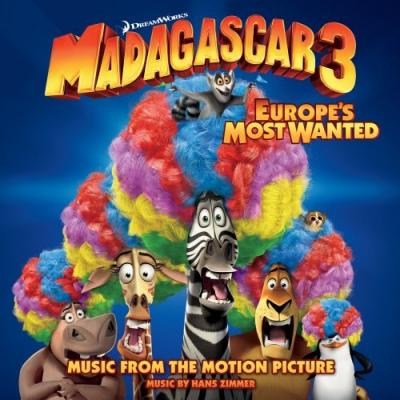
"Madagascar 3: Europe's Most Wanted" Soundtrack Lyrics
Cartoon • 2012
Track Listing
The Youngbloods
Peaches & Herb
Barenaked Ladies
M2M
Britney Spears
Care Bears on Fire
The Beach Boys
Rich Dickerson
Bill Medley & Jennifer Warnes
The Surfaris
Weezer
Antonin Dovrak
Richard Strauss
The 5th Dimenson
The Zoo Gang
Katy Perry
Peter Asher
The Capitols
"Madagascar 3: Europe's Most Wanted (Music from the Motion Picture)" – Album Guide to Tracks and Key Scenes
Overview
What happens when a lion’s midlife crisis meets EDM, circus marches, tango strings, and a Katy Perry fireworks anthem? Madagascar 3: Europe’s Most Wanted (Music from the Motion Picture) answers by going louder, brighter and more aggressive than the previous two films. The album is officially a Hans Zimmer soundtrack, but it behaves more like a traveling circus mixtape where score cues crash into pop covers, parodies and classical quotes.
The core comes from five original Zimmer set-pieces: “New York City Surprise”, “Game On”, “Light the Hoop on Fire!”, “Fur Power!” and “Rescue Stefano”. They carry the emotional and narrative weight — from Alex’s homesickness to DuBois’ villain waltz and the final rescue — while the rest of the album swings through Danny Jacobs’ King Julien covers (“Gonna Make You Sweat”, “Wannabe”, “Hot in Herre”), Frances McDormand belting Piaf, Peter Asher’s gentle ballad “Love Always Comes as a Surprise”, Katy Perry’s “Firework” and the inevitable “Afro Circus/I Like to Move It” mash-up.
Compared with the more African-flavored Escape 2 Africa, this score leans into quotation and pastiche. Themes for DuBois and the circus fold in classical references (“Entrance of the Gladiators”, “Land of Hope and Glory”), while source songs like “Any Way You Want It”, “Con Te Partirò” and Enya’s “Watermark” ride along in the film but sit outside the main album. The result is chaotic by design: a soundtrack that mirrors a circus train charging through Europe, switching musical languages every few minutes.
Genre-wise, you can split the soundtrack into clear bands. The Zimmer cues live in orchestral film music with big, melodic hooks and rhythm-forward writing; his “Game On” theme for DuBois is essentially a menacing waltz with action dressing. The Julien covers and “Afro Circus/I Like to Move It” belong to dance-pop and hip hop — brash, loop-driven, built for repetition and slapstick. “Firework” and “Love Always Comes as a Surprise” sit in mainstream pop and soft-rock, carrying the emotional circus bonding scenes. Classical and opera-adjacent cues (“Non, je ne regrette rien”, “Con Te Partirò”, “Sabre Dance”) are used as punchlines or to signal over-the-top “European” spectacle. In short: orchestral = heart and story; dance-pop = chaos and comedy; pop ballad = romance and hope; classical = parody and flamboyance.
How It Was Made
The album was released by Interscope Records on June 5, 2012, with roughly 13 tracks and a running time around 38–40 minutes depending on edition. Zimmer is credited as composer and producer, building on his work from the first two films, and once again working under the DreamWorks Animation umbrella. Label and library sources show the project recorded in 2011–2012, with key sessions at AIR Studios in London, and a familiar Remote Control circle handling orchestration, engineering and score production.
According to label notes and trade coverage, Zimmer focused on five new score pieces that would anchor the film’s emotional arc: “New York City Surprise” for Alex’s longing for home, “Game On” to define DuBois with a dangerous tango-waltz hybrid, “Light the Hoop on Fire!” to dramatize Vitaly’s trauma and later redemption, “Fur Power!” to celebrate the reborn circus with a brass-heavy march quoting “Land of Hope and Glory”, and “Rescue Stefano” as the full-ensemble action cue for the climax. Pop and song material came from multiple directions: Peter Asher and Dave Stewart wrote and produced “Love Always Comes as a Surprise”; Frances McDormand recorded a full-blast cover of “Non, je ne regrette rien”; and Katy Perry’s existing hit “Firework” was licensed and repurposed for the circus set piece.
One label press release also emphasizes the role of producer Stephen Hilton in reworking famous tracks for King Julien’s covers — turning “Gonna Make You Sweat (Everybody Dance Now)”, “Wannabe” and “Hot in Herre” into in-character performances — and in constructing the “Afro Circus/I Like to Move It” medley with Chris Rock and Danny Jacobs. Behind the scenes, additional music from Lorne Balfe and others, extensive choir work (Metro Voices) and a dense production credit list underline how much of a collage this soundtrack really is.

Tracks & Scenes
"New York City Surprise" — Hans Zimmer
Where it plays: This cue underpins the birthday sequence where Gloria, Marty and Melman reveal a mud replica of New York City for Alex. The camera glides over the hand-built skyline as the animals try to recreate their home in the African reserve, then cuts to Alex’s bittersweet reaction. The piece returns in fragments later whenever Alex’s homesickness surfaces. It is non-diegetic, but the scene plays like a tiny musical number dedicated to nostalgia.
Why it matters: The theme blends the familiar Madagascar motifs with a more wistful tone, setting up the entire film’s “we still want to go back to New York” drive. It’s the emotional baseline the circus has to compete with.
"Gonna Make You Sweat (Everybody Dance Now)" — Danny Jacobs
Where it plays: Early in the film, as the gang arrives by sea in Monte Carlo and attempts their casino break-in, Julien cranks up this cover over their entrance. The beat kicks in as they sneak through port traffic and try to pull off an over-the-top infiltration. It functions as source music in-universe (Julien’s idea of a heist anthem) but is mixed like a foreground track during the sequence.
Why it matters: The track immediately establishes Julien as the self-appointed DJ of the group, and it turns what could have been a straightforward stealth scene into a comic club sequence. It also signals that this movie will lean heavily on dance tracks, even when they’re re-recorded covers.
"Any Way You Want It" — Journey
Where it plays: During the high-speed chase through the Monaco streets, the classic Journey cut blasts over the action. As police cars and DuBois pursue the animal convoy, neon signs and coastal tunnels whip past to the beat of the song. The cue is non-diegetic but tightly synced to gags like vehicles flying over steps and the plane’s wild maneuvers.
Why it matters: The song’s chorus turns the chase into a rock music video, pushing the film’s already manic energy into full cartoon excess. It also adds a wink for older viewers who recognize the track, making the sequence play on two levels at once.
"New York, New York" — Graham Blvd (cover)
Where it plays: After one escape, the characters find themselves on a plane, exhausted but temporarily safe from DuBois. They launch into a group sing-along of “New York, New York”, swaying in the aisles and dreaming of home while the battered aircraft rattles around them. It starts almost diegetically casual — someone humming, others joining — and builds into a full-blown cabin performance.
Why it matters: It’s a simple gag, but it crystallizes the film’s core motivation: every wild detour is still about getting back to Central Park Zoo. Musically, it also foreshadows the later use of classic marches and standards as circus parody material.
"Cool Jerk" / "We No Speak Americano" — The Capitols / Yolanda Be Cool & DCUP
Where they play: In different edits and releases, the moment when the gang buys into the traveling circus and departs uses either “Cool Jerk” or “We No Speak Americano”. The music comes in as the animals negotiate with the circus troupe, then follows them onto the train, cutting between quirky wagon interiors and exterior shots of the locomotive pulling out. It’s primarily source music, presenting the circus world as one long party on rails.
Why it matters: These cues define the traveling circus as something chaotic, slightly retro and very European. The use of different tracks in different versions underlines how modular the soundtrack is — even the film seems to treat this sequence like a DJ slot that can be swapped.
"Con Te Partirò / Time to Say Goodbye" — Andrea Bocelli (and Sarah Brightman in some uses)
Where it plays: In one of the film’s driest jokes, Julien and Sonya the bear travel through Italy — including a Vatican City stop — to the soaring strains of “Con Te Partirò”. The operatic vocal sits over shots of scooters, gondolas and postcard vistas, plus Julien’s delusional romantic gestures toward Sonya. The song is used as non-diegetic commentary, but the visuals treat it like their personal love anthem.
Why it matters: The cue sends up both Italian tourism ads and overblown opera-tinged romance, while still giving the Julien–Sonya subplot a strangely sincere emotional texture.
"Sabre Dance" — Royal Philharmonic Orchestra / Khachaturian arrangement
Where it plays: During the troupe’s first proper circus demonstration, Stefano the sea lion balances on a ball and performs a rapid-fire routine as “Sabre Dance” spins underneath. The frantic tempo matches his nervous energy and the initial sloppiness of the act, with the music slamming into comedic cuts when things go wrong.
Why it matters: It’s a textbook use of a classical warhorse to telegraph “this is going to go off the rails.” At the same time, it gives Stefano’s early failures a slapstick rhythm that pays off when later circus numbers become genuinely impressive.
"Game On" — Hans Zimmer
Where it plays: “Game On” functions as DuBois’ musical calling card. Built as a twisted tango-waltz hybrid with pounding low strings and bold brass, it scores her key entrances and hunt scenes — from interrogating witnesses to stalking the animals across Europe. The motif frequently returns in fragments whenever the camera cuts to her board of clues or her relentless pursuit plans.
Why it matters: This is the villain theme of the film. The swaggering, European-tinged rhythm sells DuBois as both ridiculous and genuinely dangerous, which is exactly the balance the story needs.
"Light the Hoop on Fire!" — Hans Zimmer
Where it plays: Zimmer’s cue underscores both Vitaly’s tragic backstory and his later redemption. In flashback, we see the tiger at his prime, leaping through an ever-shrinking ring of fire to an almost ritualistic choral build; then the botched jump, the fall, and his retreat into fear. In the present, when the circus stakes everything on a new act, the same musical material comes back as Vitaly prepares to jump again — choir, low brass and percussion pushing toward the moment of truth.
Why it matters: This is the emotional centerpiece for Vitaly and arguably for the circus plot as a whole. The Russian choral flavor and escalating harmonies give the sequence real drama, beyond the slapstick around it.
"Fur Power!" — Hans Zimmer
Where it plays: After Alex and friends reimagine the circus as a modern, neon-lit show, “Fur Power!” scores the rehearsal and reveal of the revamped performances. The cue includes a quotation of “Land of Hope and Glory”, turning the circus into a tongue-in-cheek patriotic march for misfit animals. We see quick cuts of each act upgrading its skills, the troupe painting new posters, and morale rising.
Why it matters: Musically, it signals renewal: the same circus, but with a completely new self-image. The classical quote works as an inside joke about “British pomp” while also functioning as a genuine anthem of reinvention.
"Non, je ne regrette rien" — Frances McDormand
Where it plays: In one of the film’s most memorable comic beats, a badly injured DuBois lies in a hospital bed surrounded by battered officers. She suddenly launches into “Non, je ne regrette rien”, belting the Edith Piaf classic at full power and literally singing her squad back to life. As she reaches the chorus, the men stagger to their feet, instruments join in, and the sequence turns into a surreal rallying song.
Why it matters: It cements DuBois as a full cartoon supervillain — melodramatic, indestructible, and utterly committed. It also frames the film’s European tour through one of France’s most iconic chansons, twisted into pure slapstick.
"Love Always Comes as a Surprise" — Peter Asher
Where it plays: This gentle soft-rock ballad becomes the love theme for Alex and Gia. It plays as Alex demonstrates trapeze moves with her, coaching and flirting in midair while the others watch. The music wraps around slow-motion shots of them flying through the air, trading trust falls and catching each other on the bar.
Why it matters: The film needs a sincere, non-ironic romantic thread to balance all the wild comedy. This song delivers that without getting syrupy, and its melody stays in the background of later Alex–Gia beats.
"Rescue Stefano" — Hans Zimmer
Where it plays: Near the climax, when Stefano is in danger and the zoo authorities move to shut everything down, Alex, Gia and Marty mount a risky mid-air rescue. “Rescue Stefano” underpins the entire set piece — trapeze swings, cannon shots, close calls and the final catch that returns Stefano safely to Vitaly. The cue runs through statements of the circus, DuBois and friendship themes in quick succession.
Why it matters: It’s the most extended pure-score track on the album and effectively a mini-suite of the film’s main ideas: danger, teamwork and showmanship. Many score-focused listeners treat it as the standout cue.
"Firework" — Katy Perry
Where it plays: For the first fully realized live circus performance, the troupe unveils their new neon act in Rome: wireframes of animals, multi-colored trails, and impossible physics all choreographed to “Firework”. The song starts quietly as the tent goes dark, then explodes as Alex, Gia and the others launch into synchronized jumps and stunts, turning the whole show into a pyrotechnic ballet. The sequence later repeats in London with tweaks, again synced to the track.
Why it matters: This is the film’s big emotional catharsis. The lyrics about being a “firework” line up almost embarrassingly neatly with the circus finally believing in itself — but that’s why it works. It’s also the moment most casual viewers remember when they think of Madagascar 3’s music.
"Afro Circus/I Like to Move It" — Chris Rock & Danny Jacobs
Where it plays: The medley dominates the end credits, beginning as Marty-as-zebra hypes up “Afro Circus” with the familiar “polka dot, polka dot” chant and then sliding into the franchise’s signature “I Like to Move It” groove. On screen, we see snippets of extended circus acts, dancing animals and stylized credit art, all cut tightly to the beat.
Why it matters: This track officially welds “Afro Circus” to “I Like to Move It” as the series’ joint party anthem. For the soundtrack, it’s the commercial hook — the piece that charted on ARIA and kept the album visible after release.

Notes & Trivia
- The official album title is Madagascar 3: Europe’s Most Wanted (Music from the Motion Picture), and it is catalogued as a Hans Zimmer soundtrack even though several tracks are covers or licensed songs.
- Some releases swap “We No Speak Americano” out for “Cool Jerk” in the track order, reflecting the flexible music choices around the circus-train sequence.
- “Sexy and I Know It” by LMFAO appears in marketing and at trailer level but not in the final film, where “Firework” takes over the key circus set piece.
- “Fur Power!” explicitly quotes “Land of Hope and Glory” inside the score, one of several moments where classical music is folded into the circus sound.
- The “Afro Circus” motif is built on Julius Fučík’s march “Entrance of the Gladiators”, a classic circus piece reworked into Marty’s polka-dot chant.
- Outside the main album, the film also uses Journey’s “Any Way You Want It”, Enya’s “Watermark” and “Con Te Partirò” during travel and montage scenes.
- “Love Always Comes as a Surprise” picked up a Satellite Award nomination for Best Original Song, even though most casual viewers associate the film with “Firework” and “Afro Circus”.
Music–Story Links
The soundtrack’s score cues are tightly tied to character arcs. “New York City Surprise” attaches to Alex’s longing for home, so every recurrence turns even a comic bit into a reminder that New York remains the end goal. “Game On” marks DuBois as a force of nature; when her waltz rhythm shows up, you know the stakes just jumped.
Vitaly’s narrative is almost entirely carried by “Light the Hoop on Fire!”. In the flashback, the cue tells you everything: pride, danger, hubris and the crash. When the music returns for his second attempt, the emotional beat lands even before the visuals confirm whether he makes it. Likewise, “Rescue Stefano” pulls the circus together into one functioning team. It is not just about saving the sea lion; it’s about proving that the circus really can act like a family.
On the song side, “Love Always Comes as a Surprise” and “Firework” map the circus’s emotional curve. The former is about tentative trust between Alex and Gia; the latter is what happens when that trust extends to the whole troupe and they collectively bet everything on a new act. Meanwhile, “Afro Circus/I Like to Move It” is pure identity: Marty’s voice, the franchise’s party DNA, and the comfort of ending on something familiar.
Finally, the European tour itself is scored with carefully chosen references. Piaf’s “Non, je ne regrette rien” turns DuBois into a French caricature while still giving her genuine menace. “Con Te Partirò” underlines Julien’s absurd romantic pilgrimage through Italy. These choices keep reminding the audience where the animals are geographically, even when the visuals go full fantasy.
Reception & Quotes
Critically, the soundtrack drew a mixed but lively response. Enthusiastic, family-oriented outlets described it as a fun, brisk listen that mirrors the film’s relentless pace and circus chaos, praising the blend of Zimmer cues with crowd-pleasing songs. More specialist soundtrack reviewers were divided: several highlighted the five core score tracks as strong additions to Zimmer’s animation work, while criticizing the album structure for favoring covers and medleys over a fuller presentation of the score.
One review noted that only five of the thirteen album tracks are straight Zimmer instrumentals, and argued that while they are not on the level of his most iconic work, they show his usual command of theme and orchestration. Another, from a film-music site, was much harsher, calling the album’s mixture of “awful versions of decent songs, decent originals and heavily referential score” a difficult combination to enjoy as a standalone listen. Filmtracks pointed out how dense the interpolation of mainstream and classical melodies has become by this third entry, and wished for a longer, score-heavy release.
“All in good fun and a quite enjoyable ride, much like the neon circus movie it supports.”
Paraphrase of The Joy of Movies’ review
“A curious mix of covers, pop singles and referential score that never quite gels as an album, even when individual tracks hit the mark.”
Paraphrase of Movie Wave and Filmtracks commentary
Commercially, the album performed solidly. It reached the top 60 of the U.S. Billboard 200 and top 15 on the U.S. Soundtrack Albums chart, also placing on multiple UK compilation and soundtrack lists. The single “Afro Circus/I Like to Move It” charted on ARIA’s Hitseekers list in Australia. Over time, “Firework” and “Afro Circus/I Like to Move It” kept the soundtrack alive on streaming platforms and in meme culture, even as deeper score cuts remained more of a niche favorite.
Interesting Facts
- Different territories and releases report slightly different runtimes: around 40:25 on some databases, about 38:40 on others, depending on mastering and format.
- MusicBrainz and related catalogues file the album as a Various Artists release even though it is often marketed as a Hans Zimmer soundtrack.
- Showbiz-focused coverage at the time highlighted the odd mix of contributors: Hans Zimmer, Peter Asher, Dave Stewart, Frances McDormand, Yolanda Be Cool, DCUP and Katy Perry all sit side by side in the credits.
- The “Afro Circus/I Like to Move It” single not only charted but later spawned its own official (and many unofficial) music videos and kids’ compilation placements.
- Russian-language coverage of the score explicitly breaks out the five main Zimmer cues as character pieces, an angle English-language reviews mostly glanced over.
- A separate “Original Motion Picture Score” configuration exists in databases and fan circles, containing many more cues than the 13-track commercial album.
- Enya’s “Watermark” and Journey’s “Any Way You Want It” are often mentioned by fans as “missing tracks” they wish had been included on the official album.
- Because so many songs are covers performed in-character, metadata gets messy: for example, catalogues sometimes file “Gonna Make You Sweat” under both C+C Music Factory and Danny Jacobs/King Julien.
Technical Info
- Title: Madagascar 3: Europe’s Most Wanted (Music from the Motion Picture)
- Film: Madagascar 3: Europe’s Most Wanted (2012, DreamWorks Animation / Paramount)
- Year of album release: 2012 (digital and CD issues around early June; some library copies dated July 2012)
- Type: Film soundtrack (hybrid score + covers + licensed tracks)
- Primary composer/producer: Hans Zimmer (score composer and soundtrack producer)
- Additional key contributors: Peter Asher (songwriter/producer), Dave Stewart (songwriter), Lorne Balfe (additional music), Stephen Hilton (arranger/producer of covers), Frances McDormand (vocal), Katy Perry, Chris Rock, Danny Jacobs
- Notable original cues: “New York City Surprise”, “Game On”, “Light the Hoop on Fire!”, “Fur Power!”, “Rescue Stefano”
- Key featured songs: “Gonna Make You Sweat (Everybody Dance Now)”, “Wannabe”, “Hot in Herre”, “We No Speak Americano” / “Cool Jerk”, “Non, je ne regrette rien”, “Love Always Comes as a Surprise”, “Firework”, “Afro Circus/I Like to Move It”
- Other film-only songs (not on main album): “Any Way You Want It” (Journey), “Watermark” (Enya), “Con Te Partirò/Time to Say Goodbye”, “Sexy and I Know It” (trailer only)
- Label: Interscope Records (with Universal/DreamWorks branding and catalogue control)
- Approximate album length: ~38:40–40:25 depending on edition
- Chart highlights: U.S. Billboard 200 peak around #58; U.S. Soundtrack Albums chart around #11; UK compilation and soundtrack chart placements in the 20s–50s; “Afro Circus/I Like to Move It” reached #7 on ARIA Hitseekers.
- Awards: ASCAP Top Box Office Films award for Zimmer’s work on the movie; Satellite Award nomination for “Love Always Comes as a Surprise”.
- Availability: Widely available on streaming platforms and digital stores; CD editions still present in libraries and second-hand markets; a longer “complete score” circulates unofficially.
Canonical Entities & Relations
| Subject | Relation | Object |
|---|---|---|
| Madagascar 3: Europe’s Most Wanted (film) | features music by | Hans Zimmer |
| Madagascar 3: Europe’s Most Wanted (Music from the Motion Picture) | is soundtrack to | Madagascar 3: Europe’s Most Wanted (2012) |
| Hans Zimmer | composed score for | Madagascar 3: Europe’s Most Wanted |
| Hans Zimmer | produced | Madagascar 3: Europe’s Most Wanted (Music from the Motion Picture) |
| Peter Asher | wrote and performed | “Love Always Comes as a Surprise” on the soundtrack |
| Frances McDormand | performed | “Non, je ne regrette rien” as DuBois in the film and on the album |
| Katy Perry | performed | “Firework”, used for the main circus performance |
| Chris Rock & Danny Jacobs | performed | “Afro Circus/I Like to Move It” end-credits medley |
| Yolanda Be Cool & DCUP | performed | “We No Speak Americano”, used in circus-train departure sequences |
| Journey | performed | “Any Way You Want It”, used in the Monte Carlo car chase |
| DreamWorks Animation | produced | Madagascar 3: Europe’s Most Wanted |
| Paramount Pictures | distributed | the film theatrically in 2012 |
| Interscope Records | released | Madagascar 3: Europe’s Most Wanted soundtrack album |
| Madagascar 3: Europe’s Most Wanted soundtrack | is part of | the Madagascar franchise music chronology |
Questions & Answers
- Who composed the main score for Madagascar 3: Europe’s Most Wanted?
- Hans Zimmer composed and produced the core score, including “New York City Surprise”, “Game On”, “Light the Hoop on Fire!”, “Fur Power!” and “Rescue Stefano”.
- Is the Madagascar 3 soundtrack mostly songs or mostly instrumental score?
- On the commercial album, only about five tracks are straight instrumentals; the rest are songs, covers or medleys, so it leans song-heavy even though the film itself has much more score.
- Which songs play during the big circus performances?
- The training and reinvention of the circus rely on Zimmer cues like “Fur Power!” and “Light the Hoop on Fire!”, while the first full neon show uses Katy Perry’s “Firework” as its main song.
- What song does DuBois sing in the hospital scene?
- She belts “Non, je ne regrette rien”, an Edith Piaf classic, in a version performed by Frances McDormand. The scene uses it as a comic rallying anthem for her injured squad.
- Which track plays over the end credits?
- The credits are driven by “Afro Circus/I Like to Move It”, a medley performed by Chris Rock and Danny Jacobs that merges Marty’s “Afro Circus” chant with the franchise’s signature dance track.
Sources: Wikipedia and Wikidata entries for film and soundtrack; MusicBrainz and Discogs release data; Muziekweb catalogue; DreamWorks/Madagascar Wiki pages for specific cues; Soundtrakd scene–song listings; AllMusic and Soundtrack.net album info; The Joy of Movies, Movie Wave and Filmtracks reviews; trade coverage from ShowbizJunkies; selected official clips and lyric videos for scene confirmation.
November, 14th 2025
A-Z Lyrics Universe
Cynthia Erivo Popular
Ariana Grande Horsepower
Post Malone Ain't No Love in Oklahoma
Luke Combs Good Riddance (Time of Your Life)
Green Day Bye Bye Bye
*NSYNC You're the One That I Wan
John Travolta & Olivia Newton-John I Always Wanted a Brother
Braelyn Rankins, Theo Somolu, Kelvin Harrison Jr. and Aaron Pierre The Power of Love
Frankie Goes to Hollywood Beyond
Auli’i Cravalho feat. Rachel House MORE ›