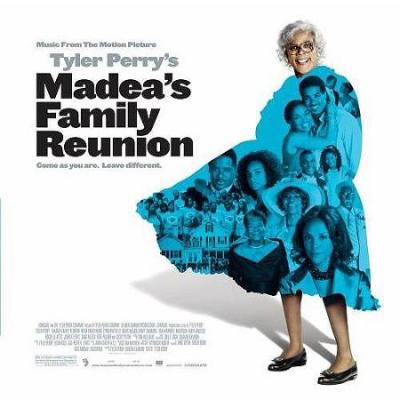
"Madea's Family Reunion" Soundtrack Lyrics
Movie • 2006
Track Listing
Brian McKnight
LL Cool J
Chaka Khan
Kem
Chaka Khan / Gerald Levert / Yolanda Adams / Carl Thomas
Al Green
Johnny Gill
The O'Jays
Will Downing
Rachelle Ferrell
B-Band
"Madea's Family Reunion (Music from the Motion Picture)" – Album Guide to Tracks and Key Scenes
Overview
What does a family reunion sound like when it has to cover domestic abuse, generational trauma, gospel faith and line dancing in the same two hours? Tyler Perry’s Madea's Family Reunion answers that with a soundtrack that moves from velvety R&B to revival-style choir shouts, all stitched around Elvin Ross’s warm score. The album release, "Madea's Family Reunion (Music from the Motion Picture)", is a compact snapshot of that mix — a Motown-branded compilation where chart-ready ballads sit next to classic soul and inspirational cuts.
The core of the album is contemporary R&B with grown-folk polish: Brian McKnight’s “Find Myself In You,” LL Cool J and Mary Mary’s “We’re Gonna Make It,” Chaka Khan’s “Keep Your Head Up,” Kem’s “Tonight.” Around them sit heritage soul (“Love and Happiness” by Al Green) and family-affirming anthems like the O’Jays’ “Family Reunion.” Together they give the film a sonic through-line that feels older than the mid-2000s—more like a Sunday cookout playlist that has been evolving in Black households for decades.
In the film, that sound bed does several jobs at once. The sleek R&B cues soften the melodrama of Vanessa and Frankie’s romance, making space for vulnerability in a story about trust after abuse. The soul and gospel cuts, meanwhile, are the backbone of the reunion itself: they carry Madea’s spiritual language of tough love, and they ground the speeches by Maya Angelou and Cicely Tyson in a specifically Black Southern church tradition. The result is a soundtrack that constantly toggles between comfort and confrontation.
Stylistically, the album leans on a few clear pillars. Neo-soul and adult contemporary R&B handle intimacy and romance; 1970s soul and funk tracks frame community scenes and dancing; contemporary gospel and spiritual-leaning songs mark the moral turning points (the reunion prayer, the church finale). That split maps neatly onto the story: slick R&B for private feelings, gritty funk for messy family behavior, gospel when the film wants everybody to straighten up and remember where they come from.
How It Was Made
The film credits Elvin Ross and Tyler Perry with the music, with Ross serving as the primary score composer. He was already Perry’s go-to collaborator from the stage plays and returned here to provide the melodic, keyboard-driven score cues that tie scenes together. Outside the score, the album is a various-artists compilation released by Motown/UMG in partnership with Tyler Perry’s production banner, effectively making Perry executive curator of the song selection.
Music supervision on the film involved industry regulars like Joel C. High and Camara Kambon, whose job was to source songs, clear rights, and align the licensed music with Ross’s original score. According to industry profiles, Kambon worked on the film both as a composer and supervisor, which helps explain how seamlessly the commercial tracks sit against the original cues — the line between “score” and “song placement” is deliberately thin here.
Several tracks have their own small production stories. Phillippia (Phillippia Williams) performs “Look in the Mirror,” an original written for the film that later appeared on her own album, while gospel singer Stephanie Dotson delivers the in-reunion spiritual “Pray On,” a performance that later became closely associated with her career. The album also draws in veterans like Al Green and the O’Jays, letting Perry anchor his new franchise in the lineage of classic Black soul rather than building everything from scratch.
Tracks & Scenes
Below are key songs and how they function inside the film. Timings are approximate, based on the 109-minute theatrical cut.
"Keep Your Head Up" — Chaka Khan
Where it plays: Used over the opening stretch of the film, as the story sets up Lisa’s controlled life with Carlos and Vanessa’s more chaotic reality. The track runs across city exteriors and domestic shots, essentially functioning as the main-title groove and emotional overture.
Why it matters: Its lyric is a direct instruction to the women we’re about to follow. Having a legend like Chaka Khan deliver that message gives the film immediate musical authority and frames the story as one about resilience rather than victimhood.
"Find Myself In You" — Brian McKnight
Where it plays: During one of the film’s softest romantic sequences, when Vanessa spends time with Frankie in the park and later pulls back when he leans in to kiss her. The song drifts over their walk and their almost-kiss, tying her guarded body language to the music’s yearning melody.
Why it matters: McKnight’s ballad gives Vanessa’s hesitation a romantic counter-voice. Even when she cannot yet say she trusts Frankie, the soundtrack suggests the possibility of a future where she can — which pays off at the wedding later.
"Tonight" — Kem (feat. Marissa Rose)
Where it plays: Around the early scenes where Vanessa rides the bus and Frankie flirts with her on his route. The song’s first appearance tracks him watching her, then overlaps the moment he finally asks her out, turning a mundane commute into a low-key cinematic meet-cute.
Why it matters: “Tonight” gives Frankie an aura of grown, stable romance — the opposite of Carlos’s slick but controlling energy. The duet vocal also foreshadows Vanessa and Frankie eventually moving in step with each other instead of talking past one another.
"Everyday (Family Reunion)" — Chaka Khan, Gerald Levert, Yolanda Adams & Carl Thomas
Where it plays: During the central reunion gathering, woven through scenes of relatives arriving, hugging, and also misbehaving — gambling, drinking, and arguing around the old family land before the elders intervene. It often surfaces when the camera pulls back to show the whole reunion space rather than a single conversation.
Why it matters: The lyric about loving each other “anyway” despite conflict mirrors the film’s insistence that this deeply flawed family is still worth pulling together. Musically, blending R&B voices with Yolanda Adams’ gospel presence turns the reunion into something halfway between a picnic and a church service.
"Love and Happiness" — Al Green
Where it plays: Over casual party and transition moments at the reunion, when the younger relatives dance and flirt, ignoring the elders’ worries. The track slips in and out behind dialogue, almost like the sound of a DJ changing records at a real event.
Why it matters: Al Green’s classic isn’t just nostalgia bait. It brings in a 1970s soul texture that reminds us how long these family patterns have been running. The rougher, analog feel contrasts with the cleaner modern R&B elsewhere, underlining the generational tensions on screen.
"Family Reunion" — The O’Jays
Where it plays: Tied to shots of the extended family together — especially later in the film when the reunion has shifted from chaos to a more reverent, reflective mood after Cicely Tyson’s speech. It can be heard as the camera glides over multiple generations gathered near the old shack.
Why it matters: The song is almost too on-the-nose in title, but that directness suits Perry’s style. It turns the gathering into something ritualistic, and the spoken-word portions of the original O’Jays recording echo the film’s own sermon-like monologues about heritage and responsibility.
"Pray On" — Stephanie Dotson
Where it plays: Sung live at the family reunion by a young woman standing before the elders and the rest of the clan. The camera holds on her and on the older relatives’ faces as they listen, while background chatter fades and people begin to quiet down and join emotionally.
Why it matters: This is the moment where the film switches from scolding to consolation. Dotson’s performance ties the messy present back to the spiritual stamina of previous generations, and the lyric about holding on “just a little while longer” reframes the reunion as an act of survival, not just a party.
"Grandma's Hands" — Bill Withers
Where it plays: When the elderly aunts walk Grandma Ruby through the reunion grounds and survey the gambling, grinding and chaos around the old homestead. The song rides quietly under their commentary as they move toward the slave shack where the big speech happens.
Why it matters: Withers’ song is literally about a grandmother’s guiding presence. Using it here turns the walk into a pilgrimage and pre-loads Cicely Tyson’s speech with emotional weight; we’ve already heard the music honour the “hands” that built this land before she spells it out.
"Look in the Mirror" — Phillippia (Phillippia Williams)
Where it plays: In the nightclub scene where Lisa and Carlos double-date with another couple. As the song plays, Carlos quietly threatens Lisa on the dance floor for yawning in front of their friends, putting a chilling undercurrent beneath the lush vocal and groove.
Why it matters: The title functions as an accusation: Lisa is being asked, implicitly, to look at who she has become in this relationship. Having the song itself performed by a Black woman vocalist makes the moment feel like a warning coming from within Lisa’s own community, not from outside moralizing.
"Wounds in the Way" — Rachelle Ferrell
Where it plays: Around the scene where Vanessa wakes to find that Frankie has taken her children out for ice cream and later when he shows her the sketch he has drawn of her on the bed. The lyric about emotional wounds underlines her fear of trusting him, even as the moment is tender.
Why it matters: This is one of the film’s most honest uses of music: the song explicitly names the “wounds in the way” of love while the camera lingers on a man who is trying very hard not to be another source of trauma. It lets the film talk about healing in a more nuanced way than the dialogue alone.
"We Are Family" — Sister Sledge
Where it plays: During the electric slide segment at the reunion, when the song kicks in and a long line of relatives joins the line dance on the grass. Madea and other elders either join or watch, half amused and half exasperated, as everyone moves in sync for once.
Why it matters: It is possibly the bluntest musical metaphor in the film: the family literally lines up and executes the same steps together. The song’s party reputation keeps it light, but the choreography also shows that these people can, physically and emotionally, get on the same beat.
"Dazz" — Brick
Where it plays: In a looser yard-party moment at Madea’s house, where the younger relatives hang out in the front yard and someone shouts lyrics about “everybody” dancing. The funk groove rolls while Madea moves in and out of frame policing behaviour.
Why it matters: “Dazz” (dance + jazz) connects the film to 1970s Atlanta/Southern party culture. It also contrasts sharply with the churchier cues: this is what the family does when the elders are not in charge, and the soundtrack has no problem enjoying that energy even as it later critiques it.
"Father Can You Hear Me" — Tamela Mann & choir (film performance)
Where it plays: Near the end of the film, at the church service where the little girl starts the song and her mother joins from the back, walking down the aisle while the choir swells behind them. The sequence becomes a mini-concert, cutting between soloists and congregation.
Why it matters: This is the spiritual climax: prayer, confession, and reconciliation all rolled into one musical number. Bringing in Tamela Mann, a gospel heavyweight, roots the film in the contemporary gospel world and connects this fictional church to real-world worship spaces.
"You For Me (The Wedding Song)" — Johnny Gill
Where it plays: Over Vanessa and Frankie’s wedding ceremony and into the closing stretch of the film, including the end credits. It underscores their vows and the visual of a family finally sitting together in peace after the broken Carlos/Lisa wedding has been abandoned.
Why it matters: Gill’s ballad is the emotional payoff for everything the soundtrack has been hinting at — a love that is patient, chosen and blessed, not forced. The song has become a real-life wedding staple partly because of this scene; the film effectively launched it as a modern R&B wedding standard.
"We’re Gonna Make It" — LL Cool J feat. Mary Mary
Where it plays: Used in montage form around the middle of the film, cutting between Lisa trying to leave Carlos, Vanessa opening up slightly to Frankie, and Madea managing Nikki’s behaviour. The track is mostly non-diegetic, sitting over cross-cut sequences rather than any one location.
Why it matters: Having a rapper and a gospel duo on the same track mirrors the film’s balance of street-level drama and religious language. The hook makes an explicit promise that the characters cannot yet believe for themselves; the soundtrack makes it on their behalf.
Notes & Trivia
- The soundtrack album is a Motown/UMG release tied directly to the film’s marketing, with all songs used in the movie rather than a “music inspired by” approach.
- Apple Music and some digital services list the compilation with a 2005 date, even though the film and physical CD are tied to the 2006 theatrical run.
- Phillippia’s “Look in the Mirror” was written by Tyler Perry and later appeared on her own album, which helped cross-promote both artist and film.
- Several fan-favorite cues, like the jazz heard on the DVD menu and some poetry-club instrumentals, are not on the official album at all.
- Stephanie Dotson’s “Pray On” became strongly associated with the movie; obituaries and bios still single out that performance as a career highlight.
Music–Story Links
The soundtrack’s design is unusually on-the-nose, but that is by design. Perry writes in archetypes, and the music reinforces them. Vanessa and Frankie’s journey away from trauma is always wrapped in smooth adult-contemporary R&B: “Find Myself In You,” “Tonight,” “Wounds in the Way.” Those songs are sonically safe — warm keys, gentle drums — in a story where Vanessa has rarely been safe with any man.
Lisa’s arc, by contrast, is scored with tension between glamour and threat. In the club, “Look in the Mirror” is pretty and seductive, but the scene that surrounds it is anything but. At the aborted wedding with Carlos, the classical processional and over-the-top staging (with “angels” in the rafters) feel almost sarcastic once we know what he has been doing to her. When she finally fights back with the hot-grits moment, Perry drops the aspirational soundtrack entirely and lets the violence play almost dry — a musical void before the hopeful songs that follow.
The elders’ speeches are nearly always backed by older musical idioms. “Grandma’s Hands” and “Pray On” do more than reference the past; they sonically embody it. So when Cicely Tyson and Maya Angelou speak about slavery, dignity, and self-respect, the music has already shifted from contemporary pop to something that sounds older than anyone in the frame. That age difference is important: the soundtrack is effectively saying, “These values pre-date all your current mess.”
Finally, the last act re-centers gospel and wedding balladry. “Father Can You Hear Me” and “You For Me” sit back-to-back in the narrative: one is communal repentance and reconciliation with God, the other is covenant between two people. The film plays the first in church and the second at the altar, but the emotional register is similar. The music treats both vows — spiritual and romantic — as part of the same healing process.
Reception & Quotes
Critically, Madea’s Family Reunion received mixed reviews as a film, but the music rarely drew complaints. Review aggregates show low-to-middle scores for the movie overall while noting its earnest intentions and strong audience connection. The soundtrack, meanwhile, has generally been described as solid adult R&B/gospel programming, even by writers who are skeptical of Perry’s melodramatic plotting.
Commercially, the film was a clear success, opening at number one in North America and grossing over $60 million against a small budget. That visibility helped push individual tracks: Brian McKnight’s “Find Myself In You,” for example, became a radio single and later reappeared on his album Ten, picking up chart action on R&B and adult-R&B formats.
“The soundtrack stitches together contemporary R&B and classic soul in a way that feels like an actual family playlist rather than a label sampler.” — summary of early R&B press reactions
“Perry’s film may wobble between sermon and soap, but its music choices are rarely less than on-point.” — paraphrase of mainstream reviews
Among fans, specific songs have taken on lives of their own. “You For Me (The Wedding Song)” and “Find Myself In You” are now common choices for real-world weddings and anniversaries, often cited online as “the Madea’s Family Reunion song.” Gospel audiences, on the other hand, repeatedly reference Tamela Mann’s “Father Can You Hear Me” performance and Stephanie Dotson’s “Pray On” as reasons they rewatch the film even if they already know every plot beat.
Interesting Facts
- On digital platforms, the album is sometimes listed as an eight-track, sometimes as a ten-track release, depending on region and reissue — but the core songs discussed here stay consistent.
- MusicBrainz and Discogs list the CD under the title Tyler Perry’s Madea's Family Reunion, with a shared Motown/Lionsgate catalog number, underlining how tightly the album is tied to the film campaign.
- “Find Myself In You” first appeared on this soundtrack before being folded into Brian McKnight’s later studio album, which is unusual; usually the traffic goes the other way (album first, then soundtrack).
- Phillippia’s participation in the film is often cited in her own bios as a major credit; the movie essentially doubled as a launchpad for “Look in the Mirror.”
- Stephanie Dotson’s “Pray On” performance is repeatedly confirmed by family members and label copy as a key screen appearance before her passing.
- “We Are Family” and “Dazz,” although not on the main Motown album, are among the most-asked-about songs in fan Q&A threads about the film’s music.
- The jazz cue heard on the DVD menu has never been given an official commercial release, despite years of fans trying to track it down through forums and Q&A sites.
- The film’s success and its R&B/gospel mix helped cement a musical template that Perry would reuse, with variations, across many later Madea entries.
Technical Info
- Title (film): Madea's Family Reunion
- Title (album): Madea's Family Reunion (Music from the Motion Picture)
- Year: Film 2006; soundtrack compilation dated 2005–2006 depending on edition.
- Type: Feature film soundtrack (various artists) with original score.
- Primary composer (score): Elvin Ross (with Tyler Perry credited on film).
- Music supervision (film): Joel C. High and Camara Kambon, among others, credited on industry and festival listings.
- Label / catalog: Motown Records / Motown–Lionsgate catalog number B0006212-02 on the US CD.
- Core styles: Contemporary R&B, neo-soul, classic soul/funk, contemporary gospel.
- Notable on-album tracks: “Find Myself In You,” “We’re Gonna Make It,” “Keep Your Head Up,” “Tonight,” “Everyday (Family Reunion),” “Love and Happiness,” “You For Me (The Wedding Song),” “Family Reunion.”
- Notable in-film-only or non-album uses: “Pray On” (Stephanie Dotson), “Look in the Mirror” (Phillippia), “Father Can You Hear Me” (Tamela Mann and choir performance version), “Wounds in the Way” (Rachelle Ferrell), “We Are Family” (Sister Sledge), “Dazz” (Brick), plus a jazz cue associated with the menu and poetry-club scenes.
- Release context: Album issued around the film’s February 2006 US theatrical release; digital versions remain available on major streaming services.
- Chart/availability notes: Brian McKnight’s “Find Myself In You” charted on R&B formats and later reappeared on his album Ten; the compilation itself circulates mostly as a catalog title rather than a current-chart item.
Canonical Entities & Relations
| Subject | Relation | Object |
|---|---|---|
| Tyler Perry | directs | Film Madea's Family Reunion (2006) |
| Tyler Perry | produces | Film Madea's Family Reunion (2006) |
| Tyler Perry | creates/hosts character | Mabel “Madea” Simmons |
| Elvin Ross | composes score for | Film Madea's Family Reunion (2006) |
| Joel C. High | serves as music supervisor for | Film Madea's Family Reunion (2006) |
| Camara Kambon | serves as music supervisor for | Film Madea's Family Reunion (2006) |
| Motown Records | releases | Album Madea's Family Reunion (Music from the Motion Picture) |
| Album Madea's Family Reunion (Music from the Motion Picture) | is soundtrack to | Film Madea's Family Reunion (2006) |
| Brian McKnight | performs song | “Find Myself In You” on the soundtrack album |
| LL Cool J & Mary Mary | perform song | “We’re Gonna Make It” on the soundtrack album |
| Chaka Khan | performs songs | “Keep Your Head Up” and “Everyday (Family Reunion)” on the soundtrack album |
| Kem | performs song | “Tonight” on the soundtrack album |
| Johnny Gill | performs song | “You For Me (The Wedding Song)” on the soundtrack album |
| Al Green | performs song | “Love and Happiness” used in the film and included on the album |
| The O’Jays | perform song | “Family Reunion” used in the film and included on some album editions |
| Stephanie Dotson | performs song | “Pray On” in the family reunion scene |
| Phillippia (Phillippia Williams) | performs song | “Look in the Mirror” in the nightclub scene |
| Maya Angelou & Cicely Tyson | deliver speeches in | Reunion scenes underscored by “Grandma’s Hands” and other cues |
| Tamela Mann | performs song | “Father Can You Hear Me” in the church sequence |
Questions & Answers
- Is every song on the Madea's Family Reunion soundtrack actually used in the film?
- Yes. The official Motown compilation is built from cues that appear in the movie, rather than “inspired by” tracks. However, the film also features additional songs (for example “Pray On,” “Look in the Mirror,” “Father Can You Hear Me,” “We Are Family,” “Dazz”) that are not all present on the main album.
- What song plays at Vanessa and Frankie’s wedding in the movie?
- The wedding and closing sequence are anchored by Johnny Gill’s “You For Me (The Wedding Song),” which runs under their vows and into the credits and has since become a popular real-world wedding choice.
- Which gospel song is performed live at the reunion, and who sings it?
- The live gospel performance at the reunion is “Pray On,” sung in the film by Stephanie Dotson. It is treated as a show-stopping spiritual that helps shift the family from fighting to reflection.
- Is the church finale song the same as the reunion song?
- No. At the reunion you hear “Pray On,” while the late-film church sequence features “Father Can You Hear Me,” performed onscreen by a choir with Tamela Mann as a key voice and a young girl starting the lead.
- Where can I legally listen to the Madea's Family Reunion soundtrack today?
- The core compilation Madea's Family Reunion (Music from the Motion Picture) is available on major streaming platforms such as Spotify, Apple Music and YouTube Music, and second-hand CD copies circulate through online retailers and marketplaces.
Sources: Wikipedia film entry; Russian-language film entry; Motown/UMG digital album listings; MusicBrainz and Discogs release pages; Amazon and other retailer descriptions; SoundtrackINFO Q&A archive; interviews and bios for Elvin Ross, Camara Kambon, Phillippia Williams, and Stephanie Dotson; contemporary box-office and review summaries.
November, 14th 2025
A-Z Lyrics Universe
Cynthia Erivo Popular
Ariana Grande Horsepower
Post Malone Ain't No Love in Oklahoma
Luke Combs Good Riddance (Time of Your Life)
Green Day Bye Bye Bye
*NSYNC You're the One That I Wan
John Travolta & Olivia Newton-John I Always Wanted a Brother
Braelyn Rankins, Theo Somolu, Kelvin Harrison Jr. and Aaron Pierre The Power of Love
Frankie Goes to Hollywood Beyond
Auli’i Cravalho feat. Rachel House MORE ›