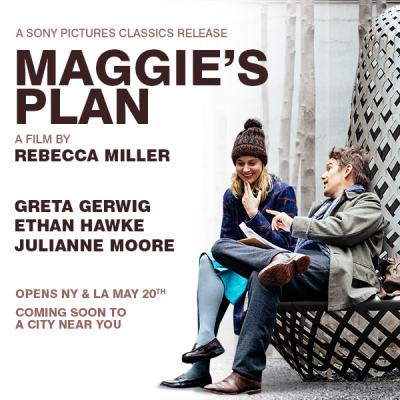
"Maggie's Plan" Soundtrack Lyrics
Movie • 2106
Track Listing
The Skatalites
Peaking Lights
Dandy Livingstone
Bruce Springsteen
Don Drummond
Keith & Ken
"Maggie's Plan (Original Soundtrack Album)" – Album Guide to Tracks and Key Scenes
Overview
What happens when a screwball New York romance leans on first-wave ska, Springsteen, and tiny slivers of chamber-like score instead of soft focus piano? Maggie’s Plan answers that with a soundtrack that is wiry, restless, and slightly off to the side of the usual rom-com comfort zone.
The album that sits behind the film – generally released as Maggie’s Plan (Original Soundtrack Album) or Original Motion Picture Soundtrack – pulls together Michael Rohatyn’s concise cues with a crate-digger’s selection of Jamaican ska and indie oddities, then drops Bruce Springsteen’s “Dancing in the Dark” in both its stadium and intimate barroom forms. It feels curated rather than compiled: songs show up at specific emotional hinges, not just as wallpaper.
In the film, music is one of the ways we understand how Maggie differs from almost everyone around her. She throws on vintage ska, children’s songs, and nervy little instrumentals while she over-plans her life; John drowns in “Dancing in the Dark” at full blast; Georgette is the one who can live inside that song with him instead of fighting it. The album mirrors that triangle – jittery, then romantic, then quietly melancholy.
Stylistically, the soundtrack jumps between strands: first-wave ska and rocksteady (Baba Brooks, Don Drummond, Dandy Livingstone), downtown-ish indie and dub-tinted psych (Peaking Lights), classic American rock (Springsteen), nursery-rhyme pastiche (“Apples and Bananas”), plus Rohatyn’s brief score pieces that sit somewhere between jazz sketches and modern chamber miniatures. Ska and rocksteady tag Maggie’s quirky, self-invented life; Springsteen’s anthemic rock marks John’s arrested adolescence; the score cues stitch together the more fragile in-between states.
How It Was Made
The film credits list composer Michael Rohatyn as the architect of the original score, with Adam Horovitz (Ad-Rock from Beastie Boys) as music supervisor – a pairing that already hints the soundtrack will be more opinionated than average studio fare. The production notes stress that Rohatyn’s brief cues were designed to sit lightly under dialogue, leaving space for the licensed songs to define key identity beats.
The official song list in the film’s press kit reads like a compact history lesson in ska and rocksteady: “Musical Communion” (Baba Brooks), “Man in the Street” (Don Drummond), “Rudy, A Message to You” (Dandy Livingstone), “Groove to the Beat” (Keith & Ken), alongside the more contemporary “Hey Sparrow” by Peaking Lights. Those sit next to two versions of “Dancing in the Dark” – Bruce Springsteen’s original and a cover performed by Kathleen Hanna & Tommy Buck – plus the children’s standard “Apples and Bananas” arranged for The Fruitbowl Harmonists, and Rohatyn’s own “A Fortune Cookie.” The package is small but very specific.
On album, Milan Records gathers those songs with Rohatyn’s cues into a full-length release, expanding from the film-minimum set of licensed titles into a 16- and, in some territories, 22-track edition with bonus instrumentals such as “A Bright Opening,” “Waltz 3.9,” and “Manic Buttons.” The longer configuration, available on streaming services, runs just under fifty minutes and almost plays like a continuous suite.
From interviews and reviews, you can see how deliberately the team used the music as a storytelling tool: John’s relationship to “Dancing in the Dark” is plotted in two very different scenes; Maggie’s taste for vintage ska becomes a shorthand for her mix of control freak and free-spiritedness; even the kids’ song is functional, underlining her role as a quasi-parent long before she fully understands what she has taken on.
Tracks & Scenes
Below are the key soundtrack moments where the film and album really lock together. Exact minute marks vary a little between releases and cuts, so the descriptions focus on story beats rather than timecodes.
“Dancing in the Dark” — Bruce Springsteen
Where it plays: Mid-film, in the Queens loft John uses as his office. The original Springsteen recording blasts out of a speaker while John types inside a glassed-in room, lost in his “ficto-critical” novel. Maggie arrives carrying their daughter Lily, winces at the volume, and scrambles to turn the music down. What should be an ordinary domestic drop-in becomes slightly tense; Lily stomps happily, John sulks that she “turned down [his] song.” The track is clearly non-diegetic until Maggie crosses into the room, then it’s explicitly source music coming from his setup.
Why it matters: The scene nails John’s self-image – he hears himself as the romantic, tortured hero of a Springsteen anthem – and shows how Maggie has slid into the role of practical killjoy. Critic readings point out that this moment starts to seed the idea that Maggie isn’t actually suited to John’s need for drama, even if she loves him.
“Dancing in the Dark” — Kathleen Hanna & Tommy Buck
Where it plays: Later, at a winter conference in Québec. John and Georgette, snowed in after academic events, stumble into a lodge room where an acoustic duo on a small stage is playing “Dancing in the Dark.” The performance is loose and a little “salsa-fied,” sung with a thick French-Canadian lilt; Hanna and Buck trade verses while faculty and guests dance, wrapped in huge coats and clutching cognac. John and Georgette collapse onto a couch, then get pulled into the dance floor, finally laughing and moving in sync as the song stretches out. The performance is fully diegetic – we see the band and the crowd, hear the room noise, watch them sing along.
Why it matters: According to one detailed review, this is the moment the film quietly proves that Georgette is the partner who can actually share John’s inner soundtrack. She lets the song stay loud; she meets him inside it. The same Springsteen composition that sounded like self-absorbed noise in Maggie’s apartment becomes a point of connection here – a clever musical argument about compatibility.
“Rudy, A Message to You” — Dandy Livingstone
Where it plays: In one of the film’s standout solo moments for Maggie. She’s alone, finally free from the social performance of being perfect colleague, perfect mother, perfect partner. As Dandy Livingstone’s rocksteady classic drifts in, she starts to move – hesitant at first, then loosening into a full-body slink, half-goofy, half-cool. It’s a private dance, more about shaking off self-consciousness than putting on a show for anyone else.
Why it matters: Commentators often single this scene out as a pure Greta Gerwig moment: slightly awkward, completely committed. The track choice is telling. “Rudy, A Message to You” is a song about warnings and second chances; pairing it with Maggie dancing alone underlines that she’s both in over her head and oddly optimistic. On the album, the track sits right before Rohatyn’s title cue, creating the same sense of someone teetering on the edge of a new scheme.
“Musical Communion” — Baba Brooks
Where it plays: Used as one of Maggie’s recurring ska needle-drops, early in the film, backing everyday New York movement – streets, campus, life logistics. The horns and shuffle beat feel slightly out of time with the modern city visuals, which is the point: Maggie is the kind of person who would be listening to vintage Jamaican instrumentals on her earbuds while planning to inseminate herself with pickle-entrepreneur sperm.
Why it matters: In reviews, writers note that the soundtrack paints her as a first-wave ska fan. “Musical Communion,” with its warm brass and rolling groove, sets that taste in motion and gives her scenes an extra layer of bounce. On the album it also functions as a de facto overture; it’s often the first track and it tells you the record will not be generic urban pop.
“Man in the Street” — Don Drummond
Where it plays: As with “Musical Communion,” this cut surfaces as background source music in Maggie’s world – another ska cue tied to moments where she is commuting, working, or juggling children. The film doesn’t spotlight the track in dialogue, but you can catch the trombone lines cutting through mix during transitional scenes.
Why it matters: Pairing Drummond’s tune with Maggie positions her as someone who romanticises chaos and street-level energy while trying to impose order on her own life. On album, “Man in the Street” also gives the middle stretch a slightly moodier, more minor-key feel before Rohatyn’s more introspective cues arrive.
“Hey Sparrow” — Peaking Lights
Where it plays: Slotted into one of the film’s looser party or social sequences, “Hey Sparrow” pushes a wobbly, dub-psychedelic texture into Maggie’s otherwise tidy aesthetic. The groove feels hazier than the sharp ska cuts, with vocals smeared across the mix as background rather than foreground performance.
Why it matters: This is the soundtrack leaning into the Brooklyn/indie edges of Maggie’s social circle. It suggests a world of people who might talk endlessly about theory and ethics but dance to sprawling, echo-y grooves. On record, it’s one of the more expansive tracks and gives the listening experience some much-needed width between the short cues.
“Apples and Bananas” — The Fruitbowl Harmonists (arr. Michael Rohatyn)
Where it plays: Tied to Maggie’s domestic life with Lily and her stepchildren – a diegetic children’s song that crops up when kids are in the room and adult neuroses have to be temporarily muted. It’s simple, repetitive, and slightly absurd next to the characters’ very adult dilemmas.
Why it matters: This track underlines how far Maggie’s life has drifted from the clean solo existence she originally planned. The arrangement, with its close-harmony vocals, also connects neatly back to Rohatyn’s more delicate score work, making the kids’ material feel like part of the same musical world rather than a throwaway gag.
“Groove to the Beat” — Keith & Ken
Where it plays: Another ska cut, usually heard as room music in social or family scenes, with the characters talking over it. It has a more explicitly dance-floor-ready character than “Musical Communion,” nudging characters – and the audience – toward the possibility of letting go for a second.
Why it matters: Collectively, the ska songs create a sonic identity for Maggie’s New York that is more vinyl-collector and less radio-hit. “Groove to the Beat” is the most on-the-nose title in that cluster and works as the album’s gentle instruction to the listener: this is a record to move to, not just to analyse.
“Maggie’s Plan” — Michael Rohatyn
Where it plays: A short, central motif cue used around key turning points of the story – the moments when Maggie sets, revises, or abandons her various schemes (first to have a child alone, then to be with John, then to send him back to Georgette). On album it appears about a third of the way in, framing the more character-specific pieces.
Why it matters: The cue is almost comically short, but it encapsulates the film’s tone: plucked strings, light percussion, a melody that sounds determined but also slightly unsure of itself. It’s the musical equivalent of Maggie’s “I’ve thought this through, I swear” energy.
“Maggie and Lily” — Michael Rohatyn
Where it plays: Near the film’s end, around the ice-skating sequence where Maggie, John, Georgette, the kids, and Guy all converge. Rohatyn scores these scenes with tender, cyclical writing – often described in reviews as warm without tipping into sentimentality – while Lily skates between the adults and starts reciting numbers out of nowhere.
Why it matters: This cue is where the film finally gives Maggie a kind of peace. The music doesn’t resolve every chord neatly, but it settles into a pattern that feels sustainable, just like the blended family we see on screen. On the album, it functions as a soft landing after the more rhythm-driven material.
Notes & Trivia
- The score and soundtrack are officially credited as music by Michael Rohatyn, with longtime New York editor Sabine Hoffmann cutting the film – so the music was built into the rhythm very early in post-production.
- Adam Horovitz’s credit as music supervisor quietly links the film to the history of Beastie Boys and New York’s downtown music scene.
- Two distinct albums circulate: a shorter “Original Soundtrack Album” configuration and a longer “Original Motion Picture Soundtrack” with additional Rohatyn cues and bonus tracks.
- Kathleen Hanna’s “Dancing in the Dark” cover, recorded for the film, was promoted separately in music press – it became a mini-event for fans of both Hanna and Springsteen.
- Italian-language materials explicitly note that the soundtrack album was released by Milan Records in May 2016, aligning with the film’s US theatrical run.
Music–Story Links
The cleanest example of music hard-wired into the narrative is the two-step use of “Dancing in the Dark.” First, the studio original tells us John is loud, self-absorbed, and stuck on his own myth; Maggie literally reaches for the volume knob. Later, the acoustic cover shows him as playful and open with Georgette – he doesn’t turn the track into a performance about himself, he just shares it. The film never states this outright, but the soundtrack makes the argument for which pairing actually works.
Maggie’s private dance to “Rudy, A Message to You” does something similar for her arc. Alone, she borrows swagger from a song about warning a young man not to mess up his life, even as she is in the middle of massively over-engineering hers. The scene lets us see both her self-awareness and her denial: she hears the warning, dances anyway, and then keeps pushing her plan forward.
The ska cuts that fill her everyday life also contrast strongly with the calmer score cues that arrive when she starts questioning herself. Rohatyn’s tracks around the ice-skating finale and around Maggie’s quiet breakfasts with Lily are less syncopated and more circular, implying a loop she might finally be content to live inside rather than break.
Even the children’s material is thematic. A song like “Apples and Bananas” sits in sequences where Maggie is engaged in caretaking rather than scheming; the simplicity of the tune mirrors the simple needs of the kids. It’s a reminder that behind the elaborate romantic logistics there is a basic job to be done – and that music, in those scenes, is no longer about her identity or taste but about their comfort.
Reception & Quotes
The film itself landed very well with critics: aggregated scores hover in the mid-70s to mid-80s percent range, with reviewers praising Greta Gerwig’s performance and the script’s twist on old screwball patterns. Several write-ups flag the soundtrack as part of what keeps the film feeling specific rather than generic.
“The soundtrack for Maggie’s Plan is more than just a collection of songs… it drives home important plot points.”
— FilmFracture review
“Greta Gerwig, Ethan Hawke, and Julianne Moore make a pleasing triangle in Rebecca Miller’s offbeat romantic comedy.”
— Variety
“A smart, goofy delight… the cast are in near-perfect harmony.”
— Vanity Fair
“Maggie’s Plan serves as a strong reminder of what a comedic force Moore can be… Gerwig effortlessly leads most of the picture.”
— The Guardian
As for the album, it never became a chart monster, but it has quietly lived on in streaming catalogues. The Springsteen and Hanna/Buck versions of “Dancing in the Dark” attract listeners who then discover the Rohatyn cues and the ska catalogue buried alongside them. The presence of bonus tracks like “A Bright Opening” and “Waltz 3.9” on some editions also makes the record more attractive to soundtrack collectors who want a fuller picture of the score.
Interesting Facts
- The soundtrack album is released under the Milan Records banner, a label known for art-leaning scores; Maggie’s Plan sits in their catalogue next to titles like The Private Lives of Pippa Lee, also scored by Rohatyn.
- The long digital edition runs 22 tracks and just under 50 minutes, including bonus cues such as “A Bright Opening,” “Waltz 3.9,” and “Manic Buttons.” Some digital stores also carry a shorter 16-track configuration.
- Press materials explicitly list two separate licensed recordings of “Dancing in the Dark” – the Springsteen original and the Hanna/Buck cover – which is unusual for a film of this size; clearing both is not cheap.
- Maggie’s love of first-wave ska is not just a character quirk: the film’s music section name-checks specific Studio One-related credits and publishers, a nice nod for collectors who read the fine print.
- The Italian release notes frame the album as a mix of Rohatyn’s compositions and existing songs, highlighting “Man in the Street,” “Hey Sparrow,” and “A Message to You, Rudy” as key non-score cuts.
- Director Rebecca Miller later mentioned in interviews about her film She Came to Me that her comfort asking Bruce Springsteen for a new song there came partly from having already used “Dancing in the Dark” so prominently in Maggie’s Plan.
- The presence of Adam Horovitz as music supervisor led some early viewers to expect a more overtly hip-hop-driven soundtrack; instead he leans into ska, indie, and classic rock in a way that feels slyly personal.
- On streaming platforms, the album is sometimes tagged as both “Soundtrack” and “Stage & Screen,” so it occasionally surfaces in recommendations next to Broadway cast recordings, which is a strange but not entirely wrong fit.
- Kathleen Hanna’s cover of “Dancing in the Dark” was promoted via streaming and press ahead of the film’s wider release, effectively turning one cue into its own small single.
- The album’s closing run of short cues (“Shoes Red,” “Shoes Blue” on some editions) doubles as a kind of epilogue suite, replaying Maggie’s changing sense of self through tiny, color-coded motifs.
Technical Info
- Title: Maggie’s Plan (Original Soundtrack Album) / Maggie’s Plan (Original Motion Picture Soundtrack)
- Year: 2016 (film premiered 2015 on the festival circuit; US release and soundtrack album followed in 2016)
- Type: Film soundtrack (songs + original score)
- Primary composer: Michael Rohatyn
- Music supervisor: Adam Horovitz
- Key featured artists: Bruce Springsteen; Kathleen Hanna & Tommy Buck; Baba Brooks; Don Drummond; Dandy Livingstone; Peaking Lights; Keith & Ken; The Fruitbowl Harmonists
- Label: Milan Records / Milan Entertainment
- Core cues & songs: “Musical Communion,” “Rudy, A Message to You,” “Man in the Street,” “Groove to the Beat,” “Hey Sparrow,” “Dancing in the Dark” (two distinct recordings), “Apples and Bananas,” plus Rohatyn cues such as “Maggie’s Plan,” “A Fortune Cookie,” “Quaker/Lost in Snow,” “Daddy’s Bubble,” “Maggie and Lily”
- Album configurations: 16-track CD/MP3 edition; extended 22-track digital edition with bonus score pieces; both commonly marketed under the same title with regional variations.
- Runtime: Approximately 29 minutes (short edition) to 49–50 minutes (long edition), depending on region and platform.
- Release context: Coincided with the film’s limited US theatrical run via Sony Pictures Classics after festival premieres in Toronto, New York, Sundance, and Berlin.
- Availability: Widely available on major streaming platforms (Spotify, Apple Music, YouTube Music) and on physical CD via Milan’s distribution partners.
Canonical Entities & Relations
| Subject | Relation | Object |
|---|---|---|
| Rebecca Miller | directs | Maggie’s Plan (film) |
| Rebecca Miller | writes | Maggie’s Plan (screenplay, from a story by Karen Rinaldi) |
| Michael Rohatyn | composes music for | Maggie’s Plan (film) |
| Michael Rohatyn | is primary artist on | Maggie’s Plan (Original Motion Picture Soundtrack) (album) |
| Adam Horovitz | serves as | Music supervisor on Maggie’s Plan |
| Bruce Springsteen | performs | “Dancing in the Dark” (original recording used in the film and on album) |
| Kathleen Hanna & Tommy Buck | perform | “Dancing in the Dark” (cover version used diegetically in Québec lodge scene) |
| Dandy Livingstone | performs | “Rudy, A Message to You” (used in Maggie’s private dance scene) |
| Baba Brooks | performs | “Musical Communion” (ska source music in the film and on album) |
| Don Drummond | performs | “Man in the Street” (ska track used in the film and on album) |
| Peaking Lights | performs | “Hey Sparrow” (licensed song in Maggie’s Plan) |
| Keith & Ken | perform | “Groove to the Beat” (licensed ska track in the film) |
| The Fruitbowl Harmonists | perform | “Apples and Bananas” (children’s song arranged by Rohatyn for the film) |
| Milan Records | releases | Maggie’s Plan soundtrack albums |
| Sony Pictures Classics | distributes | Maggie’s Plan (film) |
| Maggie’s Plan (album) | is part of | Maggie’s Plan (film) franchise |
| Toronto International Film Festival | hosts premiere of | Maggie’s Plan (2015 Special Presentations section) |
Questions & Answers
- What makes the Maggie’s Plan soundtrack stand out from other romantic comedies?
- Instead of leaning on current radio pop, it builds a personality from first-wave ska, a major Springsteen song used twice in different arrangements, and a series of short, slightly off-kilter score cues. The result feels curated to the characters rather than generic.
- How are the two versions of “Dancing in the Dark” used differently in the film?
- The Springsteen original blares in John’s loft while he writes, emphasising how self-absorbed and stuck he is; the acoustic Kathleen Hanna & Tommy Buck cover appears later at a snowy conference lodge, where John and Georgette finally relax and dance together. Same song, different emotional verdict.
- Is Kathleen Hanna actually visible in the Québec lodge scene?
- Yes. The cover is performed on screen by a small acoustic duo; Hanna and Tommy Buck appear as members of that band, singing live in the diegetic space rather than as an off-screen recording.
- How many different editions of the Maggie’s Plan soundtrack exist?
- Broadly, two. A shorter “Original Soundtrack Album” edition (around 16 tracks) and an extended “Original Motion Picture Soundtrack” edition with 22 tracks and bonus cues like “A Bright Opening” and “Waltz 3.9.” Region and platform determine which one you see.
- Where can I legally listen to the soundtrack today?
- The album is available on major streaming platforms (Spotify, Apple Music, YouTube Music) under Michael Rohatyn’s name, and on physical CD through Milan Records’ distribution. Availability of the long vs. short edition may differ by country.
Sources: official Maggie’s Plan press kit; film credits; Milan Records release notes; Apple Music and Spotify metadata; Italian and English Wikipedia entries for film and soundtrack; FilmFracture review; major outlet reviews (Variety, Vanity Fair, The Guardian) and regional review coverage.
In this film Julianne Moore plays very eccentric lady, who is married to a man-writer (rather narcissistic and self-centered, it must be admitted), in whom the protagonist falls in love. She also creates a sort of a plan, following which, the present-day his wife will become the former, and they will be together with him. There is also a second-plan role played by Australian Travis Fimmel, which is known to series fans as the powerful Konung Ragnar Lodbrok from the series Vikings, where he quite skillfully plays King of the Vikings in the 9th century B.C., which was the scourge of medieval England and France. However, the main roles here went to Greta Gerwig and Ethan Hawke. Soundtrack to the motion picture is pretty positive, consisting entirely of songs that are of sunny mood. A striking example is the Hey Sparrow in the genre of psychedelic pop. Behind it, keeps up Man in the Street by Don Drummond – the singer, who died young, having been noted only by a few catchy compositions in his life. Bruce Springsteen is a pleasant bonus for anyone who was born in the U.S.A. – the title of one of his most popular songs that the post-Soviet audience may have heard in the comedy series ALF, in the scene where Lynn Tanner guesses this song on the radio with Alf, and then he, who couldn’t guess it, was joking that ‘no wonder I didn’t know this song’. Thin and funny – he was not indeed born in the USA. Here there is one instrumental song that has no lyrics – Musical Communion. Dancing in the Dark, on the contrary, wins with its lyrics, presenting the same vigor as the rest of this wonderful content of this rejuvenating composition. Groove to the Beat represents another genre – reggae – thus allowing to say that each composition performed in its own genre. The rest are of pop, jazz, rock and ska.November, 15th 2025
Find "Maggie's Plan" profile on IMDb and Rotten TomatoesA-Z Lyrics Universe
Cynthia Erivo Popular
Ariana Grande Horsepower
Post Malone Ain't No Love in Oklahoma
Luke Combs Good Riddance (Time of Your Life)
Green Day Bye Bye Bye
*NSYNC You're the One That I Wan
John Travolta & Olivia Newton-John I Always Wanted a Brother
Braelyn Rankins, Theo Somolu, Kelvin Harrison Jr. and Aaron Pierre The Power of Love
Frankie Goes to Hollywood Beyond
Auli’i Cravalho feat. Rachel House MORE ›