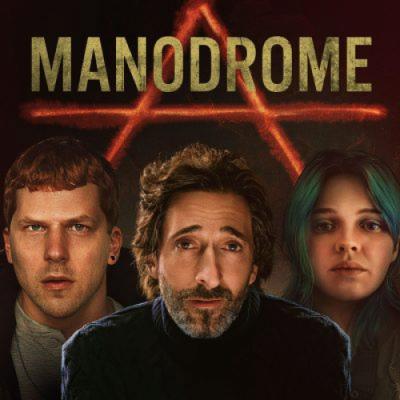
"Manodrome" Soundtrack Lyrics
Movie • 2023
Track Listing
David Tobin & Jeff Meegan
Sakîna
Yung Skeeter
Neil Taylor & Simon Eugene
Pete Masitti & Joshua Spacht
Nasrullah Faizullah
Le Mystere Des Voix Bulgares
"Manodrome (2023) – Soundtrack & Score" – Album Guide to Tracks and Key Scenes
Overview
What happens when a Christmas movie refuses to feel comforting? The music of Manodrome answers that question with a steady, unnerving grin. Holiday standards, obscure carols, and an anxiety-ridden original score grind against each other while Ralphie’s life falls apart on-screen.
The soundtrack sits in a strange but deliberate space: part Christmas compilation, part cult mixtape, part psychological horror score. Familiar seasonal sounds – choral hymns, retro festive pop, even novelty Christmas tunes – play over some of the bleakest moments in the story. Instead of warmth, they create a cold irony, showing how Ralphie’s reality no longer matches the cheerful music around him.
Underneath the songs runs Christopher Stracey’s original score, built on tense drones, bowed textures, and pulses that feel like an adrenaline spike that never comes down. Reviewers have described it as a “soundscape of an anxiety attack,” and that fits: cues often hover on one dissonant idea, pushing the viewer into the same trapped headspace as Ralphie.
Stylistically, the soundtrack juggles several clear threads. The score leans into minimalist electronic and modern thriller textures – sustained synths, processed strings, low percussion – to suggest dread and mental collapse. The needle drops skew heavily toward Christmas music (from choral “Carol of the Bells” to indie-flavoured holiday rock), which turns the film into a kind of anti-Christmas story. Add in world vocal music (Bulgarian choir, Middle Eastern-inflected carol settings) and a Thai ballad, and the film’s sonic world becomes global and disorienting, mirroring Ralphie’s sense that he no longer fits anywhere.
How It Was Made
Composer Christopher Stracey makes his solo feature-score debut here. Previously known for work on Maid, Cha Cha Real Smooth and War Pony, he took on Manodrome as a character study in sound – building a score that stays very close to Ralphie’s point of view and rarely offers relief.
In interviews, director John Trengove has talked about an intuitive process with Stracey: experimenting in the studio with bowed instruments, treated noises and rough textures while watching scenes, then locking in on sounds that matched Ralphie’s inner chaos. Rather than a thematic, melodic score, they chose a more textural approach, where small changes in tone signal Ralphie’s shifts between fragile control and total break.
On the song side, the film leans on a dense set of licensed tracks. Music supervision is credited to Ben Persky, with additional consultants, and you can feel the curatorial hand: most of the songs are not obvious mainstream choices. Instead of big, glossy Christmas hits, you get niche catalogue pieces (Elton Duck’s “Christmas,” Carl Coccomo’s “It’s Christmas”) and library-style festive cuts that sit just slightly “wrong” over the images.
That strategy means the film can sound both recognisably seasonal and oddly anonymous, like the canned music you hear in malls and radio stations in December – only here it’s underscoring cult indoctrination, financial desperation, and violence. Stracey also co-arranges a new version of “Holy Are You” with Nakhane for the end credits, linking his score world to the more song-based part of the soundtrack.
Tracks & Scenes
Below are key music moments in Manodrome. This is not a full tracklist, but a guide to how some of the most important songs and cues hit the screen.
"At Christmas Time" — David Tobin & Jeff Meegan (feat. Donna Byrne & Alex MacDougall)
Where it plays: Very early in the film (around 00:05), Ralphie and Sal wander through a baby store, drifting past strollers and tiny clothes while this polished, jazzy Christmas tune wafts over the speakers. The music is clearly diegetic: background store audio that feels aggressively cheerful. Sal’s swollen discomfort, her request to leave, and Ralphie’s slightly absent gaze clash with the warm, brushed-drums swing of the track.
Why it matters: This cue sets up the core contradiction of the film – cosy seasonal music against characters who are exhausted, broke and emotionally out of sync. It also quietly frames parenthood as a kind of consumer ritual that Ralphie can’t afford, musically smoothing over the financial anxiety that will drive him toward the cult.
"Narine" — Sakina
Where it plays: Around the 30-minute mark, as Ralphie takes a kid’s forgotten phone to a pawn shop to scrape together extra cash. The song, with its Middle Eastern-flavoured vocal lines and steady groove, plays over his walk and the exchange, turning what could be a simple errand into a tense, morally messy detour.
Why it matters: The music’s wandering, modal feel underlines the sense that Ralphie has already stepped off the straight path. It gives his petty theft a ritual weight, as if this small compromise is the first real initiation into the darker choices to come.
"Stand Again (VIP Mix)" — Yung Skeeter
Where it plays: Around 00:40, at the gym. Two guys complain about the current playlist and get the manager to switch the music; this glossy, club-leaning track kicks in over the sound system. The beat syncs with Ralphie’s reps, the camera hugging his body as he strains, preening and punishing himself at the same time.
Why it matters: Diegetic gym bangers are a cliché, but here “Stand Again” is almost mocking. The title suggests resilience and self-empowerment, while Ralphie is the least stable person in the room. It also shows how male spaces in the film – the gym, the cult house – share the same sonic language of hype and aggression.
"Happy Christmas" — Neil Taylor & Simon Eugene
Where it plays: About 46 minutes in, Ralphie cranks up the car stereo and speeds through the streets with two men in the backseat, who quickly panic as his driving becomes erratic. The song itself is a bright, guitar-led festive tune, with upbeat rhythms and a friendly radio-rock sheen.
Why it matters: The dissonance is obvious, but effective. The car becomes a moving pressure cooker, filled with cheery Christmas wishes and real fear. The song locks the scene into a specific December atmosphere while showing how the season’s forced joy pushes Ralphie even further out of sync with the world.
"Christmas Morn" — The Hutch Stereos (a.k.a. Hutchinson Sunbeams)
Where it plays: Immediately after, at roughly 00:47, Ralphie tries on an expensive shirt in a clothing store, surrounded by his new “brothers” from the group. This sweet, almost innocent-sounding Christmas track plays in the background as they nudge him toward a purchase he can’t afford, praising how it makes him look like one of them.
Why it matters: Musically it feels like a children’s choir memory of Christmas morning, but in context it’s about pressure, not joy. The song helps frame the cult as an alternate “family Christmas,” with gifts and approval replacing genuine care.
"See Me" — Pete Masitti & Joshua Spacht
Where it plays: Around 00:52, in another gym sequence. Ralphie focuses on his workout, headphones and background speakers mixing into a mid-tempo, radio-ready pop-rock bed. The camera lingers on his body and on his gaze toward other men, while the song’s title line (“see me”) feels almost too on the nose.
Why it matters: The cue reinforces a theme the film returns to again and again: Ralphie’s obsession with being seen as strong, masculine and invulnerable. The music is smooth and aspirational, but we know, by now, that his inner life is anything but.
"Carol of the Bells" — Nasrullah Faizullah
Where it plays: Still around the 00:52 mark, after a burst of anger in Ralphie’s car. He storms out and brutally attacks a man dressed as Santa Claus in public. Over this, we hear an arrangement of “Carol of the Bells” with a clear Eastern-tinged vocal colour, giving the familiar carol a more haunting, minor-key edge.
Why it matters: “Carol of the Bells” is already one of the more ominous Christmas standards, but this version turns the scene into outright nightmare satire: Santa beaten to a quasi-sacred choral piece. It signals that the film’s Christmas world has fully curdled.
"Ergen Deda (Live)" — Le Mystère des Voix Bulgares
Where it plays: Around 01:10, just after Ralphie shoots Ahmet and escapes, the film follows him to a pawn shop where he sells the stolen items. The famous Bulgarian women’s choir, recorded live, unfurls those sharp, stacked harmonies as he walks in and haggles over blood money.
Why it matters: The cue is one of the most striking in the film. The non-Western choral sound instantly lifts the scene into something mythic and ritualistic, as if Ralphie has stepped into a tragic folk tale. It also underlines how far he has drifted from ordinary life; no more mall jingles, just stark, ancient-sounding voices.
"Jayce Is Coming" — Kara Jones
Where it plays: Heard later in the film in connection with Ralphie’s newborn son, Jayce – the track’s title explicitly names the baby and points to his arrival. The song itself, written by Marco Dutra and Gwydion Beynon, carries a bittersweet, lullaby-like tone with a modern edge, more intimate than the earlier Christmas source cues.
Why it matters: Critics have singled this song out as encapsulating Ralphie’s fractured feelings about fatherhood. It functions almost like an in-world hymn to a child who, in reality, barely softens Ralphie’s spiral. The gentle arrangement throws his inability to step up as a parent into even sharper relief.
"Holy Are You" — Nakhane & Christopher Stracey (cover of The Electric Prunes)
Where it plays: The film closes and the end credits roll over Nakhane’s haunting reinterpretation of the psychedelic gospel “Holy Are You,” arranged in collaboration with Stracey. Gone are the cult chants and panicked strings; instead, we get rich vocals and a slow, reverent build that washes over the final images and text.
Why it matters: Placing this song at the very end re-frames what we’ve seen. A track originally steeped in spiritual awe becomes commentary on a story warped by false prophets and broken men. It’s also one of the few moments where the film allows something like beauty to sit on the soundtrack without immediate undercutting.
"Christmas" — Elton Duck
Where it plays: A Fervor Records deep cut that surfaces early in the film during a domestic argument involving a child complaining about going to a friend’s house. The track’s late-70s power-pop energy – choppy guitars, driving drums – hums beneath overlapping dialogue and background noise.
Why it matters: The song reminds us that this story, for all its extremity, happens in ordinary families and apartments. It’s not a grand, orchestral cue; it sounds like music someone might actually have on, which makes the scene’s discomfort feel lived-in rather than stylised.
"It’s Christmas" — Carl Coccomo
Where it plays: Another Fervor catalogue track, heard diegetically later in the film as part of the seasonal sonic wallpaper – a crooning, old-fashioned tune that would fit on a nostalgic holiday radio playlist.
Why it matters: This song has been licensed across several series and ads, so its presence gives Manodrome a faintly familiar, TV-Christmas texture. That familiarity, set against the cult’s extremism and Ralphie’s breakdown, is exactly the point: horror unfolding inside the most generic festive soundscape possible.
"Tear the World Apart" — Casey Line / Casey Laine (trailer song)
Where it plays: This track scores the main trailer rather than the film itself. Its pounding drums, distorted guitars and escalating vocal lines are cut to shots of Ralphie lifting, shouting, and storming through night streets, promising a more overtly “action-thriller” energy than the movie actually sustains.
Why it matters: As a marketing cue it does heavy lifting: the title alone sells a story about a man ready to rip his world apart. If you come in via the trailer, the contrast between this explosive track and the film’s colder, more clinical score is striking.
"Motivation (From 'Manodrome' Soundtrack)" — Dirtybandaid
Where it plays: Released as a single tied to the film, this metal-leaning track does not dominate any one scene in the way the Christmas songs do, but it extends the film’s sound world into a standalone listening experience – jagged riffs, harsh vocals, and a clipped runtime that mirrors the film’s intensity.
Why it matters: It functions almost like an externalisation of Ralphie’s gym persona: loud, aggressive, determined not to show weakness. As bonus material around the movie, it underlines just how much of Manodrome is about bodies under pressure.
Notes & Trivia
- The story is set in the run-up to Christmas, which explains the unusually high density of seasonal songs for such a bleak thriller.
- Christopher Stracey’s score here is his first full solo feature score after prior collaborations and TV work.
- The end-credit “Holy Are You” cover connects Manodrome back to Trengove’s earlier collaboration with Nakhane on The Wound.
- Several Christmas tracks (“Christmas,” “It’s Christmas”) are vintage Fervor Records catalogue songs that have also appeared in TV shows and commercials.
- Bulgarian choir track “Ergen Deda” has a long life in world-music circles; its use here is one of the film’s boldest musical choices.
Music–Story Links
The easiest way to read the soundtrack is as a war between surfaces and interiors. On the surface, music promises cozy holidays, self-improvement, inspiration; underneath, Ralphie is cracking.
The baby-store “At Christmas Time” scene tells you everything about Ralphie and Sal’s relationship: the world around them insists this is a magical moment, but the music can’t hide their exhaustion and money problems. Later, “Christmas Morn” turns the cult’s shopping trip into a dark parody of family bonding; the men cheer Ralphie into a purchase the same way a parent might cheer a child opening a present.
Gym cues like “Stand Again (VIP Mix)” and “See Me” mirror Ralphie’s performance of masculinity. The tracks are full of bounce and swagger, but the camera shows their cost: strained muscles, disordered eating, desperate glances at other men’s bodies. The music says “you can be better”; the story shows that he is already at breaking point.
Once violence enters, the musical world tilts further. “Carol of the Bells” under the Santa assault and “Ergen Deda” over the aftermath of murder both push the film into mythic, almost religious territory. Ralphie’s actions feel less like random crimes and more like the warped rituals of a lost believer.
Finally, “Jayce Is Coming” and “Holy Are You” bookend the idea of fatherhood and faith. The former is a soft welcome song to a baby whose father is emotionally absent; the latter plays as the credits roll over the wreckage of Ralphie’s choices. Together they sketch a tragic arc: a man who wanted to be someone’s dad and ended up needing a “dad” himself more than ever.
Reception & Quotes
As a film, Manodrome drew mixed reviews: competition slot at the Berlin International Film Festival, but mid-range aggregate scores on critic sites. The music, though, often gets singled out as one of the most effective elements, especially Stracey’s nervy score and the daring Christmas-song framework.
Some critics praised the way the score traps us inside Ralphie’s mind, while others felt the overall film didn’t fully deliver on its premise. Viewers also split on the heavy use of holiday music: for some, it’s an intelligent commentary on toxic masculinity wrapped in tinsel; for others, it feels like a grim joke stretched over 95 minutes.
The score plays like a continuous anxiety attack, buzzing under every scene until even silence feels unsafe. — online review
The film offers “Jesse Eisenberg’s best turn in years,” but buries it in a punishing vision of modern manhood. — festival coverage
A reductive take on contemporary masculinity, elevated by a sharp, icy sound design and needle drops that do much of the heavy lifting. — trade review
Unnerving and compelling, with a music score that gnaws at your nerves long after the credits end. — critic’s blog
On the album side, things are looser. An official, complete score album still hasn’t materialised, though individual tracks like “Motivation (From 'Manodrome' Soundtrack)” and the various licensed songs are widely available on digital platforms. Fans often have to build their own playlists based on soundtrack databases.
Interesting Facts
- The film premiered in competition at the 73rd Berlin International Film Festival, unusual visibility for such a grim, music-heavy character piece.
- Despite early announcements on soundtrack sites, a full official score album has yet to appear; fans rely on scattered singles and song releases.
- “Holy Are You” in the credits is a double-layered reference: to the original Electric Prunes track and to Nakhane’s earlier work with Trengove.
- Elton Duck’s “Christmas” and Carl Coccomo’s “It’s Christmas” are both relatively obscure songs that have found new life through sync placements like this film.
- The Thai song “Rue Wa Chan Ngao” and Bulgarian “Ergen Deda” quietly make the film one of the more globally sourced Christmas soundtracks in recent memory.
- Stracey later went on to score festival titles and a studio romcom, but Manodrome stays one of his harshest, least sentimental works.
- The soundtrack’s heavy Christmas presence has already led some viewers to add the movie to “unconventional holiday viewing” lists online.
Technical Info
- Title: Manodrome – Soundtrack & Score (film music overview)
- Film Year: 2023
- Type: Feature film (thriller / drama) – music overview
- Original Score: Christopher Stracey
- Key Songs / Artists (selection): “At Christmas Time” — David Tobin & Jeff Meegan; “Narine” — Sakina; “Stand Again (VIP Mix)” — Yung Skeeter; “Happy Christmas” — Neil Taylor & Simon Eugene; “Christmas Morn” — Hutchinson Sunbeams; “Ergen Deda (Live)” — Le Mystère des Voix Bulgares; “Holy Are You” — Nakhane & Christopher Stracey; “Jayce Is Coming” — Kara Jones; “Christmas” — Elton Duck; “It’s Christmas” — Carl Coccomo.
- Trailer Song: “Tear the World Apart” — commonly credited to Casey Line / Casey Laine.
- Music Supervision: Ben Persky (with additional music consultants credited).
- Production Companies: Capstone Studios, Felix Culpa, Liminal Content, Riverside Entertainment.
- Distributors: Lionsgate / Grindstone Entertainment (US); Universal Pictures in some territories.
- Release Context: World premiere at Berlin (competition), US release November 2023.
- Album / Availability: No comprehensive official OST album to date; individual songs and the Dirtybandaid single are available on major streaming platforms.
Canonical Entities & Relations
| Subject | Relation | Object |
|---|---|---|
| John Trengove | directed | Manodrome (film) |
| Christopher Stracey | composed score for | Manodrome (film) |
| Ben Persky | served as music supervisor on | Manodrome (film) |
| Jesse Eisenberg | portrays | Ralphie in Manodrome |
| Adrien Brody | portrays | Dan in Manodrome |
| Odessa Young | portrays | Sal in Manodrome |
| Capstone Studios | produced | Manodrome (film) |
| Lionsgate / Grindstone | distributed | Manodrome (film) |
| David Tobin & Jeff Meegan | wrote and performed | “At Christmas Time” |
| Le Mystère des Voix Bulgares | performed | “Ergen Deda (Live)” |
| Nakhane & Christopher Stracey | recorded version of | “Holy Are You” for Manodrome |
| Marco Dutra & Gwydion Beynon | wrote | “Jayce Is Coming” |
| Kara Jones | performed | “Jayce Is Coming” in Manodrome |
| Elton Duck | performed | “Christmas” (used in Manodrome) |
| Carl Coccomo | wrote and performed | “It’s Christmas” (used in Manodrome) |
| Fervor Records | licensed catalogue songs to | Manodrome (film) |
Questions & Answers
- Who composed the original score for Manodrome?
- Christopher Stracey wrote the score, marking his solo feature-film scoring debut after work on projects like Maid and Cha Cha Real Smooth.
- Is there an official Manodrome soundtrack album?
- There is no single, comprehensive OST album yet. However, individual songs and the single “Motivation (From 'Manodrome' Soundtrack)” are available digitally.
- Why does the film use so many Christmas songs?
- The story takes place around Christmas, and the filmmakers use festive music as an ironic counterpoint to Ralphie’s breakdown and the cult’s toxicity.
- What is the song during the Santa beatdown scene?
- The brutal attack on Santa is underscored by a tense arrangement of “Carol of the Bells,” performed by Nasrullah Faizullah.
- What song is used in the main Manodrome trailer?
- The main trailer is scored with “Tear the World Apart,” commonly credited to Casey Line / Casey Laine, which does not appear prominently in the film itself.
Sources: Wikipedia (film & credits), Soundtracki (scene placements), IMDb (soundtrack credits), Film Music Reporter (score details), Metacritic & festival coverage (reception), Fervor Records news (licensing), Ringostrack (song/artist confirmations), various critic and blog reviews.
November, 15th 2025
A-Z Lyrics Universe
Cynthia Erivo Popular
Ariana Grande Horsepower
Post Malone Ain't No Love in Oklahoma
Luke Combs Good Riddance (Time of Your Life)
Green Day Bye Bye Bye
*NSYNC You're the One That I Wan
John Travolta & Olivia Newton-John I Always Wanted a Brother
Braelyn Rankins, Theo Somolu, Kelvin Harrison Jr. and Aaron Pierre The Power of Love
Frankie Goes to Hollywood Beyond
Auli’i Cravalho feat. Rachel House MORE ›