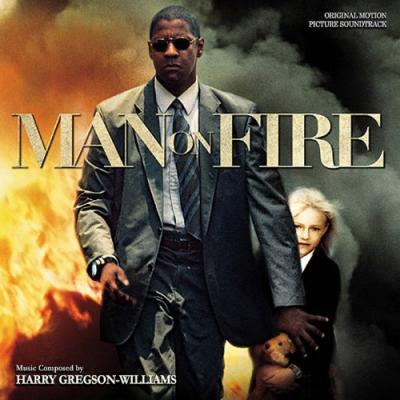
"Man On Fire" Soundtrack Lyrics
Movie • 2004
Track Listing
Carlos Varela
Kinky
Hybrid
"Man on Fire (Original Motion Picture Soundtrack)" – Album Guide to Tracks and Key Scenes
Overview
How do you score a revenge story that is this brutal and still let a love story breathe inside it? Man on Fire answers with a soundtrack that swings between industrial violence and spiritual lament. The album built around Harry Gregson-Williams’s score feels like a pressure cooker: glitchy electronics, processed guitars, and percussion slamming against small, fragile themes for a broken man and a child who saves him.
The film’s soundworld is unusually hybrid. On one side you have a fully composed score, from brooding cues like “Creasy’s Room” to lyrical set-pieces such as “Smiling” and “Pita’s Sorrow.” On the other, Tony Scott floods the track with songs: trippy psy-trance in the Mexico City club, Linda Ronstadt’s “Blue Bayou,” Carlos Varela’s “Una Palabra,” chunks of Nine Inch Nails, Puccini’s “Nessun dorma,” Debussy’s “Clair de lune,” and Lisa Gerrard’s wordless vocals at the end. The album presents most of the score plus a handful of key songs, while several high-profile cues (NIN, Ronstadt, some club tracks) remain off-album.
Heard straight through, the soundtrack tells its own arc. Early score tracks are watchful, even numb; then distortion, loops, and harsh synths take over as Creasy turns into an avenging operator. The last stretch softens into Gerrard’s vocal elegy and the resigned warmth of “Una Palabra.” You can feel the narrative move from self-loathing to purpose, then to sacrifice.
Stylistically, the album fuses modern film score tropes with distinct genre colors: industrial rock textures for the rage, Latin guitar and rhythmic figures for the Mexico City setting, trance and psy-trance for the club, and classical piano and opera to suggest a wounded sense of grace. Indie-ish ambient pads and processed drums underscore Creasy’s alcoholism and PTSD; 1970s soft-rock (“Blue Bayou”) marks the sentimental fantasies he barely allows himself. The contrast is intentional: genteel classical and ballad choices sit on top of a story about kidnapping and systemic corruption, which makes every gentle cue feel like a lie the world is telling itself.
How It Was Made
The score is by British composer Harry Gregson-Williams, a frequent Tony Scott collaborator who had already worked with him on Enemy of the State and Spy Game. Here he pushes his usual mix of orchestra and electronics further into abrasion: filtered drums, distorted bass lines, and erratic rhythmic chopping that match Scott’s hyperactive cutting style. Strings and piano still carry the emotional weight, especially in themes associated with Pita, but they are often surrounded by noise rather than cushioned by it.
Gregson-Williams recorded the orchestral material and then heavily processed it in the studio, slicing and looping fragments so the score could be cut up as aggressively as the images. Several cues on the album (“The Rave,” “Bullet Tells the Truth,” “Angel Vengador”) are built to be modular: accents can be dropped in anywhere Creasy pulls a trigger or lays out a plan. The more contemplative pieces (“Pita’s Room,” “Smiling,” “Pita’s Sorrow”) play closer to traditional scoring, with long lines and clear harmonies.
Alongside the score, Scott leaned on Nine Inch Nails tracks from The Downward Spiral and The Fragile era, using pieces like “The Mark Has Been Made” and “The Wretched” as raw material for several action and preparation sequences. According to one long-form interview about the film’s sound design, Trent Reznor effectively served as an unofficial music consultant, his work chopped and collaged into the mix rather than simply laid under it. That industrial layer is not on the official album but defines the film’s sound.
Vocals were another key choice. Lisa Gerrard (best known from Dead Can Dance and Gladiator) recorded the ethereal end-theme “Creasy Dies” / “The End,” which appears in the film’s climax and in extended form on some soundtrack editions. Her invented-language singing gives the finale a liturgical feel without tying it to any specific culture. At the pop end, Cuban singer-songwriter Carlos Varela licensed “Una Palabra,” and Linda Ronstadt’s earlier hit “Blue Bayou” was cleared for both a diegetic CD and a key suicide scene.

Tracks & Scenes
"Una Palabra" – Carlos Varela
Scene: This slow Cuban ballad enters as the story ends. After Creasy exchanges himself for Pita and is driven away, the film passes through Lisa Gerrard’s choral lament and then into “Una Palabra” over the first part of the end credits. The visual rhythm slows: the camera lingers on Mexico City, the Ramos family, and finally black. The song is non-diegetic, wrapping Creasy’s sacrifice in a melancholic, almost whispered blessing.
Why it matters: The lyrics about a single word holding everything and nothing mirror Creasy’s quiet turnaround from despair to purpose. The track became strongly associated with the film; one Spanish-language profile of Carlos Varela even highlights the Man on Fire finale as a turning point in the song’s global visibility.
"Blue Bayou" – Linda Ronstadt
Scene: Creasy first hears “Blue Bayou” playing from a street stall, then buys a best-of Ronstadt CD. Later, during his first night on the job, he sits alone in the bedroom, drinking and assembling his pistol while this song plays loudly from the stereo. The sound is diegetic; we see him change tracks and restart it, using the music as a shield while the camera circles, the image degrades, and his suicidal thoughts peak.
Why it matters: The song is pure 1970s romantic escapism: going back home, starting over, “saving nickels, saving dimes.” In context, it becomes bitterly ironic. Creasy cannot go anywhere; he is stuck in Mexico City with a past he hates. The contrast between soft country-rock and self-destruction is one of the soundtrack’s sharpest juxtapositions.
"Clair de lune" – Claude Debussy
Scene: In the same suicide sequence, the sound design fractures “Blue Bayou” and drops in fragments of harsher electronic textures. As the attempt fails – the bullet “tells the truth” and the gun misfires – the chaos gives way to Debussy’s “Clair de lune.” The piano piece continues into the following, calmer scene, even as location and time shift, effectively smoothing the transition from nocturnal despair to the morning aftermath.
Why it matters: Debussy’s piece carries strong cultural associations with nostalgia and moonlit calm. Here it works almost as a reset, musically implying that something – fate, grace, simple mechanical luck – has given Creasy a second chance. Several academic discussions of “Clair de lune” in cinema use this scene as an example of music overriding the brutality of the image.
"The Mark Has Been Made" – Nine Inch Nails
Scene: After recovering from his injuries, Creasy prepares for revenge. In the sequence where he visits an arms dealer, calmly shopping for weapons and explosives, a grinding NIN instrumental underpins his focused movement. The track is non-diegetic but mixed loud, almost as if we are hearing his pulse. Guitars and drones build as he walks through the arsenal, then cut hard when he makes his decision.
Why it matters: This piece functions as Creasy’s “switch” cue – the moment the haunted ex-operative becomes a methodical killer again. Fans and Q&A sites consistently identify “The Mark Has Been Made” as the track used here, and it’s one of the clearest cases of an existing NIN piece being treated almost like part of the score.
"Mas" – Kinky
Scene: In the Mexico City nightclub sequence that ends in an explosion, “Mas” is one of the first tracks heard as Creasy moves through the crowd. The camera stutters between strobe lights, bodies, and surveillance angles while the song’s Latin-rock groove, distorted guitars, and shouted vocals anchor the soundscape. The track is diegetic – coming from the club system – but the mix keeps it unnaturally present as we follow Creasy toward his target.
Why it matters: The song plants the film firmly in an early-2000s Mexico City night-life texture instead of generic Hollywood “club music.” It also sets up the later use of harsher psy-trance in the same scene, making the eventual explosion feel like an extension of the music’s overload.
"Juice (live)" – Growling Mad Scientists, plus other rave cues
Scene: As the club scene escalates, the soundtrack layers “Juice (live)” and further psy-trance tracks by Deedrah (“Reload”), Zorba (“The Rush”), and Deakin Scott (“Hell-Bent”). The music pounds in double-time while Scott’s editing fragments the image into scratches, flash frames, and almost subliminal inserts. Creasy plants explosives, threads through dancers, and keeps his focus while the sound design blurs the boundary between score, source music, and pure noise.
Why it matters: According to a detailed fan breakdown on a soundtrack information site, this scene features one of the densest stacks of licensed tracks in the film. It is also where Scott’s music-video instincts peak: you could almost follow the narrative with your eyes closed, just from how the trance builds, drops out, and slams back in at the moment of detonation.
"Oye Como Va" – Kinky (Tito Puente composition)
Scene: In an early torture sequence, Creasy confronts a corrupt official at a racetrack parking area. As he interrogates the man – eventually cutting off fingers and using a cigarette lighter on his wounds – a modern rock-inflected version of “Oye Como Va” plays in the background. The song is diegetic, audible over loudspeakers and car radios, its famous groove drifting in and out while the violence escalates.
Why it matters: The choice borders on black comedy. A classic Latin standard, reworked by a Mexican band, plays as Creasy methodically dismantles a kidnapper’s operation. Several soundtrack Q&A responses specifically identify this as Kinky’s cover, and the dissonance between that familiar riff and the brutality on screen underlines how normalized violence has become in this world.
"Nessun dorma" – from Puccini’s Turandot, sung by Luciano Pavarotti
Scene: Opera surfaces later in the revenge run, during one of the sequences where Creasy has a kidnapper immobilized and is extracting names. The aria swells on the soundtrack while the camera lingers on his face, the victim’s terror, and the cold preparation of another bomb. It plays non-diegetically, functioning more as a commentary than as something anyone in the scene can hear.
Why it matters: The famous cry of “Vincerò!” (“I will win”) could easily be read as Creasy’s inner monologue. Music scholars sometimes point to this moment when they talk about opera being repurposed as “vengeance music” in modern thrillers, and the cue adds a strange nobility to acts that are otherwise purely sadistic.
"Smiling" – Harry Gregson-Williams
Scene: “Smiling” (and closely related score material) recurs in the film’s gentler passages: Creasy timing Pita’s laps at the pool, sharing jokes in the car, or watching her from the stands while pretending not to care. The cue is non-diegetic, built around a repeating piano motif, light guitar figures, and subtle electronic pads; it often bridges from one bonding scene to another, making their relationship feel continuous.
Why it matters: This is the film’s emotional center. The theme became well-known enough that it was later reused in luxury-watch advertising, but in the movie it belongs to Pita and Creasy. Whenever it surfaces after the kidnapping, the music hurts: we are reminded of what has been lost, and what Creasy is really avenging.
"Creasy Dies" / "The End" – Harry Gregson-Williams & Lisa Gerrard
Scene: In the final act, as Creasy walks Pita to the kidnappers’ car and sends her back to her mother, Gerrard’s voice rises over a slowly evolving harmonic bed. The cue continues as he is driven away, bleeding out, cutting between his face, the city, and the exchange behind him. Her vocals neither state words nor follow a pop structure; they feel like a private prayer.
Why it matters: Many viewers first went looking for this song as “the Gladiator-style piece at the end,” and several fan and Q&A threads debate its exact title and version. On the album, its material appears in the long track “The End” and in variants of “Creasy Dies.” Wherever you find it, this is the moment where the score stops being action support and becomes an obituary.
Trailer & non-album highlights
Scene: One of the trailers uses “Clair de lune” over a montage of Creasy and Pita scenes, cutting the images to the piano’s ebb and flow rather than to percussion hits. Other spots lean harder on the industrial side, using NIN material and percussive score snippets to sell the movie as a revenge thriller first. Several club tracks (like “Juice,” “Reload,” and “Hell-Bent”) and many Nine Inch Nails cues never appeared on the official soundtrack CD but are catalogued by dedicated fans.
Why it matters: For collectors, Man on Fire exists as at least three overlapping soundtracks: the official album, the in-film score edits, and the wider universe of songs and trailer music. Part of the fun is tracing how the same theme or licensed track is used differently across those variants.
Notes & Trivia
- The film is a remake of a 1987 adaptation of the same A. J. Quinnell novel, whose earlier score was by John Scott; both stories use music to underline grim vengeance.
- Harry Gregson-Williams received a BMI Film Music Award for Man on Fire, marking it as one of his standout early-2000s works despite mixed critical reception of the film itself.
- Lisa Gerrard’s vocal style in “Creasy Dies” uses her own invented language, a technique she had already employed in Gladiator and various Dead Can Dance projects.
- Several cues from David Arnold’s score for Changing Lanes (“Gavin Leaves Message,” “Gavin Sees Val and Kids”) are tracked into Man on Fire but not listed prominently, a detail you mainly find in specialist cue lists.
- Opera fans often discover the film because of the use of “Nessun dorma,” which has its own separate compilation releases emphasizing its appearance in Man on Fire alongside other movies.
Music–Story Links
The soundtrack mirrors Creasy’s psychological trajectory almost scene by scene. Early in the film, his life is scored with numb, repetitive textures and a lot of silence; the only strong musical identity belongs to Pita, whose small, hopeful motifs and lighter orchestrations contrast with his heaviness. As she breaks through his defenses, themes like “Smiling” and warmer guitar writing begin to overlay his spaces, signaling that he is slowly letting her in.
Once the kidnapping happens, almost all of Pita’s material disappears from the score. In its place come harsh loops, Nine Inch Nails fragments, and percussive hits. When classical pieces appear in this stretch – “Nessun dorma,” “Clair de lune” – they do not comfort; they act as cold, almost abstract commentary on executions and interrogations. The film uses this disjunction to show how far Creasy has moved from any normal emotional life.
“Blue Bayou” is tied specifically to Creasy’s fantasy of escape. He buys the CD on a whim, then uses it in his suicide attempt, then half-jokingly promises to play the song for Pita. That recurring reference makes his line about “Blue Bayou” near the end resonate: it is the dream he will never get, but that she might still have.
Finally, the transition from Gerrard’s “Creasy Dies” to “Una Palabra” in the last minutes closes the loop. Wordless lament followed by a song about the power and fragility of a single word suggests that what redeems Creasy is not the violence but the simple bond expressed between him and Pita – the word “Creasybear,” the promise to be there at the finish line. The music says that out loud when the dialogue no longer can.
Reception & Quotes
Critically, the film divided reviewers, and the score rode that same line. Some mainstream reviews called Gregson-Williams’s music “overbearing” and too aggressively mixed, arguing that the combination of pounding electronics and sentimental themes pushed already intense scenes into sensory overload.
Specialist soundtrack outlets were more nuanced. One prominent review described the album as a dark, modern action score whose synthetic elements sometimes “stutter and rip” through the listening experience but also praised its thematic writing for Pita and the boldness of its concept. Another noted that the task of reconciling tender character music with ferocious revenge cues might simply have been impossible to solve cleanly.
Among fans, though, the soundtrack has become one of the film’s calling cards. Threads on Nine Inch Nails forums and film subreddits frequently single out the Man on Fire needle-drops as a gateway into Reznor’s work, while others share their fixation on “Una Palabra” and the end-title sequence. Several retrospective essays on Tony Scott’s career argue that this film is where his music-driven, collage-like style fully crystallized.
“The use of Nine Inch Nails music in this movie is amazing… Rejuvenated my love for Trent Reznor.”
Reddit user on a Man on Fire discussion thread
“The cues driven by synthetic loops are brutal in their volume and intent.”
Filmtracks review of the Man on Fire score
“Scott backs up his flashy visuals with a real emotional connection between its two leads that lies at the center of the story.”
Director-focused essay reflecting on Man on Fire
On aggregators, the film still sits in the “mixed reviews” range, but audience scores are significantly higher and home-video sales were strong. For soundtrack collectors, the album became a sought-after Varèse Sarabande title; some physical editions went out of print and now circulate mainly on secondary markets, even though digital and streaming access has since made the music easier to hear.
Interesting Facts
- The official soundtrack album, released by Varèse Sarabande in 2004, opens with “Una Palabra” rather than a score cue – unusual for a modern action film score.
- Several Nine Inch Nails tracks used in the film (“The Mark Has Been Made,” “The Wretched,” “The Great Below,” among others) do not appear on the album and must be sourced from NIN’s own releases.
- “Smiling,” one of the main themes, later turned up in Omega watch commercials, giving the cue a second life far outside the context of a kidnapping thriller.
- Because of licensing, some regional home-video releases and TV broadcasts slightly adjust or remix the song cues, but the core Gregson-Williams score remains intact.
- Collectors track at least three main CD pressings of the soundtrack, including standard Varèse, “Encore”–style reissues, and international editions with minor artwork or track-order differences.
- Lisa Gerrard’s end-theme is labelled differently across fan communities: “Creasy Dies,” “The End,” and “Man on Fire End Theme” often refer to overlapping recordings or edits.
- Debussy’s “Clair de lune” appears on many generic “movie classics” compilations that explicitly name Man on Fire alongside films like Ocean’s Eleven as a key usage.
- David Arnold’s uncredited cues (“Gavin Leaves Message,” etc.) are a rare case of music from one studio thriller being tracked directly into another without most viewers noticing.
- The full in-film music roster includes mariachi pieces, classical piano nocturnes, trance, alternative rock, and choral music – far more varied than the official album suggests.
- The film’s renewed popularity around its 20th anniversary, including a podcast episode arguing that “Rotten Tomatoes is wrong” about it, has indirectly raised interest in the soundtrack again.
Technical Info
- Title: Man on Fire (Original Motion Picture Soundtrack)
- Year: 2004 (film released 2004; album first issued 2004)
- Type: Film score / soundtrack album
- Primary composer: Harry Gregson-Williams
- Key featured artists: Carlos Varela (“Una Palabra”), Lisa Gerrard (“Creasy Dies” / “The End”), Linda Ronstadt (“Blue Bayou”), Luciano Pavarotti (“Nessun dorma”), Nine Inch Nails (multiple tracks), Kinky, GMS and other club artists.
- Music supervision / additional music: Studio music departments and supervisors for Fox / New Regency coordinated licensed tracks; David Arnold cues from Changing Lanes are tracked in uncredited.
- Label: Varèse Sarabande (CD edition); later digital releases through major platforms.
- Notable placements: “Blue Bayou” in Creasy’s suicide scene; “Clair de lune” bridging that sequence; NIN’s “The Mark Has Been Made” in the arms-deal preparation; “Mas” and related trance tracks in the club explosion; Gerrard’s “Creasy Dies” and Varela’s “Una Palabra” in the finale and credits.
- Release context: Album issued around the film’s theatrical run, with some international pressings and later re-pressings as the original CD went out of print.
- Awards / charts: Score honored with a BMI Film Music Award; not a major mainstream chart hit but a persistent cult favorite among film-music collectors.
- Availability: Original CD often commands collector prices; the album and core tracks are generally available on streaming services and digital stores.
Canonical Entities & Relations
| Subject | Relation | Object |
|---|---|---|
| Harry Gregson-Williams | composed | Original score for the film Man on Fire (2004) |
| Carlos Varela | wrote and performed | Song “Una Palabra,” used in the film’s final scene and credits |
| Lisa Gerrard | performed vocals on | End-theme cues commonly titled “Creasy Dies” and “The End” |
| Nine Inch Nails | provided existing recordings for | Multiple revenge-sequence cues, including “The Mark Has Been Made” |
| Linda Ronstadt | performed | “Blue Bayou,” heard via an in-film CD and in Creasy’s suicide attempt scene |
| Luciano Pavarotti | performed | “Nessun dorma” from Puccini’s Turandot, used over a torture / interrogation sequence |
| Varèse Sarabande | released | Man on Fire (Original Motion Picture Soundtrack) on CD |
| Tony Scott | directed | Film Man on Fire (2004), for which this soundtrack was created |
| Fox 2000 Pictures / New Regency | produced | Film Man on Fire and oversaw music licensing and score production |
| Man on Fire (Original Motion Picture Soundtrack) | is musical companion to | Feature film Man on Fire (2004), based on A. J. Quinnell’s novel |
Questions & Answers
- What makes the Man on Fire soundtrack different from typical action-movie scores?
- It combines a full modern score with an unusually wide set of licensed pieces: industrial rock, opera, classical piano, trance, Latin pop, and ethereal vocals, all edited as aggressively as the images.
- Which song plays at the very end when Creasy dies?
- The emotional climax is underscored by Lisa Gerrard’s end-theme (often labelled “Creasy Dies” or “The End”); Carlos Varela’s “Una Palabra” then takes over as the end credits roll.
- Why do people talk so much about “Blue Bayou” in this movie?
- “Blue Bayou” is tied to Creasy’s private fantasy of escape and is the song he plays during his failed suicide attempt, so it becomes a shorthand for his inner longing and despair.
- How are Nine Inch Nails tracks used in the film?
- Existing NIN instrumentals and soundscapes underscore several revenge and preparation scenes. They are treated less like standard songs and more like aggressive, looping extensions of the score.
- Is the official soundtrack album complete?
- No. It covers most of Harry Gregson-Williams’s score and a few key songs, but several club tracks, classical pieces, and all the Nine Inch Nails cues are missing and exist only on their original releases.
Sources: Wikipedia, IMDb, SoundtrackINFO, AMC Story Notes, Filmtracks, MovieMusicUK, Discogs, MusicBrainz, academic articles on film music, and fan Q&A / forum discussions about Man on Fire.
November, 15th 2025
A-Z Lyrics Universe
Cynthia Erivo Popular
Ariana Grande Horsepower
Post Malone Ain't No Love in Oklahoma
Luke Combs Good Riddance (Time of Your Life)
Green Day Bye Bye Bye
*NSYNC You're the One That I Wan
John Travolta & Olivia Newton-John I Always Wanted a Brother
Braelyn Rankins, Theo Somolu, Kelvin Harrison Jr. and Aaron Pierre The Power of Love
Frankie Goes to Hollywood Beyond
Auli’i Cravalho feat. Rachel House MORE ›