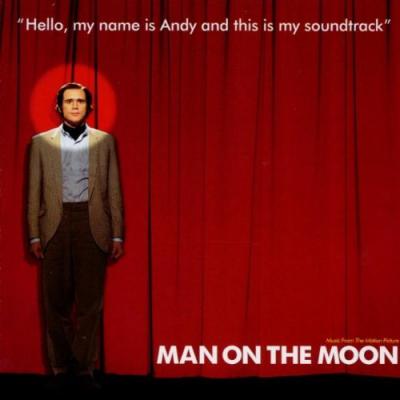
"Man on the Moon" Soundtrack Lyrics
Movie • 1999
Track Listing
The Sandpipers
R.E.M.
Exile
Bob James
R.E.M.
R.E.M.
R.E.M., Andy, Tony
R.E.M.
R.E.M.
Andy Kaufman
R.E.M.
Tony Clifton
R.E.M.
R.E.M.
Andy Kaufman
"Man on the Moon (Music from the Motion Picture)" – Album Guide to Tracks and Key Scenes
Overview
What happens when a band that already wrote the definitive song about your life comes back to score the movie about you? That is the odd, very Andy Kaufman puzzle behind "Man on the Moon (Music from the Motion Picture)". The album has to do two things at once: honour Kaufman’s unruly comedy and work as a compact, 37-minute soundtrack that can sit next to the rest of R.E.M.’s discography.
On record, the soundtrack plays like a collage. R.E.M. thread together a new single, short orchestral cues, needle-drops from the 1970s and early 1980s, and archival vocals from Kaufman himself. The mood jumps fast: one moment a stately alternative-rock anthem, the next a lounge singer howling “I Will Survive” in character, then a delicate piece for strings. It feels fractured on purpose, mirroring Kaufman’s career of broken formats and elaborate hoaxes.
The film uses two R.E.M. pillars — the 1992 track "Man on the Moon" and the 1999 original "The Great Beyond" — to bookend Kaufman’s story over the titles and credits, while shorter score cues handle transitions: getting fired, wrestling fallout, the milk-and-cookies Carnegie Hall show, the final hospital and funeral passages. Around them sit period songs like Exile’s "Kiss You All Over" and Bob James’ "Angela (Theme from Taxi)", doing quiet but important work locating scenes in late-70s television and nightclub culture.
Stylistically the album leans on alternative rock and chamber-like score from R.E.M., then sprinkles in soft-rock, disco, MOR pop, and Broadway-leaning show tunes. The contrast is meaningful: indie-rock gravity signals reflection and legacy; glossy soft-rock and disco stand in for the mainstream world Andy keeps disrupting; the old-fashioned ballads and operetta pieces mark his sincerity and love of corny show-business craft. Even played without the film, you can hear those worlds colliding.
How It Was Made
By the late 1990s, R.E.M. had already released "Man on the Moon" as a tribute to Kaufman on Automatic for the People. When Miloš Forman’s biopic went into production, the band were asked not just for licensing but for a full soundtrack. According to the album’s credits, they recorded new material in May 1999, with longtime producer Pat McCarthy and their usual live collaborators handling drums and additional instrumentation.
The brief was unusual: instead of a traditional orchestral score, R.E.M. would provide both rock songs and underscoring cues, then coexist with outside period tracks and Kaufman archive recordings. Short cues such as "Tony Thrown Out", "Andy Gets Fired", "Milk & Cookies", and the orchestral "Man on the Moon" are essentially mini-score cues written and arranged by the band, then played by session orchestras. Music supervisors Anita Camarata and Kaylin Frank helped clear the vintage material and integrate it with Kaufman’s NBC and Carnegie Hall performances.
The new single, "The Great Beyond", was written specifically for the film and cut as a standalone song first, then edited for the album version with a snippet of dialogue at the end. It later became R.E.M.’s biggest UK hit and picked up a Grammy nomination, which is why you’ll often see it discussed as much as the film itself in retrospective pieces. The rest of the album was compiled to be short and re-playable rather than a complete document of every needle-drop in the film.
Tracks & Scenes
Below are the key songs and score moments, with how they are used on screen. Timings are approximate, based on the theatrical cut.
"Mighty Mouse Theme (Here I Come to Save the Day)" – The Sandpipers
Where it plays: Early in the film, during Andy’s breakout nightclub routine and the recreation of his first Saturday Night Live appearance, Kaufman walks on stage to a battered record player. The Mighty Mouse theme spins while he stands there, rigid and silent, until the hook line comes; he lip-syncs only “here I come to save the day” and then goes blank again. The scene lasts a couple of minutes and is diegetic — the record is visibly playing in the club and on the TV set.
Why it matters: This song is the blueprint for Kaufman’s “anti-comedy”: he refuses to give the crowd the rhythm they expect, stretching awkward silence until it becomes the joke. On album, the full theme (with announcer intro) doubles as a compact radio play of that act.
"The Great Beyond" – R.E.M.
Where it plays: Used prominently over titles and again around the film’s final stretch, this is the big thematic song. It plays non-diegetically over montages of Kaufman’s career highlights and the idea of him drifting “beyond” the stage — roughly at the start and near the end of the film. Short instrumental stems also show up under transitions.
Why it matters: Written specifically for the film, the track turns Michael Stipe’s fascination with Kaufman into a direct commentary on belief, hoaxes, and the impossibility of fully knowing someone. It also ties the movie to R.E.M.’s own history: buried backing vocals quote lines from their earlier song "Man on the Moon", making the soundtrack fold back on itself.
"Man on the Moon" – R.E.M.
Where it plays: The earlier 1992 song appears in full over the end credits and in shorter fragments earlier, notably after major career milestones and during reflective transitions. In the closing credits, the full studio version lets the film exhale after the ambiguous final gag.
Why it matters: This is the song that gave the film its title in the first place. Its references to wrestling, Elvis, and conspiracies mirror events we’ve just watched dramatized, so by the time the credits roll the track feels like a meta-commentary on the biopic the band just helped score.
"Kiss You All Over" – Exile
Where it plays: Dropped in as a period needle-drop during late-70s nightlife sequences, the sultry soft-rock track hums through bar speakers and background radios while Kaufman navigates crowds and relationships. It is non-diegetic to the characters but clearly “in the air” of the era.
Why it matters: The song is pure mainstream AM-radio romance, the exact sort of smooth, predictable entertainment Kaufman keeps disrupting with his own shows. It also anchors the film in a very specific late-70s sound without needing dialogue to explain the time jump.
"Angela (Theme from Taxi)" – Bob James
Where it plays: Heard when Kaufman’s agent George Shapiro tells him about the sitcom offer and during glimpses of the Taxi set. The familiar electric-piano melody plays over shots of soundstages, cast members, and Andy’s reluctant ascent into network TV. It’s non-diegetic in some moments and functions as source music in others, as if coming from monitors or a rehearsal playback.
Why it matters: Using the original TV theme grounds the film’s re-staging of Taxi in something authentic. It is also an ironic counterpoint: the music is warm and inviting, while Kaufman secretly hates the sitcom format even as it makes him famous.
"This Friendly World" – Michael Stipe & Jim Carrey (as Andy Kaufman and Tony Clifton)
Where it plays: Near the end, at Andy’s funeral, mourners gather around his open casket while a grainy black-and-white projection of Kaufman performing fills the space. The cast and friends sing along to “This Friendly World”, turning the scene into a strange mixture of wake, sing-along, and performance art. The cue runs for several minutes and is diegetic: the characters are visibly singing.
Why it matters: The arrangement blurs identities — Jim Carrey performs in Kaufman’s style, Michael Stipe joins in, and Tony Clifton’s persona is folded into the harmonies. The song’s simple, almost corny optimism plays against the reality of Andy’s death, making the ending weirdly tender instead of just tragic.
"Rose Marie" – Andy Kaufman
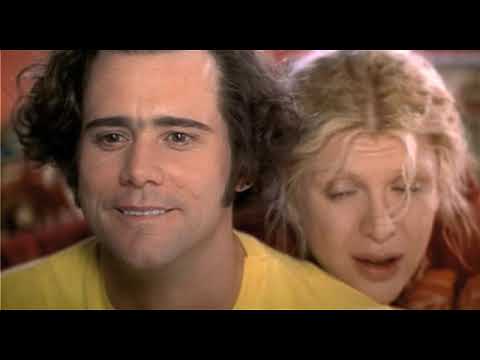
Where it plays: Earlier in the film, Kaufman serenades Lynne Margulies privately with “Rose Marie” when he asks her to move in with him, echoing the real-life performance the comedian once did on television. The scene is intimate, mostly in close-ups, with the song performed live in-character.
Why it matters: Hearing the real Kaufman’s voice (the film uses authentic audio) breaks the biopic illusion for a moment. It shows that behind the chaos there was a performer who genuinely loved old-fashioned show tunes and could sing them straight.
"I Will Survive" – Tony Clifton (Jim Carrey in character)
Where it plays: In one of the film’s most abrasive comic set-pieces, Jim Carrey as Tony Clifton mangles the disco classic “I Will Survive” in a smoky lounge and later during club appearances. The band thrashes behind him as he shouts, heckles the crowd, and deliberately misses notes. It is fully diegetic, filmed as a live performance.
Why it matters: The cue is a joke on both the idea of the inspirational anthem and Kaufman’s habit of sabotaging his own gigs. On album, it functions as a jarring burst of chaos between more polished R.E.M. tracks, reminding the listener that Kaufman’s alter ego never quite lets things settle.
"Lynne & Andy" – R.E.M. (score)
Where it plays: A short instrumental cue underscoring scenes of Andy and Lynne together — driving, talking quietly, or navigating hospital corridors after his diagnosis. It’s non-diegetic and usually timed to their dialogue rather than big visual beats.
Why it matters: The writing is restrained: gentle strings, small melodic fragments. It gives the relationship emotional weight without sentimentality and shows R.E.M. working like a traditional film composer, not just a rock band dropping songs.
"Milk & Cookies" – R.E.M. (score)
Where it plays: During the Carnegie Hall sequence, when Andy leads the audience out of the theater to share milk and cookies, this cue plays underneath the logistical chaos — ushers moving people, doors opening, chatter. It is non-diegetic, smoothing what would otherwise be pure noise.
Why it matters: The cue’s light, almost whimsical tone matches the absurd generosity of Kaufman’s stunt. It also sets up the later hospital scenes, where similar orchestral colours are used in a much darker way.
"Andy Gets Fired" – R.E.M. (score)
Where it plays: Around the point where network executives decide Andy is no longer worth the trouble, the film cuts between tense meetings and Andy reacting to career blows. The cue is short — little more than a minute — and non-diegetic, built around nervous, ascending figures.
Why it matters: It’s a classic “downturn” cue, but filtered through R.E.M.’s harmonic language. You can hear the same sort of progression they might use in a slow rock song, compressed into a film-score gesture.
"One More Song for You" – Andy Kaufman
Where it plays: Near the end of the film (and toward the end of the album), Kaufman performs a gentle, straight rendition of “One More Song for You” as part of his stage act. The camera lingers on him longer than usual, letting the sincerity sit without any twist. It plays diegetically from the stage and then continues over a transition.
Why it matters: The title alone feels like a farewell, and in context it functions as Kaufman’s last direct address to his audience. The soundtrack uses the original performance, giving the album a quiet, human closing after the bigger R.E.M. bookends.
Notes & Trivia
- The soundtrack is officially credited as a R.E.M. album, even though it also contains tracks by The Sandpipers, Exile, Bob James, Tony Clifton, and Andy Kaufman.
- The real Andy Kaufman is heard twice on the album proper: on “Rose Marie” and “One More Song for You”, taken from archive recordings.
- “The Great Beyond” became R.E.M.’s highest-charting UK single and later appeared on their best-of compilations alongside “Man on the Moon”.
- The orchestral “Man on the Moon” cue is a short rearrangement of the band’s earlier hit, written to work under dialogue without vocals.
- Several score cues are built from the same harmonic material, so you can hear little echoes of “The Great Beyond” in pieces like “Miracle” and “Lynne & Andy”.
Music–Story Links
The soundtrack’s structure mirrors Kaufman’s own games with reality. The album starts in chaos — the Mighty Mouse theme, with all its awkward pauses — then moves toward more conventionally moving material like “This Friendly World” and “One More Song for You”. The journey from kitsch to vulnerability is the same arc the film traces.
R.E.M.’s music tends to appear when the film steps outside stage personas and looks at Andy’s interior life. “The Great Beyond” and the instrumental cues sit over montages of reflection, illness, and career re-evaluation. By contrast, the needle-drops and Kaufman vocals dominate whenever he is “performing”: wrestling, sabotaging talk shows, tormenting audiences as Tony Clifton.
The use of “Angela (Theme from Taxi)” is a neat example of this strategy. On TV, that tune promises comfort and routine; in the film, it plays when Andy is reluctantly accepting the job that will make him famous but also trap him in a character he dislikes. A friendly melody covers a private compromise. Meanwhile “I Will Survive” is the opposite: a song about resilience turned into a barely listenable act of self-sabotage.
Even the closing pairing of “Man on the Moon” and “One More Song for You” operates like a final gag. The former is R.E.M. mythologising Kaufman from the outside; the latter is Kaufman singing himself, modest and small. The album lets both versions co-exist, which suits a performer who blurred his own boundaries so aggressively that people still argue about where the act ended.
Reception & Quotes
At release, the soundtrack was treated as a minor but interesting entry in R.E.M.’s catalogue. Contemporary reviewers described it as a jumbled but fitting tribute: part greatest-hits sampler (“Man on the Moon”, “The Great Beyond”), part oddball collage of vintage pop, and part miniature score. Some listeners were surprised by how short it was, given the number of songs heard in the film.
The broader critical consensus on the film itself was mixed, but there was near-universal praise for Jim Carrey’s performance and for how well R.E.M.’s music dovetailed with Kaufman’s story. The album has quietly stayed in print and on streaming services, helped by “The Great Beyond” becoming a radio hit and recurring on compilations.
“Anchored with a score by R.E.M., the album is a mixed collection of vintage throwaways, era-friendly pop relics and cheeky covers — exactly the chaos Kaufman deserved.” – a contemporary local-press review
“R.E.M. already had the definitive Kaufman song. The soundtrack simply lets that song meet the man’s strangest hits halfway.” – retrospective online essay
“The title comes from a 1992 R.E.M. track that closes the film in full, turning the credits into a final wink at the audience.” – Kaufman-focused blog
Interesting Facts
- “The Great Beyond” includes faint backing lines lifted from “Man on the Moon”, turning the new song into a kind of sequel.
- On the album version of “The Great Beyond”, a short snippet of film dialogue appears at the end; the standalone single omits this.
- “Mighty Mouse Theme” is presented with its full Saturday Night Live style announcer intro, so the track plays like a self-contained comedy sketch.
- Two songs (“Rose Marie” and “One More Song for You”) are not R.E.M. recordings at all but licensed Kaufman performances drawn from TV and stage archives.
- The soundtrack credits list Anita Camarata as music supervisor, but the album itself is marketed as “R.E.M. – Man on the Moon”, slotting it into the band’s album chronology.
- Because the album runs under 40 minutes, several pieces heard in the movie — including additional classical and source cues — never appear on the official release.
- The disc has been variously filed as a R.E.M. studio album, a compilation, and a soundtrack, depending on the country and retailer.
- The orchestral “Man on the Moon” cue keeps the song’s chord progression but strips away vocals and most of the rhythm section, making it usable under dialogue.
Technical Info
- Title: Man on the Moon (Music from the Motion Picture)
- Year: 1999
- Type: Soundtrack album for the film Man on the Moon (1999)
- Primary artist / composers: R.E.M. (Peter Buck, Mike Mills, Michael Stipe, with earlier contributions from Bill Berry on “Man on the Moon”)
- Additional artists: The Sandpipers, Exile, Bob James, Tony Clifton (Jim Carrey), Andy Kaufman, Michael Stipe (guest vocal on “This Friendly World”)
- Music supervision: Anita Camarata (music supervisor), Kaylin Frank (associate music supervisor)
- Label: Warner Bros. Records / Jersey Records
- Recorded: Mainly May 1999 (new R.E.M. material and score cues)
- Release dates: Late November 1999 (UK and US, CD)
- Running time: Approximately 37 minutes for the standard 15-track edition
- Notable placements: “Mighty Mouse Theme” (club and SNL sequences), “Angela (Theme from Taxi)” (TV set and deal scenes), “This Friendly World” (funeral), “Man on the Moon” and “The Great Beyond” (bookending credits and montages)
- Availability: Widely available on major streaming platforms and digital stores; original CD and later repressings share the same track order.
Canonical Entities & Relations
| Subject | Relation | Object |
|---|---|---|
| Man on the Moon (Music from the Motion Picture) | is soundtrack to | Film Man on the Moon (1999) |
| Man on the Moon (Music from the Motion Picture) | music by | R.E.M. |
| R.E.M. | record label | Warner Bros. Records / Jersey Records |
| “The Great Beyond” | is part of album | Man on the Moon (Music from the Motion Picture) |
| “Man on the Moon” (song) | pre-exists and is reused in | Man on the Moon (Music from the Motion Picture) |
| Andy Kaufman | performs on | “Rose Marie” and “One More Song for You” |
| Jim Carrey | performs as | Tony Clifton on “I Will Survive” |
| Film Man on the Moon | directed by | Miloš Forman |
| Man on the Moon (Music from the Motion Picture) | produced by | Pat McCarthy and R.E.M. |
| “Angela (Theme from Taxi)” | composed by | Bob James |
Questions & Answers
- Is the Man on the Moon soundtrack a “real” R.E.M. album or just a compilation?
- It functions as both: it is officially part of R.E.M.’s album chronology, but mixes their new songs and score cues with outside artists and archive performances.
- Do all the songs heard in the film appear on the official album?
- No. The CD and digital soundtrack focus on 15 key pieces; some background and classical cues from the movie are not included.
- What’s the difference between “The Great Beyond” on the album and the single version?
- The soundtrack version runs longer and includes a short snippet of film dialogue at the end; the single is a tighter radio edit without that tag.
- Are Andy Kaufman’s vocals in the film recreated by Jim Carrey or taken from originals?
- Both appear. Carrey performs in character for several songs, but tracks like “Rose Marie” and “One More Song for You” use genuine Kaufman recordings.
- Where should I start if I only want one or two tracks from this soundtrack?
- The usual starting points are “The Great Beyond” for the film-specific material and “Man on the Moon” for the earlier tribute that closes the movie.
Sources: Wikipedia, Wikidata, IMDb, AllMusic, UPI archives, Discogs, MusicBrainz, official R.E.M. communications, contemporary reviews and fan documentation.
November, 15th 2025
A-Z Lyrics Universe
Cynthia Erivo Popular
Ariana Grande Horsepower
Post Malone Ain't No Love in Oklahoma
Luke Combs Good Riddance (Time of Your Life)
Green Day Bye Bye Bye
*NSYNC You're the One That I Wan
John Travolta & Olivia Newton-John I Always Wanted a Brother
Braelyn Rankins, Theo Somolu, Kelvin Harrison Jr. and Aaron Pierre The Power of Love
Frankie Goes to Hollywood Beyond
Auli’i Cravalho feat. Rachel House MORE ›