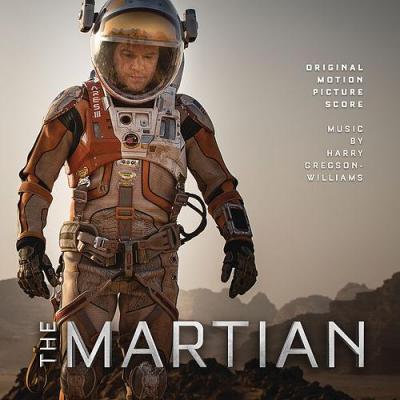
"Martian" Soundtrack Lyrics
Movie • 2015
Track Listing
composed by Harry Gregson-Williams
Jimi Hendrix
Vicki Sue Robinson
Donna Summer
The Hues Corporation
Thelma Houston
David Bowie
Abba
The O'Jays
Gloria Gaynor
Harry Gregson-Williams
"The Martian (Deluxe Soundtrack)" – Album Guide to Tracks and Key Scenes
Overview
What happens when the loneliest man on Mars is stuck with the most extroverted playlist in the solar system? The Martian leans into that joke, and the music is where it lands its sharpest punches. The soundtrack pairs a cool, glassy science-fiction score with a wall of 1970s disco and pop, turning Mark Watney’s survival saga into something closer to a workplace comedy in space.
The core of the album comes in three layers. First, Harry Gregson-Williams’ hybrid score — long synth pads, careful electronics, and wide orchestral chords — paints Mars as both beautiful and lethal. Second, the diegetic songs from commander Melissa Lewis’ laptop library blast across the HAB and rover speakers, the only music Watney can access. Finally, a deluxe edition stitches those two worlds together, collecting both the score and the disco cues into one listening experience.
Across the film, music keeps reframing the same images. A dust storm or launch sequence could play as horror; here, cue up David Bowie or ABBA and the tone shifts to gallows humor. Critics have pointed out that the soundtrack echoes what Watney does as a character — he refuses melodrama, keeps things practical, and uses jokes as life support. The music follows suit: it undercuts grandiosity and makes survival look like a long, stubborn workday.
Stylistically, the soundtrack is a tug of war between 1970s feel-good grooves and modern science-fiction scoring. The disco and pop tracks — funk bass, four-on-the-floor drums, handclaps — signal camaraderie, memory, and a slightly kitschy optimism. The score leans on ambient textures, synth arpeggios, and slowly evolving harmonies; that sound world codes as intellect, isolation, and the raw scale of space. When the two meet in the deluxe album, you get a musical portrait of The Martian’s themes: ingenuity under pressure, international cooperation, and a stubborn, slightly sarcastic belief that people will figure it out.
How It Was Made
The Martian’s music actually exists as two separate albums. The Martian: Original Motion Picture Score collects Harry Gregson-Williams’ instrumental cues, while Songs from The Martian compiles the 1970s tracks heard in the film. Both were released by Columbia Records in early October 2015, with a later two-disc deluxe edition (The Martian (Deluxe Soundtrack)) combining songs and score into one package.
Gregson-Williams came onto the film after working with Ridley Scott on earlier projects and had to solve a specific problem: how to make Mars feel vast and calm, but never safe. In interviews he has described the score as a hybrid, with long, unhurried notes that let you feel the emptiness, while electronic pulses, processed percussion, and choir keep reminding you that a single mistake will kill Watney. The main theme tracks Watney’s arc — early cues sit in a darker, more fragile register; later ones broaden into more confident, almost triumphant statements as his plans scale up.
Production-wise, the score was recorded with a large orchestra and choir at Abbey Road Studios, then layered with synths and sound design. You can hear that blend in cues like “Mars”, “Making Water”, and “Fly Like Iron Man”: live strings and brass provide emotional weight while arpeggiated synth patterns echo the film’s data-driven problem solving. According to an NPR breakdown of the score, that hybrid texture was designed to echo both the NASA control rooms and the lonely, almost meditative life inside the HAB.
On the song side, the music team cleared a tight set of ‘70s tracks that would make sense as Commander Lewis’ personal library. Most of them are written into the film as diegetic music — Lewis’ playlists, TV reruns, or exit music in the HAB. The choice to emphasize disco rather than classic rock or modern pop was deliberate: as one Billboard feature argued, the soundtrack leans into a “groovy ‘70s” sound that can play as both sincere and deeply ironic.
Tracks & Scenes
Below are key placements from across the film and its marketing, with timestamps rounded to the nearest minute.
"Crossing Mars" — Harry Gregson-Williams
Where it plays: Early in the film (around 0:00–5:00), as the Ares III crew works on the Martian surface and the storm begins to roll in, this cue underpins the mission’s routine science work and the sudden shift to crisis. The music stretches out over wide shots of the red landscape, then tightens as the wind picks up and the crew fights their way back to the MAV through the sandstorm. It stays non-diegetic, glued to the editing rather than any on-screen source.
Why it matters: This track sets the film’s musical language for Mars itself — patient, spacious, but with a low, constant tension. It also establishes the contrast the disco songs will later disrupt: here the tone is straight sci-fi survival, no jokes yet.
"Happy Days Theme" — Pratt & McClain
Where it plays: About 24 minutes in, Watney sits alone in the HAB, watching an episode of Happy Days on Lewis’ media drive while he works through his plan to make water from rocket fuel. The theme plays diegetically from the TV speakers, its cheery nostalgia clashing with the sterile, humming life-support systems around him. The camera cuts between the show’s laugh track and Watney’s decidedly non-laughing face as he calculates how not to blow himself up.
Why it matters: The cue anchors The Martian’s habit of using media from Earth as emotional wallpaper. The sound of a cozy multi-cam sitcom plays over what is essentially industrial hazard planning, underlining how far Watney is from anything resembling home.
"Turn the Beat Around" — Vicki Sue Robinson
Where it plays: Around 34 minutes in, this track kicks in while Watney moves around inside the HAB, adjusting equipment, logging entries, and trying to establish a new routine. The song plays from Lewis’ playlist, flooding the small habitat with bright percussion and horns as Watney weaves through cables and makes-shift planters. The camera moves with him in a loose, almost music-video rhythm, but his dialogue is pure grumbling about her taste in music.
Why it matters: This is one of the first times the disco soundtrack becomes a running joke rather than just background color. The lyric “love to hear percussion” lands ironically against the soft hiss of air recyclers and pumps, but the relentless groove also keeps Watney moving, mirroring how he pushes through the boredom of maintenance tasks.
"Hot Stuff" — Donna Summer
Where it plays: At roughly 38 minutes, Watney drives the rover with the radioactive RTG strapped inside, having decided that sleeping next to a chunk of plutonium is worth the heat. “Hot Stuff” blasts from the rover’s system as he bounces along the Martian surface, joking to his video log about Lewis’ questionable playlist. Outside, we get wide shots of the small rover cutting across endless desert; inside, the disco beat is deafening, with Watney half-dancing in his seat despite himself.
Why it matters: The song literalizes the situation — he is, in fact, hauling hot stuff — but it also reframes a deeply risky decision as a punchline. As one Washington Post piece noted, this is where the soundtrack turns Watney’s survival gambles into something oddly joyful rather than grim.
"Rock the Boat" — The Hues Corporation
Where it plays: Around the 1-hour mark, playing over the sequence where Watney poses for a photograph via the reactivated Pathfinder camera. The track rolls in as NASA realizes he’s alive, cutting between the clunky, old-school rover snaps and control-room reactions back on Earth. The song is diegetic to Lewis’ collection, but the mix pushes it like montage music, rhythmically tied to the Pathfinder’s stop-motion movements.
Why it matters: This is the moment the film shifts from “one man against Mars” to “the whole planet’s watching.” The lyrics about rocking the boat layer a little wink over a scene where a decades-old NASA probe becomes the conduit for global attention and, indirectly, political risk.
"Don't Leave Me This Way" — Thelma Houston
Where it plays: At about 1:14, the song plays as Watney works out how to stretch his food rations after the potato farm is in full swing. We see him carefully dividing portions, popping a Vicodin as both pain management and darkly comic garnish while the disco track fills the HAB. The contrast between the song’s pleading vocal and Watney’s deadpan commentary turns the scene into a long, uneasy joke about starvation.
Why it matters: The needle drop underlines how fragile Watney’s situation still is. The lyric “don’t leave me this way” reads as a plea to NASA, to his crew, even to the HAB’s aging systems. At the same time, the upbeat groove keeps the scene from tipping into despair.
"Starman" — David Bowie
Where it plays: Around 1:33, in a major montage: Watney prepares the rover for his long trek, NASA officials visit the Chinese space agency, and the Hermes crew secretly plots to turn back for Mars. “Starman” plays non-diegetically, gluing these parallel storylines together as rockets roll out, orbital trajectories appear on screens, and the camera tracks over Earth and Mars. The song bridges quiet, solitary work on the red planet with the bureaucracy and engineering ballet unfolding back home.
Why it matters: This is one of the film’s emotional peaks. By tying all the human efforts to Bowie’s soaring chorus, the soundtrack treats Watney not as a lone hero but as one point in a huge network, a literal “starman” being helped by hundreds of unseen engineers and officials.
"Waterloo" — ABBA
Where it plays: Near 1:47, as Watney strips down and hacks the Ares IV MAV for his desperate launch. Panels are ripped away, seats are removed, and we watch him step into what is essentially a flying tin can. “Waterloo” kicks in over the montage of last-minute preparations and the final ascent from Mars’ surface, its cheerful bounce cutting against the raw danger of the sequence.
Why it matters: The lyrics about finally facing one’s Waterloo line up almost too perfectly with the situation. As one pop-history write-up notes, the cue has become one of the song’s definitive modern screen uses, turning a breakup anthem into a commentary on scientific risk and the possibility of total failure in a single launch.
"Love Train" — The O'Jays
Where it plays: Around 2:12, during the final montage showing the Ares V mission launch and the lives of the major characters after Watney’s rescue. The song plays over shots of new astronauts training, NASA staff watching another rocket rise, and scientists and students around the world. We briefly track the Hermes crew members back in their new roles as they get ready to head into space again.
Why it matters: “Love Train” literalizes the film’s subtext about global cooperation. A New Zealand feature on the film’s musical moments called the choice corny but perfect — the whole world really does “join hands” in the story, from NASA to the Chinese space agency to remote tracking stations.
"I Will Survive" — Gloria Gaynor
Where it plays: Roughly 2:16 and into the closing credits. After Watney’s final lecture about survival and problem solving, we follow him out into the world: a limp from his injuries, a life on Earth again, and a new generation of astronaut candidates listening to him. “I Will Survive” starts up as the camera cuts between him and the new Ares mission, then continues over the credit roll.
Why it matters: It is the most on-the-nose song choice in the film, and it knows it. The cue works because the film has earned the right to be that literal; after two-plus hours of sardonic humor, hearing this anthem over images of routine Earth life and ambitious new missions feels like a reward.
"Mars" — Harry Gregson-Williams
Where it plays: Early in the score album and in the film’s opening sequences, often over wide establishing shots of the Martian landscape before the storm. The cue leans on slow, shifting chords and subtle electronic textures under the orchestra, giving the planet a stately, almost indifferent personality. There are no big melodic gestures here, just a sense of a landscape that will not move for anyone.
Why it matters: “Mars” gives the planet its own musical identity, separate from Watney or NASA. That identity stays largely unchanged even as Watney’s personal theme evolves, underscoring that Mars does not care whether he lives or dies.
"Making Water" — Harry Gregson-Williams
Where it plays: This cue lines up with the scenes of Watney synthesizing water from hydrazine in the HAB, a process that goes from carefully controlled experiment to near-disaster when an explosion scorches the interior. The music starts with methodical pulses and lightly ticking patterns while he explains the chemistry, then surges into more chaotic textures as the flame front gets away from him. It remains non-diegetic, but the sound design almost blends into it as alarms go off.
Why it matters: The track is a perfect example of the score’s “science as suspense” approach. Instead of treating the scene like a typical action beat, the music focuses on process, showing how small errors in a system can suddenly spiral out of control.
"Fly Like Iron Man" — Harry Gregson-Williams
Where it plays: In the climax, as Watney launches in the stripped-down MAV and the Hermes crew attempts the risky “Iron Man” maneuver to catch him, this cue swells underneath. We hear surging strings, synth arpeggios, and choir as Watney jokes about puncturing his suit to thrust toward the ship, intercut with frantic course corrections on Hermes. The cue rides the fine line between tension and euphoria as the tether finally connects.
Why it matters: Musically, it is the payoff for the entire score — Watney’s theme, the Mars texture, and the Hermes material all collide in one long, rising gesture. It also mirrors the way the film treats heroism: not as swagger, but as one more insane idea rigorously modeled and executed.
"All Along the Watchtower" — The Jimi Hendrix Experience (Trailer only)
Where it plays: This track never appears in the finished film, but is central to the trailer campaign. In the main trailer, Hendrix’s version of “All Along the Watchtower” kicks in about a minute in, under Watney’s video log revealing he is still alive. The guitar riff drives the montage of problem-solving shots, NASA reaction shots, and wide space vistas until it blends into more traditional trailer score.
Why it matters: Classic rock fans still associate that trailer with Hendrix’s riff. A classic-rock outlet praised how the song’s sense of searching and entrapment matched the marketing pitch — even if the actual movie leans more into disco irony than rock doom.
Notes & Trivia
- The film’s music exists as two primary albums — the score and the song compilation — plus a later deluxe set that binds them into a single narrative playlist.
- The disco selections are written into the story as Commander Melissa Lewis’ personal music collection, which accidentally becomes Watney’s only entertainment on Mars.
- One song heard in the film, “All Along the Watchtower” by Jimi Hendrix (originally written by Bob Dylan), is absent from the main soundtrack albums despite its prominence in marketing.
- The soundtrack was nominated for several industry awards, including a Best Soundtrack nod at the Empire Awards and a Best Music nomination at the Satellite Awards.
- Gregson-Williams recorded the score at Abbey Road Studios in London, continuing his long-running collaboration with Ridley Scott on large-scale historical and science-fiction projects.
Music–Story Links
The Martian’s soundtrack is unusually tightly woven into the script. The 1970s songs do not just play as retro wallpaper; each one underlines a specific beat in Watney’s journey. “Turn the Beat Around” and “Hot Stuff” arrive when he is turning sheer survival into repeatable routines, making risky decisions feel like just another item on the checklist. His complaints about the playlist are the comic version of his scientific gripes: he cannot change the data he has, so he learns to work with it.
“Starman” is the transition cue that re-centers the story on collaboration rather than isolation. The montage it scores shows NASA running numbers, the Chinese space agency opening up a secret booster program, and the Hermes crew choosing to risk their own lives. The song bridges all of those institutions with Watney’s solitary work, implying that every small scene of problem solving is part of one continuous arc.
“Waterloo” and “Love Train” function as a pair. The former underlines the personal risk in Watney’s final launch — a last stand against physics where failure would be absolute. The latter pulls back out to the global level, showing how many people had to cooperate to make that launch even possible. Together they track the film’s movement from individual survival to collective achievement.
The score, meanwhile, often steps in where a more sentimental movie might use a song. Cues like “Making Water”, “Work the Problem”, and “See You in a Few” focus on process and quiet resolve. They sketch Watney as someone whose internal monologue is more about equations than feelings, which makes the rare swells of emotion in “Fly Like Iron Man” or “See You in a Few” hit harder.
Reception & Quotes
The Martian’s music was widely praised by both film and music critics. The combination of straight-faced science-fiction scoring and disco needle drops stood out in a decade crowded with more traditional space-movie soundtracks. Several year-end lists singled out the soundtrack as one of 2015’s best, especially in the way it balanced humor with tension.
“The Martian soundtrack reflects Watney’s struggle, and by the time you leave the theater, you’ll have heard enough ’70s hits to last a lifetime.”
— Johny Brayson, Bustle
“The music of The Martian becomes a metaphor not just for an exploratory approach to the cosmos, but for a colonial one.”
— Megan Garber, The Atlantic
“The Martian is smart music, cleverly conceived and with a clear dramatic course.”
— James Southall, Movie Wave
“Gregson-Williams interprets Ridley Scott’s vision perfectly… the electronic ideas celebrate intellect and ingenuity.”
— Jonathan Broxton, Movie Music UK
On the industry side, the soundtrack and score earned multiple nominations, even if they did not convert to major wins. The combination of mainstream disco hits and a modern orchestral-electronic score made the album easy to market internationally, and the deluxe edition remains the simplest way to experience the film’s full musical arc in one sitting.
Interesting Facts
- The deluxe two-disc edition (The Martian (Deluxe Soundtrack)) groups the disco songs on one disc and almost the full score on the other, mirroring the film’s Earth/Mars split.
- “Songs from The Martian” has been issued in multiple territories with slightly different packaging and catalog numbers, but the nine-track lineup stays consistent.
- “All Along the Watchtower” became so associated with the trailers that some viewers misremember it as appearing in the film itself, even though it does not.
- Several critics compared the film’s “awesome mix” of old songs to the approach taken by Guardians of the Galaxy, but here the song choices are narrower and more thematically pointed.
- The end-credit pairing of “Love Train” followed by “I Will Survive” turns the credits into a tiny, wordless epilogue about global cooperation and personal resilience.
- Because most of the songs are diegetic, they are often slightly muffled, echoing around the HAB or rover instead of playing like a clean stereo mix — a rare touch in big-budget studio films.
- The running gag that Lewis is a disco superfan gives the film an excuse to avoid more obvious classic-rock cues, keeping the sonic palette surprisingly focused.
- The soundtrack helped introduce some younger viewers to 1970s soul and disco acts, with streaming bumps reported for several tracks after the film’s release.
Technical Info
- Title: The Martian (Deluxe Soundtrack)
- Film: The Martian (2015), directed by Ridley Scott
- Year of soundtrack releases: 2015 (initial albums and deluxe edition)
- Type: Film soundtrack (score + song compilation)
- Score composer: Harry Gregson-Williams
- Primary featured artists (songs): Vicki Sue Robinson, Donna Summer, The Hues Corporation, Thelma Houston, David Bowie, ABBA, The O’Jays, Gloria Gaynor
- Label: Columbia Records (with the film produced and distributed by 20th Century Fox)
- Key score cues: “Mars”, “Making Water”, “Watney’s Alive!”, “Crossing Mars”, “Science the S*** Out of This”, “Fly Like Iron Man”
- Key song placements: “Hot Stuff” over the RTG rover trip, “Starman” for the international rescue montage, “Waterloo” for the stripped-down MAV launch, “Love Train” and “I Will Survive” over the finale and credits
- Availability: Digital download, streaming, CD releases of the separate albums and the deluxe 2×CD; widely available on major music platforms.
- Awards & nominations (music-related): Nominated for Empire Awards Best Soundtrack; Satellite Awards Best Music; Hollywood Music in Media Awards recognition for the score; and a St. Louis Film Critics Association Best Soundtrack nomination.
Canonical Entities & Relations
| Subject | Relation | Object |
|---|---|---|
| The Martian (film, 2015) | is directed by | Ridley Scott |
| The Martian (film, 2015) | has music by | Harry Gregson-Williams |
| The Martian (film, 2015) | is based on | The Martian (novel) by Andy Weir |
| The Martian (film, 2015) | stars | Matt Damon as Mark Watney |
| The Martian (Deluxe Soundtrack) | is part of | The Martian (film, 2015) |
| The Martian (Deluxe Soundtrack) | is released by | Columbia Records |
| Songs from The Martian | is a song compilation for | The Martian (film, 2015) |
| The Martian: Original Motion Picture Score | is a score album for | The Martian (film, 2015) |
| “Hot Stuff” — Donna Summer | is used in | RTG rover sequence with Mark Watney |
| “Starman” — David Bowie | is used in | international montage of NASA, CNSA, and Hermes crew |
| “Waterloo” — ABBA | is used in | MAV modification and launch sequence on Mars |
| “Love Train” — The O’Jays | underscores | final global-cooperation montage and Ares V launch |
| “I Will Survive” — Gloria Gaynor | plays over | end credits and Watney’s Earth epilogue |
| 20th Century Fox | distributes | The Martian (film, 2015) |
| NASA (fictionalized) | is portrayed as partner of | CNSA (Chinese National Space Administration) in rescue plan |
Questions & Answers
- Why does The Martian use so much 1970s disco instead of more modern music?
- The disco focus comes from Commander Lewis’ in-story music library, which is the only collection Watney can access on Mars. Creatively, it gives the film a bright, rhythmic counterpoint to the serious survival plot, and lets the soundtrack comment on scenes with irony instead of melodrama.
- Are the songs mostly diegetic, or are they just background like a normal soundtrack?
- Most of the big tracks — “Hot Stuff”, “Waterloo”, “Rock the Boat”, “Don’t Leave Me This Way” — are diegetic, playing from Lewis’ devices or HAB speakers. A few, like “Starman” and the end-credit cues, behave more like traditional montage music, sitting on top of the action rather than coming from an on-screen source.
- Is “All Along the Watchtower” actually in the movie, or only in the trailer?
- Jimi Hendrix’s “All Along the Watchtower” is used prominently in one of the main trailers, where it scores Watney’s reveal that he’s still alive. It does not appear in the feature itself and is not part of the core soundtrack or deluxe album.
- What’s the best way to listen to The Martian’s music — songs first, score first, or the deluxe album?
- If you want the film experience in miniature, the deluxe edition is the cleanest route, since it mirrors the structure of songs plus score. For a focused listen to the orchestral writing and synth textures, go straight to The Martian: Original Motion Picture Score; for the character and humor of the film, Songs from The Martian on its own is more than enough.
- Did the soundtrack influence other space-movie scores or playlists?
- Direct lines are hard to prove, but critics quickly grouped The Martian with films like Guardians of the Galaxy in using curated older songs as a core part of the brand. Since then, a lot of space-set and science-driven films have leaned more heavily on recognizable pop tracks alongside their scores, even when they do not go full disco.
Sources: official soundtrack credits; The Martian (film) production notes; The Martian (soundtrack) documentation; song-scene breakdowns from soundtrack databases; critical reviews from Bustle, The Atlantic, Movie Wave, Movie Music UK, and related interviews with Harry Gregson-Williams.
Anyone speaks about this film, even lazy ones. This motion picture promises to become not only a remarkable motion picture, but also the one with the biggest cash boxes in the history of cinema ever. During just the opening weekend, it had already collected USD 100 million. While production costs amounted to only USD 108 million. That is, in just 2 days, we can say that it is almost fully paid off – this is an incredible leap for science fiction movie. And there appears to be much less technical, physical and philosophical blunders than Interstellar had, which is just stuffed with them to the eyeballs. As for the music, here are 28 songs, from which only nine are non-instrumental. Most are of the disco genre, despite the existence of other directions such as pop, rock and glam rock. Songs by David Bowie are beloved by music producers of films because of their little strangeness and otherworldly sound. Here he also presented with the song named Starman. Space theme continues with the song I Will Survive, which, as it turned out, has words "And now you're back from outer space", as if hinting by chance at the denouement of the film (spoiler or not? We have not seen movie yet, but expect the happy ending. Why don’t we?). Jimi Hendrix presented a good rock in a collection. Somehow, this artist is not very popular in soundtracks, and we do not know why. He has an amazing voice, his music is very much alive, and free of some idiotic frames. He feels every note that is born as his child. In general, a very distinctive singer, whose soundtracks we have heard only once or twice on this site. Song Waterloo has one of the best sounds in the collection due to the presence of very good alloy of voices and music, the main theme of which defined by a gorgeous piano party. This soundtrack is worthy to be in your collection. Not to say that it is “must have”, but very strong in quality.November, 15th 2025
The Martian (2015): Rotten Tomatoes, IMDb, WikipediaA-Z Lyrics Universe
Cynthia Erivo Popular
Ariana Grande Horsepower
Post Malone Ain't No Love in Oklahoma
Luke Combs Good Riddance (Time of Your Life)
Green Day Bye Bye Bye
*NSYNC You're the One That I Wan
John Travolta & Olivia Newton-John I Always Wanted a Brother
Braelyn Rankins, Theo Somolu, Kelvin Harrison Jr. and Aaron Pierre The Power of Love
Frankie Goes to Hollywood Beyond
Auli’i Cravalho feat. Rachel House MORE ›