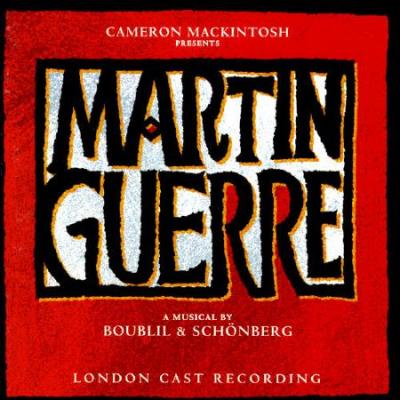
"Martin Guerre" Soundtrack Lyrics
Musical • 1999
Track Listing
"Martin Guerre (1999 Cast Recording)" – Album Guide to Tracks and Key Scenes
Overview
What does a “problem musical” sound like once it’s rebuilt from the ground up? The 1999 cast recording of Martin Guerre answers that with a score that feels leaner, more psychological, and more openly political than its 1996 West End ancestor. It preserves the UK tour version of Boublil & Schönberg’s musical about identity, faith, and imposture in a 16th-century French village torn apart by Catholic–Huguenot conflict.
This album doesn’t have the sheer, wall-to-wall grandeur of Les Misérables or the lush romance of Miss Saigon. Instead, it tightens the focus to a handful of people – Bertrande, the absent Martin, the impostor Arnaud, and the zealot Father Dominic – and lets the music trace their shifting loyalties. Choruses still thunder through the village scenes, but the arrangements are more intimate, almost chamber-like compared with the London original. Where the first recording often sounded like an epic trying to burst out of its theatre, the 1999 disc plays like a tense historical thriller that happens to be sung through.
Story-wise, we’re still in Artigat: a forced marriage, a young husband who flees to war, a stranger who returns claiming to be Martin, and a wife who chooses to believe him until the real man comes back. The big difference – and you hear it clearly on this album – is how heavily the rewrite leans into religious intolerance. Father Dominic’s music is harsher and colder, village ensembles bristle with “God’s anger”, and even romantic duets carry the suspicion that belief and community can turn against you in a second.
Stylistically, the album sits at an interesting crossroads. You get Renaissance-flavoured chorales and processional hymns standing in for institutional power; muscular folk-dance rhythms whenever the village closes ranks; and very direct 1990s musical-theatre ballads for Bertrande and Arnaud. The poppier, hook-driven writing of numbers like “Live With Somebody You Love” or “Don’t” underlines personal desire, while more austere choral writing in “God’s Anger” and “Justice Will Be Done” signals that doctrine and mob thinking are taking control. When the show wants vulnerability, it goes to lyrical lines and open harmonies; when it wants fanaticism, it goes to rhythm and unison.
How It Was Made
The journey to this recording is almost as tangled as the plot. Martin Guerre first opened at London’s Prince Edward Theatre in 1996, produced by Cameron Mackintosh and directed by Declan Donnellan, with a large orchestra and a more sprawling, operatic structure. Reviews were mixed, the show closed briefly for major rewrites that shifted focus toward Bertrande, and the revised London production eventually won the 1997 Olivier Award for Best New Musical but still never quite became a box-office juggernaut.
Rather than walk away, the team effectively wrote a new musical using the same story. For the 1998–99 collaboration with West Yorkshire Playhouse and the subsequent UK tour, Alain Boublil and Claude-Michel Schönberg overhauled the libretto, trimmed the physical production, and re-orchestrated the score for a smaller band. A large part of Act I now plays as an extended flashback from the vantage point of Martin’s trial, and the religious conflict – with Father Dominic as a more central antagonist – moves to the foreground. According to later commentary on the show’s development, roughly forty percent of the material in this version hadn’t been in the original West End run at all.
The 1999 cast recording captures that touring edition. It features the UK tour company led by Stephen Weller (the man claiming to be Martin), Matthew Cammelle (the real Martin), Joanna Riding (Bertrande), and Maurice Clarke (Benoît/Pierre, depending on track), along with a reduced but punchy orchestra. Commercially the disc has appeared under several labels – First Night Records in the UK, DreamWorks Records in the US, and later digital releases through Exallshow Ltd/Warner – but the content is the same: 26 tracks, just over 70 minutes, covering virtually the entire sung score of the tour adaptation.
From a production standpoint, you can hear the difference immediately. The orchestrations lean on rhythm section, woodwinds, and brass with a more transparent texture; the choral writing is preserved, but the underscoring feels closer to a touring chamber ensemble than a West End pit. The rewrite also re-uses several themes from the London score with new titles and lyrics, so part of the album’s appeal is hearing familiar melodic DNA re-deployed to tell a tighter, darker version of the story.
Tracks & Scenes
Below, I’m focusing on how key numbers function in the show and on this album rather than listing the full track order.
"Prologue" — Company
Where it plays: The recording opens in the heart of the village, with the company sketching in Artigat’s world of land, faith, and suspicion. On stage, this plays like a compressed overture and tableau: villagers at work, the church looming, hints of the later trial and burning embedded in choral fragments. It’s non-diegetic – a musical lens on the community rather than a song the characters “know” they’re singing.
Why it matters: It sets the stakes before any individual enters the frame. We understand instantly that this is a place where religion, land ownership, and bloodlines are everything, so any “error” in identity will be punished publicly.
"Live With Somebody You Love" — Ensemble
Where it plays: Early in Act I, just before or around the arranged wedding. The villagers urge Martin and Bertrande toward marriage, but the lyric slyly shifts from duty to desire: if you must marry, at least “live with somebody you love.” The number is staged as a bustling village celebration, with dancers circling the couple and elders watching like referees.
Why it matters: As a song it’s unusually hooky for this score – almost a pop anthem dropped into a Renaissance village. Dramatically it underlines the central irony: the community sings about marrying for love while forcing a match that Martin doesn’t want, planting the seed for his eventual flight.
"Your Wedding Day" — Company
Where it plays: The wedding itself. This is a tighter, more ritualised follow-up, shifting from the somewhat carefree mood of “Live With Somebody You Love” into a more formal ceremony led by the priests and parents. On stage, the music underscores a public rite – procession, vows, blessing – while the staging makes clear that Martin is uncomfortable and Bertrande is equally anxious but hopeful.
Why it matters: It’s the moment where social obligation wins over individual will. The music’s ceremonial feel contrasts sharply with Martin’s later solo material, making his eventual “disappearance” feel inevitable rather than impulsive.
"The Deluge" — Company
Where it plays: Not long after the wedding sequence, this erupts as a violent ensemble about war and religious persecution. The staging usually intercuts villagers reacting to news of conflict with battle flashes of Martin among the Huguenots. Drums, brass, and choral chanting give it an almost cinematic, montage-like energy.
Why it matters: It justifies Martin’s flight as something more than a personal tantrum. The “deluge” is both literal (rain, floods, the chaos of war) and metaphorical (a flood of violence and fanaticism) that sweeps him into a wider conflict and eventually into Arnaud’s orbit.
"I'm Martin Guerre" — Arnaud / “Martin”
Where it plays: This is the impostor’s declaration song, placed when Arnaud first commits to the masquerade in Artigat. The scene usually occurs after he’s recognised – or misrecognised – by the villagers and Bertrande, and he realizes that claiming Martin’s name will secure him a home and a life. It’s non-diegetic in the sense of being internal, but staged as a bold, almost swaggering address to the village.
Why it matters: As collected audition anthologies have noted, the number works as a classic leading-man showpiece, but in context it’s more insidious. The music is triumphant, the lyric full of self-definition, yet we know it’s built on a lie. That tension between rousing musical theatre bravado and moral ambiguity is one of the most interesting things in the 1999 version.
"Without You As a Friend" — Martin & Arnaud
Where it plays: In flashback at the front, with the real Martin and Arnaud as comrades in arms. On stage, this is often staged simply – two soldiers around a campfire, the chaos of battle kept offstage – to emphasise the intimacy of their bond. It’s diegetic only in a loose sense: they’re not literally singing a duet to each other, but the song expresses what they can’t say plainly about trust and dependency.
Why it matters: The album makes the friendship feel genuine, which is crucial. When Arnaud later steps into Martin’s identity, we hear not just opportunism but also the echo of a vow made in this duet: that one will take responsibility for the other’s unfinished business.
"God's Anger" — Father Dominic & Company
Where it plays: As the village clergy and Catholic loyalists react to Protestant “threats”. The staging tends to feature Father Dominic presiding over a fervent congregation, sometimes intercut with images of persecuted Huguenots. It’s strongly choral, almost hymn-like but harmonically harsher than the earlier wedding music.
Why it matters: This track crystallises the 1999 rewrite’s decision to make religious intolerance the engine of the plot. The melody is persuasive and powerful, which makes the text – calling down divine punishment – all the more unsettling. It also positions Dominic as a truly dangerous antagonist, not just a comic or fussy priest.
"How Many Tears" — Bertrande
Where it plays: Bertrande’s big Act I or early Act II lament, sung after years of abandonment and uncertainty. She reflects on the emotional cost of waiting for a husband who left her and on the burden of keeping faith in a community that judges her. Staging is usually minimal: a woman alone at night, sometimes with her child sleeping nearby, the village silent around her.
Why it matters: This is the score’s most straightforwardly emotional power ballad and has a life outside the show as a concert and audition piece. Within the narrative it deepens Bertrande from “wronged wife” into a complex character whose choice to accept Arnaud later is understandable – she’s clinging to any version of love that might finally stop those tears.
"Welcome to the Land" — Company
Where it plays: After Arnaud returns to Artigat as “Martin”, the community embraces him. The villagers celebrate his apparent conversion to their values and his return to work the family lands. The scene is staged with villagers crowding around, offering gifts, and physically drawing him into their circle.
Why it matters: Musically it’s buoyant, but the subtext is chilling: acceptance is conditional on conformity. The tune’s warmth masks a kind of possessiveness – “welcome, as long as you are who we say you are” – which later flips to hostility once doubt is raised.
"Don't" — Arnaud & Bertrande
Where it plays: This duet usually falls at the point where Bertrande, now in love with the man she believes to be Martin, senses that he might leave or confess. She begs him not to tear down the fragile happiness they’ve built; he fears the weight of his lie. The staging puts them in a private domestic space, contrasting with the show’s big public scenes.
Why it matters: The song captures the emotional trap at the heart of the story: telling the truth will hurt the person you love, but living the lie will too. On the album it’s one of the most contemporary-sounding tracks, with a clear verse–chorus shape that makes the emotional push-pull very accessible even if you don’t know the plot in detail.
"All the Years" — Bertrande
Where it plays: Later in the story, as Bertrande reckons with the span of time between Martin’s departure and the present. The song collapses a decade of loneliness, brief happiness, and looming scandal into a reflective solo. On stage you often get a semi-montage: Bertrande moving through seasons, perhaps with projections or shifting light rather than big set changes.
Why it matters: It’s a bridge number, emotionally and structurally. It connects the early “waiting” Bertrande of “How Many Tears” with the woman who will ultimately step into the witness box at the trial, fully aware that any answer she gives could kill someone.
"The Holy Fight" — Company
Where it plays: Around the midpoint of the show, this ensemble explodes as Catholics and Huguenots square off more directly. Soldiers, villagers, and clergy are all swept up in the idea of a divinely sanctioned conflict. Staging often uses banners, torches, and stylised combat; musically, it reworks thematic material associated with “Bethlehem” from the earlier version of the show into something more militant.
Why it matters: It’s one of the clearest examples of how the 1999 rewrite repurposes existing music for a different dramatic emphasis. Here faith is less about consolation and more about justification for violence, and the song’s driving rhythm pushes the story toward its courtroom reckoning.
"The Revelation" — Guillaume / Company
Where it plays: As doubts about “Martin” harden into accusation. Guillaume and others put together inconsistencies in Arnaud’s story; the community moves from whispers to open confrontation. On stage the number flows into a sequence where evidence is gathered and the authorities are summoned, often with sharp lighting shifts and choreographed crowd movement.
Why it matters: Dramatically it marks the turn from domestic drama to legal thriller. Musically it layers repeated motifs for suspicion and certainty over choral outbursts, giving the feeling that the village itself is waking up – or turning on its own.
"The Day Has Come" / "If You Still Love Me" — Bertrande & Arnaud
Where it plays: These tracks cluster around the start of the trial. “The Day Has Come” frames the hearing as an inevitable showdown; “If You Still Love Me” is a quieter, desperate exchange between Bertrande and the man she’s been calling Martin, as they confront the fact that her testimony will decide his fate. Staging typically places them on opposite sides of the courtroom, bound by music even when separated by physical distance and legal formality.
Why it matters: Together they show how the rewrite puts Bertrande’s agency at the center. She is not just a witness but the moral pivot of the piece, and these songs force her to weigh personal love against communal “truth” and religious duty.
"The Courtroom" / "Who?" — Judge, Company
Where it plays: In the core trial sequence. “The Courtroom” introduces Judge Coras, the legal process, and the idea that testimony and memory will now decide what reality is. “Who?” acts as a kind of cross-examination chorus, with villagers and lawyers hammering at the question of identity. The staging usually keeps Arnaud, Bertrande, and Martin visible throughout, even in silence, so the audience can read their reactions between lines.
Why it matters: These numbers translate what could be a dry legal dispute into musical drama. Rhythmic patterns mimic interrogation, while recurring melodic fragments from earlier love songs and village choruses surface in altered form, as if everyone’s previous certainties are being turned against them.
"Justice Will Be Done" — Father Dominic & Company
Where it plays: Late in Act II, as the verdict is reached and the machinery of punishment cranks into motion. Father Dominic whips the crowd into a fervour about divine justice, even as the specifics of guilt remain morally ambiguous. Staging usually features the preparation for Arnaud’s execution or burning, with the chorus functioning almost like a Greek chorus of righteous fury.
Why it matters: The track is terrifying precisely because it is musically thrilling. The sense of inevitability in the harmonies and the crowd’s unanimity make “justice” feel indistinguishable from vengeance. On the album it’s one of the clearest sonic portraits of how community fervour can erase individual nuance.
"The Burning" / "The Killing" — Orchestra & Company
Where it plays: These cues cover the climactic violence: the literal burning of heretics and the death of the impostor. On the recording, “The Burning” appears as an instrumental, while “The Killing” uses vocal fragments and rhythmic motifs to suggest chaos and horror rather than describe it directly. On stage, fire, smoke, and tightly choreographed crowd movement dominate the visuals.
Why it matters: They function as the brutal full stop on the story’s argument about fanaticism. By giving the violence largely to the orchestra and chorus rather than individual leads, the show underlines that the real killer is collective certainty, not just one antagonist.
"Live With Somebody You Love (Reprise)" — Company
Where it plays: Near the end, after the tragedy has played out. The reprise often lands as a bitter echo at first, then softens into something more hopeful as the surviving characters try to imagine a future built on genuine love rather than coercion. The staging usually pares away spectacle, leaving a simple image of Bertrande and her son, or the community tentatively rebuilding.
Why it matters: Returning to this melody closes a structural loop from the forced wedding of Act I to a more fragile, honest understanding of love. The recording lets you hear how the same tune can mean naïve optimism in one context and hard-won wisdom in another.
Notes & Trivia
- The 1999 tour version is not just a tweak of the London show; its first act is substantially re-structured as a flashback from Martin’s trial, which is why the album feels so narratively focused.
- Several themes from the 1996 cast album reappear here with new titles and lyrics – “The Holy Fight” is a notable example, evolving out of material associated with “Bethlehem” in the earlier score.
- While the London recording foregrounds Guillaume as the main antagonist, the tour recording’s song order and emphasis make Father Dominic the primary musical voice of opposition.
- The UK release through First Night Records and the US DreamWorks CD share the same audio, but artwork and logo colouring differ, mirroring the black-on-flame branding adopted for the tour.
- Because the show has been revised multiple times, fans often talk about “which Martin Guerre” they mean – this album is effectively the soundtrack to the “religious conflict” version, not the more romantic earlier one.
Music–Story Links
One of the most satisfying things about this album, if you listen with the synopsis in mind, is how precisely musical motifs track character decisions.
Martin’s journey, for example, is mostly told in absence. In the 1999 version, he doesn’t sing as much as you might expect on his own album. Instead, his presence saturates songs like “Without You As a Friend” (shared with Arnaud) and the various village choruses that invoke his name. The music suggests that “Martin Guerre” is really a role people project things onto – the soldier, the heir, the Catholic husband – more than a stable person.
Arnaud, by contrast, gets dynamic, forward-moving material. “I’m Martin Guerre” and its reprise are built on ascending figures and confident rhythmic patterns, so even when the lyric slips into doubt, the underlying music pushes onward. It’s the musical equivalent of a man talking himself into a lie. When Arnaud’s certainty fractures in “If You Still Love Me”, you can hear the score pull back – more sustained notes, less drive – signalling that the persona is starting to crack.
Bertrande’s songs map her movement from passivity to agency. Early numbers like “How Many Tears” frame her as someone events happen to; later pieces such as “All the Years” and her contributions within “The Day Has Come” and the courtroom sequences give her harmonically more complex lines, often sitting above or against the chorus. The music literally places her voice in tension with the village, which matches the way the story ultimately hinges on her testimony.
Father Dominic and the community share musical DNA. “God’s Anger”, “The Holy Fight”, and “Justice Will Be Done” all rely on tight unisons and block chords, often with minimal harmonic movement. That sound becomes shorthand for collective pressure – whenever it appears, we know that private conscience is about to be squeezed by public expectation.
Benoît, the younger character, is musically associated with curiosity and dissonance. While “Benoît’s Lament” itself isn’t one of the album’s marquee tracks, its melodic fragments echo earlier child-like motifs and then twist them, underlining how innocence is damaged by the adults’ choices.
And then there’s the village itself. The recurring use of “Live With Somebody You Love” as both an opening celebration and a closing reflection turns the community into an evolving character. At first it sings blithely about love as if that can be commanded; by the reprise, the same community has watched a man die and a marriage collapse. The tune hasn’t changed, but the shared understanding behind it has, which is one of the quietest but most powerful storytelling moves in the score.
Reception & Quotes
Critical reaction to Martin Guerre in general has always been split. Some reviewers saw both the original and rewritten versions as over-earnest or structurally fussy; others argued that the ambition of the piece outweighed its flaws. The 1999 cast album inherits that divided reputation but has slowly gained a following among musical-theatre fans who appreciate deep cuts and “lost” scores.
One cast-album reviewer described the touring rewrite as “one of the most extensive overhauls of any musical”, noting that while the plot remained broadly similar, the score felt almost like a new show built out of old material. Fans on theatre forums often say they discovered the piece through this disc first and only later tracked down the London recording, treating the two as parallel versions rather than a simple “original vs. revision”.
“A big, magnificent, epic musical… powerful and thunderous. It is what used to be called a great evening out.”
John Peter, Sunday Times (on the revised London staging)
“As much a masterpiece of musical magic and mystery as Les Misérables… a great and classic musical.”
Sheridan Morley, International Herald Tribune
“A timeless tale of love, greed and bigotry… powerful ballads and compelling ensemble work.”
Evening Standard on the London production
“An almost total rewrite… even now, a fascinating musical that never quite found its definitive form.”
Modern retrospective on the 1999 tour version
On the album’s availability and status: the 1999 cast recording is widely accessible on major streaming platforms and still turns up on CD through both First Night Records (UK) and DreamWorks/Warner-distributed pressings. It has never charted in a mainstream pop sense, but within musical-theatre circles it’s treated as the “primary text” for the tour version – the most complete way to experience that incarnation short of a rare revival.
Interesting Facts
- The 1999 recording runs to 26 tracks, which is unusually comprehensive for a touring cast album; many numbers that might normally be cut as “minor” are preserved.
- A making-of documentary, The Making of Martin Guerre: A Musical Journey, exists for the London production, but there’s no official filmed capture of the 1999 tour that matches this album.
- “How Many Tears”, “I’m Martin Guerre”, “Don’t”, and “Justice Will Be Done” show up in vocal anthologies and auditions more often than the show itself, which has helped keep the score alive.
- MusicBrainz and Discogs list multiple releases under slightly different branding – sometimes “Martin Guerre (1999 UK tour cast)”, sometimes “Martin Guerre (1999 Cast Recording)” – but they all trace back to the same sessions.
- Because the piece never reached Broadway despite a US tour, this recording effectively stands in for a Broadway cast album that never happened.
- For listeners who only know Boublil & Schönberg through Les Misérables and Miss Saigon, this album is often their first exposure to how the team handles a smaller-scale, more ambiguous ending.
- The credit line on digital services lists the rights holder as Exallshow Ltd, linking the recording back to Cameron Mackintosh’s production companies via a Warner-distributed imprint.
- Although several later regional productions have blended material from different versions of the show, none has yet generated a competing full cast recording, which keeps the 1999 disc uniquely important.
- Some choral excerpts, especially from “The Holy Fight” and “Bethlehem”-related material, have crossed into church and concert repertoires, detached from the musical’s narrative context.
- Among collectors, promo copies of the DreamWorks CD with alternative stickering or cover art are a minor niche item on resale sites.
Technical Info
- Title: Martin Guerre (1999 Cast Recording)
- Year: 1999
- Type: Stage musical cast album (UK tour version)
- Source work: Martin Guerre — musical by Alain Boublil & Claude-Michel Schönberg, inspired by the historical Martin Guerre case and the film The Return of Martin Guerre
- Music: Claude-Michel Schönberg
- Lyrics: Alain Boublil, with additional lyrics by Stephen Clark and Edward Hardy (core musical); touring version uses revised lyric credits where applicable
- Book (musical): Alain Boublil & Claude-Michel Schönberg
- Principal performers (1999 tour album): Stephen Weller, Matthew Cammelle, Joanna Riding, Maurice Clarke, Gareth Snook, Michael Bauer, and the 1999 UK Tour Ensemble
- Producers (stage): Cameron Mackintosh in association with West Yorkshire Playhouse (for the reworked 1998/99 production)
- Album labels: First Night Records (UK release, catalogue CastCD 70); DreamWorks Records (US CD release, catalogue 004-50215-2); later digital distribution via Exallshow Ltd / Warner Music Group
- Format & length: 1 CD / digital album, 26 tracks, roughly 73 minutes
- Recording context: Captures the fully reworked UK tour version that opened at West Yorkshire Playhouse in late 1998 and toured the UK and US in 1999–2000
- Notable song placements: “Live With Somebody You Love” & “Your Wedding Day” (arranged marriage and early village scenes); “I’m Martin Guerre” (Arnaud’s assumption of identity); “How Many Tears” (Bertrande’s lament); “The Courtroom” / “Who?” / “Justice Will Be Done” (trial and verdict); “The Burning” / “The Killing” (climactic violence)
- Related recordings: Martin Guerre 1996 Original London Cast; later concert and compilation appearances of individual songs like “How Many Tears” and “I Will Make You Proud”
- Availability: In print/streaming on major platforms (Apple Music, Spotify, etc.); physical CD periodically available new or second-hand via theatre-specialist retailers and online marketplaces
Canonical Entities & Relations
| Subject | Relation | Object |
|---|---|---|
| Martin Guerre (musical) | music by | Claude-Michel Schönberg |
| Martin Guerre (musical) | book & original concept by | Alain Boublil & Claude-Michel Schönberg |
| Martin Guerre (1999 Cast Recording) | is part of | Martin Guerre (musical) — UK tour version |
| Martin Guerre (1999 Cast Recording) | by artist | Martin Guerre (1999 Cast) |
| Martin Guerre (1999 Cast Recording) | composer | Claude-Michel Schönberg |
| Martin Guerre (1999 Cast Recording) | lyricist | Alain Boublil, Stephen Clark, Edward Hardy |
| Martin Guerre (1999 Cast Recording) | record label | First Night Records / DreamWorks Records / Exallshow Ltd |
| West Yorkshire Playhouse | co-produced | 1998/99 reworked staging of Martin Guerre |
| Prince Edward Theatre, London | premiere venue | Original 1996 West End production of Martin Guerre |
| Cameron Mackintosh | producer of | West End and touring productions of Martin Guerre |
| “I’m Martin Guerre” (song) | in album | Martin Guerre (1999 Cast Recording) |
| “How Many Tears” (song) | in album | Martin Guerre (1999 Cast Recording) |
| “Justice Will Be Done” (song) | in album | Martin Guerre (1999 Cast Recording) |
| The Return of Martin Guerre (film) | inspired | Martin Guerre (musical) |
| Artigat, France | setting of | Martin Guerre (musical) |
Questions & Answers
- Which version of Martin Guerre does the 1999 Cast Recording represent?
- It documents the extensively revised UK tour edition developed at West Yorkshire Playhouse in 1998 and toured through the UK and US from 1999, not the earlier London staging.
- How different is this album from the 1996 Original London Cast recording?
- The basic story is the same, but many songs are new or retitled, the structure uses more flashback and courtroom framing, and the orchestrations are leaner with a stronger emphasis on religious conflict.
- Does the 1999 recording contain the complete score of that version?
- It’s very close: the 26 tracks cover essentially all major numbers and scene-setting passages from the tour adaptation, with only minor trims that don’t affect the narrative clarity.
- What are the standout tracks if I just want a quick sense of the score?
- For a snapshot, try “Live With Somebody You Love”, “I’m Martin Guerre”, “How Many Tears”, “Don’t”, and “Justice Will Be Done” — they cover romance, identity, and religious zeal.
- Is there a filmed performance that matches this album?
- No full official video of the 1999 tour has been released. A separate documentary, The Making of Martin Guerre: A Musical Journey, focuses on the London production, so the 1999 cast recording remains the main record of this rewrite.
Sources: Wikipedia and national-language articles on Martin Guerre; MusicBrainz; Discogs release listings; Apple Music and Spotify album pages; stage synopsis and song lists from theatre databases; reviews and retrospectives from mainstream press and cast-album review sites.
November, 15th 2025
A-Z Lyrics Universe
Cynthia Erivo Popular
Ariana Grande Horsepower
Post Malone Ain't No Love in Oklahoma
Luke Combs Good Riddance (Time of Your Life)
Green Day Bye Bye Bye
*NSYNC You're the One That I Wan
John Travolta & Olivia Newton-John I Always Wanted a Brother
Braelyn Rankins, Theo Somolu, Kelvin Harrison Jr. and Aaron Pierre The Power of Love
Frankie Goes to Hollywood Beyond
Auli’i Cravalho feat. Rachel House MORE ›