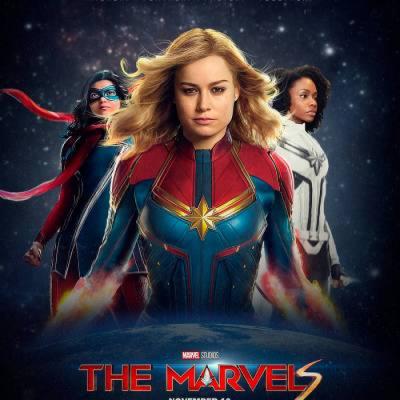
"Marvels" Soundtrack Lyrics
Movie • 2023
Track Listing
M.I.A.
Skrillex
Beastie Boys
Barbra Streisand
Mora
"The Marvels (Original Motion Picture Soundtrack)" – Album Guide to Tracks and Key Scenes
Overview
What happens when a cosmic war movie suddenly breaks into a musical number and then drops Barbra Streisand over a Flerken panic? The Marvels leans into that question and turns its soundtrack into part of the joke, the tension, and the heart. Laura Karpman’s score and a tight set of needle drops track the film’s journey from disoriented arrival, through messy adaptation, into rebellion and finally a literal solar restoration.
The film brings together Carol Danvers, Monica Rambeau, and Kamala Khan, and the music treats them less as three separate heroes and more as one unstable, entangled system. The core orchestral palette is dense: big brass, restless strings, layered choirs, and a lot of strange percussive colors that make space feel noisy and slightly hostile. Against that, familiar pop and hip-hop tracks drop in like radio stations from another universe, grounding the action in something recognizably human and a bit silly.
The soundtrack’s main function in the narrative is to chart how this accidental trio becomes chosen family. Early cues are fragmented and dissonant, often cutting out abruptly as the characters swap locations against their will. By the time we reach the training montage and the musical planet Aladna, rhythms line up, vocals lock to the beat of the editing, and the main theme starts to feel earned rather than imposed. Even the wildest choices – especially that “Memory” moment – serve character beats, not just meme potential.
In terms of genres, the score cycles through phases that match the story’s tone. Modern orchestral “space opera” underpins the cosmic stakes. Aggressive, slightly glitchy action writing underlines the Kree conflict and Dar-Benn’s villainy. World-music flavored vocals and instruments wrap around Kamala and Aladna, signaling vulnerability and cultural specificity rather than generic “epic” scale. The needle drops add their own coded meanings: 2010s global pop for Kamala’s fan-girl energy, 90s hip-hop for the training bravado, classic stage-musical balladry to tilt action into absurd comedy. Put simply: indie-ish grit for identity crises, club-ready beats for bravado, and old-school show-tunes for the moments where the film knowingly breaks its own tone.
How It Was Made
The Marvels score comes from composer Laura Karpman, who had already been playing in this sandbox with What If...? and Ms. Marvel. Director Nia DaCosta reportedly asked her not for three character themes, but for one team identity – the equivalent of how The Avengers theme covers multiple heroes at once rather than tracking individuals. That decision is why “Higher. Further. Faster. Together.” feels like a mission statement more than a simple title cue.
Karpman approached the project as a kind of compact “space opera”. She built an international choir of basso profundos, countertenors, and singers from South American, African, and Indian Carnatic traditions, then deliberately let them retain their own vocal colors instead of smoothing everything into one anonymous choir. In parallel, she worked with percussionist Evelyn Glennie to create “space junk” textures: bowed titanium disks, scraped metals, and other extended techniques that give many cues their restless metallic shimmer.
For the villain Dar-Benn, Karpman built a slithering, jazz-tinged theme primarily voiced by flutes – from piccolo down to contrabass – with a lot of audible breath and sliding lines. It’s pointedly different from the heroic brass for the Marvels themselves. Kamala’s musical world folds in the South Asian inflections that defined her series, now blended with big-screen superhero orchestration rather than sitting beside it.
Outside the score, long-time MCU music supervisor Dave Jordan handled licensing and placement for the pop tracks, while producer Trygge Toven helped glue those songs into the sonic world of the film. James Murphy and Nico Muhly were brought in to co-write and arrange the musical-planet numbers, giving Aladna a deliberately theatrical, almost Broadway-meets-K-pop energy rather than a straight MCU pastiche.
Tracks & Scenes – Key Cues and Needle Drops
This section walks through the most important songs and score cues, with approximate timestamps based on the theatrical runtime (~1h45m). “Diegetic” means the characters can hear the music; “non-diegetic” means it’s for us only.
"Double Bubble Trouble" — M.I.A.
Where it plays: Around the 00:01 mark, over our first proper visit to Kamala Khan’s room in Jersey City. The song blasts on her speakers while she doodles and storyboards her superhero fan-art, lost in her own world of space battles and Captain Marvel fantasies. It’s fully diegetic – the volume dips and swells with room noise – and the visuals cut tightly to the beat as the camera glides over posters and sketchbooks.
Why it matters: This track instantly reconnects the film to the hyperactive, collage-like visual style of Ms. Marvel. M.I.A.’s restless beat and political edge mirror Kamala’s sense that the world is chaotic but changeable, and the track’s lo-fi, sample-heavy feel sits in deliberate contrast to the sleek orchestral material we hear in space.
"RATATA" — Skrillex, Missy Elliott & Mr. Oizo
Where it plays: Roughly 00:17, during the first big fight that yanks Carol, Monica, and Kamala into each other’s spaces. As the powers entangle and the heroes keep swapping places mid-punch, the track kicks in as mostly non-diegetic, but Karpman’s brass and percussion are layered into the mix so it feels half-remix, half-score. The sequence jumps from Kamala’s living room to a Kree site and back, so the song plays as a unifying rhythmic grid over chaotic editing.
Why it matters: Sonically, “RATATA” matches the film’s glitchy teleport mechanic: sudden cuts, chopped phrases, and heavy drops. Missy Elliott’s presence adds swagger to what could have been a confusing exposition sequence. It’s the movie saying, “Yes, this is ridiculous. You’re allowed to enjoy the chaos.”
"Higher. Further. Faster. Together." — Laura Karpman
Where it plays: This is the main theme of the film and shows up in fragments throughout, but it’s most noticeable over the opening logos and in several heroic swells in the third act. When the Marvels finally sync up in combat near the finale, the full version arrives: solo viola introduction, growing choir chanting the title phrase in Latin, and a massive horn line carrying the melody over pounding percussion.
Why it matters: The cue is written as a “chosen family” theme rather than a single-hero motif. Melodic fragments for Carol, Monica, and Kamala interlock instead of simply stacking. That’s why the theme doesn’t quite “complete” earlier in the film – it’s waiting for these characters to actually function like a unit.
"Intergalactic" — Beastie Boys
Where it plays: Around 00:51, in the extended training montage where Carol, Monica, and Kamala try to weaponize their unwanted power-swapping. The scene jumps between space, Kamala’s family shipboard chaos, and zero-G drills. The song is non-diegetic, but the editing cuts strongly on the downbeats: teleport swaps hit the “Intergalactic, planetary” hook, punches and photon blasts land on snare hits, and the trio’s movement finally falls into sync.
Why it matters: On paper, using “Intergalactic” for an outer-space montage is almost too on-the-nose. In practice, the track’s playful arrogance helps puncture the solemnity that sometimes drags MCU training sequences down. It gives the trio a shared pop-culture moment and frames them as dorks having to learn choreography, not mythic icons who always knew what they were doing.
"Arrival on Aladna" / "Voices of Aladna" — Laura Karpman & ensemble
Where it plays: From about 00:54 onward, as the team arrives on the musical planet Aladna. “Arrival on Aladna” introduces a bright, theatrical orchestral sound with harp runs and almost Disney-princess harmonies. “Voices of Aladna” takes over as the citizens literally sing to Carol, welcoming her back in an operetta-style chorus. Later in the sequence (around 00:57) Carol joins in, performing choreographed dance steps and trading lines with Prince Yan.
Why it matters: These cues are fully diegetic; on Aladna, everyone literally communicates in song. They act as a meta-comment on the MCU’s tendency to treat heroes as royalty, by dropping Carol into a space rom-com musical she clearly isn’t comfortable with. Musically, they let Karpman stretch into Broadway territory, while still sneaking in her main theme as sub-motifs in the accompaniment.
"Welcome Home" — James Murphy, arranged by Nico Muhly & Laura Karpman
Where it plays: Layered into the Aladna palace sequence, “Welcome Home” functions as a ceremonial greeting number when Carol is reintroduced to Yan’s court. The melody is sung by the assembled subjects and dancers in the hall while Carol tries to stay in step with elaborate choreography and stiff court etiquette. It’s entirely diegetic, with the band and singers visible on screen.
Why it matters: This is where the film most openly becomes a musical. The lyrics frame Carol as a returning savior and partner, while the staging shows her discomfort with that role. The harmonic language nods both to classic MGM musicals and to modern indie-disco, a nice wink to Murphy’s own LCD Soundsystem background.
"Duet" — James Murphy, arranged by Nico Muhly & Laura Karpman
Where it plays: A more intimate number in the Aladna sequence, “Duet” underscores Carol and Prince Yan’s partnered dance. The song starts as a courtly piece sung by the ensemble, then narrows focus as the camera circles them and the rest of the room drops into soft focus. There’s a brief moment where the vocals thin out and we sit with strings and woodwinds while Carol decides how honest she wants to be with him.
Why it matters: This cue is less about romance and more about Carol’s guilt. The lyrics and staging say “storybook royal pairing”; her body language says “I’m terrified I’ve ruined your planet.” The music bridges those two attitudes, first indulging in musical-comedy sweetness, then letting dissonant chords creep in as reality intrudes.
"Memory" — Barbra Streisand
Where it plays: Around 01:12, during the Flerken evacuation sequence. While the space station is falling apart and chaos erupts, Goose and the baby Flerkens calmly swallow crew members and civilians so they can be safely transported. Streisand’s recording of “Memory” from Cats plays non-diegetically over the entire gag, almost in full, its lush orchestration and wistful vocal gliding serenely above panicked screaming and slapstick chases.
Why it matters: This needle drop is pure tonal whiplash by design. The song’s nostalgia and melancholy clash hilariously with people being devoured by tentacled cats, then reappear later unharmed. It’s also one of the few moments where the music invites us to see the scene almost from Goose’s perspective: calm, inevitable, a bit smug. The choice came directly from DaCosta, who reportedly had “Memory” in mind from the outset and refused to consider anything else.
"Evacuation" — Laura Karpman
Where it plays: Underneath and between “Memory”, Karpman’s cue “Evacuation” occasionally breaks through with sharp brass hits and percussive thrusts as the station’s structural failure gets worse. We hear fragments of the team theme twisted into minor mode when it looks like they might not finish swallowing everyone in time.
Why it matters: The cue keeps the sequence from drifting too far into parody. Every time the Streisand track risks turning the scene into pure joke, “Evacuation” reminds us of actual danger: hull breaches, re-entry trajectories, and the fact that people can still die if the Flerkens don’t finish the job.
"Restoration" — Laura Karpman
Where it plays: Close to 01:28, in the aftermath of the final battle, as Carol reignites the sun over the devastated Kree homeworld of Hala. The cue opens with quiet, suspended strings and voices, then slowly builds into a broad, luminous statement of the main theme as the star flares back to life and light floods the planet.
Why it matters: This is the emotional payoff for both Carol’s guilt and the film’s wider “restoration” arc. Musically, it’s one of the most straightforwardly beautiful cues in the score – less dissonant, more harmonically resolved. The choir’s ascending lines and the long brass phrases underline that this isn’t just a win; it’s penance, repair, and the first tangible sign that Carol is done running from her past mistakes.
"The Marvels" — Laura Karpman
Where it plays: Beginning around 01:33 over the end credits, this cue serves as the album’s summation. It weaves the main team theme, Kamala’s more playful material, and fragments of the villain and Aladna colors into one continuous suite. The first half rides on strong rhythmic ostinatos and choir, the second half relaxes into warmer strings and woodwinds as the credits roll through the cast list.
Why it matters: For listeners who only want one track to represent the whole score, this is it. It functions almost like a concert piece, taking you through the film’s emotional beats in miniature and tying together many motifs that casual viewers might not have consciously heard during the movie.
John Ottman’s X-Men themes — Score excerpts from "X2" and "Days of Future Past"
Where it plays: In the mid-credits stinger, when the film teases a wider multiverse connection and brings in familiar mutant imagery, you can briefly hear motifs from John Ottman’s earlier X-Men scores in the background. The quotes are non-diegetic, mixed under dialogue and sound effects but still clearly identifiable to fans of those films.
Why it matters: These quotations musically confirm what the visuals imply: the MCU is now openly borrowing from the Fox X-Men continuity. It’s also a neat example of how film music can carry franchise continuity across studio lines.
Trailer usage – "Intergalactic" revisited
Where it plays: Outside the film proper, “Intergalactic” also anchors the teaser and at least one main trailer, where its hook is cut to power-swap gags and hero shots. The trailers lean harder on the song’s robotic vocal effects and scratchy samples, playing up the sci-fi angle.
Why it matters: This is one of those rare cases where a trailer song actually becomes a meaningful part of the finished movie. Viewers who saw the marketing walked into the theater already primed to associate the song with this trio, which makes the training montage land with instant familiarity.
Notes & Trivia
- The soundtrack album is released as The Marvels (Original Motion Picture Soundtrack), credited solely to Laura Karpman, even though several songs in the film are by outside artists.
- The score won a Hollywood Music in Media Award for Original Score – Sci-Fi/Fantasy Film, one of the few Phase Five MCU scores to pick up a major music prize.
- “Higher. Further. Faster. Together.” premiered in concert before the movie came out, as part of a BBC Proms program, effectively acting as a live trailer for the score.
- A lo-fi remix of the main theme was officially released in collaboration with Lo-Fi Girl, re-framing the heroic motif as study music.
- Aladna’s musical culture was built in collaboration with James Murphy (LCD Soundsystem) and Nico Muhly, which is why those sequences feel more like a real musical than a Marvel parody sketch.
- Dave Jordan, the music supervisor here, has effectively overseen music across the entire MCU feature slate, making The Marvels part of a very consistent licensing ecosystem.
Music–Story Links
The soundtrack tracks the trio’s emotional journey in a fairly clean line. Early on, Karpman’s score leans heavily on dissonance and unfinished phrases; cues often cut on awkward bars when the characters teleport or lose control. Needle drops like “Double Bubble Trouble” sit in Kamala’s private world, not yet integrated into the team dynamic – it’s a teenager’s bedroom soundtrack, not a team anthem.
“RATATA” marks the pivot from confusion to improvisation. It sits on top of the score rather than blending with it, which mirrors the way the heroes are still fighting around each other instead of together. Once we arrive at “Intergalactic”, the grid lines between pop song, editing rhythm, and stunt choreography have fused. The training montage is effectively a music video for the trio’s developing synergy.
Aladna’s songs are where the film tests Carol’s identity most directly. By forcing her to sing and dance her way through diplomatic duties, “Voices of Aladna”, “Welcome Home”, and “Duet” expose the gap between how this world sees her – as a glamorous savior – and how she sees herself – as someone who broke promises and fled. The orchestrations quote the main theme, but often in lighter, major-key transformations, as if the planet insists on a happy ending she isn’t sure she deserves.
The “Memory” and “Evacuation” pairing is the soundtrack’s sharpest piece of storytelling. The choice of an iconic, emotionally loaded ballad over a mass devouring sequence reframes the Flerkens from simple monsters into oddly tender protectors. At the same time, Karpman’s underlying cue keeps the stakes real enough that the gag never becomes weightless. It’s a joke and a rescue mission at once.
Finally, “Restoration”, “Chosen Family”, and “The Marvels” close the loop. Harmonic tension eases, the choirs sing in long, stable phrases, and the brass writing becomes less jagged. Even if the wider MCU plot remains messy, the music makes one thing feel settled: this trio has found a way to function as a family, and their sound reflects that.
Reception & Quotes
Critically, the album landed in an interesting place: praised for its ambition and thematic craft, but occasionally criticized for being dense and prickly as a casual listen. Some film-music writers singled out “Higher. Further. Faster. Together.” and “Restoration” as standout cues, while others argued that the heavy dissonance and lack of overt references to earlier MCU themes made it feel slightly detached from the broader franchise sound.
Among fans, reactions often split along two lines: those who loved the unapologetically weird choices (Aladna, “Memory”, the Flerken montage) and those who felt those moments broke the film’s tonal consistency. The score itself, separated from the movie, tends to fare better; listeners who enjoy modern, big-canvas orchestral writing with complex harmonies have generally embraced it as one of the more distinctive late-MCU scores.
According to one prominent soundtrack review, Karpman’s approach offers “a superhero score done right, weaving a stunningly crafted new main theme with thunderous orchestra and exquisite vocals,” while another notes that the music can be “appreciated intellectually more than casually,” highlighting both its strengths and its potential barrier to casual replay.
“A triumph of a superhero score, one of the best of its type this year… Karpman blows that tired opinion completely into space.” — MovieMusicUK
“A highly intelligent and accomplished score filled with sonic intrigue… the solid narrative and resounding ambience compensate, but only to a point.” — Filmtracks
“The soundtrack… mirrored their efforts to become one during pivotal moments like a fight scene, a training montage and an entertaining cat chase.” — Press review
“The Marvels is a superhero score done right, weaving a stunningly crafted new main theme with thunderous orchestra and vocals.” — Zanobard Reviews
Interesting Facts
- “Memory” is used with Streisand’s original recording, not a cover; the choice came straight from DaCosta and was non-negotiable during music planning.
- The Flerken evacuation was storyboarded to music very early, so the timing of people being swallowed was designed around the ballad’s structure.
- John Ottman’s X-Men themes are among the first non-MCU film scores to be explicitly quoted inside an MCU movie, signaling a more open cross-continuity approach.
- The official album omits licensed songs like “Double Bubble Trouble” and “Intergalactic”; those live only in the film and on separate artist releases or playlists.
- “Voices of Aladna” runs over six minutes on album, expanding significantly on what you hear in the final cut, with extra choral verses and instrumental breaks.
- The choir sessions reportedly included separate recording days in both Los Angeles and London, reflecting the “cosmic but grounded” brief for the vocal sound.
- A lofi remix of the main theme was released the same day as the film’s overseas premiere, a rare case of an official study-playlist spin-off for a Marvel score.
- Music producer Trygge Toven helped integrate the licensed tracks with Karpman’s score so that pieces like “RATATA” could carry extra orchestral overlays in the mix.
Technical Info
- Title: The Marvels (Original Motion Picture Soundtrack)
- Film: The Marvels (2023)
- Year of film release: 2023
- Year of album release: 2023 (digital)
- Type: Feature film score / soundtrack
- Composer: Laura Karpman
- Key songwriters: Laura Karpman; Kai-Lilly Karpman (lyrics); James Murphy; Nico Muhly; various artists for licensed tracks (M.I.A., Beastie Boys, Skrillex, Missy Elliott, Mr. Oizo, Barbra Streisand, John Ottman)
- Music supervision: Dave Jordan (music supervisor); Trygge Toven (music producer)
- Label / release: Hollywood Records & Marvel Music, Inc. – digital release on major platforms (Apple Music, Spotify and others)
- Notable placements: “Double Bubble Trouble” (Kamala’s intro); “RATATA” (first entangled fight); “Intergalactic” (training montage); “Voices of Aladna” / “Welcome Home” / “Duet” (Aladna musical sequence); “Memory” (Flerken evacuation); “Restoration” (Hala’s sun reignited); “The Marvels” (end credits); X-Men themes (mid-credits)
- Runtime (album): about 65–70 minutes depending on edition
- Recording / ensembles: Large symphony orchestra, multiple choirs, expanded flute section, extensive percussion and “found” metallic instruments, international vocal soloists.
- Awards / recognition: Hollywood Music in Media Award for Original Score – Sci-Fi/Fantasy Film; widely cited by soundtrack reviewers as one of the more distinctive Phase Five scores.
- Availability notes: Official album contains score only; licensed songs are not included and must be found on artist releases or curated playlists.
Questions & Answers
- How is The Marvels’ score different from the first Captain Marvel movie?
- The first film used a more straightforward, synth-driven superhero sound. The Marvels leans into dense orchestral writing, choirs, and unusual percussion, with a team-based theme instead of focusing on Carol alone.
- Why does the film use Barbra Streisand’s “Memory” in the Flerken sequence?
- It’s a deliberate tonal clash. A soaring, nostalgic ballad plays over slapstick horror, turning a potentially grim evacuation into black comedy while still treating the rescue as strangely tender.
- What song plays during the training montage where the trio syncs their powers?
- That sequence is cut to “Intergalactic” by Beastie Boys, used as a non-diegetic track that locks the heroes’ teleport swaps, punches, and jumps to the song’s beat.
- Which pieces are heard on the musical planet Aladna?
- Aladna’s main musical moments use “Arrival on Aladna”, “Voices of Aladna”, “Welcome Home”, and “Duet”, blending Karpman’s score with theatrical songs performed in-world by the characters.
- Does the official soundtrack album include all the songs from the movie?
- No. The album is a score release. It features Karpman’s cues but not licensed songs like “Double Bubble Trouble”, “Intergalactic”, “RATATA”, or “Memory”. Those live on separate artist releases and playlists.
Canonical Entities & Relations
| Subject | Relation | Object |
|---|---|---|
| Laura Karpman | composed | The Marvels (Original Motion Picture Soundtrack) |
| Nia DaCosta | directed | The Marvels (film) |
| Dave Jordan | supervised music for | The Marvels (film) |
| Trygge Toven | produced music for | The Marvels (film) |
| Marvel Studios | produced | The Marvels (film) |
| Hollywood Records | released | The Marvels (Original Motion Picture Soundtrack) |
| Marvel Music, Inc. | co-released | The Marvels (Original Motion Picture Soundtrack) |
| James Murphy | co-wrote songs for | The Marvels (film) |
| Nico Muhly | arranged songs for | The Marvels (film) |
| M.I.A. | performed | "Double Bubble Trouble" used in The Marvels |
| Beastie Boys | performed | "Intergalactic" used in The Marvels |
| Skrillex, Missy Elliott & Mr. Oizo | performed | "RATATA" used in The Marvels |
| Barbra Streisand | performed | "Memory" used in The Marvels |
| John Ottman | composed themes quoted in | The Marvels mid-credits scene |
| Aladna | appears as | musical planet in The Marvels |
| Hala | appears as | Kree homeworld restored in The Marvels |
Sources: Wikipedia; Marvel Cinematic Universe Wiki; Soundtracki; IMDb; Radio Times; BamSmackPow; Filmtracks; Zanobard Reviews; MovieMusicUK; official Disney/Marvel press materials and interviews.
November, 15th 2025
A-Z Lyrics Universe
Cynthia Erivo Popular
Ariana Grande Horsepower
Post Malone Ain't No Love in Oklahoma
Luke Combs Good Riddance (Time of Your Life)
Green Day Bye Bye Bye
*NSYNC You're the One That I Wan
John Travolta & Olivia Newton-John I Always Wanted a Brother
Braelyn Rankins, Theo Somolu, Kelvin Harrison Jr. and Aaron Pierre The Power of Love
Frankie Goes to Hollywood Beyond
Auli’i Cravalho feat. Rachel House MORE ›