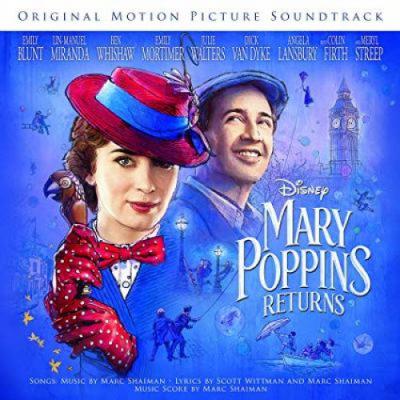
"Mary Poppins Returns" Soundtrack Lyrics
Movie • 2018
Track Listing
"Mary Poppins Returns (Original Motion Picture Soundtrack)" – Album Guide to Tracks and Key Scenes
Overview
Can a sequel arrive more than fifty years later and sound like it has always been there? The Mary Poppins Returns (Original Motion Picture Soundtrack) tries exactly that: it rebuilds a 1960s musical language with 2010s recording polish, then drops it into Depression-era London. The film picks up with a grown-up Michael and Jane Banks facing grief and foreclosure, and the soundtrack follows the same path: arrival, reluctant adaptation, rebellion against despair, and a last-minute rescue that literally takes to the air.
Composer Marc Shaiman and lyricist Scott Wittman wrote nine new songs plus a full orchestral score. They lean hard into the Sherman Brothers’ DNA without copying melodies outright. You hear it in the architecture: patter verses that flip into broad waltz choruses; music-hall bounce sitting next to sincere lullabies; underscoring that quotes harmonic turns from “A Spoonful of Sugar” or “Feed the Birds” without ever stating them in full. Richard M. Sherman himself acted as music consultant, so the album sits in an explicit dialogue with the 1964 original.
Dramatically, the soundtrack charts the Banks family’s move from paralysis to motion. Early numbers sit in narrow ranges and tight rhythms – Michael’s grief in “A Conversation”, Jack’s quiet prologue under a grey sky. As Mary Poppins lands and pulls the children into bath oceans, porcelain music halls and upside-down workshops, the music loosens into bigger intervals and denser orchestration. By the time “Trip a Little Light Fantastic” and “Nowhere to Go But Up” hit, the score is throwing full choirs, brass fanfares and tap-dance rhythms at scenes that would collapse without that musical energy.
Stylistically, the album moves through phases. There is storybook melancholy in “(Underneath the) Lovely London Sky” and “The Place Where Lost Things Go”, mapping directly onto the family’s grief. There is music-hall bravado in “The Royal Doulton Music Hall” and “A Cover Is Not the Book”, where Shaiman basically writes his own Sherman-style variety show. Then there is spectacle mode – “Turning Turtle”, “Trip a Little Light Fantastic”, “Nowhere to Go But Up” – where the score becomes bigger than the frame, deliberately echoing “Step in Time” and “Let’s Go Fly a Kite” without repeating them. You can almost hear the baton being passed: 1964’s ideas, filtered through a Broadway brain that grew up on that original LP.
How It Was Made
Disney brought in Shaiman and Wittman in 2016, giving them a clear brief: new songs only, but they had to feel like they could sit beside the Sherman catalogue without embarrassment. They wrote nine originals plus reprises and score, workshopping them closely with director Rob Marshall, producer John DeLuca and screenwriter David Magee. The songs were locked early because Marshall tends to stage musical numbers like full Broadway sequences in pre-production, with storyboards cut to demo tracks.
Richard M. Sherman acted as “godfather” to the score. Shaiman has said he effectively wrote fan-fiction for the Sherman style: he studied chord progressions, internal rhymes and even orchestration tricks from the 1964 soundtrack, then built new pieces that quoted shapes rather than literal tunes. The new score still sneaks in small, authorised references to the original – a rising string figure from “Let’s Go Fly a Kite” here, a “Feed the Birds” harmonic colour there – but never enough to turn into a jukebox sequel.
The soundtrack album, Mary Poppins Returns: Original Motion Picture Soundtrack, dropped on 7 December 2018 via Walt Disney Records, with 27 tracks totaling just over 78 minutes. It combines full song performances from Emily Blunt, Lin-Manuel Miranda, Ben Whishaw, Meryl Streep, Angela Lansbury, Dick Van Dyke and others with score cues like “Kite Takes Off”, “Into the Royal Doulton Bowl” and “Mary Poppins Arrives”. Recording took place in London, including sessions at AIR Lyndhurst and Abbey Road, with engineer Andrew Dudman handling much of the recording and mixing. A separate 2019 album later presented an “Original Score” selection focused purely on Shaiman’s instrumental cues.
Production-wise, the music had to support heavy VFX and complex choreography – especially in the animated Royal Doulton sequence and the lamplighter set-piece. Numbers like “Trip a Little Light Fantastic” were run as extended takes with more than fifty dancers and cyclists, then rebuilt in post so that every hoofbeat, bike chain and footfall sat inside Shaiman’s rhythmic grid. The result is a soundtrack that feels almost over-engineered, but that level of precision is what keeps the film’s busiest sequences readable.
Tracks & Scenes – Key Songs and Score Moments
This is not a full tracklist; it focuses on the most important cues and how they play in the film.
"(Underneath the) Lovely London Sky" — Lin-Manuel Miranda
Where it plays: Right at the start, as Jack cycles through a damp, early-morning London lighting lamps and greeting shopkeepers. Fog rolls in over the park, Big Ben looms in the distance, and the camera tracks alongside him in long glides. It is a fully diegetic busker’s song inside the story, but the orchestration gradually outgrows what a lone leerie could produce, adding strings and woodwinds as the shot widens.
Why it matters: This is the film’s equivalent of “Chim Chim Cher-ee” as prologue. It sets the period (Depression-era 1930s), mood (melancholy but hopeful) and Jack’s role as friendly observer. Musically, it lays down several motivic cells that Shaiman later sneaks into the score.
"A Conversation" — Ben Whishaw
Where it plays: Early in the film, Michael is alone in the attic, sorting through boxes of his late wife’s belongings. He addresses the song to her as if she were still there, moving between half-spoken and fully sung lines while the children play downstairs, unaware. The space is quiet, dust motes in the light; orchestration stays sparse – piano, soft strings, a few woodwind sighs.
Why it matters: This is the emotional baseline of the story: a father paralysed by grief and debt. The melody keeps falling rather than rising, and phrases end on unresolved chords. It’s one of the few moments where the soundtrack drops the “family musical” smile and lets the sadness sit unvarnished.
"Can You Imagine That?" — Emily Blunt with Pixie Davies, Joel Dawson, Nathanael Saleh
Where it plays: In the now-classic bathtub sequence. Mary tries to pull the children out of their anxious fixation on adult problems, turning bathtime into a plunge into an undersea fantasia. On screen, the tub becomes an ocean; the kids and Mary surf on a ship’s hull and ride a giant rubber duck past colourful sea creatures. The song starts in the bathroom (diegetic lull of domesticity) then slides into full non-diegetic fantasy as the orchestra erupts underwater.
Why it matters: This is the film’s first big “you’re in a Mary Poppins movie” moment. The lyrics hammer the idea that imagination is not an escape but a tool for survival. Musically, it’s one of the clearest nods to the Sherman palette, with bright woodwinds and quick-switch tempo changes, but filtered through Shaiman’s Broadway sense of build.
"The Royal Doulton Music Hall" — Emily Blunt, Lin-Manuel Miranda & ensemble
Where it plays: After Georgie takes the Royal Doulton bowl, a crack and carriage chase send everyone tumbling into an animated porcelain world. Mary and Jack lead the children into a music-hall tent painted on the inside of the bowl, where animals in period costume fill the audience. The song introduces the stage, the “cast” of animated performers and the rules of this world. It is fully diegetic within the bowl: the band is visible, performers bow, applause crashes in waves.
Why it matters: This number is the bridge between hand-drawn fantasy and live-action performance. The orchestrations mimic vintage pit bands, but the harmony and inner lines are more complex than a straight pastiche, reminding you that it is still 2018 studio work under the hood.
"A Cover Is Not the Book" — Emily Blunt, Lin-Manuel Miranda & ensemble
Where it plays: In the same Royal Doulton tent, right after the introductory patter. Jack tries a verse about not judging books by their covers; Mary steals the spotlight and launches into a full-blown vaudeville showpiece, complete with costume changes, tongue-twisters and a notorious verse about a bookish royal. On screen it’s a staged variety number, with Mary dancing, Jack rapping in a deliberately old-fashioned way and animated audience reactions everywhere.
Why it matters: This is the soundtrack’s show-off piece for wordplay. It lets Emily Blunt switch from prim nanny to sly music-hall emcee and gives Lin-Manuel Miranda enough rhythmic room to nod to his own hip-hop reputation without breaking the film’s period frame. It also nails the sequel’s core theme: appearances lie; dig deeper.
"The Place Where Lost Things Go" — Emily Blunt
Where it plays: That night, after the Royal Doulton adventure turns into a near-disaster and the children admit they miss their mother, Mary tucks them into bed. The room is dim, the streetlamps outside barely visible. She sits between the beds and sings a simple lullaby about how “lost things” aren’t gone, just out of sight for a while. The accompaniment stays very thin: harp, soft strings, a few woodwind echoes.
Why it matters: This ballad is the emotional centre of the film and the soundtrack. It was the track pushed for awards, and it earned an Oscar nomination. The melody is deliberately reminiscent of “Feed the Birds” in its contour and harmonic language but stops short of quoting it. The song reframes grief in terms even small children can carry without sugarcoating what happened.
"Turning Turtle" — Meryl Streep with ensemble
Where it plays: Mid-film, when Mary takes the children to see her eccentric cousin Topsy in a cluttered repair shop. Every second Wednesday, Topsy’s world literally turns upside down, and the scene obeys that rule: the camera rotates, furniture hangs from the ceiling, and everyone scrambles across inverted beams while trying to fix a broken bowl. The song is a klezmer-tinged, off-kilter circus piece with shifting accents and deliberately “wrong-footed” phrases.
Why it matters: The sequence is a pressure release after the heavy emotions of the lullaby, but it also hides a metaphor: the idea that perspective shifts – literally turning things upside down – can reveal solutions. Musically it gives Meryl Streep a chewable character song and lets the orchestration go strange for a few minutes.
"Trip a Little Light Fantastic" — Lin-Manuel Miranda, Emily Blunt & ensemble
Where it plays: In the second half, as the clock ticks toward the bank’s repossession deadline. Jack and his fellow lamplighters (“leeries”) lead the Banks children – and eventually Mary – through alleys, parks, sewers and an abandoned playground. The song starts as a modest street tune then explodes into an eight-minute dance-and-stunt sequence with bikes, lamppost-swinging and acrobatics around a central fountain. The phrase itself is an old idiom for “dance nimbly”.
Why it matters: This is the sequel’s “Step in Time”: the big, no-apologies showstopper. It binds Jack to the tradition of Bert while staying distinct, and it pushes the visual and musical scale as far as the film can handle. On album, the full version shows how carefully the sections are structured – rap-like patter, call-and-response, key changes, a quiet bridge, then a huge final shout.
"Trip a Little Light Fantastic (Reprise)" — Lin-Manuel Miranda & company
Where it plays: Near the climax, when the leeries use ladders, ropes and bike tricks to slow Big Ben’s mechanical hands so Mary and the kids can reach the clock room. The reprise is faster and more urgent, foregrounding percussion and brass as the lamplighters literally climb through the gears of time.
Why it matters: The reprise shows how the score can take a playful tune and turn it into straight suspense without writing a new theme. It also cements the leeries as this film’s version of the chimney sweeps: working-class guardians of magic and timing.
"Nowhere to Go But Up" — Angela Lansbury, Emily Blunt & ensemble
Where it plays: Near the end, after the bank crisis resolves and spring breaks through the fog. The Balloon Lady offers balloons in the park; each person who takes one floats into the sky, but only if their spirits are light enough. Mary and the Banks family join a crowd of Londoners bobbing in the air above the park trees. The song is a gentle waltz that gradually gathers full chorus and orchestra.
Why it matters: This is the film’s answer to “Let’s Go Fly a Kite”. It turns emotional weight into literal weight: people weighed down by regret stay on the ground, those who let go rise. Angela Lansbury’s cameo vocal delivers the kind of warm, slightly quavering reassurance that only she can sell.
"(Underneath the) Lovely London Sky (Reprise)" — Lin-Manuel Miranda
Where it plays: As the film winds down and Mary prepares to leave, Jack reprises his opening song, this time under blue skies and restored Banks fortunes. The melody is the same, but phrasing stretches a little more; the city feels less heavy.
Why it matters: The reprise closes the loop: the world is still the same London, but tuned differently. It’s a small, neat musical gesture that lives quietly at the edge of the bigger finale.
Score highlights: "Theme from Mary Poppins Returns", "Kite Takes Off", "Mary Poppins Arrives" — Marc Shaiman
Where they play: These cues are used around key non-song moments. “Kite Takes Off” and “Mary Poppins Arrives” score the stormy sequence where the ragged old kite pulls the children into the park and Mary descends from the clouds. “Theme from Mary Poppins Returns” functions more as an album piece and trailer music than a film cue; it presents a lush statement of the new main theme that only appears in fragments on screen.
Why they matter: The orchestral material glues the songs together and embeds little quotations from the Sherman catalogue in its inner voices. The score keeps a consistent sound – mainly London orchestra and choir – but shifts orchestration colours to match each set-piece: porcelain delicacy in the Royal Doulton sections, heavy brass and low strings for the bank, glassy high strings and harp for Mary’s entrances.
Notes & Trivia
- The soundtrack album features 27 tracks in total, with nine completely new songs, several reprises and a generous selection of score cues.
- “The Place Where Lost Things Go” received an Academy Award nomination for Best Original Song, while the score itself was nominated for Best Original Score.
- “Theme from Mary Poppins Returns” appears on the album and in trailers but is not used in the final cut of the film.
- A deleted song, “The Anthropomorphic Zoo”, was written for the Royal Doulton sequence but dropped; a demo paired with storyboards later appeared as a home-media bonus feature.
- Richard M. Sherman, one half of the original Sherman Brothers team, is credited as music consultant and signed off on the new score after hearing demos and sessions.
- There is a separate album, Mary Poppins Returns (Original Score), which re-presents the orchestral cues without songs for listeners who prefer the instrumental side.
Music–Story Links
The soundtrack mirrors the film’s structure quite cleanly. “(Underneath the) Lovely London Sky” sets up a city in slow decline; “A Conversation” drops us into a family frozen by loss. Neither piece solves anything; both simply lay out the emotional terrain. Only when Mary arrives and launches “Can You Imagine That?” does the harmonic language begin to move: the chords stretch further from home keys, and rhythms loosen, suggesting that the world can bend without breaking.
The Royal Doulton section – “The Royal Doulton Music Hall” into “A Cover Is Not the Book” – uses music to test how much the children have absorbed. The songs are fun on the surface, but each verse is a parable about misjudging people and situations. When the bowl cracks and Georgie is snatched by animated repossessors, the shift from song to action is abrupt on purpose: the kids have to apply those lessons immediately.
“The Place Where Lost Things Go” is not just a pretty lullaby. It rewires how the children think about their mother’s absence and, by extension, how they think about Mary herself. After this point, the soundtrack stops treating Mary as a simple source of spectacle; her later lines in “Trip a Little Light Fantastic” are more like reminders than instructions, and she sings less overall, letting others carry more musical weight.
“Turning Turtle” and the lamplighter sequences play a structural role too. Topsy’s upside-down workshop literalises the idea that the world will sometimes invert itself without warning; “Trip a Little Light Fantastic” then shows how community and rhythm can navigate that chaos. The reprise at Big Ben links that lesson directly to action: it’s not enough to dance through trouble, you have to climb into the machinery and move it.
The final pairing – “Nowhere to Go But Up” and the reprise of “Lovely London Sky” – closes the emotional arc. George Banks in the original film found lightness by mending a kite; Michael Banks in the sequel does it by accepting help and letting go of guilt. The music reflects that: recurring motifs from the overture reappear smoother, less tense, as if the score itself had decided to stop clenching.
Reception & Quotes
Critical reaction separated the songs from the film. Many reviewers praised Shaiman and Wittman for finding a convincing “lost Sherman score” vibe without falling into parody, though some argued that no new song matched the instant-classic status of “Supercalifragilisticexpialidocious” or “Chim Chim Cher-ee”. “The Place Where Lost Things Go” and “Trip a Little Light Fantastic” were singled out most often as standouts, the former for emotional directness, the latter for sheer kinetic joy.
Film-music writers generally highlighted the sophistication of the orchestrations and the density of internal references to the 1964 score. A few took issue with the album’s length – 78 minutes of music is a lot for casual listening – but even sceptical reviews tended to concede that the craftsmanship was high. Fans of Shaiman’s Broadway work (for example, Hairspray) often responded positively to the way his harmonic quirks snuck into the more traditional Disney framework.
One soundtrack review described it as “a superbly crafted homage that still feels like a Marc Shaiman score”, while another noted that “the emotional high point of the songs is the ballad ‘The Place Where Lost Things Go,’ quiet, intimate, and as soothing as a lullaby.” A UK chart write-up stressed that the album’s 27 tracks and all-star vocal cast made it a strong seasonal seller in late 2018, with the record entering various soundtrack and compilation charts.
“The emotional high point of the songs is the ballad ‘The Place Where Lost Things Go,’ quiet, intimate, warm, and as soothing as a lullaby.” — film-music review
“An all-original new soundtrack that honours the spirit of the Shermans while carving out a sound of its own.” — studio / press commentary
“Shaiman channels the Sherman Brothers without ever impersonating them, weaving sly musical quotes through a lush, unabashedly old-fashioned score.” — critical analysis
“Nine new songs, all of them built for big-screen spectacle, and performances from Blunt, Miranda, Van Dyke and Lansbury make this a holiday-album event.” — chart / industry write-up
Interesting Facts
- The soundtrack sits officially as the next entry after the 1964 Mary Poppins: Original Cast Soundtrack in Disney’s catalogue, linking the two albums across a 54-year gap.
- The album’s 27 tracks include three different uses of “(Underneath the) Lovely London Sky” material (prologue, reprise and score fragments), subtly framing the whole story around Jack’s point of view.
- “The Place Where Lost Things Go” was one of two songs briefly considered for live Oscar performance by Emily Blunt; she ultimately declined performing at the ceremony despite the nomination.
- “Trip a Little Light Fantastic” was run as an extended eight-minute dance take during shooting, even though only part of that length appears in the final cut and on the album.
- The deleted “Anthropomorphic Zoo” song would have shown the Banks children visiting a zoo where the humans are in cages and the animals watch them – a darker gag that the filmmakers ultimately cut for tone and pacing.
- A separate Disney Sing-Along: Mary Poppins Returns album repackages several of the songs with guide vocals and lyric-book material, aimed at younger singers.
- Some vinyl editions appear on transparent red wax, turning the record itself into a collector’s object that visually matches the Royal Doulton colour palette.
- Later piano/vocal/guitar folios highlight “Can You Imagine That?”, “A Cover Is Not the Book”, “The Place Where Lost Things Go”, “Turning Turtle”, “Trip a Little Light Fantastic” and “Nowhere to Go But Up” as the core performance pieces.
Technical Info
- Album title: Mary Poppins Returns: Original Motion Picture Soundtrack
- Work: Mary Poppins Returns (2018 feature film)
- Year of film release: 2018
- Year of album release: 2018 (December 7, digital and CD)
- Type: Film soundtrack (songs and score)
- Composers / lyricists: Marc Shaiman (songs & score); Scott Wittman and Marc Shaiman (lyrics)
- Music consultant: Richard M. Sherman
- Key vocal performers: Emily Blunt, Lin-Manuel Miranda, Ben Whishaw, Emily Mortimer, Pixie Davies, Joel Dawson, Nathanael Saleh, Julie Walters, Colin Firth, Meryl Streep, Dick Van Dyke, Angela Lansbury
- Label: Walt Disney Records (often co-branded with UMC in some territories)
- Representative key songs: “(Underneath the) Lovely London Sky”, “A Conversation”, “Can You Imagine That?”, “The Royal Doulton Music Hall”, “A Cover Is Not the Book”, “The Place Where Lost Things Go”, “Turning Turtle”, “Trip a Little Light Fantastic” (and reprise), “Nowhere to Go But Up”
- Score highlights: “Overture”, “Theme from Mary Poppins Returns”, “Kite Takes Off”, “Mary Poppins Arrives”, “Into the Royal Doulton Bowl”, “Banks in the Bank”, “Rescuing Georgie”
- Runtime: approx. 78 minutes (27 tracks)
- Recording / mixing: Recorded in London (including AIR Lyndhurst and Abbey Road Studio One); mixed at Abbey Road by Andrew Dudman; mastered by Miles Showell and team for various formats.
- Awards / recognition: Academy Award nominations for Best Original Score and Best Original Song (“The Place Where Lost Things Go”); presence on 2019 US soundtrack album year-end charts.
- Availability: Widely available on CD, vinyl and digital/streaming platforms; a separate Original Score album and a Disney Sing-Along edition provide alternate listening options.
Questions & Answers
- How closely does the Mary Poppins Returns soundtrack copy the original film’s songs?
- It doesn’t reuse the old songs outright. Instead, Marc Shaiman and Scott Wittman wrote nine new numbers that echo the Sherman Brothers’ style in harmony, rhythm and orchestration, while the score weaves in subtle instrumental references to classics like “A Spoonful of Sugar” and “Feed the Birds”.
- Which song in Mary Poppins Returns was nominated for an Oscar?
- “The Place Where Lost Things Go”, Mary’s lullaby to the Banks children about grief and memory, received an Academy Award nomination for Best Original Song.
- Is “Trip a Little Light Fantastic” just a remake of “Step in Time”?
- It fills a similar role – the big ensemble dance number led by the working-class guide (here, lamplighters instead of chimney sweeps) – but it is a new song with different melody, structure and choreography, written to suit Lin-Manuel Miranda and the updated story.
- Are all the songs from the film on the official soundtrack album?
- Yes, the album includes the nine main songs, their key reprises, and a substantial portion of the instrumental score. One deleted song, “The Anthropomorphic Zoo”, appears only as a demo on home-media extras, not on the main soundtrack.
- Is there an instrumental-only version of the Mary Poppins Returns music?
- There is a separate album titled Mary Poppins Returns (Original Score) that focuses on Marc Shaiman’s orchestral cues without the vocal songs, aimed at listeners who want the film’s background music on its own.
Canonical Entities & Relations
| Subject | Relation | Object |
|---|---|---|
| Mary Poppins Returns: Original Motion Picture Soundtrack | scores | Mary Poppins Returns (film) |
| Marc Shaiman | composed music for | Mary Poppins Returns (film) |
| Scott Wittman | co-wrote lyrics for | Mary Poppins Returns (film songs) |
| Richard M. Sherman | served as music consultant on | Mary Poppins Returns (film) |
| Rob Marshall | directed | Mary Poppins Returns (film) |
| Walt Disney Pictures | produced | Mary Poppins Returns (film) |
| Walt Disney Records | released | Mary Poppins Returns: Original Motion Picture Soundtrack |
| Emily Blunt | performed as | Mary Poppins (vocals on soundtrack) |
| Lin-Manuel Miranda | performed as | Jack the lamplighter (vocals on soundtrack) |
| Ben Whishaw | performed | “A Conversation” on Mary Poppins Returns soundtrack |
| Meryl Streep | performed | “Turning Turtle” on Mary Poppins Returns soundtrack |
| Angela Lansbury | performed | “Nowhere to Go But Up” on Mary Poppins Returns soundtrack |
| Dick Van Dyke | appears as | Mr. Dawes Jr. and sings in “Trip a Little Light Fantastic” |
| “The Place Where Lost Things Go” | is performed by | Emily Blunt on Mary Poppins Returns soundtrack |
| “Trip a Little Light Fantastic” | is performed by | Lin-Manuel Miranda and ensemble on Mary Poppins Returns soundtrack |
| Mary Poppins Returns (film) | is a sequel to | Mary Poppins (1964 film) |
Sources: Wikipedia and Disney Wiki entries for Mary Poppins Returns and its soundtrack; Walt Disney Records / Universal and PR Newswire press releases; Official Charts write-ups; Abbey Road and AIR Lyndhurst recording notes; Apple Music, Spotify and Discogs album metadata; film reviews and soundtrack reviews including MovieMusicUK and other film-music outlets; interviews with Marc Shaiman, Scott Wittman and Richard M. Sherman; feature pieces on specific songs and sequences from studio and media sites.
November, 15th 2025
A-Z Lyrics Universe
Cynthia Erivo Popular
Ariana Grande Horsepower
Post Malone Ain't No Love in Oklahoma
Luke Combs Good Riddance (Time of Your Life)
Green Day Bye Bye Bye
*NSYNC You're the One That I Wan
John Travolta & Olivia Newton-John I Always Wanted a Brother
Braelyn Rankins, Theo Somolu, Kelvin Harrison Jr. and Aaron Pierre The Power of Love
Frankie Goes to Hollywood Beyond
Auli’i Cravalho feat. Rachel House MORE ›