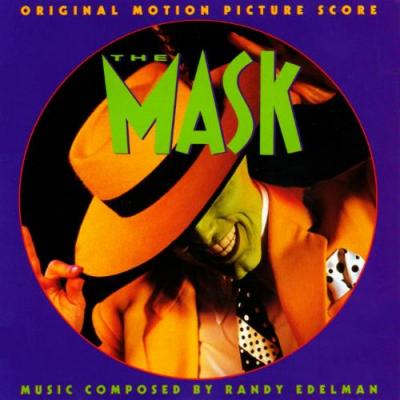
"Mask, The" Soundtrack Lyrics
Movie • 1994
Track Listing
C&C Pop Radio Edit
Xscape
Domino
Tony! Toni! Tone!
Harry Connick, Jr.
Vanessa Williams
K7
Fishbone
The Brian Setzer Orchestra
Royal Crown Revue
Susan Boyd
Jim Carrey
"The Mask: Music From The Motion Picture" – Album Guide to Tracks and Key Scenes
Overview
What does a cartoon in human form sound like? In The Mask: Music From The Motion Picture, the answer is brass stabs, jump-blues horns, Latin breaks and early-90s R&B running into each other at full speed. The 1994 film turns timid bank clerk Stanley Ipkiss into a Tex Avery fever dream; the song soundtrack does the same thing to mainstream radio, mashing big-band swing with New Jack swing and hip-hop.
The film’s story arc is simple: arrival (Stanley finds the mask), adaptation (he learns how far it will push him), rebellion (against mobsters and cops) and a messy collapse that forces him to choose who he wants to be without the green face. The album follows that: early tracks feel like club wallpaper, then the big band and Latin cues slam in once “The Mask” persona hits Coco Bongo and the streets. By the time “Cuban Pete” rolls around, the record has fully committed to live-action cartoon logic.
Two officially released albums cover the music: the song compilation The Mask: Music From The Motion Picture and Randy Edelman’s The Mask (Original Motion Picture Score). Here we focus on the song album but keep the score in the conversation where it shapes key scenes. Stylistically, the disc falls into three broad zones: slick R&B / New Jack and pop (“Who’s That Man”, “You Would Be My Baby”), hard-swinging jump jazz and Latin-coloured big-band (“Straight Up”, “Hey! Pachuco!”, “Let the Good Times Roll”), and a cluster of novelty / diegetic set-pieces (“Gee Baby, Ain’t I Good To You”, “Cuban Pete”) that are welded to major beats in the film. That mix is exactly why people still point to this disc when they talk about the mid-90s swing revival.
How It Was Made
The soundtrack had to do two slightly different jobs. New Line wanted a contemporary compilation that could sit on shelves next to other 1994 tie-ins, so Chaos/Columbia built a various artists album: R&B acts like Xscape and Vanessa Williams, rap-adjacent cuts like Domino’s “This Business of Love”, plus cult-friendly ska-funk outfit Fishbone and The Brian Setzer Orchestra for the retro swing. At the same time, director Chuck Russell needed very specific diegetic songs for the Coco Bongo nightclub and the mask’s set-pieces.
That’s where Royal Crown Revue and Fishbone come in. Royal Crown Revue were brought into the production to physically appear as the house band at Coco Bongo; their tune “Hey! Pachuco!” became the huge dance sequence for the mask and Tina on the club floor and later a marketing hook. Fishbone’s cover of “Let the Good Times Roll” is used with the band appearing on screen as part of the club’s charged, slightly grimy atmosphere.
The official compilation, The Mask: Music From The Motion Picture, hit in July 1994. It opens with Jim Carrey’s “Cuban Pete” remix and closes with the “Arkin Movie Mix” of the same, bracketing a run of Xscape, Domino, Tony! Toni! Toné!, Harry Connick Jr., Vanessa Williams, K7, Fishbone, The Brian Setzer Orchestra, Royal Crown Revue and Susan Boyd. A score album followed, The Mask (Original Motion Picture Score), written and conducted by Randy Edelman and recorded with the Irish Film Orchestra at Windmill Lane Studios in Dublin. Both albums are short by modern standards, but together they cover almost everything you hear in Edge City’s clubs, alleys and night streets.
One film-music review notes that Edelman’s score works with two main themes – a tender woodwind idea for Stanley and a brass-heavy motif for the mask itself – while the songs handle the overt “cartoon nightclub” vibe. That division is important: the compilation is the sound of the mask taking over the room; the score is the nervous pulse underneath.
Tracks & Scenes – Key Songs and Screen Moments
This is not a full tracklist; it highlights how the most important songs hit the screen. Timecodes vary by release, but the placement and function are consistent.
"Gee Baby, Ain’t I Good To You" — Susan Boyd (Cameron Diaz lip-sync)
Where it plays: Tina Carlyle’s entrance at Coco Bongo. The club lights drop to amber, the band slides into slow swing, and Tina glides onto the stage in a clingy dress, singing directly to the room – and, effectively, to Stanley in his cheap suit. The camera alternates between a sultry close-up of her and Stanley’s stunned reaction. Entirely diegetic: this is the club’s featured performance, a classic standard done smoky and low.
Why it matters: This is the moment the film sells Tina as a genuine star, not just “the girlfriend of a mobster”. It also sets the contrast the soundtrack keeps playing with: languid, old-school jazz for genuine desire; hyperactive cartoon swing for the mask’s chaos later. The album version lets you hear Susan Boyd’s full vocal, which the film partly buries under crowd noise.
"Hey! Pachuco!" — Royal Crown Revue
Where it plays: Same night, same club, shortly afterward. The mask, having robbed the bank, crashes Coco Bongo in a yellow zoot suit. When he drags Tina on stage for a dance, he snaps at the band to switch gears, and Royal Crown Revue slam into “Hey! Pachuco!”. Brass hits, slap bass and tom rolls lock into a frantic tempo as they tear across the dance floor in a choreographed routine that nods to Fred Astaire and Gene Kelly. It’s fully diegetic, with the band on camera and the crowd clapping in time.
Why it matters: This is the film’s signature musical scene and the centerpiece of the soundtrack. The horn arrangements and shouted interjections are pure modern swing revival, years before most people discovered the style via ads and retro compilations. It also marks the point where Tina starts falling for the man under the mask, even if she doesn’t realise it yet.
"Let the Good Times Roll" — Fishbone
Where it plays: Later in the film at Coco Bongo during the charity ball sequence, just before Dorian storms in. Fishbone appear on stage, hammering through the New Orleans standard in their own ska-funk hybrid style, while the wealthy crowd mingles and toasts each other on the floor. It’s pure diegetic club music, but it also functions as ironic commentary: everyone’s celebrating under the illusion that things are under control.
Why it matters: This track underlines how weird Edge City’s culture is – high society and heavy horns in the same room. It also quietly connects The Mask to a long line of films that used Fishbone as the in-universe band for chaotic parties and bars.
"Straight Up" — The Brian Setzer Orchestra
Where it plays: In and around Coco Bongo as the house band material cycles, and in montage material tied to the club’s wild reputation. The song’s arrangement is all punchy horn riffs, slap bass and Setzer’s sharp guitar, with breaks that let the brass section show off while background characters drink, flirt and gamble. In the film it behaves like needle-drop source music: coming out of the club’s PA, cutting in and out as scenes move.
Why it matters: According to one Cinema Sounds write-up, this track is a clear template for the big-band revival that would become mainstream a few years later. It gives the album a straight, no-gimmick swing cut without dialogue or comedy layered on top.
"This Business of Love" — Domino
Where it plays: Over scenes establishing Dorian Tyrell’s operations and the general criminal undercurrent in Edge City. The groove leans on early-90s R&B-rap production: thick bass, programmed drums, sung hook, rap verses. Depending on the cut, it comes in as Tyrell and his men talk plans or stride through the club spaces.
Why it matters: This is the soundtrack’s nod to contemporary radio. It doesn’t play as comedy; it grounds the movie in the mid-90s instead of pure throwback fantasy, making the jump to cartoon swing more violent and, therefore, funnier.
"Who’s That Man" — Xscape
Where it plays: As a source track around the club and during transitional scenes focused on Tina’s dangerous relationship with Dorian. Warm R&B harmonies sit over a laid-back beat while the camera lingers on Tina observing the room and realising how trapped she is. The characters treat it as background; the mix keeps vocals high enough that you can still enjoy it as a song.
Why it matters: On album, this track is one of the clearest reminders that the record is also meant to be a standalone R&B compilation, not just a novelty disc. It balances the brass-heavy material and broadens the record’s audience beyond swing and cult-film fans.
"(I Could Only) Whisper Your Name" — Harry Connick Jr.
Where it plays: As lounge-style source in quieter moments touching Michael’s romantic yearning for Tina and general late-night moods in the city – notably on television and in the background at home. Connick’s croon and jazz-piano phrasing echo the standards sung in the club but tie them to Stanley’s more private, vulnerable moments.
Why it matters: It’s the “straight” romantic thread on the album. No gags, no slapstick. That sincerity makes the mask persona feel even more unhinged when the music flips back to cartoon mode.
"You Would Be My Baby" — Vanessa Williams
Where it plays: As slick, radio-friendly source music around scenes that focus on Tina away from the Coco Bongo stage and on general city nightlife. The song’s clean pop-soul production keeps the film anchored to 1994 while cameras drift past neon and taxis.
Why it matters: The track helps sell Tina as someone who belongs in a glamorous, mainstream pop world, not just in smoky retro clubs. On the album it sits nicely between the more aggressive cuts, a palate cleanser before things get loud again.
"Hi De Ho" — K7
Where it plays: At the charity party inside Coco Bongo, just before Dorian crashes the event. The track riffs on “Minnie the Moocher” in a 90s club style; guests are dancing and drinking as the camera prowls the floor, giving us a last look at normality before the guns come out.
Why it matters: It’s a direct bridge between Cab Calloway’s big-band call-and-response tradition and the film’s cartoon tone. The Mask Wiki notes the explicit melodic link, and once you hear it you can’t unhear it.
"Cuban Pete" (C&C Pop Radio Edit) — Jim Carrey
Where it plays: Mid-film, when the police corner the mask in the street outside his apartment. To avoid arrest, he launches into a full-blown conga line, turning cops into backup dancers as he croons “Cuban Pete” in a mock-Latin accent. The track on the album is a remixed, radio-ready version with extra percussion and backing vocals; the scene mix matches it closely but leaves in more crowd noise.
Why it matters: This is the album’s most blatant novelty cut. It also shows how dangerous the mask is: he can literally weaponise music and charisma to disarm law enforcement. The fact that the song itself is a 1940s Desi Arnaz number, repackaged here with dance-mix polish, fits the soundtrack’s whole retro-meets-90s approach.
"Cuban Pete (Arkin Movie Mix)" — Jim Carrey
Where it plays: This mix runs closer to the film version and closes the album. It keeps in more of the call-and-response and hand-clap energy from the scene, with slightly less studio sheen.
Why it matters: Treat it as a curtain-call. After a run of songs that bounce between club cool and violence, this track shoves you back into pure silliness, right where the film leaves Stanley and Milo at the bridge.
Notes & Trivia
- The song album and Randy Edelman’s score album were released separately in 1994; casual buyers usually encountered only the various-artists compilation.
- “Gee Baby, Ain’t I Good To You” is an old jazz standard; Susan Boyd dubs Cameron Diaz’s vocals, a detail many viewers miss and only discover years later.
- Royal Crown Revue’s on-screen cameo and “Hey! Pachuco!” placement are often cited as one catalyst for the late-90s swing revival.
- Fishbone’s “Let the Good Times Roll” marks yet another film where the band both appear on screen and contribute to the soundtrack, continuing a long run of cult-movie cameos.
- The separate score album opens with “Opening – The Origin of the Mask” and ends with “Finale”, giving a more orchestral, less club-driven view of the story.
Music–Story Links
The Mask’s soundtrack doesn’t just decorate scenes; it mirrors Stanley’s psychology. Before he puts the mask on, the music we notice most is slow and wistful: Tina’s “Gee Baby…” performance, the crooner textures around Stanley’s lonely nights. Once he wears the mask, the sound flips almost instantly to hyper-swing and Latin party tracks – the musical equivalent of his id taking the wheel.
Coco Bongo itself is scored as a character. The mix of standards, neo-swing and funk tells us this is a liminal place where old Hollywood glamour, underworld crime and cartoon physics overlap. “Gee Baby…” is the fantasy of classic romance; “Hey! Pachuco!” is the same room weaponised as a chaos engine when the mask arrives; “Let the Good Times Roll” becomes the soundtrack to a potential massacre.
The choice of “Cuban Pete” for the police stand-off is deliberate. It’s not just a random Latin number; it’s a pop-culture artifact from another era, re-cut for 1994, just as Stanley is an ordinary man re-cut as something dangerously flamboyant when he puts on the mask. The fact that he turns a firing squad into a carnival line says everything about how music functions in this film: it’s not background, it’s mind control.
Edelman’s score fills the gaps that songs can’t cover. Woodwind and string writing soften Stanley’s scenes with Tina when he’s just himself, while low brass and cartoonish percussion underline Dorian’s violence and the mask’s more sinister edges. The song album gives you the club, the joke and the swagger; the score gives you the nerves, guilt and romance.
Reception & Quotes
The film was a hit, and the soundtrack rode its slipstream. The compilation album cracked the Billboard 200, a decent showing for such an eccentric mix of styles. Commentators later pointed out that, before big retail campaigns made swing fashionable again, The Mask had already smuggled jump-blues and zoot-suit aesthetics into multiplexes.
One retrospective described the disc as “a seamless intertwining of swing, lounge and modern R&B, giving an updated glaze to old school club music from previous decades.” Another, more sceptical, take called it “brash and brassy, but mostly unauthentic,” while still admitting that the sheer energy makes it hard to dislike. Fans often single out the Royal Crown Revue and Brian Setzer cuts as the real keepers, with Jim Carrey’s “Cuban Pete” landing firmly in the “love it or skip it” pile.
Film-music writers paid more attention to Edelman’s orchestral score, which some compared to the comic work of David Newman mixed with a lighter Goldsmith-style action language. Still, even those reviews usually concede that the club tracks are half the reason the movie feels this cartoony. The combination – goofy songs plus earnest score – is what keeps The Mask’s tone from collapsing.
“This soundtrack is a wild card in ’90s film music – big band horns, Latin rhythms and New Jack R&B somehow spinning in the same orbit.” — soundtrack commentary
“Like the film, it’s gaudy, dated and oddly charming; ‘Hey! Pachuco!’ and ‘Gee Baby…’ are the real gold.” — album review
“Edelman’s score provides the heart; the needle drops deliver the grin.” — film-music analysis
“Big band, Latin and hip hop rhythms meet on the soundtrack to Jim Carrey’s comedy hit The Mask.” — later swing-revival overview
Interesting Facts
- There are effectively three different “Cuban Pete” experiences tied to the film: the film mix, the C&C Pop Radio Edit and the Arkin Movie Mix closing the album.
- Royal Crown Revue’s profile jumped sharply after the film; they later featured heavily in swing-revival tours and compilations.
- “Gee Baby, Ain’t I Good To You” predates the film by decades; The Mask helped introduce it to a generation that had never heard it outside jazz records.
- Fishbone’s “Let the Good Times Roll” cemented their reputation as the go-to band when a director wanted a chaotic, high-energy club scene.
- The score album is relatively short (16 tracks) and was initially harder to find than the song compilation, becoming a cult item among Edelman fans.
- One background cue in the mechanics’ garage uses opera (“Vesti la giubba”) as a joke about Stanley’s humiliation, underscoring how eclectic the film’s music choices really are.
- The Mask’s success helped director Chuck Russell argue for similarly bold musical choices on later projects, even when those films weren’t overt comedies.
- Several later trailers and TV spots for unrelated films borrowed “Cuban Pete” or “Hey! Pachuco!” to signal “wild, chaotic fun” in just a few seconds.
Technical Info
- Album title (songs): The Mask: Music From The Motion Picture
- Film: The Mask (1994) – US action/comedy/fantasy based on the Dark Horse comic
- Year of film release: 1994
- Year of song album release: 1994 (July; Chaos/Columbia)
- Year of score album release: 1994 (TriStar Music / Epic Soundtrax)
- Type: Various-artists film soundtrack (songs); separate orchestral score album
- Key song artists: Jim Carrey, Xscape, Domino, Tony! Toni! Toné!, Harry Connick Jr., Vanessa Williams, K7, Fishbone, The Brian Setzer Orchestra, Royal Crown Revue, Susan Boyd
- Score composer: Randy Edelman; performed by the Irish Film Orchestra
- Score recording: Windmill Lane Studios, Dublin
- Representative song highlights: “Gee Baby, Ain’t I Good To You”, “Hey! Pachuco!”, “Let the Good Times Roll”, “Straight Up”, “This Business of Love”, “Who’s That Man”, “(I Could Only) Whisper Your Name”, “Cuban Pete” (various mixes)
- Representative score cues: “Opening – The Origin of the Mask”, “Tina”, “Carnival”, “Transformation”, “Tango in the Park”, “Lovebirds”, “Milo to the Rescue”, “The Mask Is Back”, “Finale”
- Genre tags: Soundtrack, swing, jazz, Latin, R&B, hip hop, film score
- Chart notes (song album): Reached the lower half of the Billboard 200 in 1994
- Labels: Chaos Recordings / Columbia (songs); TriStar Music / Epic Soundtrax (score)
- Availability: Song album and score are both available on major streaming platforms; original 90s CDs and tapes remain common on the second-hand market.
Questions & Answers
- Is The Mask soundtrack mainly swing music?
- No. Swing and jump-blues are the most distinctive flavours, but the album also includes contemporary R&B, hip hop-influenced tracks and smooth pop ballads. That stylistic clash is part of its identity.
- What song plays when the Mask dances wildly with Tina at Coco Bongo?
- That dance is set to “Hey! Pachuco!” by Royal Crown Revue, performed on screen by the band as the Mask drags Tina across the floor in full yellow zoot suit.
- Is Cameron Diaz really singing in the club scenes?
- On screen she appears to sing “Gee Baby, Ain’t I Good To You”, but the vocal is by Susan Boyd, who dubs Tina’s singing voice for the film and the album.
- Are “Cuban Pete” and “Cuban Pete (Arkin Movie Mix)” different recordings?
- They use the same basic performance by Jim Carrey, but the C&C Pop Radio Edit adds more remix polish for radio, while the Arkin Movie Mix stays closer to the film arrangement and placement.
- How does the score album differ from the song compilation?
- The score album drops all the club songs and focuses on Randy Edelman’s orchestral cues, highlighting romantic, suspense and action material that often sits under dialogue in the movie.
Canonical Entities & Relations
| Subject | Relation | Object |
|---|---|---|
| The Mask: Music From The Motion Picture | compiles songs for | The Mask (1994 film) |
| The Mask (Original Motion Picture Score) | scores | The Mask (1994 film) |
| Randy Edelman | composed and conducted | The Mask (Original Motion Picture Score) |
| Royal Crown Revue | performed | “Hey! Pachuco!” for The Mask soundtrack and film |
| Fishbone | performed | “Let the Good Times Roll” for The Mask soundtrack and appears in the film |
| Jim Carrey | performed | “Cuban Pete” for The Mask soundtrack |
| Susan Boyd | performed vocals for | “Gee Baby, Ain’t I Good To You” in The Mask |
| The Mask (1994 film) | is based on | The Mask comic series (Dark Horse Comics) |
| Chuck Russell | directed | The Mask (1994 film) |
| New Line Cinema | distributed | The Mask (1994 film) |
| Chaos Recordings / Columbia | released | The Mask: Music From The Motion Picture |
| TriStar Music / Epic Soundtrax | released | The Mask (Original Motion Picture Score) |
| The Mask (1994 film) | starred | Jim Carrey as Stanley Ipkiss / The Mask |
| The Mask (1994 film) | introduced | Cameron Diaz as Tina Carlyle |
| The Mask: Music From The Motion Picture | features tracks by | Xscape, Domino, Tony! Toni! Toné!, Harry Connick Jr., Vanessa Williams, K7, Fishbone, The Brian Setzer Orchestra, Royal Crown Revue, Susan Boyd |
Sources: Wikipedia – The Mask (1994 film) & music; The Mask soundtrack and score listings from Discogs, AllMusic, Amazon and Archive.org; Cinema Sounds feature on The Mask soundtrack; SoundtrackInfo and MovieMusic tracklists and Q&A; The Mask Wiki (Fandom) song placement notes; Fishbone and “Gee Baby, Ain’t I Good To You” entries; film reviews and later swing-revival retrospectives discussing the album’s role in 90s culture.
November, 15th 2025
A-Z Lyrics Universe
Cynthia Erivo Popular
Ariana Grande Horsepower
Post Malone Ain't No Love in Oklahoma
Luke Combs Good Riddance (Time of Your Life)
Green Day Bye Bye Bye
*NSYNC You're the One That I Wan
John Travolta & Olivia Newton-John I Always Wanted a Brother
Braelyn Rankins, Theo Somolu, Kelvin Harrison Jr. and Aaron Pierre The Power of Love
Frankie Goes to Hollywood Beyond
Auli’i Cravalho feat. Rachel House MORE ›