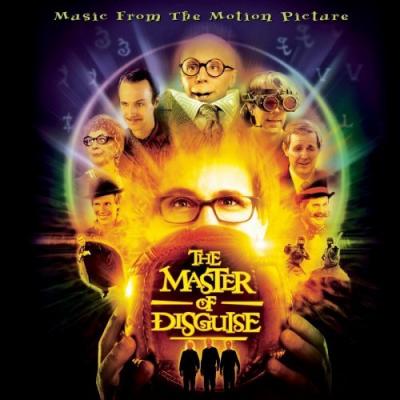
"Master Of Disguise" Soundtrack Lyrics
Movie • 2002
Track Listing
Play faet. Lil' Fizz
Rose Falcon
Destiny's Child
Strong
Val C
Vitamin C
Devin
Miami Sound Machine
Solange Knowles
Jhene
Hardhedz/Play
The Rayn
"The Master Of Disguise – Music From The Motion Picture" – Album Guide to Tracks and Key Scenes
Overview
Can a soundtrack built out of teen-pop, cartoonish needle drops and classic rock anthems rescue a film that critics almost unanimously hated? The Master of Disguise soundtrack more or less bets the house on that idea. What it delivers is less a subtle score and more a sugar rush of early-2000s pop and familiar hooks pasted across 80 brisk minutes of gags.
The film itself follows Pistachio Disguisey, a hapless Italian waiter who discovers he comes from a long line of “Masters of Disguise” and must rescue his kidnapped parents from art smuggler Devlin Bowman. The story plays like a live-action cartoon: thin plot, broad characters, and set pieces built almost entirely around Dana Carvey’s voices and costumes. The music mirrors that approach. Original scoring by Marc Ellis mostly stays in the background, while the pop soundtrack steps forward any time the movie wants to yell, “This is fun now!”
Heard on its own, the album is a snapshot of Columbia/Sony’s turn-of-the-millennium roster: Destiny’s Child, Solange, Vitamin C, teen group Play with Lil’ Fizz from B2K, plus Latin pop via Miami Sound Machine and a bubblegum track from Rose Falcon. The film then piles on a second layer of recognizable catalog songs — Devo, Reel 2 Real, Survivor, M.C. Hammer, Madonna — often used for quick parody beats rather than emotional depth.
The arc the soundtrack traces is simple: arrival, adaptation, rebellion, collapse. Early cues lean on bright, radio-friendly pop to sell Pistachio’s wide-eyed innocence. Mid-film, harder-edged club tracks and novelty songs crash into the disguises and action sequences. By the finale and extended credits, the film leans back into affirming R&B and its in-house rap theme, trying to send viewers out with something warmer than fart jokes. Genre-wise that means: teen pop and soft rock for vulnerability, club-ready dance and hip-hop for “attitude,” and borrowed classical or score themes for surface polish and parody.
How It Was Made
The score is credited to composer Marc Ellis, working under the Happy Madison / Revolution Studios umbrella. His orchestral cues — especially the whimsical opening — sketch a more conventional family fantasy, with strings and woodwinds hinting at something closer to a children’s adventure film than a pure gag reel.
The commercial soundtrack, however, was built as a label sampler. Music World Music/Columbia/Sony Music Soundtrax released The Master Of Disguise – Music From The Motion Picture in July 2002, just ahead of the film’s August theatrical opening, showcasing then-emerging Columbia artists like Play, Solange, Rose Falcon, Devin Vasquez and Jhene alongside established acts such as Destiny’s Child, Miami Sound Machine and Vitamin C.
“M.A.S.T.E.R. Part 2” by Play featuring Lil’ Fizz was pushed as the lead single, complete with a Radio Disney campaign and a music video featuring multiple soundtrack artists. That decision tells you the strategy: sell a kid-friendly, high-energy pop brand first, the film second. Fans who discovered the songs on TV or radio sometimes arrived at the movie expecting a glossy teen comedy, only to find something stranger and more chaotic.
Behind the scenes, the music editors had to weave together three competing layers: Ellis’s score, the album’s original pop/R&B tracks, and short quotations from famous themes (“Chariots of Fire,” “Tubular Bells,” “Theme from Jaws,” “Eye of the Tiger”). The result is dense: very few scenes play without either a song or a pastiche cue underneath, which gives the film an almost channel-surfing feel.
Tracks & Scenes
This section focuses on how specific songs hit specific moments. Time ranges are approximate and based on the standard ~80-minute cut.
"Fun" – Rose Falcon
Where it plays: After the prologue in Palermo, the film jumps to present-day America and into its title sequence. “Fun” slides in as the orchestral opening drops out, over bright shots of Pistachio biking and working around his family’s restaurant. The vocals sit on top of wide daylight shots and slapstick waiter business, non-diegetic and mixed fairly loud for a credits cue. The moment lasts a couple of minutes and essentially functions as the “our hero is a lovable dork” montage.
Why it matters: As an original song recorded for the film, “Fun” was meant to function as a de facto theme. Its relentlessly upbeat production fights against the slightly sad picture of Pistachio’s life — mocked by customers, misunderstood by Sophia — and that clash becomes a micro-version of the film’s tone problem. On the album, though, it plays like a standard early-2000s feel-good pop track and sets up the rest of the compilation cleanly.
"I Like To Move It" – Reel 2 Real featuring The Mad Stuntman
Where it plays: Roughly 17 minutes in, Pistachio’s grandfather narrates the secret history of the Disguisey family. We cut to Abraham Lincoln on the campaign trail, struggling to win over a bored crowd. Lincoln excuses himself “for a drink of water,” then re-emerges with a whistle and shouts “Let’s party! Hit it, boys!” as “I Like To Move It” blasts out. The track is non-diegetic in the sense that the movie doesn’t show a band or source, but characters react as if they hear it, so it plays as a cartoony diegetic gag. The sequence runs under a minute, all quick cuts of Lincoln dancing and a horrified audience while the chorus repeats.
Why it matters: This is one of the purest examples of the soundtrack being used as punch line. The song is iconic enough that even a few bars immediately signal “cheap party,” turning Lincoln into a proto-meme. For Pistachio, it’s also a reveal: this ridiculous musical detour is part of his “legacy” as a Disguisey, something the film underlines when Grandfather says, “Well, this is your legacy, Pistachio,” directly after the dance.
"Training rap / Master of Disguise theme" – Play, Vitamin C and collaborators
Where it plays: At about the 21-minute mark, Grandfather finally begins Pistachio’s formal training in his father’s “nest” — a hidden lair revealed in the attic. As the training starts, a rap kicks in with lines like “Listen up, I got a story to tell / about the dopest new hero and I know him so well,” followed by a chorus repeating “He’s the master of disguise.” Variants of this theme recur later, including the ninja-dojo fight and the late-film raid on Bowman’s compound, and again over the main closing credits where the chorus spells out “M-A-S-T-E-R of Disguise.”
Why it matters: On the album, these ideas are split across multiple tracks — “Master Of Disguise” and the two “M.A.S.T.E.R.” cuts — but on screen they blur into one suite: the film’s own “hero theme,” filtered through early-2000s pop-rap. It reframes Pistachio’s buffoonery as something aspirational for kids, leaning on Will-Smith-style movie-single logic: if the rap is catchy enough, maybe you remember the character more fondly than the jokes deserve.
"Whip It" – Devo
Where it plays: Mid-film, Pistachio and Grandfather place an ad for an assistant, leading into a montage of increasingly unsuitable candidates. “Whip It” rolls over the entire sequence as a non-diegetic track: quick cuts of applicants bragging, failing, or storming out line up with beats and instrumental stabs. The camera rarely stays long on anyone; the music is the glue. The moment lasts around a minute, functioning like a music-video break inside the movie.
Why it matters: The choice is deliberately incongruous — a sharp, late-70s new-wave song pasted onto a kids’ comedy hiring montage. That mismatch has drawn criticism, but it also underlines how transactional the scene is: we’re not learning anything new about Pistachio or Jennifer; we’re just burning through a gag reel while a “cool” catalog song plays.
"Conga" – Miami Sound Machine
Where it plays: Around the 50-minute mark, Jennifer accompanies Bowman to a flashy party at his mansion while Pistachio slips in under a new disguise, the infamous “Mr. Peru.” On the dance floor, he suddenly steals the room, launching into wild hips-first moves as “Conga” hits full volume. The song is diegetic, blasted through the party speakers while Bowman’s guests form a conga line behind Pistachio. The cue runs for a good chunk of the sequence, only ducking in volume when Bowman notices “this idiot is ruining my party” and demands he be brought over. Immediately after, the film pivots into a Jaws spoof around the pool, still rhythmically linked to the Latin groove.
Why it matters: “Conga” is one of the few soundtrack choices that genuinely fit the on-screen energy: it’s big, shameless and a little exhausting, exactly like the Peru character. It also marks Pistachio’s first real success at weaponizing his disguises socially rather than just for slapstick, turning the entire party’s attention in his favour long enough for Jennifer to search for clues.
"Happy Face" – Destiny’s Child
Where it plays: In the final stretch — after Bowman’s defeat, the restoration of the stolen artifacts, and Pistachio’s ascension as a “true” Master of Disguise — “Happy Face” drops in over a string of celebratory material. It starts as the grandfather officiates Pistachio and Jennifer’s wedding, then continues into the extended credit sequence made up of outtakes, improvised riffs (“You like the juice?” reprises, fake interviews, extra disguises) and bits that look half-behind-the-scenes. The track plays non-diegetically but feels almost like a music-video overlay for a “greatest hits” montage.
Why it matters: After 70 minutes of frantic jokes, “Happy Face” tries to reframe the whole experience as something affirming: grateful, resilient, lightly spiritual. It also ties the film to Destiny’s Child at a moment when the group sat near the centre of mainstream pop. In practice, the warmth of the song clashes with the chaos of the footage, but on the album it stands out as one of the more polished, fully formed tracks.
"This Could Be Love" – Solange
Where it plays: The film uses “This Could Be Love” much more sparingly than the album might suggest. It surfaces late, associated with the softening of Pistachio and Jennifer’s relationship — more background mood than spotlight moment, often mixed low under dialogue or transitional shots rather than as a full montage. Many viewers only really “hear” it on the album, where its mid-tempo R&B production and Solange’s vocal make it feel like an out-of-town cousin to Destiny’s Child’s contribution.
Why it matters: On record, this is one of the more emotionally grounded songs: gentle, melodic, and decidedly romantic. It hints at the movie that could have been — a character-centric rom-com about a socially awkward mimic falling for a grounded single mom — rather than the gag machine we got. The fact that its impact lands primarily via the album rather than the film says a lot about where the creative energy went.
"Don't Stop (Doin' It)" – Anastacia
Where it plays: “Don’t Stop (Doin’ It)” is tied more to the film’s marketing than to any single on-screen set-piece. It appears in studio-curated track lists and promo tie-ins, and brief snippets of it surface in certain TV spots and international trailers. In the film proper, if it plays at all in a given cut, it’s as a short, quickly-faded needle drop rather than a sustained set-piece cue.
Why it matters: The track demonstrates how aggressively the producers leaned on then-current Columbia artists to extend the movie’s footprint into music channels. For soundtrack collectors, it adds a dose of polished adult-leaning pop that otherwise sits slightly to the side of the film’s more kid-oriented material.
"Eye of the Tiger" – Survivor
Where it plays: Used (briefly) as a parody sting during one of the film’s fight beats, “Eye of the Tiger” appears in the movie as a wink to the entire Rocky training-montage tradition. Rather than a full verse-chorus run, the film typically grabs the instantly recognizable guitar intro and first bars of the verse, then either cuts it off with a gag or lets it crash into another musical joke.
Why it matters: This sort of micro-quotation is part of the film’s broader collage approach: it relies less on original scoring than on the audience’s pre-existing associations with songs. Hearing “Eye of the Tiger” for a second or two is enough to frame Pistachio’s flailing as “heroic training,” even if the actual choreography is absurd.
"U Can't Touch This" – M.C. Hammer, and other brief drops
Where it plays: Like “Eye of the Tiger,” “U Can’t Touch This,” “Papa Don’t Preach,” “Tubular Bells,” “Chariots of Fire” and “Theme from Jaws” enter and exit quickly, usually attached to a single visual gag: a churchly scolding, a slow-motion run, a horror pastiche, a shark monologue at the pool. They are almost always non-diegetic and often truncated mid-phrase to land a joke.
Why it matters: These cues make the movie feel like a jukebox of late-20th-century pop culture. You recognize the riff, you get the joke, you move on. For some viewers the effect is numbing; for others it’s a kind of proto-meme editing that anticipates the way later internet culture raids old songs for punch lines.
Notes & Trivia
- The commercial album and the film’s actual music track differ: not every song on the OST is clearly foregrounded in the final cut, and vice versa.
- “Fun,” “This Could Be Love,” “Master Of Disguise” and the “M.A.S.T.E.R.” tracks were all promoted as original recordings tied to the film rather than simple library picks.
- “M.A.S.T.E.R. Part 2” received a dedicated music video with Play and Lil’ Fizz, functioning almost like a parallel mini-movie for the soundtrack’s pop-rap branding.
- The Disguisey history montage crams environmental activism, art theft, and presidential politics into under two minutes, stitched together largely by “I Like To Move It” and score flourishes.
- Several famous themes — “Tubular Bells,” “Chariots of Fire,” “Theme from Jaws” — are used so briefly they can fly past a casual viewer, but they still had to be licensed.
Music–Story Links
The soundtrack rarely deepens character psychology, but it does trace Pistachio’s arc in broad strokes. Early on, the relentless cheer of “Fun” over the title sequence and the bouncy restaurant music frame him as a man out of step with his world, happy in a way no one around him understands.
When Grandfather opens the Disguisey history and training, the tone shifts to collage. “I Like To Move It” in the Lincoln flashback and the rap-driven training montage both tell Pistachio: your heritage is chaotic, shape-shifting, permanently in costume. The music is loud and external, not inner life; his identity is something performed to a beat.
Jennifer’s arrival doesn’t get a dedicated love theme, which is where a more traditional score might lean in. Instead, softer R&B like Solange’s “This Could Be Love” and the warmth of “Happy Face” seep in around the edges of their scenes and the wedding. You feel their emotional arc more strongly listening to the album than watching the film, where the romance takes a back seat to disguises.
The villain, Devlin Bowman, is mostly underscored by gags: Latin dance at the party (“Conga”), action-music parody stings, and the same Master-of-Disguise rap that celebrates Pistachio. That choice flattens the moral register; the soundtrack treats Bowman as another performer in the show rather than a genuinely threatening presence.
By the extended end credits, the film effectively becomes a long music-video for “Happy Face” and the rap theme, retrofitting bloopers and sketch fragments into an affirmation that the chaos we just watched was, above all, “fun.” Whether that works depends entirely on how much patience you have left for the jokes.
Reception & Quotes
The film is notorious for its critical reception: a 1% approval rating on Rotten Tomatoes and a Metacritic score deep in the red. The soundtrack, though, tends to be discussed separately — sometimes as a guilty-pleasure time capsule, sometimes as evidence of how over-produced the project was.
“An ill-conceived attempt to utilize Dana Carvey’s talent for mimicry… an irritating, witless farce.” Rotten Tomatoes consensus
“Like a party guest who thinks he is funny and is wrong.” Roger Ebert, Chicago Sun-Times
“Never have so many jokes clunked off the screen to such a silent audience.” Jamie Russell, BBC
“A film about idiots, made by idiots, for idiots.” Alan Morrison, Empire
The album itself didn’t become a blockbuster seller, but its tracks have lived on in fan playlists and artist discographies. Solange’s “This Could Be Love” and Destiny’s Child’s “Happy Face” often get rediscovered outside the movie, while the Vitamin C / Play material resurfaces periodically in nostalgia threads.
Interesting Facts
- The soundtrack album was released on CD in July 2002, a little over a week before the US theatrical premiere, positioning it as advance promotion.
- “M.A.S.T.E.R. Part 2” was added to Radio Disney’s rotation, a rare push for a song explicitly tied to a PG theatrical comedy.
- Val C’s “Walking On Sunshine” is a cover; the original hit was by Katrina and the Waves, but the film leans on the song’s general familiarity over artist recognition.
- Because of rights and regional catalog differences, some international home-video releases have slightly altered music in a few short cues, though the main pop songs remain intact.
- On streaming platforms today, the album usually appears under the full title The Master Of Disguise – Music From The Motion Picture and is credited to “Various Artists.”
- Vitamin C’s involvement here came between her own solo releases, adding another soundtrack notch alongside earlier work on teen-focused films.
- The film quotes not only popular music but also iconic film themes, effectively turning the soundtrack into a quick-and-dirty tour through late-20th-century media history.
Technical Info
- Title (album): The Master Of Disguise – Music From The Motion Picture
- Film year: 2002
- Work type: Feature-film soundtrack (compilation of various artists + original score)
- Primary composer (score): Marc Ellis
- Key featured artists: Destiny’s Child, Solange, Play featuring Lil’ Fizz, Rose Falcon, Devin Vasquez, Vitamin C, Miami Sound Machine, Jhene
- Label(s): Music World Music / Columbia / Sony Music Soundtrax
- Original album release: 23 July 2002 (US, CD and digital promotions aligned with theatrical roll-out)
- Notable placed songs (in film): “Fun,” “Happy Face,” “This Could Be Love,” “Master Of Disguise” / “M.A.S.T.E.R.” themes, “Conga,” “I Like To Move It,” “Whip It,” “Eye of the Tiger,” “U Can’t Touch This,” excerpts from “Chariots of Fire,” “Tubular Bells,” “Theme from Jaws”
- Availability: Widely available on major streaming platforms as a compilation album; individual tracks also appear on artist albums (e.g., Solange’s material, Destiny’s Child catalog).
- Chart notes: No major long-term chart presence reported; most attention clustered around Radio Disney play and fan discovery of specific tracks rather than the album as a whole.
Questions & Answers
- Is the soundtrack better regarded than the movie itself?
- Generally, yes. While the film is often cited among early-2000s critical flops, the soundtrack is remembered more fondly as a pop-R&B time capsule with a few genuinely solid songs.
- Do all the songs heard in the movie appear on the official soundtrack album?
- No. The album focuses on label-affiliated artists and key pop cues. Several short quotes from older hits and famous film themes are used in the movie but not included on the commercial OST.
- Where does Destiny’s Child’s “Happy Face” actually play in the film?
- It comes in near the ending, over Pistachio and Jennifer’s wedding and the extended outtakes/bonus material that runs during the closing credits.
- What role do the “M.A.S.T.E.R.” tracks play in the story?
- They effectively act as a hero theme suite. Variations of the rap appear during Pistachio’s training, the ninja fight and the climactic raid, and again over parts of the end credits.
- Is the album still easy to find today?
- Yes. It is available on major streaming platforms under its full title, and physical CDs can still be found on the secondary market and occasional catalog re-stocks.
Canonical Entities & Relations
| Subject | Relation | Object |
|---|---|---|
| The Master of Disguise (film) | features character | Pistachio Disguisey |
| Dana Carvey | plays | Pistachio Disguisey |
| Brent Spiner | plays | Devlin Bowman |
| Jennifer Esposito | plays | Jennifer Baker |
| Harold Gould | plays | Grandfather Disguisey |
| James Brolin | plays | Fabbrizio Disguisey |
| Marc Ellis | composed score for | The Master of Disguise (film) |
| Destiny’s Child | performs | “Happy Face” |
| Solange Knowles | performs | “This Could Be Love” |
| Rose Falcon | performs | “Fun” |
| Vitamin C | performs | “Master Of Disguise” |
| Play featuring Lil’ Fizz | performs | “M.A.S.T.E.R. Part 2” |
| Miami Sound Machine | performs | “Conga” |
| Reel 2 Real | performs | “I Like To Move It” |
| Survivor | performs | “Eye of the Tiger” |
| M.C. Hammer | performs | “U Can’t Touch This” |
| The Master Of Disguise – Music From The Motion Picture | is soundtrack to | The Master of Disguise (film) |
| The Master Of Disguise – Music From The Motion Picture | released by | Music World Music / Columbia / Sony Music Soundtrax |
Sources: Sony Music press materials; Ringostrack soundtrack index; Discogs release data; film scripts and subtitles; major reviews (Chicago Sun-Times, Empire, BBC, Rotten Tomatoes); Wikipedia film and regional entries; Tumblr and fan essays discussing scene placements.
November, 15th 2025
A-Z Lyrics Universe
Cynthia Erivo Popular
Ariana Grande Horsepower
Post Malone Ain't No Love in Oklahoma
Luke Combs Good Riddance (Time of Your Life)
Green Day Bye Bye Bye
*NSYNC You're the One That I Wan
John Travolta & Olivia Newton-John I Always Wanted a Brother
Braelyn Rankins, Theo Somolu, Kelvin Harrison Jr. and Aaron Pierre The Power of Love
Frankie Goes to Hollywood Beyond
Auli’i Cravalho feat. Rachel House MORE ›