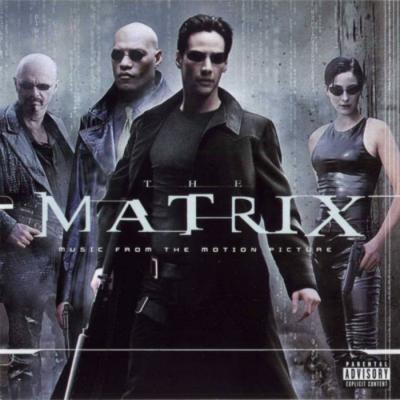
"Matrix" Soundtrack Lyrics
Movie • 1999
Track Listing
Marilyn Manson
Propellerheads
Ministry
Rob D
Meat Beat Manifesto
Lunatic Calm
Prodigy
Rob Zombie
Deftones
Hive
Monster Magnet
Rammstein
Rage Against the Machine
"The Matrix – Music from the Motion Picture & Original Motion Picture Score" – Album Guide to Tracks and Key Scenes
Overview
What if a soundtrack could warn you that your life is a simulation before any character says a word? The Matrix (1999) comes very close. Its music fuses industrial, big beat, metal and an aggressively modern orchestral score so tightly with the images that the album feels like another system running under the film’s code.
The narrative is simple on paper — Thomas Anderson, a weary hacker, follows a white rabbit and discovers that reality is a machine-built prison — but the soundtrack keeps telling you something more: this is not just an action film, it is a mood. Songs like “Dissolved Girl”, “Dragula”, and “Clubbed to Death” catch Neo at three states of mind: numb, shocked and finally awake. The score by Don Davis then threads those beats with dense brass clusters and choral surges that sound like the Matrix itself pushing back.
Across the story, source tracks (music that characters can “hear”) often underline Neo’s life inside the simulation — club speakers, headphones, an old TV — while Davis’s score usually belongs to the “real” world or to the system observing him. That split gives the film its tension: distorted guitars and breakbeats for the cage, dissonant orchestral writing for the machinery that built the cage.
Over time, the combined soundtrack has become a shorthand for a very specific late-90s energy: big beat and industrial metal for rebellion, trip hop and dark electronica for alienation, and angular modern orchestral writing for the cold architecture of the Matrix. Early scenes lean on trip hop and industrial club tracks (Neo’s numb routine), the middle acts pivot into big beat fight music and dense score (training, ambushes, the Oracle), and the finale rides full-throttle rock and radical brass writing to signal Neo’s shift from pawn to anomaly.
How It Was Made
The commercial song album, The Matrix: Music from the Motion Picture, gathers 13 tracks from various artists and was released in March 1999 on Warner Bros. / Maverick, produced by a long list of rock and electronic names including Marilyn Manson, Rob Dougan, Meat Beat Manifesto, Lunatic Calm, Al Jourgensen, Rammstein and members of Rage Against the Machine. It focuses on big beat, trip hop, industrial and metal — essentially the “club and fight” face of the movie.
In parallel, Don Davis composed the orchestral score, later issued as The Matrix: Original Motion Picture Score. He recorded it with a large Hollywood orchestra and chorus at the Newman Scoring Stage in Los Angeles, using tight brass clusters, layered rhythms and atonal harmonies to give the machines their own sound. According to later score analyses and interviews, Davis demoed all cues on synths for test screenings, then orchestrated and recorded the final music in an intense series of sessions with a 90-piece orchestra plus choir.
The Wachowskis and music department took an unusually integrated approach: rock and electronic tracks were chosen early as “needle-drops” for key scenes, and Davis sometimes wrote alternate cues in case licenses fell through. That is why the final film has such seamless transitions between songs and score; the editorial team could cut between pre-cleared tracks and Davis’s music without breaking tempo or energy.
The score has since grown through several releases: the short 1999 album, a 2008 deluxe expansion, a complete score in 2021, and a 25th-anniversary expanded edition on LP, CD and digital in 2024 curated by Davis himself. Those later editions restore much of the music fans only knew from the film — including extended versions of “The Hotel Ambush”, “No More Spoons” and “He’s the One Alright” — and confirm how much of the film’s rhythm comes from the score, not only the famous song placements.
Tracks & Scenes
Below is a selection of the most important cues and songs from The Matrix, with where they play, how they work in the scene, and why they stick.
"Dissolved Girl" — Massive Attack
Where it plays: Around 00:06:40, in Neo’s cramped apartment, the track bleeds out of his headphones while he sleeps at the computer. The room is dark, only lit by the monitor searching for “Morpheus”. The song is diegetic — we hear what Neo hears — until the sudden, eerie text “Wake up, Neo” appears on screen and knocks on the door pull him out of sleep.
Why it matters: The lyrics about repeating patterns and the inability to break free mirror Neo’s stuck life. They foreshadow his feeling that “something is wrong with the world” even before Morpheus says it out loud. The intimate trip-hop texture makes the scene feel personal and interior, not like an action film yet.
"Dragula (Hot Rod Herman Remix)" — Rob Zombie
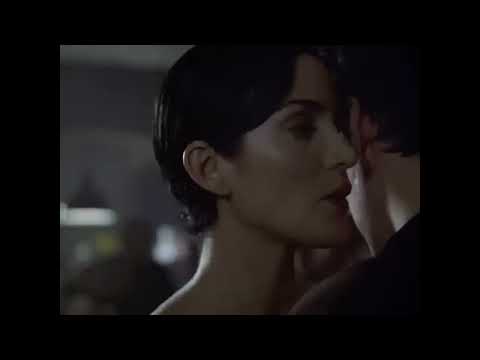
Where it plays: At roughly 00:09:40, in the crowded goth/industrial club where Neo follows the white rabbit tattoo. The track blasts over the PA as strobes cut across bodies on the dance floor. It is fully diegetic: the bass smothers dialogue until Trinity leans in and says, “Hello, Neo.”
Why it matters: The aggressive industrial groove snaps the film out of Neo’s sleepy apartment into a dangerous subculture. It wraps Trinity in a sense of threat and seduction at once — she isn’t just a messenger; she feels like part of an underground scene that Neo only half understands.
"Mindfields" — The Prodigy
Where it plays: Faded in from “Dragula” around 00:10:20, continuing in the same club as Trinity and Neo talk. The camera pulls closer as she says, “My name is Trinity,” and the beat tightens under the dialogue. It remains diegetic, glued to the room’s speakers rather than the score.
Why it matters: Shifting from Rob Zombie to The Prodigy keeps the energy spiky but a bit more hypnotic, matching the way Trinity calmly dismantles Neo’s assumptions. The mix of drum-and-bass textures and distorted synths underlines that this is not just a regular nightclub encounter; it is the door to a different reality.
"Plasticity" — Plastikman (Richie Hawtin)
Where it plays: Also associated with the nightclub sequence, heard as an undercurrent in certain mixes of the scene. Its minimal techno pulse sits under the chatter and strobe lights while Neo tries to process Trinity’s warnings. It is diegetic, part of the club’s DJ set rather than a score cue.
Why it matters: Minimal techno here works almost like an anxiety monitor: repetitive, clinical, and stripped down, echoing the mechanistic side of the Matrix that still surrounds these characters even when they think they’re off the grid.
"Leave You Far Behind (Lunatic’s Rollercoaster Mix)" — Lunatic Calm
Where it plays: About 00:50:20, in the iconic training program where Neo spars with Morpheus on the virtual dojo stage. The film actually uses a hybrid: a mix of Lunatic Calm’s track with Don Davis’s percussive cue “Bow Whisk Orchestra” and the score track “Switch or Break Show”. The music is non-diegetic, synced closely to punches, falls and wire-assisted jumps.
Why it matters: This is the moment where the film proves its action pedigree, and the track’s heavy breakbeat helps sell every impact. The “I’m going to leave you far behind” energy also captures Morpheus’s challenge: Neo has to catch up with a reality that is already sprinting ahead of him.
"Clubbed to Death (Kurayamino Mix)" — Rob Dougan
Where it plays: Around 00:56:30, when Morpheus walks Neo through a training construct of the city streets, culminating in the famous “woman in the red dress” moment. The track is non-diegetic but mixed so prominently it feels like the city’s own pulse. Its strings and piano loop over a slow, heavy beat as pedestrians move in unnatural patterns.
Why it matters: The contrast between classical-sounding strings and a downtempo breakbeat perfectly matches the scene’s theme: everyday reality with something wrong underneath. The sudden freeze on the woman and the Agents appearing lock the music to Neo’s first real brush with how dangerous the Matrix is.
"Prime Audio Soup" — Meat Beat Manifesto
Where it plays: Around 01:07:00, when the crew of the Nebuchadnezzar jack into the Matrix with Neo for their trip to the Oracle. The track starts over a montage of plug-in shots, cables and the loading program’s white void. The film uses only an instrumental portion; the vocals from the album version are held back.
Why it matters: The layered rhythms and glitch textures create a sense of procedural, high-tech ritual. We are watching a routine the crew does all the time, but for Neo it is a near-religious crossing — and the music underscores that this is neither the “real” world nor his old life; it is something in between.
"Minor Swing" — Django Reinhardt & Stéphane Grappelli / Quintette du Hot Club de France
Where it plays: Softly in the background when Neo first enters the Oracle’s apartment, around the mid-film mark. The tune comes from an old TV or radio in the living room; it is clearly diegetic and mixed under the dialogue and the children’s spoon-bending tricks.
Why it matters: The gypsy-jazz standard instantly dates the Oracle’s space as cozy and anachronistic compared to the industrial real world and the cold Matrix cityscapes. It disarms both Neo and the audience: instead of a futuristic temple, we get a kitchen with an old jazz record, which makes the later revelations hit harder.
"I’m Beginning to See the Light" — Duke Ellington (Ella Fitzgerald version in most listings)
Where it plays: Follows “Minor Swing” in the Oracle’s apartment, switching on as she sits down and lights a cigarette. Again, the music is diegetic, coming from the same source in the room, and it continues under their conversation about fate, cookies and broken vases.
Why it matters: The song title is an obvious wink at Neo’s journey, and the smooth swing feel frames the Oracle as someone who has seen all of this before. The relaxed groove under a life-changing prophecy keeps the tone grounded rather than mystical, which is one of the film’s best tricks.
"Begin the Run" — Jimmie Haskell (from Night of the Lepus)
Where it plays: Briefly from the television set in the Oracle’s living room, a second layer of diegetic sound behind the jazz tracks and dialogue. It is easy to miss unless you focus on the TV audio.
Why it matters: The choice of a piece from a campy 1970s horror film about giant rabbits is a sly joke in a movie obsessed with white rabbits and hidden horrors. It is one of those details you only notice on repeat viewings, and it adds to the Oracle’s space feeling oddly stacked with other stories.
"Spybreak! (Short One)" — Propellerheads
Where it plays: At about 01:42:10, during the lobby shootout sequence as Neo and Trinity storm the building to rescue Morpheus. The track is non-diegetic, pumping over slowed-down bullet trails, marble dust and cartwheeling bodies. It drops out and surges back with key action beats as columns explode.
Why it matters: This is the soundtrack’s most famous needle-drop. The big-beat groove and spy-movie brass stabs sell the duo as unstoppable, and the track’s slightly tongue-in-cheek swagger prevents the violence from feeling grim. It is style as a weapon, and the song is a big part of why this scene became a touchstone for action cinema.
"The Hotel Ambush" — Don Davis (score cue)
Where it plays: During the sequence after Neo’s visit to the Oracle, when the Agents ambush the crew in the Matrix hotel. Brass clusters, string runs and choral stabs cut through rapid editing as the team is separated and Mouse is killed. The cue is non-diegetic, completely tied to Davis’s score language rather than any source music.
Why it matters: This is where you really hear what the score brings that the song album cannot. The cue is jagged, rhythmically complex and nearly atonal, amplifying panic rather than cool. It reinforces that, unlike the lobby shootout, this is not a stylish victory but a trap.
"Wake Up" — Rage Against the Machine
Where it plays: Starting around 02:08:45, the song hits right after Neo’s final phone-booth monologue to the Matrix (“I’m going to show them a world without you”). The riff crashes in as he hangs up, puts on his sunglasses and flies upward; it then plays into the first part of the end credits.
Why it matters: This is the political thesis statement of the soundtrack. The lyrics about systemic control and the need to “wake up” line up almost too perfectly with the film’s imagery. It turns the closing moments into a call to action rather than a simple victory lap.
"Rock Is Dead" — Marilyn Manson
Where it plays: Immediately after “Wake Up” in the credits, around 02:11:24. It is non-diegetic in the strict sense (no characters hear it), but at this point we are fully in album-mode; the film is over, and the soundtrack is playing directly to the audience as they leave the theatre.
Why it matters: As a follow-up to Rage Against the Machine, it keeps the energy high while shifting to a more glam-industrial tone. It also ties into the marketing — the track was a single for both Marilyn Manson’s album and the film’s soundtrack — and cements how much this movie lived at the intersection of cinema and late-90s alternative music culture.
"(Can’t You) Trip Like I Do" — Filter & The Crystal Method (trailer only)
Where it plays: Used in the theatrical marketing rather than the film itself, this collaboration scores one of the key trailers, syncing its build-ups and drops to bullet time and slow-motion fights. It does not appear in the movie or on the main Matrix song album; instead, it lives on the Spawn soundtrack.
Why it matters: For many people, this track is tied to their first exposure to The Matrix — a promise of hyper-stylised sci-fi backed by aggressive electronic rock. It shows how carefully the franchise’s sound was curated even outside the feature itself.
Notes & Trivia
- The commercial song album and the orchestral score were released separately — the original 1999 song CD contains no Don Davis score at all.
- Some tracks on the album, like “My Own Summer (Shove It)” and “Du hast”, barely appear (or do not appear) in the film, making the disc part soundtrack, part curated mixtape.
- The dojo fight music in the movie is not the same mix as the album version of “Leave You Far Behind”; the film uses a hybrid with Davis’s score cues.
- Old jazz in the Oracle’s apartment was specifically chosen to contrast with both the futuristic theme and the rusty real-world ship interiors.
- The theatrical and worldwide trailers used several tracks not present in the movie itself, including music by Enigma and the Filter/Crystal Method collaboration.
Music–Story Links
The soundtrack doesn’t just decorate scenes; it mirrors Neo’s internal arc. “Dissolved Girl” marks his life as a dissociated office worker and hacker, passively drifting while a song about leaving plays in his ears. Minutes later, “Dragula” and “Mindfields” drop him into a subculture where the rules are looser, but he is still only a spectator, crowded by bodies and noise.
Once Morpheus pulls him out of the pod and into the real world, the music shifts. Big beat and industrial appear mainly in training programs and stylised action, where Neo is learning to bend rules rather than break the system itself. “Clubbed to Death” lays out that transition literally: Morpheus walks him through a constructed city to teach him how the Matrix deceives him, and the track’s mix of classy strings and grinding beats reflects the shiny surface and corrupted core.
By the third act, songs and score work as a single engine. “Prime Audio Soup” underscores the crew’s clinical efficiency and hints at how routine their high-risk missions have become. “Spybreak!” turns the lobby shootout into a balletic demonstration of control, while Davis’s “The Hotel Ambush” and later cues reassert how fragile that control actually is. When “Wake Up” crashes in over Neo’s end-speech, the soundtrack takes a final step: it stops commenting on Neo and addresses the audience directly, inviting them — at least metaphorically — to take the red pill.
Reception & Quotes
At release, the song album The Matrix: Music from the Motion Picture performed strongly on charts worldwide, reaching the top ten in the US and several European territories and eventually earning multiple gold and platinum certifications. The score album, while shorter and more challenging, quickly built a reputation among film-music fans for its originality and technical craft.
Critics have often separated their reactions into “songs” and “score”. General-audience outlets tended to highlight the rock and electronic tracks — Marilyn Manson, Rage Against the Machine, The Prodigy, Rob Zombie — as a perfect match for the film’s cyber-punk style. More specialist soundtrack reviewers focused on Don Davis’s contribution, noting his use of dense brass clusters, modernist harmony and rhythmic layering to give the Matrix itself a musical identity.
“Don Davis has delivered a very powerful score, very well constructed and superbly orchestrated.”
— early film-music review
“Altogether, The Matrix is extremely original, but it’s not easy listening on album.”
— specialist score critic
“The soundtrack is such a mish-mash of rock, industrial and electronic staples that its longevity only grew stronger with time.”
— retrospective feature
Fans have kept the album alive well beyond the film’s initial run. Online discussions often describe it as a “gateway” record that introduced listeners to big beat, trip hop and industrial metal. The 25th-anniversary score expansion and later vinyl reissues of both song and score albums show that labels still see demand, and the inclusion of The Matrix on lists of “best film soundtracks” underlines its lasting impact.
Interesting Facts
- The song album’s official title in many markets is The Matrix: Music from the Motion Picture, but streaming platforms sometimes label it Music From and Inspired by the Motion Picture The Matrix.
- According to the soundtrack’s chart data, the album reached the US Billboard 200 top 10 and later achieved platinum status in the United States and multiple gold certifications in Europe.
- A 25th-anniversary edition of Don Davis’s score was released in 2024 with expanded track selection and new artwork by illustrator Yuko Shimizu.
- “Spybreak!” became so tightly associated with the lobby scene that later remixes and fan edits often rebuild the sequence around new variations of the track.
- The notorious “Matrix chord” — a stacked, dissonant brass cluster — has been analysed in music-theory videos and papers as a modern textbook example of atonal scoring in blockbuster cinema.
- “Bow Whisk Orchestra” and “Switch or Break Show” are both anagrams of “Wachowski Brothers”, a small in-joke buried in the score cue titles.
- The song album includes “Du hast” by Rammstein, tying the film into the late-1990s wave of German industrial metal’s international popularity, even though the track is barely (if at all) audible in the final mix.
- Some early DVD menus used custom music (“The Conquest of Truth”) inspired by Enigma’s “The Eyes of Truth”, continuing the Matrix habit of blurring official and unofficial sonic worlds.
Technical Info
- Title (song album): The Matrix: Music from the Motion Picture
- Title (score album): The Matrix: Original Motion Picture Score
- Film: The Matrix (feature film, 1999, dir. Lana & Lilly Wachowski)
- Year of initial soundtrack release: 1999 (song album March 30; score May 4)
- Type: Film soundtrack (commercial song compilation) and original motion picture score
- Primary composer (score): Don Davis
- Key song artists: Massive Attack, Rob Zombie, The Prodigy, Lunatic Calm, Rob Dougan, Meat Beat Manifesto, Propellerheads, Rage Against the Machine, Marilyn Manson, Rammstein, Deftones, Monster Magnet, Hive
- Music supervisors / selection: Studio and label-driven A&R with close involvement from the Wachowskis and Don Davis in balancing songs and score (exact credits vary by territory)
- Labels: Warner Bros. / Maverick (song album); Varèse Sarabande / Concord (score and later expanded editions)
- Recording venue (score): Newman Scoring Stage, 20th Century Fox (Los Angeles)
- Genres (song album): Big beat, trip hop, industrial metal, nu metal, rap metal
- Genres (score): Contemporary classical, film score, avant-garde / minimalist-influenced orchestral music
- Notable song placements: “Dissolved Girl” (Neo’s apartment), “Dragula” and “Mindfields” (club), “Clubbed to Death” (woman in red dress simulation), “Prime Audio Soup” (plugging in for the Oracle), “Spybreak!” (lobby shootout), “Wake Up” and “Rock Is Dead” (end credits)
- Trailer / marketing music: Enigma’s “The Eyes of Truth” fragment and “(Can’t You) Trip Like I Do” by Filter & The Crystal Method in key trailers; additional custom trailer cues in later re-releases
- Later releases: Expanded and “complete” score editions (2008, 2021) and a 25th-anniversary expanded edition (2024) on LP, CD and digital
- Chart highlights (song album): Top-10 placements on the US Billboard 200 and several European album charts; platinum in the US and gold in multiple territories
Questions & Answers
- How many official albums make up the Matrix (1999) soundtrack?
- Two core releases: the song compilation The Matrix: Music from the Motion Picture and Don Davis’s orchestral The Matrix: Original Motion Picture Score, plus later expanded score editions.
- Which song plays during the lobby shootout?
- The lobby shootout is scored by “Spybreak! (Short One)” by Propellerheads, used non-diegetically and cut very tightly to Neo and Trinity’s movements.
- What music is Neo listening to when his computer tells him to “follow the white rabbit”?
- Neo is wearing headphones playing Massive Attack’s “Dissolved Girl” in his apartment; the track leaks into the room while his computer begins messaging him.
- Why isn’t Don Davis’s score on the main 1999 song soundtrack CD?
- The 1999 song album was designed as a rock/electronic compilation for retail, while the orchestral score was given its own separate release with different label partners and marketing.
- Is the theatrical trailer music available on the Matrix soundtrack albums?
- Not exactly. The main trailer music includes Enigma material and “(Can’t You) Trip Like I Do” by Filter & The Crystal Method, which appears on the Spawn soundtrack instead of the Matrix albums.
Canonical Entities & Relations
| Subject | Relation | Object |
|---|---|---|
| The Matrix (film, 1999) | directed-by | Lana Wachowski |
| The Matrix (film, 1999) | directed-by | Lilly Wachowski |
| The Matrix (film, 1999) | music-by (score) | Don Davis |
| The Matrix (film, 1999) | features-song | "Dissolved Girl" — Massive Attack |
| The Matrix (film, 1999) | features-song | "Dragula (Hot Rod Herman Remix)" — Rob Zombie |
| The Matrix (film, 1999) | features-song | "Spybreak! (Short One)" — Propellerheads |
| The Matrix (film, 1999) | features-song | "Wake Up" — Rage Against the Machine |
| The Matrix: Music from the Motion Picture | is-soundtrack-of | The Matrix (film, 1999) |
| The Matrix: Music from the Motion Picture | released-by | Maverick Records / Warner Bros. |
| The Matrix: Original Motion Picture Score | composed-by | Don Davis |
| Don Davis | known-for | The Matrix score trilogy |
| Rage Against the Machine | performs | "Wake Up" |
| Propellerheads | performs | "Spybreak! (Short One)" |
| Rob Dougan | performs | "Clubbed to Death (Kurayamino Mix)" |
| Neo (Thomas A. Anderson) | protagonist-of | The Matrix (film, 1999) |
| Trinity | ally-of | Neo (Thomas A. Anderson) |
| Morpheus | mentor-of | Neo (Thomas A. Anderson) |
| Nebuchadnezzar (hovercraft) | operated-by | Morpheus’s crew |
| The Matrix (film, 1999) | set-in | Simulated late-20th-century city; Machine-controlled real world |
Sources: Wikipedia (film, song album, score), Matrix Wiki, AllMusic, Discogs, Soundtrakd, MoviesOST, Filmtracks, MusicWeb International, academic and fan analyses of the score and song placements, label and press announcements for anniversary editions.
November, 15th 2025
A-Z Lyrics Universe
Cynthia Erivo Popular
Ariana Grande Horsepower
Post Malone Ain't No Love in Oklahoma
Luke Combs Good Riddance (Time of Your Life)
Green Day Bye Bye Bye
*NSYNC You're the One That I Wan
John Travolta & Olivia Newton-John I Always Wanted a Brother
Braelyn Rankins, Theo Somolu, Kelvin Harrison Jr. and Aaron Pierre The Power of Love
Frankie Goes to Hollywood Beyond
Auli’i Cravalho feat. Rachel House MORE ›