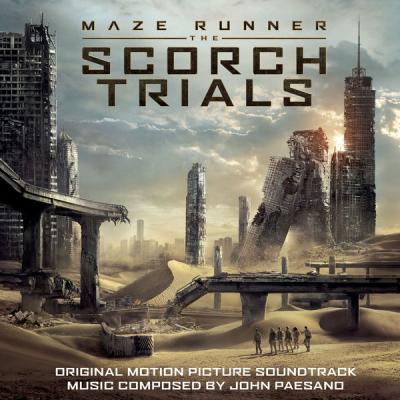
"Maze Runner: The Scorch Trials" Soundtrack Lyrics
Movie • 2015
Track Listing
Patsy Cline
Motorcycle
Crash
One Way
Mercenary
Temporal Shift
"Maze Runner – The Scorch Trials (Original Motion Picture Soundtrack)" – Album Guide to Tracks and Key Scenes
Overview
What does a young-adult dystopia sound like once the walls of the maze fall away and only sand, steel and betrayal remain? The second film in the series, Maze Runner: The Scorch Trials, answers with a score that abandons the puzzle-box feel of the first movie and dives into full-on survival mode. John Paesano’s music stretches across desert vistas, infected cities and underground rebel outposts, keeping a tight grip on tension even when the story scatters the characters in every direction.
The film picks up seconds after the first one ends: Thomas and the other Gladers are “rescued” into a sterile facility, pushed toward a new set of tests, and then blasted out into the ruined world known as the Scorch. The soundtrack mirrors that path. Early cues like “Opening” and “Your New Lives” stay relatively controlled, with steady pulses and restrained brass hinting that something is off beneath the clinical calm. Once the kids break out and hit the sand, the writing becomes harsher: more percussion, more distorted textures, more jagged brass writing.
As the journey moves through the abandoned mall, the Crank-haunted city and the rebel base in the mountains, the score takes on a kind of industrial-western flavour. Orchestral strings still do most of the emotional heavy lifting, but they’re wrapped in processed beats, deep synths and grainy sound design. The full 21-track album plays almost like one long, evolving chase, with only a few real breathers before the next onslaught.
At the same time, the film uses a small handful of licensed songs in very pointed ways. A 1950s country torch song, anonymous-sounding electronic bangers and a 2000s trance classic all drop into the soundtrack at key moments. Each one cuts across Paesano’s score, either mocking the characters’ sense of safety or underlining how fragile that safety really is. The contrast between old vinyl warmth and harsh post-apocalyptic images is part of the film’s identity.
In terms of genre, the album sits squarely in modern blockbuster territory: hybrid film score with strong action writing, long-form suspense cues and some bleak, almost horror-like Crank material. Broadly, you can hear four phases: controlled thriller textures in the facility (arrival), percussive survival music in the desert (adaptation), aggressive action writing around WCKD confrontations and raids (rebellion), and a more tragic, minor-key focus once the Right Arm camp is attacked (collapse). Electronic elements mark the system — WCKD, laboratories, tech — while more organic strings and piano are reserved for the Gladers’ loyalty and doubt.
How It Was Made
Composer John Paesano returned from the first Maze Runner film and expanded his palette rather than reinventing it. Working again with director Wes Ball, he kept the core thematic DNA from the original — a tense, repeating motif for the Gladers’ fight to survive — but pushed the orchestration harder to match the much bigger physical scale of the sequel. According to industry discographies and label notes, Sony Classical released the 21-track album on 11 September 2015, clocking in at roughly 76 minutes and marketed as a full-length original motion picture soundtrack rather than a “music from and inspired by” compilation.
Recording reports place the sessions with a large orchestra at a major Hollywood scoring stage, with Paesano in the booth and veteran conductor–orchestrator Pete Anthony on the podium. Behind-the-scenes coverage of the sessions describes thick brass lines, layered percussion and detailed string writing, the kind of ensemble you need when nearly every set piece involves running, collapsing structures or swarms of infected bodies. Additional composers and orchestrators contributed to action-heavy passages, but the thematic material remains tightly controlled, which is why the album still plays coherently even without picture.
The music team also had to integrate a small group of licensed tracks chosen for their contrast with the score. A classic Patsy Cline recording, several modern electronic tracks and trailer-library cues from specialist companies all had to sit alongside Paesano’s orchestral work without breaking the film’s tone. From interviews with trailer-music publishers and spotting information, you can see how carefully those placements were planned: old country for false sanctuary, hypnotic club music for chemically induced “freedom”, and premium trailer tracks for marketing materials that still feel related to the film’s sound-world.
Tracks & Scenes
Below are key songs and cues, focusing on where they play in the film and how they function. Timestamps are approximate, based on home-video runtimes.
Licensed Songs
"Walkin' After Midnight" — Patsy Cline
Scene: This classic country single plays inside Jorge’s salvage-yard hideout when Thomas and the Gladers first arrive, roughly around the 1:07:00 mark. It comes from an old record player, diegetic and scratchy, floating through the rust and hanging junk while everyone pretends, for a moment, that they’ve found a safe place. The melody continues under the tense conversation where Jorge sizes the newcomers up and Brenda quietly watches Thomas, and it’s still there when WCKD’s sudden assault shatters the illusion of safety.
Why it matters: The song’s warm, 1950s sound sits in stark contrast to the devastated world outside. Its lyrics about roaming at night pick up the Gladers’ constant running, but in a strangely romanticised way. The choice underlines how nostalgia and comfort are both luxuries in the Scorch, and how quickly they can be ripped away.
"Crash" — Anthony Loomis
Scene: “Crash” drops when the group enters the underground club, about 1:22:00 into the film. The track is heavily processed and rhythmic, playing over the speakers as bodies sway under dirty yellow lights. It’s fully diegetic: we hear it filter and muffle as the camera moves through the crowd and as Thomas and Brenda push deeper into the space. The song keeps pounding while the bartender offers them shots and the camera lingers on other revelers already drifting out of it.
Why it matters: The repetitive, anonymous feel of the track mirrors the club’s atmosphere — a place where people drown fear in chemicals and noise. It turns the scene into a kind of trap: the more the music pushes, the more the characters slide toward losing control, just as WCKD and the virus keep stripping away their agency.
"One Way" — Daniel Heath
Scene: This cue takes over inside the same club, roughly around 1:23:00, after the earlier track has softened everyone’s resistance. “One Way” leans more melodic and emotional, with a slow build that follows Brenda and Thomas as they decide to split up to search. As the drink kicks in and Thomas starts to feel dizzy, the music swirls with him; when Brenda suddenly kisses him, the song stretches the moment, making it feel intimate even though they’re surrounded by strangers.
Why it matters: “One Way” is one of the few pieces in the film that plays a romantic line almost straight. Its gentle progression cuts through the chaos of the Scorch and hints at a possible future that isn’t defined by WCKD. At the same time, the drugged context and the club’s moral grey area keep the scene uneasy, which fits the story’s larger theme that trust and emotion are never simple in this world.
"As The Rush Comes (Gabriel & Dresden Chillout Mix)" — Motorcycle
Scene: This famous trance track appears later in the club sequence, around 1:25:00, once the room is fully in its altered-state groove. The chillout remix smooths the original’s drive into a slower, more hypnotic pulse, threading through shots of dancers lost in their own worlds and the Gladers moving in and out of focus. It starts as diegetic club music, but the mix is so atmospheric that it feels half like score, blurring the line between what the characters hear and what the audience experiences.
Why it matters: “As The Rush Comes” was already a dance classic long before the movie, and using its chillout version in this context is a deliberate choice. The lyrics about drifting and giving in to a moment echo what’s happening to the characters under the influence. It becomes a sonic shorthand for temptation — the “rush” of forgetting the apocalypse for a few minutes, even though reality is waiting just outside the club doors.
Score Cues
"Opening" — John Paesano
Scene: The album’s first track underpins the film’s prologue and immediate aftermath of the Gladers’ escape from the maze. The cue builds from quiet, uneasy textures into heavier percussion as we move from flashbacks of Thomas being handed over to WCKD into the chaotic evacuation by armed rescuers. The low strings sit like a held breath while the camera tracks the new environment, then brass swells as Thomas realises they are still very much inside someone else’s experiment.
Why it matters: “Opening” resets the musical language for the sequel. It nods to the first film’s tense ostinati but quickly adds more weight and size, signalling that the stakes and the world have both expanded. On album, it sets the tone for the entire listening experience.
"Your New Lives" — John Paesano
Scene: This track is tied to the facility sequences where Janson promises the Gladers safety and “new lives”. The music is calmer on the surface — softer strings, less aggressive percussion — but the harmony never really settles. While the kids shower, eat proper meals and stare at the other survivors in the cafeteria, the cue quietly repeats little fragments that feel just wrong enough to raise suspicion.
Why it matters: The cue plays the facility as a hospital that is also a prison. It tells the audience, musically, that the clean walls and polite staff are another maze, even before we see what’s happening behind the doors. That creeping unease makes the later escape feel earned rather than sudden.
"You're Not Getting Out Of Here" — John Paesano
Scene: This is the big breakout music, spanning the sequence where Thomas and Aris discover the suspended kids and then make a run for it with the Gladers through the corridors and out into the night. The cue starts with stealthy writing — low pulses, distant metallic hits — then erupts into full orchestra as alarms blare and security forces close in. As the group smashes through windows and drops into the storm, heavy brass and choral textures take over.
Why it matters: As a set piece, this is one of the film’s musical centrepieces. It bridges the controlled horror of the lab imagery with the raw chaos of the Scorch. On the album it’s a standout because it captures both suspense and release over several minutes without losing clarity.
"The Mall" — John Paesano
Scene: “The Mall” accompanies the first major Crank encounter in the derelict shopping centre. The cue leans on frantic string figures, sharp orchestral stabs and snarling sound design, tracking every flicker of a flashlight and every sudden movement in the dark. When the infected bodies burst into view, the rhythm fractures into panicked hits and clusters that feel almost like horror scoring rather than straight action.
Why it matters: This is where Paesano pushes the franchise closest to pure horror, musically. The cue sells the Cranks as unpredictable and truly dangerous, not just generic movie zombies, and it makes the mall sequence one of the most memorable stretches of the film.
"Leaning Tower Of Scorch" — John Paesano
Scene: Later in the journey, as the group navigates the ruined cityscape and clambers through unstable skyscraper shells, “Leaning Tower Of Scorch” scores their scramble. Long, held brass chords mirror the vertigo of looking down through broken floors, while the percussion mimics falling debris and shifting metal. During the most precarious climbs, the music drops into tense, almost suspended passages before slamming back in when someone slips or a structure gives way.
Why it matters: The track ties the physical geography of the Scorch to the soundtrack. It makes the location feel like an antagonist in its own right — unstable, hostile and always one vibration away from collapse. On the album, it’s one of the longest and most developed action cues.
"Hello Thomas" — John Paesano
Scene: Near the end, after the Right Arm’s mountain base is attacked and Thomas faces Ava Paige’s plans, “Hello Thomas” underscores the confrontation and aftermath. The cue weaves in the series’ main thematic material but slows it down, turning the once-hopeful, forward-driving motif into something almost accusatory. Strings carry the weight of betrayal while low brass marks WCKD’s continued power.
Why it matters: The track is a hinge between this film and the third. It musically acknowledges that Thomas’s choices have consequences for everyone around him and that the war with WCKD is nowhere near finished.
"Tired Of Running" — John Paesano
Scene: The closing stages of the film and the lead-in to the credits lean on “Tired Of Running”. It plays over the survivors as they regroup, mourn what they’ve lost and commit to taking the fight to WCKD directly. The cue starts fragile, with gentle piano and strings, then slowly builds to a more determined, almost militaristic pulse without ever turning triumphant.
Why it matters: The title says it outright: the Gladers have spent two films running from one controlled space to another. This cue marks the moment when they decide to stop running and strike back. As an album closer, it leaves you with a sense of unfinished business rather than clean resolution, which fits the middle-entry role of the movie.
Notes & Trivia
- The official album only contains John Paesano’s score. None of the club songs or Patsy Cline’s “Walkin’ After Midnight” appear on the Sony Classical release.
- “As The Rush Comes” appears in its Gabriel & Dresden Chillout Mix form, a slower, more atmospheric version than the better-known club remixes.
- Composer Daniel Heath, who wrote “One Way” for the club sequence, has also worked closely with Lana Del Rey on tracks like “Blue Jeans” and the Maleficent cover of “Once Upon a Dream”.
- The soundtrack album is structured more or less in story order, so you can follow the broad arc of the film by listening straight through from “Opening” to “What’s Next”.
- Soundtrakd credits confirm that Anthony Loomis’s “Crash” is used exclusively in this film, making it a niche cult favourite among Maze Runner fans.
Music–Story Links
The soundtrack constantly ties musical choices to Thomas’s shifting view of WCKD and the world. In the facility segments, relatively polished cues like “Your New Lives” and “Follow Me” mirror the promise that someone else is finally in control. Under the surface, the harmony leans unstable, mirroring his suspicion that this comfort is just another layer of experimentation.
Once the characters hit the Scorch, the writing becomes more exposed. Tracks such as “The Farm”, “The Mall” and “Cranks!” use harsh, almost metallic percussion and clashing string figures that give the impression of a world literally grinding itself apart. Whenever the kids move through open desert or ruined highways, the score breathes a little more, but it never settles into heroic adventure music; the landscape is too hostile for that.
The licensed songs then act as psychological markers. “Walkin’ After Midnight” turns Jorge’s lair into a fake living room — a memory of normal life that can’t quite cover the danger. “Crash”, “One Way” and “As The Rush Comes” turn the club into a seductive distraction, a place where characters can pretend the apocalypse isn’t happening for a track or two. Once the sequence ends, Paesano’s darker textures flood back in, underlining how temporary those escapes are.
By the time we reach “Hello Thomas” and “Tired Of Running”, the musical language has shifted again. Motifs that once accompanied fear in the maze now attach to active resistance against WCKD. The album quietly tracks Thomas’s transformation from confused test subject to someone willing to take the fight to the people who built the maze in the first place.
Reception & Quotes
Critical response to the film itself was mixed, and the soundtrack’s reception followed a similar pattern: respected for craft, debated for distinctiveness. Aggregated album listings place it firmly within modern blockbuster scoring — big, dense and relentlessly functional — which some reviewers praise as the right fit for a relentlessly paced sequel.
One soundtrack critic argued that the music works well in context but doesn’t always stick in the memory as a standalone listen, especially compared with Paesano’s other work on projects like Daredevil. In their words:
“The music fits the mold of the modern blockbuster, but without a strong identity it risks fading into the background once the film ends.”
— David J. Moore, The Action Elite (paraphrased)
On the other side, user ratings on retail and streaming platforms tend to land in the 4-out-of-5-star range, with buyers praising the album’s length and its ability to recreate key action beats at home. One typical comment calls it “a solid continuation of the first score, darker and more intense, perfect for writing or gaming.”
As for availability, the album was released worldwide as a digital download and stream, with a physical CD pressing in several territories. According to retailer and database entries, it remains in print digitally and is easy to find on major platforms, even if you may have to look elsewhere for the club songs and Patsy Cline track.
Interesting Facts
- The first main trailer for the film is scored with “Mercenary” by Twelve Titans Music, a trailer-library cue, not with Paesano’s film score.
- At least one TV spot uses “Dead Man Walking” by Really Slow Motion, keeping with the then-common trend of hiring specialised trailer-music houses for marketing campaigns.
- Online databases list “Maze Runner – The Scorch Trials (Original Motion Picture Soundtrack)” as a 21-track digital album with official length of about 76 minutes, released globally on 11 September 2015.
- The album credits show it as a Twentieth Century Fox Film Corporation release under exclusive licence to Sony Classical, indicating a standard studio–label partnership for big franchise scores.
- While the movie’s soundscape is heavy on sound design for the Cranks, the score album itself stays surprisingly clean, with most of the extreme effects baked into the film mix rather than the CD/digital master.
- MusicBrainz and similar archives link the album directly to the film’s IMDb entry, which helps keep metadata consistent across film and music databases.
- Soundtrakd, which documents the club and Patsy Cline placements in detail, is the successor to the long-running site soundtrack.net, giving the film a reliable online song log.
- Because the official album omits the licensed songs, fan-made playlists often combine Paesano’s tracks with “Walkin’ After Midnight”, “Crash”, “One Way” and “As The Rush Comes” to recreate the full in-film experience.
Technical Info
- Title: Maze Runner – The Scorch Trials (Original Motion Picture Soundtrack)
- Year: 2015
- Type: Original motion picture score (album soundtrack)
- Film: Maze Runner: The Scorch Trials (feature film, 131 minutes, directed by Wes Ball)
- Composer: John Paesano
- Primary label: Sony Classical, under licence from Twentieth Century Fox Film Corporation
- Album format: Digital (worldwide), CD (selected territories), 21 tracks
- Official release date: 11 September 2015 (worldwide digital release)
- Approximate album length: 1 hour 16 minutes (about 76 minutes)
- Key cues highlighted in film: “Opening”, “Your New Lives”, “The Farm”, “You’re Not Getting Out Of Here”, “The Mall”, “Leaning Tower Of Scorch”, “Hello Thomas”, “Tired Of Running”
- Notable licensed songs in film (not on album): “Walkin’ After Midnight” (Patsy Cline), “Crash” (Anthony Loomis), “One Way” (Daniel Heath), “As The Rush Comes (Gabriel & Dresden Chillout Mix)” (Motorcycle)
- Recording: Large orchestral sessions at a major Hollywood scoring stage, with Pete Anthony conducting and a full studio orchestra.
- Digital availability: Widely available on major streaming platforms (Spotify, Apple Music, Deezer, Tidal and others).
Questions & Answers
- Who composed the soundtrack for Maze Runner: The Scorch Trials and how does it differ from the first film’s score?
- John Paesano composed the soundtrack. Compared with the first film, this score is bigger, noisier and more aggressively hybrid, with heavier percussion, more electronics and longer action cues to cover the expanded desert and city set pieces.
- Which songs play in the underground club sequence?
- The club uses a sequence of tracks: Anthony Loomis’s “Crash” when the group first enters, Daniel Heath’s “One Way” as Brenda and Thomas start to drift and kiss, and Motorcycle’s “As The Rush Comes (Gabriel & Dresden Chillout Mix)” as the room slips fully into a druggy, hypnotic atmosphere.
- What Patsy Cline song is used in the film, and in which scene?
- The movie uses Patsy Cline’s “Walkin’ After Midnight” in Jorge’s hideout, playing diegetically from a record player while Thomas and the Gladers meet Jorge and Brenda and briefly believe they’ve found sanctuary.
- Are the licensed songs like “Walkin’ After Midnight” and “As The Rush Comes” on the official soundtrack album?
- No. The official Sony Classical release only contains John Paesano’s score cues. To hear the licensed tracks, you need to seek out the original singles or assemble your own playlist combining them with the score album.
- Where can I listen to or buy the Scorch Trials soundtrack today?
- The album is available on major streaming and download services including Spotify, Apple Music, Deezer, Tidal and others, and remains obtainable on CD through various retailers and marketplaces.
Canonical Entities & Relations
| Subject | Relation | Object |
|---|---|---|
| John Paesano | composed | Maze Runner – The Scorch Trials (Original Motion Picture Soundtrack) |
| John Paesano | composed | Score for the film Maze Runner: The Scorch Trials |
| Wes Ball | directed | Film Maze Runner: The Scorch Trials |
| James Dashner | wrote | Novel The Scorch Trials |
| Novel The Scorch Trials | inspired | Film Maze Runner: The Scorch Trials |
| Sony Classical | released | Maze Runner – The Scorch Trials (Original Motion Picture Soundtrack) |
| Twentieth Century Fox Film Corporation | produced | Film Maze Runner: The Scorch Trials |
| Gotham Group | co-produced | Film Maze Runner: The Scorch Trials |
| Temple Hill Entertainment | co-produced | Film Maze Runner: The Scorch Trials |
| Dylan O’Brien | portrayed | Thomas (protagonist of the film) |
| Patsy Cline | performed | Song “Walkin’ After Midnight” |
| Anthony Loomis | performed | Song “Crash” used in the club scene |
| Daniel Heath | wrote | Song “One Way” used in the club sequence |
| Motorcycle | performed | “As The Rush Comes (Gabriel & Dresden Chillout Mix)” |
| Gabriel & Dresden | remixed | “As The Rush Comes (Chillout Mix)” |
| Film Maze Runner: The Scorch Trials | features | Maze Runner – The Scorch Trials (Original Motion Picture Soundtrack) |
| Maze Runner – The Scorch Trials (Original Motion Picture Soundtrack) | is part of | Maze Runner film series music |
| Newman Scoring Stage | hosted recording for | Orchestral sessions on the Maze Runner scores by John Paesano |
Sources: Wikipedia, AllMusic, Apple Music, MusicBrainz, Soundtrakd, IMDb, ScoringSessions.com, Sony Classical, The Action Elite, Trailer Music Weekly.
The collection has 27 compositions, and only four of them are not instrumental. One created in the genre of country music, by Patsy Cline who sang Walkin' After Midnight song. Another is charmingly pleasant trance + pop, titled As The Rush Comes. It was performed whether by the girl or a band called Motorcycle. Among the instrumental compositions, almost all made in the inspiring style, sublime or even threatening. For example, The Scorch (Instrumental). And so be it, because the whole film is not a toy. It has a huge budget and stunning special effects. The plot of the film is simple and complicated at the same time. In the foreground, we have a mystery of existence in post-apocalyptic world, which is terribly not loyal to the people who want to survive in it. If the first part of the Maze Runner was basically about a maze puzzle, and that was very local riddle, the second part already involves a much larger world. And there are many pitfalls and much more deadly traps. People who live in the outside world, in which our heroes eventually go, look like some kind of fast-moving zombies (very similar to those that were in the movie I Am A Legend with Will Smith, who even had two alternative endings to whet up the interest of the audience). There are more special effects, more drive, energy, explosions, traffic and people. In general, it has more of everything that the first part had. If we continue on the same exponent, from the third part of the movie we should expect the action that merely goes beyond the planet, and actors should not be less than a thousand. Wonderfully qualitative action movie, which you will definitely want to add to your collection and watch it time from time.November, 15th 2025
"Maze Runner: The Scorch Trials" on the Web: IMDb, Wikipedia, RottenTomatoes.comA-Z Lyrics Universe
Cynthia Erivo Popular
Ariana Grande Horsepower
Post Malone Ain't No Love in Oklahoma
Luke Combs Good Riddance (Time of Your Life)
Green Day Bye Bye Bye
*NSYNC You're the One That I Wan
John Travolta & Olivia Newton-John I Always Wanted a Brother
Braelyn Rankins, Theo Somolu, Kelvin Harrison Jr. and Aaron Pierre The Power of Love
Frankie Goes to Hollywood Beyond
Auli’i Cravalho feat. Rachel House MORE ›