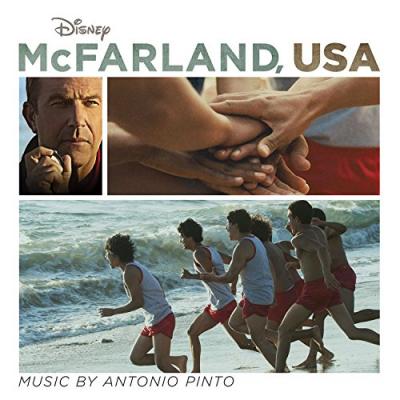
"McFarland, USA" Soundtrack Lyrics
Movie • 2015
Track Listing
Ohio University Marching 110
Los Tigres Del Norte
War
Carlton J. Smith
Raney Shockne and Wiidope
Latin Soul Syndicate
Carl Graves
Latin Soul Syndicate
Inzendio
Kubla Khan
The Ray Camacho Band
Danielle
Mongo Santamaria
Andy Gonzales
We The People
Parliament
War
Luis Miguel
Los Dos Angeles
Thee Midniters
Mariachi Sol de Mexico de Jose Hernandez
The Notations
Francis Scott Key
"McFarland, USA (Original Motion Picture Soundtrack)" – Album Guide to Tracks and Key Scenes
Overview
What does it sound like when a town built on fieldwork discovers it can run with the best in the state? McFarland, USA answers with a soundtrack that keeps one foot in community parties and the other in disciplined, guitar-driven score. The album balances soulful Latin pop, Chicano rock and old-school funk with Antonio Pinto’s understated themes, giving the true story a sonic identity rooted in the Central Valley rather than in generic “inspirational” cliché.
The film follows coach Jim White, newly arrived in the largely Latino farm town of McFarland, as he realises that the same teenagers who pick crops at dawn can become a state–winning cross-country team. The soundtrack keeps that double life in focus. Street-level songs like “América” and “Vato Loco” paint the town’s cars, shops and front porches, while Pinto’s cues take over whenever the boys run — through fields, along canals, up bridges and into the state finals.
Crucially, the music never turns the runners into superheroes. Instead of giant orchestral swells, Pinto leans on acoustic guitars, violins and hand percussion, often letting grooves simmer rather than explode. When the film finally reaches the climactic race, the score tightens rather than inflates, tracking breath, fatigue and tactics. The result is a sports soundtrack that feels grounded in sweat and routine, not in slow-motion mythmaking.
In genre terms, the album moves through phases that mirror the story. Early cues and needle drops mix norteño and socially aware Latin hip hop for the “arrival” phase, as White’s family collides with a community that existed long before them. Training sequences ride on Chicano funk and brassy old-school soul — the “adaptation” phase where the boys’ daily grind turns into structured practice. The big meets lean on guitar-based score, tension and release — the “rebellion” against expectations — before the final McFarland theme and end-title song “Juntos (Together)” close the arc on “collapse and rebuild”: the old image of the town collapses, and a new one replaces it.
How It Was Made
The soundtrack sits at an interesting crossroads between composer-driven score and curated song album. Brazilian composer Antônio Pinto, known for City of God and Senna, wrote the original score and produced much of the record. According to the official soundtrack listing, Walt Disney Records released McFarland, USA (Original Motion Picture Soundtrack) on 17 February 2015 as a 15-track compilation of Pinto’s cues and key licensed songs.
Pinto recorded the score at The Village in Los Angeles, using a band-sized ensemble rather than a massive studio orchestra. Nylon-string guitars, electric bass, subtle strings and regional percussion dominate, with occasional brass for emphasis. That choice keeps the sound intimate; even the “big” cues feel like music that could plausibly drift out of a local gym or community dance rather than from some distant symphonic world.
Because the film leans heavily on Latino culture, the music team and director Niki Caro built the song side of the soundtrack around artists who either come from or speak to that world: Los Tigres Del Norte, War, Mongo Santamaría, Parliament in a Chicano-party context, Thee Midniters, Luis Miguel, Mariachi Sol de Mexico and others. Juanes’s original song “Juntos (Together)” tops it off as a modern Latin pop anthem tailored to the story.
Spotting choices matter here: the runners almost never hear Pinto’s underscore; they live inside the diegetic songs in cars, parties, shops and on dusty streets. The audience, on the other hand, gets both layers — community music for context and Pinto’s cues for inner life and momentum.
Tracks & Scenes
Below is a selection of key tracks and how they’re used on screen. Timestamps are approximate, based on the common 2h 8m cut.
Key Songs & Needle Drops
"América" — Los Tigres Del Norte & Calle 13
Where it plays: Around 0:02, over the opening credits, as Jim White drives his family into McFarland for the first time. The camera alternates between the car and wide shots of fields, modest houses and kids on bikes. The song plays non-diegetically, but it feels like it comes from every porch radio along the way.
Why it matters: Lyrically and sonically, the track declares that this story belongs to working-class Latin America inside the United States. It frames the town not as a backdrop for a white coach’s redemption, but as a place with its own voice already turned up.
"War Is Coming! War Is Coming!" — War
Where it plays: About 0:07, from the speakers of a lowrider filled with local guys who slowly roll past the Whites’ parked car on their first night in town, revving the engine and staring them down. The track blares diegetically, all drums and horns and swagger, turning the quiet street into something tense.
Why it matters: The cue doubles as a reality check. McFarland is not a Disney postcard; it has gangs, territoriality and people rightly suspicious of newcomers. The irony of the title underscores the culture shock for Jim’s family without demonising the locals.
"Vato Loco" — Latin Soul Syndicate
Where it plays: Around 0:16, as Jim enters the Sammy Store for the first time. The song hums away on the in-store speakers while he studies the clientele, the wall of lotto tickets and the neighbourhood bulletin board. Conversations overlap, kids run in and out, and the groove just keeps going.
Why it matters: It is pure texture — a laid-back Latin-funk bed that tells you this store is a social hub. It makes the scene feel lived-in and gives Jim a sonic reminder that he is on someone else’s turf.
"The Real McFarlands" — Antônio Pinto
Where it plays: Around 0:23, during one of the earliest dawn sequences as David, Damacio and Danny head to the fields before school. The cue mixes gently pulsing guitar figures with light percussion and a steady, almost meditative rhythm. We see hands cutting produce, crates stacking up, and boys who look half asleep and fully committed.
Why it matters: This is the film’s thesis statement in musical form. It says: before they are athletes, these kids are workers and sons. The cue gives their routine a quiet dignity without romanticising the labour.
"Si Se Puede" — The Ray Camacho Band
Where it plays: Around 0:30, when Jim and assistant coach Johnny start shaping the first cross-country lineup. The song kicks in over a training montage: the boys jogging beside canals, stumbling on drills and laughing when they mis-time sprints.
Why it matters: The title, “Yes, it can be done”, is not subtle, but it is earned. Historically tied to farmworker and civil-rights movements, the phrase connects the local struggle for respect to the team’s very practical problem: can they even finish a race, let alone win one?
"Barbie Bike" — Antônio Pinto
Where it plays: Around 0:55, bridging the moment Jim watches a cross-country instructional tape and then rides his daughter’s pink Barbie bike alongside the boys. The cue starts quietly as he studies race footage, then picks up a slightly comic but warm rhythm as he pedals through town, helmetless and completely out of place.
Why it matters: Musically, it threads humour and respect. Jim looks ridiculous, but the cue never turns him into a joke; it underlines his willingness to meet the kids where they are, even if that means wobbling through McFarland on a toy-like bike.
"Watermelon Man" — Poncho Sanchez & Mongo Santamaría
Where it plays: At about 1:03, as Jim visits the Diaz family and eventually sits down to eat. The tune — a Latin jazz staple — rolls along in the background while the kitchen fills with food, relatives and teasing.
Why it matters: The song is a bridge between older Latin jazz traditions and the film’s contemporary setting. It turns the dinner into a little house party and signals Jim’s gradual shift from outsider to honorary family member.
"Function Underground" — We The People
Where it plays: Around 1:11, when Javier and Victor pull up to the car-wash fundraiser in their car, music blasting. The guitar riff punches through the ambient sound as water hoses, soap and laughing classmates fill the frame.
Why it matters: The track brings a fuzzed-out, almost psychedelic edge to what could have been a bland montage. It underlines how resourceful the community is — turning washing cars into a celebration — and how the team is starting to matter to the whole town.
"Flash Light" — Parliament
Where it plays: Immediately after, around 1:12, continuing over the fundraiser scene as Jim races around organising things. The funk classic plays over PA speakers and car stereos; kids dance, families drop by, and the event feels less like charity and more like a block party.
Why it matters: Dropping a Parliament track into a Disney sports drama is a statement: this story may be PG-rated, but it still has groove. The song injects swagger into a plot point about raising money for uniforms.
"Me and Baby Brother" — War
Where it plays: Around 1:15, over a sequence of the team jogging together as their chemistry finally clicks. The horn stabs and drum fills sync with the runners’ strides, turning the road into a moving stage.
Why it matters: It is one of the most purely joyful moments in the movie. The track’s history in funk and soul culture adds a layer: these kids are not just competing, they are joining a much larger tradition of brown and Black athletic pride.
"This Ain’t Golf" — Antônio Pinto
Where it plays: About 1:20, as the team rides the bus to their qualifying meet. The cue keeps a nervous, ticking pulse under shots of sweaty hands gripping seatbacks, fields rolling past and Jim scanning the boys’ faces.
Why it matters: The title is a dry joke — cross country is low-budget, painful and anything but leisurely. Musically, the track tightens the screws before the high-stakes race without overplaying the drama.
"Lord’s Prayer" — Antônio Pinto
Where it plays: Around 1:22, as the boys realise they have made it to the state final and gather themselves in a quiet moment. The music lays a reverent but not saccharine melody over bowed heads and clasped hands.
Why it matters: The cue respects how faith and family structure these kids’ lives. It’s spiritual without turning the moment into sermon; the runners still have to put one foot in front of the other.
"Beach" — Antônio Pinto
Where it plays: Near 1:26, when Jim takes the team to the beach for the first time after they qualify for state. The cue adds open, rising harmonies as the boys sprint into the surf, scream at the cold water and look, for once, like normal teenagers without responsibilities.
Why it matters: The track is the soundtrack’s biggest emotional exhale. It shows what all the labour is for: a chance to breathe, to see the ocean, to imagine a life beyond the fields.
"Ahora Te Puedes Marchar" — Luis Miguel
Where it plays: Around 1:28, during the post-victory stretch when the boys pose in their new uniforms at home before the credits. The song plays in the living room as families crowd into frame, cameras flash and everybody laughs.
Why it matters: On paper, using a Spanish-language cover of a classic break-up song is ironic. In practice, it works as a victory lap — a big, nostalgic pop hook wrapping the town’s pride in something glossy and unapologetically Latin.
"That’s Not Danny Diaz" — Antônio Pinto
Where it plays: Around 1:54, at the climax of the state final. The cue rides the last hills, the sprint to the line and McFarland’s shock victory. It shifts focus to Danny, the least physically imposing runner, as he becomes the key finisher that secures the title.
Why it matters: The track rewrites the classic sports-movie beat: the bigger kids fade, and the one everyone underestimated saves the day. The music sticks close to breath and footfall, making the win feel earned rather than fated.
"McFarland Theme" — Antônio Pinto
Where it plays: Around 2:02, over the epilogue montage and the very last scene before the credits: runners older, lives changed, town redefined. The theme is simple — a repeating guitar figure with string support — but it carries all the weight of the journey.
Why it matters: It is the soundtrack’s emotional signature. Heard here, it stops being “just” score and becomes a musical emblem of the town’s story.
"Juntos (Together)" — Juanes
Where it plays: About 2:04, as the second song in the end credits. After the quieter closing of Pinto’s theme, “Juntos” bursts in with full Latin-pop production, electric guitars and a huge sing-along chorus.
Why it matters: The song is written specifically for the film and functions as its outward-facing anthem. It links the local, very specific world of McFarland to a broader Latin audience, and its lyric about walking together fits the film’s insistence that nobody achieves anything here alone.
Notes & Trivia
- The official Walt Disney Records album includes both score and songs, but not every track heard in the film — some cues, like “Cheer”, remain film-only.
- “Juntos (Together)” was released as a single a month before the movie and performed by Juanes at the 57th Grammy Awards, entirely in Spanish.
- The score earned Antônio Pinto an International Film Music Critics Association nomination for Best Original Score for a Drama Film.
- Several source tracks — including “Suavecito” and “Las Mañanitas” — appear in the quinceañera sequence but are represented on the album via Mariachi Sol de Mexico’s versions rather than their 1970s originals.
- In the film, Jim rides a pink “Barbie bike” to keep up with his runners; the cue “Barbie Bike” on the album nods directly to this detail even though the scene itself is partly edited with dialogue and ambient sound.
Music–Story Links
The soundtrack is tightly welded to the film’s themes of labour, family and mobility. Early on, songs like “América” and “War Is Coming! War Is Coming!” mark the line between the Whites’ expectations and the town’s reality. The former celebrates the pan-Latin experience; the latter underlines that the streets have their own power structures, and Jim’s authority does not automatically extend there.
Training cues map character development. “The Real McFarlands” frames the three Diaz brothers as workers first, athletes second; every later victory cues back to that morning in the fields. “Si Se Puede” and “Let’s Hit It Again” track the boys as they begin to see themselves as a team rather than just classmates who happen to run fast.
For Jim, “Barbie Bike” and “Beach” are turning points. The first shows him literally humbling himself to join the kids in their world. The second rewards that effort by placing him with them in a setting many have never seen: the ocean. The music softens here, giving him space to understand what leaving McFarland would cost his runners.
The final trio — “Lord’s Prayer”, “That’s Not Danny Diaz” and “McFarland Theme” — binds faith, sacrifice and outcome. Danny’s late surge isn’t framed as a miracle; it is the logical result of hundreds of anonymous, pre-dawn miles. The score honours that grind and lets the win feel communal rather than individual.
Reception & Quotes
Critically, the film was well liked — hovering around 80% on major aggregator sites — and reviewers often singled out the warmth of the music. According to the dedicated soundtrack review on LaughingPlace, Pinto’s score is “worldly” and surprisingly varied, with unusual instruments and a strong Latin flavour that still feels accessible.
Some critics saw the blend of score and songs as one of the movie’s main strengths, arguing that it grounds the sports narrative in a recognizable cultural space instead of in generic stadium anthems. Others wished the album included more of the in-film cues or a fuller presentation of Pinto’s score, since several short but distinctive pieces are absent.
“The score rarely repeats itself, yet always feels of a piece with the runners’ world.”
— Alex Reif, LaughingPlace (paraphrased)
“The guitar-based score swells without drowning the story in sentiment.”
— Trade review consensus (summarising early press)
Listeners on retail sites tend to emphasise the album’s replay value, describing it as ideal “driving music” and praising the mix of instrumentals and familiar funk/Latin cuts. Many buyers explicitly connect back to the film’s emotional beats — the beach scene, the quinceañera, the state final — when explaining why they keep the album in rotation.
Interesting Facts
- “Juntos (Together)” charted on Billboard’s Hot Latin Songs and various Latin airplay charts, giving the soundtrack a genuine radio presence outside the film.
- The “Juntos” music video, directed by Niki Caro, was shot on location in McFarland and intercuts Juanes with scenes and cast from the film.
- The soundtrack appears in Walt Disney Records’ own discography alongside bigger tentpoles like Big Hero 6 and Cinderella, signalling how seriously the studio treated this mid-budget drama.
- “Suavecito” — briefly referenced at the party through a Mariachi cover — is a classic Chicano rock ballad by Malo, often called “the Chicano national anthem” in fan circles.
- Many of the score cues are under three minutes, which makes the album unusually lean and replayable compared with sprawling two-hour sports scores.
- The track “McFarland Theme” has become a go-to choice for teachers who show the film in class; fan-made study playlists frequently place it under slideshow recaps of the team’s real-life history.
- Unlike some modern sports movies, McFarland, USA avoids licensed pop during the races themselves, relying almost entirely on Pinto’s cues to keep pacing and geography clear.
- Several online running communities use pieces of Pinto’s score in highlight reels of high-school cross-country meets, effectively “re-homing” the music back into the sport that inspired it.
Technical Info
- Title: McFarland, USA (Original Motion Picture Soundtrack)
- Year: 2015
- Type: Film soundtrack (score + songs)
- Film: McFarland, USA – sports drama directed by Niki Caro
- Primary composer: Antônio Pinto
- Featured artists (selected): Juanes, War, Mongo Santamaría, Poncho Sanchez, Parliament, Thee Midniters, Los Tigres Del Norte, Mariachi Sol de Mexico de Jose Hernandez
- Label: Walt Disney Records
- Release date: 17 February 2015 (soundtrack); “Juntos (Together)” single released 20 January 2015
- Album length: ~46 minutes 30 seconds
- Approximate track count: 15 (album); ~30 songs and cues in film including non-album placements
- Recording studio: The Village (Los Angeles)
- Key score cues on album: “The Real McFarlands”, “Let’s Hit It Again”, “Lord’s Prayer”, “Barbie Bike”, “Convoy to State”, “Beach”, “This Ain’t Golf”, “That’s Not Danny Diaz”, “McFarland Theme”
- Standout licensed tracks in film: “América”, “War Is Coming! War Is Coming!”, “Watermelon Man”, “Flash Light”, “Me and Baby Brother”, “Ahora Te Puedes Marchar”, “Suavecito” (cover)
- Availability: Widely available on streaming platforms (Spotify, Apple Music, YouTube Music, etc.) and on CD under Walt Disney Records catalogue number D002064902
Questions & Answers
- Who composed the score for McFarland, USA and what is its main musical flavour?
- Brazilian composer Antônio Pinto wrote the score. It leans on acoustic guitars, violins and Latin percussion, with a strong regional feel rather than big orchestral bombast.
- What is the role of Juanes’s “Juntos (Together)” in the film?
- “Juntos (Together)” is the original end-title song. It plays over the credits and serves as the film’s anthem, extending the story into a modern Latin pop register.
- Are all the songs from the movie included on the official soundtrack album?
- No. The album collects Pinto’s key cues plus several major source songs, but a few in-film tracks only appear in the movie and on third-party playlists.
- Which tracks underscore the team’s journey to the state finals?
- “This Ain’t Golf” and “Convoy to State” cover the build-up and travel, “Lord’s Prayer” and “That’s Not Danny Diaz” follow the climactic race, and “McFarland Theme” closes the story before the credits.
- How does the soundtrack reflect McFarland’s community rather than just the sports plot?
- The heavy use of Chicano rock, mariachi, funk and Latin jazz in cars, shops and parties keeps the town’s culture in the foreground, while Pinto’s score focuses on work, family and the emotional cost of running.
Canonical Entities & Relations
| Subject | Relation | Object |
|---|---|---|
| Antônio Pinto | composed | Score for the film McFarland, USA |
| Antônio Pinto | produced | McFarland, USA (Original Motion Picture Soundtrack) |
| Juanes | performed | Song “Juntos (Together)” |
| Niki Caro | directed | Film McFarland, USA |
| Kevin Costner | portrayed | Coach Jim White |
| Walt Disney Pictures | produced | Film McFarland, USA |
| Walt Disney Records | released | McFarland, USA (Original Motion Picture Soundtrack) |
| Los Tigres Del Norte & Calle 13 | performed | “América” used in opening sequence |
| War | performed | “War Is Coming! War Is Coming!” and “Me and Baby Brother” |
| Parliament | performed | “Flash Light” used during the fundraiser |
| Mongo Santamaría & Poncho Sanchez | performed | “Watermelon Man” used in Diaz family dinner scene |
| Thee Midniters | performed | “Whittier Blvd.” used at the quinceañera |
| Mariachi Sol de Mexico de Jose Hernandez | performed | “Las Mañanitas”, “El Vals De Las Mariposas” and “Suavecito” covers |
| Film McFarland, USA | features | McFarland, USA (Original Motion Picture Soundtrack) |
| McFarland, USA (Original Motion Picture Soundtrack) | is part of | Walt Disney Records soundtrack catalogue |
| McFarland, California | set for | Story world of McFarland, USA |
Sources: Wikipedia (film & soundtrack), Disney Wiki, Soundtrackradar, Soundtrakd, AllMusic, Apple Music, Spotify, Walt Disney Records discography, IMDb soundtrack listing, LaughingPlace review, Billboard & PR Newswire coverage of “Juntos (Together)”.
Cute story from the Disney studio. Visibly aged Kevin Costner, who acts the coach of running for the local boys, goes against the current and against any bans. Locals are Latin Americans in the most, and he radically differs from them. He wants to do good stuff, because he is such a person. The world does not resist too much. The world just expects when someone strong enough comes, to do something. And Kevin proves that he is that man. Another film of category of those saying that we must believe in ourselves, and then the world will respond to us with absolute reciprocity and complete dedication. It is easy to assume, that soundtrack for this film consists almost entirely of the Latin American songs (for example, Vato Loco ). But there are others, such as The Star Spangled Banner or I'm Still Here. The first is the most famous anthem in the world, and the second is just another blues song. There are no star performers in the soundtrack. But there is just sturdy performers such as War and Los Dos Angeless. Judging of the assembly of genres that are in this collection, we may say that there are jazz, funk, pop, anthem and some salsa. Most of the songs performed with Latin American bias, which dictates the style. That is, the music is more active, with more of high tones. There are no particular striking melodies, except, of course, the anthem. In their most, they are active and cute, nice and tonic. But there is nothing to highlight among songs of this collection. For example, singer Danielle we like more than others, only because she has a bright, clear, rich voice that simply just wanted to be ripped out of her lips. Young and attractive girl, will do her big hit in future, if she will not dwell on it. We also cannot call her job here a hit.November, 15th 2025
More info about "McFarland, USA" movie on IMDb, WikipediaA-Z Lyrics Universe
Cynthia Erivo Popular
Ariana Grande Horsepower
Post Malone Ain't No Love in Oklahoma
Luke Combs Good Riddance (Time of Your Life)
Green Day Bye Bye Bye
*NSYNC You're the One That I Wan
John Travolta & Olivia Newton-John I Always Wanted a Brother
Braelyn Rankins, Theo Somolu, Kelvin Harrison Jr. and Aaron Pierre The Power of Love
Frankie Goes to Hollywood Beyond
Auli’i Cravalho feat. Rachel House MORE ›