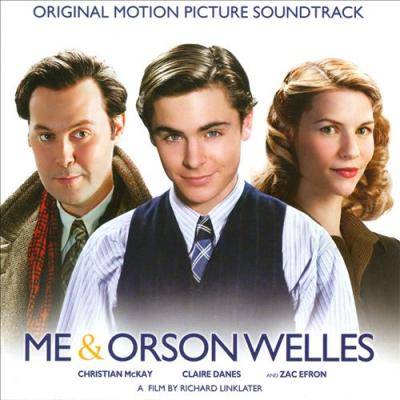
"Me and Orson Welles" Soundtrack Lyrics
Movie • 2009
Track Listing
Benny Goodman & His Orchestra
Louis Armstrong
Benny Goodman & His Orchestra
Count Basie & His Orchestra
James Langton
Jools Holland & his Rhythm and Blues Orcestra
Christian McKay
Ginger Rogers
The Mills Brothers
James Langton
Fred Astaire
Benny Goodman & His Orchestra
Tommy Dorsey & His Clambake Seven
Jools Holland & his Rhythm and Blues Orcestra
James Langton & His Solid Senders
"Me and Orson Welles (Original Motion Picture Soundtrack)" – Album Guide to Tracks and Key Scenes
Overview
How do you make a coming-of-age story feel like it was recorded straight to shellac in 1937 without turning the whole film into a museum piece? Me and Orson Welles answers with a soundtrack that lives and breathes swing. The album leans on Benny Goodman, Louis Armstrong, Count Basie, Billie Holiday, Duke Ellington and a handful of new in-character performances, so the music feels like something the Mercury Theatre troupe might actually have danced, smoked or schemed to between rehearsals.
The film follows New Jersey teenager Richard Samuels as he stumbles into Orson Welles’s infamous modern-dress production of Julius Caesar at the newly formed Mercury Theatre. The soundtrack has to cover several layers at once: bustling New York streets, the bohemian chaos of the theatre, Welles’s ego-driven power plays, and Richard’s tentative romantic life. Instead of a traditional orchestral score dominating, period recordings do most of the work, with brief bits of original underscore by Michael J McEvoy stitching things together.
The result is a film that sounds almost wall-to-wall with big-band horns, crooning vocals and sax-heavy night-club ambience. According to the official soundtrack notes, the album is built from authentic late-1930s recordings plus new sessions designed to sit seamlessly alongside them, including Christian McKay’s on-screen rendition of “Let’s Pretend There’s a Moon”. That blend allows the film to pivot from backstage bickering to fully staged Shakespeare without ever breaking the sonic illusion of 1937 New York.
Stylistically, the music runs through distinct phases. Early scenes live in romantic ballads and gentle swing — vulnerable, modest, full of unrealised ambition. As Welles’s production gains momentum, the soundtrack moves into more muscular, rhythm-forward pieces like “Sing, Sing, Sing” and “One O’Clock Jump”, which mirror the controlled frenzy of rehearsals. In the final stretch, more introspective cuts like “Solitude” and “In a Sentimental Mood” sit alongside on-stage fanfares, underlining how fragile everyone’s pride is beneath all the bravado.
How It Was Made
Me and Orson Welles (Original Motion Picture Soundtrack) is a compilation album released by Decca Records in late November 2009. It collects period jazz and swing recordings, newly licensed for the film, and a handful of bespoke tracks recorded to match the era. The film itself credits Michael J McEvoy for incidental score — he composed, arranged and conducted short cue material that never received a standalone score release, so the Decca disc focuses on songs and big-band pieces rather than orchestral underscore.
Director Richard Linklater and music supervisor Marc Marot built the musical concept around late-1930s American jazz, specifically the kind of records that would have been spinning in New York shops, cafés and rehearsal rooms at the time. They pulled from Benny Goodman, Louis Armstrong, Count Basie, Tommy Dorsey, Jools Holland’s band emulating period charts, and vocal performances by Ginger Rogers, the Mills Brothers, Fred Astaire and others. One neat twist: some standards appear in multiple guises (for example, “Let’s Pretend There’s a Moon” as a full band piece and as a brief in-character vocal from Christian McKay), creating the sense that the same songs echo through different corners of the city.
The music had to integrate closely with the film’s centrepiece: a meticulous reconstruction of Welles’s 1937 Julius Caesar, down to Marc Blitzstein’s original theatrical music. For those staged sections, McEvoy’s work sits under Shakespearean dialogue, while the source songs dominate dressing rooms, radio interludes and off-hours encounters. As one feature on the film’s making notes, the creative team treated music as another piece of period design alongside costumes and sets, a way of making the Mercury feel like a working theatre rather than a nostalgic diorama.
Tracks & Scenes
The film doesn’t use songs as pop montages so much as moving wallpaper: the music seeps out of gramophones, radios and theatre loudspeakers. Below are key cues, with the emphasis on how they sit in the drama. Scene descriptions are approximate but track the way the film frames each piece.
Key Standards & On-Screen Performances
"Jazz Baby (Wheaties)" — Zac Efron
Where it plays: Early in the film, Richard tests out his stage chops by singing this brash vaudeville number in front of Welles and the Mercury crew. The performance is staged as a kind of audition and ice-breaker: he launches into the song with nervous energy, backed by a small ensemble, while the seasoned actors look him over with a mix of amusement and scepticism.
Why it matters: Giving the lead actor his own diegetic number instantly bridges the gap between high-school dreamer and professional stage aspirant. The song’s shouty, playful lyric suits Richard’s eagerness and hints that, even if he is green, he can hold a stage long enough to be useful to Welles.
"Have You Met Miss Jones" — Zac Efron
Where it plays: Later, during rehearsal downtime, Richard sings this Rodgers & Hart standard in a more relaxed setting — less of a formal audition, more of an off-the-cuff serenade. The camera treats it as a private moment that spills outward: what begins as Richard showing off for one person gradually draws the attention of others drifting through the theatre.
Why it matters: The song’s lyric about charming introductions and romantic possibility mirrors Richard’s emotional situation with Sonja and Gretta. Musically, it softens his edges, showing he can do more than brassy salesmanship; he can handle a proper standard with some feeling.
"Let’s Pretend There’s a Moon" — Jools Holland & His Rhythm & Blues Orchestra / Christian McKay
Where it plays: The fuller Jools Holland arrangement is used as lush background, evoking the glamour of New York nightlife outside the theatre. In contrast, Christian McKay’s brief in-character version turns up in a more intimate setting, with Welles half-singing a snatch of the tune as he charms a colleague or punctuates a rehearsal break.
Why it matters: Hearing Welles himself sing a period ballad collapses the distance between the swaggering director and the sentimental material he stages. It suggests that the “great man” persona is partly performance and that music is another mask he wears when it suits him.
"This Year’s Kisses" — Benny Goodman & His Orchestra (feat. Helen Ward)
Where it plays: Used near the beginning as Richard wanders Manhattan on his way toward the Mercury Theatre, this track bleeds in from a radio or record store, brass bright against city noise. The camera tracks him past marquees and shop windows while Goodman’s band swings in the background, creating the sense that he’s walking into a movie of his own.
Why it matters: The lyric about “this year’s kisses” belonging to someone new quietly flags the film’s interest in temporary connections. The polished Goodman sound also contrasts with the scrappy, under-construction theatre Richard is about to enter; the city is glamorous, his reality less so.
"I’m Shooting High" — Louis Armstrong & His Orchestra
Where it plays: A little later, this brassy cut underpins a rehearsal montage: actors pacing lines backstage, Welles issuing rapid-fire notes, Richard trying to keep up with blockings. The track is diegetic in spirit — exactly the sort of record an ambitious troupe might spin on a break — even if the film uses it as an overlay.
Why it matters: The title could be the film’s unofficial subtitle. Everyone here is “shooting high”: Welles gunning for theatrical immortality, Richard aiming for Broadway, Sonja angling for a career beyond the Mercury. The trumpet lines match the production’s nervy upward trajectory.
"Sing, Sing, Sing" — Benny Goodman & His Orchestra
Where it plays: As the Julius Caesar dress rehearsal finds its rhythm, “Sing, Sing, Sing” fires up under a flurry of activity: props being moved, costumes adjusted, the house filling, Welles prowling through the aisles. The pounding tom-tom beat makes the theatre feel like a pressure cooker.
Why it matters: This is one of the soundtrack’s most recognisable cues, and its relentless drive mirrors Welles’s own bulldozing personality. It turns stagecraft into choreography, underscoring how much logistics and sweat go into the “effortless” opening night the audience eventually sees.
"One O’Clock Jump" — Count Basie & His Orchestra
Where it plays: The Basie classic appears as the company edges closer to opening, often bleeding from a radio or gramophone as actors loiter in dressing rooms. The riff-based structure lets the film cut between different pockets of the theatre — musicians warming up, actors reciting lines, stagehands testing cues — while the music keeps everything in the same groove.
Why it matters: The piece is all about call-and-response and ensemble work, which is exactly what the Mercury needs to function. It subtly shifts focus from the cult of Welles to the band-like cohesion required from his cast and crew.
"I Can’t Give You Anything But Love" — Billie Holiday / Teddy Wilson & His Orchestra
Where it plays: Used in a quieter, more introspective passage — typically over a night-time walk or a reflective moment for Richard after a bruising encounter with Welles or Sonja. Holiday’s voice, bathed in 1930s reverb, spills out of some off-screen source while the character processes what just happened on stage that day.
Why it matters: The song’s resigned romanticism fits a story where affection is often transactional. When laid against the film’s backstage machinations, the lyric feels like a bittersweet commentary on how little emotional honesty is actually on offer.
"Easy Living" — Billie Holiday / Teddy Wilson & His Orchestra
Where it plays: This standard tends to sit under more reflective, late-night material: the city outside the theatre, Richard alone with his thoughts, or Welles briefly unwinding after another long, manipulative day. The tempo is slow, the mood hazy, with muted horns giving everything a sepia wash.
Why it matters: The title is ironic in this context. Nobody in the film has an “easy” life; everyone is juggling debts, obligations and ambition. The track underlines the gap between the dream of the era’s romantic songs and the grind of theatrical reality.
"Solitude" / "In a Sentimental Mood (Instrumental)" — Duke Ellington and collaborators
Where it plays: These Ellington cues appear around scenes where characters are literally alone in a crowd — Richard watching others pair off, Welles isolated at the back of the theatre, Sonja caught between career and conscience. The arrangements are restrained, with clarinet or sax carrying the melody over brushed drums.
Why it matters: They give the film its emotional low-lights. For a story packed with chatter, ego and busy blocking, these tracks make room for quiet disappointment and second thoughts.
"The Music Goes Round and Round" — Tommy Dorsey & His Clambake Seven
Where it plays: This more comic cut is used during a lighter sequence of backstage chaos — costume changes gone wrong, prop mishaps, nervous jokes just before curtain. It may drift in from a radio in a dressing room, its circular melody echoing the loop of rehearsals that never seem to end.
Why it matters: The lyric is almost too on the nose: “and it comes out here.” It mirrors the process we’re watching — words and cues go in during rehearsal, theatrical magic comes out on opening night, if everyone survives Welles long enough.
Notes & Trivia
- The official Decca album is largely a compilation of pre-existing 1930s recordings, with only a few new pieces recorded specifically for the film, including Christian McKay’s vocal.
- Michael J McEvoy’s incidental score is heavily used in the movie but appears on the album only via two short cues; his full score has never been released.
- Zac Efron is credited as performer on both “Jazz Baby (Wheaties)” and “Have You Met Miss Jones”, giving him a rare chance to sing 1930s material on film outside of pure musical fare.
- The soundtrack charts surprisingly well for such a niche period piece, reaching multiple Billboard and Official Charts categories in both soundtrack and jazz slots.
- Several songs, including “Let Yourself Go” and “They Can’t Take That Away from Me”, are taken from classic Hollywood musicals, linking Welles’s theatre world back to the studio-era film industry he would later disrupt.
Music–Story Links
The soundtrack functions almost like a second script for the film. Early standards such as “This Year’s Kisses” and “Nice Work If You Can Get It” sketch Richard’s wide-eyed optimism: everything looks open, the city is big, and success feels only a lucky break away. As soon as Welles enters the picture, the song choices become sharper and more sardonic, mirroring his tendency to twist every situation to his advantage.
Numbers like “Jazz Baby (Wheaties)” and “Have You Met Miss Jones” chart Richard’s evolution more directly. His first performance is cocky but raw; by the time he revisits similar material, he has been bruised by theatrical politics and romantic disappointment, and the same kind of song carries a very different charge. The music shows us that he’s still the same kid, but the context around him has hardened.
For Welles, the mixture of bombastic swing and languid ballads mirrors his dual personality. Big-band cues accompany his grand pronouncements, his swaggering entrance speeches and his cinematic blocking of Shakespeare. Softer pieces like “Let’s Pretend There’s a Moon” and “Solitude” tag the moments when the mask slips and the film quietly asks how much of his charisma is self-defence.
Finally, the Julius Caesar sequences themselves use music as connective tissue between history and myth. Marc Blitzstein’s reconstructed theatrical music sits alongside the jazz standards on the album, making it feel as though Broadway and the jazz club live on the same street. The sound world tells you that this is where modern theatre and popular music briefly shared the same air.
Reception & Quotes
Critically, the soundtrack has been praised for its period authenticity and for the way it anchors the film’s recreated 1937 New York. An AllMusic write-up highlights how carefully the compilation sticks to late-’30s jazz and swing, arguing that the selection “deepens the film’s sense of time and place” rather than just decorating it. The album’s chart performance — modest but real, especially on jazz and soundtrack lists — reflects that there is a niche audience for this kind of carefully curated period set.
Some critics, however, felt that the very consistency of the musical palette risked turning the film into a kind of big-band snow globe. A review at Slant Magazine notes that the “brown-dominated colour scheme” and “constant blare of big-band horns” can make the whole enterprise feel “frozen in amber”, more comfortable nostalgia than living history. That tension is baked into the soundtrack: its faithfulness is both its strength and its limitation.
“The bright, brassy soundtrack does as much as the sets and costumes to sell 1937, without ever feeling like a jokey retro pastiche.”
— Summary of AllMusic’s response (paraphrased)
“Linklater fills the film with big-band standards that both enliven and entomb it, capturing an era even as they risk embalming it.”
— Slant Magazine review (paraphrased)
Audience reactions tend to be warmer. User reviews on soundtrack sites and retailers frequently call the album “a perfect Sunday-morning record” and praise its ability to double as a compact big-band sampler. Many viewers discovered specific recordings — especially the less obvious cuts from Teddy Wilson, Fats Waller and Mills Blue Rhythm Band — through the film and then chased them into separate listening rabbit holes.
Interesting Facts
- The album is officially titled Me and Orson Welles (Original Motion Picture Soundtrack), but many retailers list it simply as Me & Orson Welles, which can complicate searches.
- It was released by Decca, a label historically associated with many of the same jazz and swing artists featured, giving the compilation an extra layer of historical resonance.
- Christian McKay’s brief vocal on “Let’s Pretend There’s a Moon” is one of the few times an actor’s performance for the film doubled as a soundtrack credit alongside giants like Armstrong and Ellington.
- The track list essentially doubles as a roll call of 1930s songwriting heavyweights: Irving Berlin, Cole Porter, the Gershwin brothers, Rodgers & Hart and others all appear.
- Because McEvoy’s score remains unreleased, fans who want the complete musical picture of the film often build custom playlists that combine the Decca album with isolated audio ripped from the DVD.
- The soundtrack has been used in educational settings to illustrate swing-era arrangements, since it packages many canonical recordings in one film-branded disc.
- Several online reviews highlight the way the music turns the Mercury Theatre into a believable workplace, full of radios and records, rather than a sterile prestige-film set.
- Despite the modest box office of the movie, the album managed to chart not only on soundtrack lists but also on mainstream and jazz-specific charts in both the US and UK.
Technical Info
- Title: Me and Orson Welles (Original Motion Picture Soundtrack)
- Year: 2009 (album); film first shown 2008, widely released 2009
- Type: Film soundtrack compilation (period songs + brief underscore)
- Film: Me and Orson Welles, period drama directed by Richard Linklater
- Primary music supervisors / curators: Marc Marot and the production music team
- Incidental score composer: Michael J McEvoy
- Key featured performers: Benny Goodman & His Orchestra, Louis Armstrong & His Orchestra, Count Basie & His Orchestra, Tommy Dorsey, Duke Ellington, Billie Holiday, Teddy Wilson, Fats Waller, Jools Holland & His Rhythm & Blues Orchestra, Ginger Rogers, Fred Astaire, The Mills Brothers, James Langton & His Solid Senders, Zac Efron, Christian McKay
- Label: Decca Records (catalogue number 5323762)
- Release date: 24 November 2009 (CD)
- Album length: approximately 56 minutes 47 seconds
- Format: CD (primary physical), later digital/streaming release via major platforms
- Structure: Period recordings sequenced to mirror the film’s narrative arc, with some duplication of songs across different performers and arrangements
- Chart highlights: Appeared on UK soundtrack, compilation and jazz/blues charts, as well as US Billboard 200, jazz and soundtrack charts.
Questions & Answers
- What kind of music dominates the Me and Orson Welles soundtrack?
- The album is almost entirely late-1930s jazz and swing: big-band instrumentals, crooner ballads and a few in-character performances that match the era’s style.
- Who is credited with the actual score for the film?
- Michael J McEvoy composed, orchestrated and conducted the incidental score, but only a small portion of his material appears on the commercial soundtrack.
- Does Zac Efron really sing on the soundtrack?
- Yes. He performs “Jazz Baby (Wheaties)” and “Have You Met Miss Jones” in character as Richard, giving the film a couple of diegetic performance moments tied directly to the lead.
- Is the soundtrack a complete document of everything heard in the film?
- No. It covers the main period songs and a few custom pieces, but some bits of McEvoy’s underscore and theatrical cues remain exclusive to the film and its bonus materials.
- How does the album relate to Orson Welles’s real 1937 production of Julius Caesar?
- The film recreates that production’s staging and uses Marc Blitzstein’s theatrical music, while the album surrounds those moments with contemporary jazz and swing that would have been in the air in 1937 New York.
Canonical Entities & Relations
| Subject | Relation | Object |
|---|---|---|
| Richard Linklater | directed | Film Me and Orson Welles |
| Holly Gent & Vincent Palmo Jr. | wrote screenplay for | Film Me and Orson Welles |
| Robert Kaplow | wrote novel | Me and Orson Welles |
| Zac Efron | portrayed | Richard Samuels |
| Zac Efron | performed | “Jazz Baby (Wheaties)” and “Have You Met Miss Jones” in Me and Orson Welles |
| Christian McKay | portrayed | Orson Welles |
| Christian McKay | performed | “Let’s Pretend There’s a Moon” (brief vocal) for the soundtrack |
| Michael J McEvoy | composed | Incidental score for Me and Orson Welles |
| Decca Records | released | Me and Orson Welles (Original Motion Picture Soundtrack) |
| Benny Goodman & His Orchestra | performed | “This Year’s Kisses”, “Sing, Sing, Sing” and “In a Sentimental Mood (Instrumental)” on the album |
| Louis Armstrong & His Orchestra | performed | “I’m Shooting High” on the album |
| Count Basie & His Orchestra | performed | “One O’Clock Jump” on the album |
| Tommy Dorsey | performed | “Alone”, “I’m Getting Sentimental Over You” and “The Music Goes Round and Round” on the album |
| Billie Holiday | performed | “I Can’t Give You Anything But Love” and “Easy Living” with Teddy Wilson & His Orchestra |
| Duke Ellington | performed | “Solitude”, “Clarinet Lament”, “Scattin at the Kitkat”, “Yearning for Love” and related cues on the album |
| Jools Holland & His Rhythm & Blues Orchestra | performed | “Let’s Pretend There’s a Moon” and “I Surrender Dear” for the soundtrack |
| Film Me and Orson Welles | features | Me and Orson Welles (Original Motion Picture Soundtrack) |
| Me and Orson Welles (Original Motion Picture Soundtrack) | is part of | Decca’s film soundtrack catalogue |
| Mercury Theatre | setting of | Stage and backstage scenes in Me and Orson Welles |
| Marc Blitzstein | composed | Original theatrical music for Welles’s 1937 Julius Caesar, recreated in the film |
Sources: Wikipedia (film & soundtrack), AllMusic, Apple Music, Discogs, eCartelera (banda sonora listing), Ringostrack, soundtrack retailer track lists, contemporary reviews from Slant Magazine and other outlets, plus interviews with Richard Linklater and production notes quoted in Young Mr. Welles.
November, 15th 2025
A-Z Lyrics Universe
Cynthia Erivo Popular
Ariana Grande Horsepower
Post Malone Ain't No Love in Oklahoma
Luke Combs Good Riddance (Time of Your Life)
Green Day Bye Bye Bye
*NSYNC You're the One That I Wan
John Travolta & Olivia Newton-John I Always Wanted a Brother
Braelyn Rankins, Theo Somolu, Kelvin Harrison Jr. and Aaron Pierre The Power of Love
Frankie Goes to Hollywood Beyond
Auli’i Cravalho feat. Rachel House MORE ›