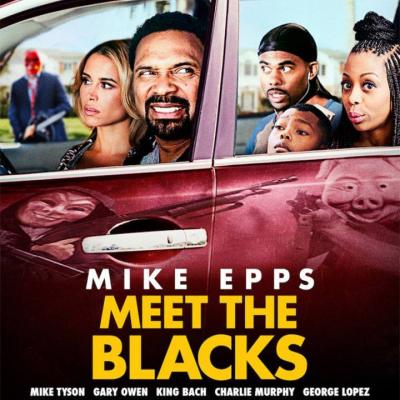
"Meet the Blacks" Soundtrack Lyrics
Movie • 2016
Track Listing
Shaggy
Fool Boy Marley
Lecrae
Lil George
Trina
STATIK KXNG
BeatKing
Derek Minor
Capone-N-Noreaga
Rekstarr X Hi-Res
Kstylis
Lil' Mo
"Meet the Blacks (Music from and Inspired by the Motion Picture)" – Album Guide to Tracks and Key Scenes
Overview
What happens when a Purge parody leans harder on mixtape energy than on pure horror? In Meet the Blacks, the answer is a loud, aggressive, sometimes chaotic soundtrack that turns Carl Black’s bad life decisions into something like a house party on the edge of a riot.
The film tracks Carl hauling his family from Chicago to Beverly Hills on stolen money, only to arrive on the night when all crime becomes legal. The songs mirror that move: early cues flex swaggering confidence and hood-rich bravado, while later tracks ride the rising panic as sirens wail and masked intruders close in. Where the script zigzags between spoof and social jab, the music stays very clear about the vibe – this is danger with a smirk.
Stylistically the album is dominated by contemporary hip-hop and trap, plus a few hybrid gospel and dancehall-flavored cuts. Lyrically and sonically, it sits closer to a street compilation than to a traditional film score release. Underneath that, RZA’s score stabs in with tense drones and percussive hits whenever the jokes briefly make room for actual threat. The result is less “underscore” and more a tug-of-war between party tracks and paranoia.
Over the runtime you can hear distinct phases: swaggering club and radio rap to sell the fantasy of “making it” out of Chicago; darker, bass-heavy tracks as purge night begins; and, in the background, RZA’s grim motifs when the family finally drops the bravado and just tries to survive. Bright dancehall flourishes underline the comedy, southern strip-club bounce leans into the film’s crudest gags, and faith-tinted Christian hip-hop briefly frames Carl’s dreams of redemption. The soundtrack is not subtle, but it is very literal about what each section of the story is doing.
How It Was Made
The music backbone of Meet the Blacks comes in two layers: RZA’s original score and a compilation of licensed songs from various hip-hop and club-leaning artists. RZA is officially credited as the film’s composer, bringing the same grimy, percussive sensibility he used in projects like Blade: Trinity and The Man with the Iron Fists. His cues tend to sit under the more violent and suspenseful beats – the siren moments, the home-invasion gags, and the rare stretches where the movie remembers it’s nominally a horror film.
The song side was steered by music supervisor Paul Stewart, whose job was to find tracks that matched Deon Taylor’s idea of a “hood folk tale” colliding with Beverly Hills. Stewart has a long history working with hip-hop and R&B for film and TV, and here he leans into recognizable names: Shaggy, Trina, Lecrae, Lil George, BeatKing, Derek Minor, Statik KXNG and others. The compilation album was released through Penalty Entertainment in partnership with Hidden Empire Film Group, the production company behind the movie. One trade piece notes that the label explicitly positioned the record as a companion album “from and inspired by the motion picture,” not a pure score release.
On the business side, Penalty and Hidden Empire used the soundtrack as a marketing arm. Tracks like Trina’s “Forget That” and Raven Felix’s “Hit the Gas” received their own music videos with film clips cut in, effectively turning the movie into a backdrop for radio-ready singles. According to Film Music Reporter, the album dropped day-and-date with the theatrical release in early April 2016, which helped it live as a standalone product even while reviews of the movie itself skewed negative. RZA’s score, by contrast, never received a separate full commercial album and lives mainly in the film and assorted promo clips.
Tracks & Scenes
Official documentation of exact placements in Meet the Blacks is patchy, so what follows focuses on moments that are either documented on soundtrack databases or clearly tied to on-screen beats. Think of it less as a stopwatch-perfect map and more as a guide to how the songs shape the experience.
"America the Beautiful" — traditional (Bates/Ward)
Where it plays: Over the opening credits and early establishing shots. The hymn contrasts cheesy patriotic imagery with Carl’s sudden “upgrade” from Chicago streets to Beverly Hills gates, underlining how fragile this version of the American dream is. The visuals cut between skyline, freeways and Carl’s family packed into their car, giving the cue a bitterly ironic edge.
Why it matters: It frames the film as a warped fable about aspiration. Starting with a national hymn and immediately pairing it with stolen money and impending violence tells you exactly how cynical the movie plans to be.
"Boom Boom" — Shaggy feat. Shhhean
Where it plays: Early in Beverly Hills, during a house-as-status montage and party material. We see Carl showing off the pool, the view and his new toys while the rhythm sways between dancehall and pop. Laughter, red cups and quick cuts of guests scrolling their phones make it feel like a rented dream.
Why it matters: Shaggy’s playful vocal and the heavy low-end sell the idea that Carl has “made it,” even as the lyrics and energy hint at excess and recklessness. It’s aspirational music that already sounds a little too loud for the neighborhood.
"Oh Boy!" — Fool Boy Marley
Where it plays: Around scenes of the family settling into the mansion and the kids exploring their new surroundings. The track’s loping rhythm pairs with shots of Allie checking out her room, Carl Jr. glued to his screen, and cousin Cronut eyeing the neighbors’ cars. You hear it bleed from diegetic (someone’s Bluetooth speaker) into the wider mix.
Why it matters: The song adds a carefree, almost naïve tone right before the film starts talking about the purge. It’s the last stretch where the characters genuinely believe they’ve escaped the old life.
"The Fever" — Lecrae feat. Andy Mineo & Papa San
Where it plays: Over a mid-film sequence where tension and bravado collide – the family arguing about the purge, neighbors acting strange, Carl insisting everything is fine. The track’s gospel-tinged hook and double-time rap verses run under quick cuts of phones lighting up with news alerts and characters trying to keep calm.
Why it matters: Lecrae’s presence brings a moral undertone that the film otherwise keeps buried. The song’s “heat” metaphor – spiritual and literal – aligns with a neighborhood about to boil over, and its Christian hip-hop roots underline Carl’s half-baked desire to go straight.
"Sauce" — Lil George feat. French Montana
Where it plays: In swaggering moments built around Carl bragging about his new life – flexing to friends back home, taking calls, peacocking around the house. The track slides between hooks and ad-libs while the camera lingers on cars, jewelry and the mansion foyer.
Why it matters: The song is pure excess. It amplifies Carl’s delusion that money plus zip code equals safety, and it does so with a catchy hook that makes his bragging feel seductive even as the audience knows it’s doomed.
"Forget That" — Trina feat. Steph Lecor
Where it plays: Tied to female-driven moments – arguments between Allie and Lorena, glimpses of exes and side-chick drama, and a brief fantasy of what life could look like without Carl’s baggage. The production leans into club rap with a sharp hook, cutting in and out of dialogue rather than playing as one uninterrupted needle drop.
Why it matters: It gives the women in the story their own sonic territory. The dismissive, no-nonsense chorus mirrors Allie’s hostility toward her stepmother and Lorena’s refusal to keep playing the “ride or die wife” role forever.
"Street Music" — Statik KXNG (Statik Selektah & KXNG Crooked)
Where it plays: Over a flashback/phone-call section that nods to Carl’s Chicago past, criminal ties and the debt he still owes dangerous people. The grimy boom-bap beat and dense verses sit under images of back-alley deals, old contacts blowing up his phone and quick flashes of the money he stole.
Why it matters: This is one of the most overtly “street” tracks on the album, and it works as a reminder that Carl’s move is built on unfinished business. The tone is darker and more serious than most of the soundtrack, hinting at a different, less jokey version of this story.
"Hit the Gas" — Raven Felix feat. Snoop Dogg & Nef the Pharaoh
Where it plays: Used in marketing and in a high-energy driving stretch as purge night traffic gets strange. Cars weave through Beverly Hills streets, masks appear in passing windows, and Carl tries to outrun both literal and metaphorical consequences. The chorus hits on cuts of headlights and screeching turns.
Why it matters: It’s tailor-made for trailers and chase beats. The hook makes flight feel fun even as the images around it push toward chaos, which matches the film’s basic thesis: these characters think they’re in a joke right up until they’re not.
"Call the Police" — StoneyThaDealer
Where it plays: As the purge countdown finishes and anxiety spikes inside the house. The family argue about whether the whole thing is real, neighbors lock their gates, and we get quick cuts of news footage and social media posts while the beat pulses underneath.
Why it matters: The title alone is an ironic punchline in a world where the authorities are about to disappear for twelve hours. The song frames the shift from party vibe to genuine unease without the film needing a lengthy exposition dump.
"Murda" — Cap 1 / Chophouze, Cap1 & Skooly
Where it plays: As the purge alarm blares and the street lights flick over to nightmare mode. Sirens, emergency broadcasts and neighbors cheering or panicking share space with the track’s menacing hook. We watch doors being bolted, weapons pulled from hiding places and masked figures stepping out of expensive cars.
Why it matters: This is the key transition needle drop. The title’s bluntness, the heavy bass and the alarm itself all land at once, making it clear that the violence will no longer be theoretical. It is one of the few moments where the film lets the music carry the horror angle instead of the jokes.
"El Chapo Jr." — 2 Chainz
Where it plays: Over scenes where Carl’s criminal past refuses to stay buried – references to the drug lord mythos, Carl hyping himself up as a “boss,” and side characters clowning him for believing he’s untouchable. We get shots of cash stacks, texts from dangerous people and nervous glances toward the window.
Why it matters: The song leans into the glamorization of cartel imagery that Carl idolizes. Hearing it during his would-be power moves underlines how much he’s cosplaying a life he barely understands.
"Diamond Diabetes" — Kstylis
Where it plays: In a hyper-sexualized party beat stretch – twerking jokes, Cronut acting reckless and a general sense that everyone is distracting themselves from the looming purge. The song’s sugary hook and club tempo match neon lighting and fast cuts on dancing bodies.
Why it matters: It’s one of the crudest, most hedonistic sounding tracks on the album, and it fits a film that keeps undercutting its own horror with bawdy humor. The title itself doubles as a metaphor for lifestyle excess catching up with you.
"iMight" — Lil’ Mo (feat. Addi Mak)
Where it plays: Later in the film, around moments when characters quietly reassess their relationships – Allie and Lorena, Carl and his son, the family as a unit. It tends to sit lower in the mix, almost like a radio playing in another room while an argument cools down.
Why it matters: The R&B-leaning mood and more emotional vocal give brief glimpses of vulnerability in a story otherwise dominated by punchlines. It hints at the idea that this family could actually grow from the ordeal, even if the movie mostly plays that for laughs.
Other notable cues
Dancehall-flavored library tracks like “Jah Armor Riddim” and club-leaning cuts such as “Booty Alarm,” “Always Standing,” “Bout It,” “All I See” and “T.U.B. (Turn Up Bitch)” round out scene texture – strip-club jokes, TV-in-the-background noise and neighborhood ambience. They rarely get showcased as set-pieces but help keep Beverly Hills feeling more like an over-amped music video than a real gated community.
Notes & Trivia
- RZA is credited both as original music composer and as an executive producer on the film, making his role broader than pure scoring.
- The companion album is songs-only; RZA’s score cues were never released as a standalone commercial record.
- Several soundtrack cuts – “Boom Boom,” “Forget That,” “Hit the Gas” – received their own music videos timed to the film’s release window.
- The film’s soundtrack was marketed specifically to urban radio and mixtape audiences, a different lane from traditional orchestral score albums.
- Some databases list more songs than the commercial album contains, reflecting additional licensed cues and library tracks heard briefly in the film.
Music–Story Links
The most obvious structural use of music in Meet the Blacks is the shift from come-up fantasy to purge panic. Early songs like “Boom Boom,” “Oh Boy!” and “Sauce” sell Carl Black’s belief that he has finally crossed into the world of wealth and security. Their upbeat, club-ready production plays over scenes of unpacking, showing off, and flexing – the sound of denial.
As the purge becomes real, the tone shifts. Tracks such as “Call the Police” and “Murda” land right as sirens start and rules disappear. The lyrics about violence and street codes bleed into images of a supposedly safe neighborhood turning predatory. The family’s confusion and fear are underlined not by traditional horror strings, but by songs that might normally soundtrack a gangsta-rap video.
The album also sketches character dynamics. Trina’s “Forget That” and the more R&B-leaning “iMight” track the film’s women – Allie’s suspicion of Lorena, Lorena’s frustration with Carl, and small reconciliations when survival forces honesty. Those cues mark moments when the camera temporarily stops chasing gags and rests on faces working through resentment.
Underneath, RZA’s score glues everything together. Short, percussive motifs creep in around masked intruders, low-budget but effective. Whenever the wall-to-wall licensed tracks threaten to turn the film into a 90-minute music video, the score quietly reasserts that there is a life-or-death scenario at play, however cartoonish the execution.
Reception & Quotes
Critically, Meet the Blacks was panned. The film sits in the “generally unfavorable” range on aggregator sites, with reviewers attacking its script, tone and production values. Some pieces singled out Bresha Webb’s performance as a bright spot, and a few noted that the movie has flashes of genuine anger about class and race, but the overall verdict was harsh.
The soundtrack, by contrast, was often treated as a separate entity – a solid if somewhat scattershot hip-hop compilation tied to a messy film. Outlets that covered the album focused on the artist lineup (Shaggy, Trina, Lecrae, Lil George, Statik KXNG) and on Penalty Entertainment’s push to use the record as a marketing tool. The presence of RZA’s name in the credits also gave the project extra credibility among film-music and Wu-Tang fans.
A few short critical reactions give a sense of the tone:
“An angry, unapologetically gutter-mouthed comedy with only a kernel of real social commentary.” – UK broadsheet review
“Criminally bad… a horror-comedy that fails at being either one.” – genre web magazine
“Too scatterbrained to fully land its satirical points, even with a strong musical backbone.” – review summary
Interesting Facts
- The commercial album title explicitly uses the formula “Music from and Inspired by the Motion Picture,” signaling that some cuts are not heard in full on screen.
- Penalty Entertainment’s CEO publicly framed the record as a “companion soundtrack” for Hidden Empire Film Group, treating it almost like a separate project.
- “Street Music” by Statik KXNG is also promoted outside the film context as “from Meet the Blacks,” giving the movie’s name a second life in hip-hop circles.
- Some library cues credited under generic names (“Booty Alarm,” “Always Standing”) circulate primarily in production-music catalogs, not on consumer platforms.
- The sequel, The House Next Door: Meet the Blacks 2, uses a different composer (Geoff Zanelli) and a new set of songs, so the original album functions as a snapshot of the first film only.
- Streaming stats show the album living mainly on mainstream platforms like Spotify and Apple Music rather than on niche soundtrack labels’ catalogs.
- Because the score never got its own album, fans often rip RZA’s cues directly from the film audio to create unofficial “complete score” playlists.
Technical Info
- Title: Meet the Blacks (Music from and Inspired by the Motion Picture)
- Year: 2016
- Type: Song-based soundtrack / companion album (hip-hop compilation) for the feature film Meet the Blacks
- Primary film composer: RZA (original score)
- Additional music: Darius Holbert (additional score cues)
- Music supervisor: Paul Stewart
- Key artists on album: Shaggy, Fool Boy Marley, Lecrae, Lil George feat. French Montana, Trina feat. Steph Lecor, Statik KXNG, BeatKing, Derek Minor, Capone-N-Noreaga feat. Tragedy, Rekstarr X Hi-Rez, Kstylis, Lil’ Mo
- Label / release partners: Penalty Entertainment in partnership with Hidden Empire Group / Hidden Empire Film Group
- Release context: Issued around the film’s U.S. theatrical opening in late March / early April 2016
- Formats: Digital download and streaming; single-disc CD releases via Penalty / Penalty ENT distributed in the U.S.
- Selected notable placements in film: “America the Beautiful” over opening; “Boom Boom,” “Oh Boy!,” “Sauce” and “The Fever” in early Beverly Hills and family-adjustment sequences; “Call the Police” and “Murda” around the purge alarm; “Hit the Gas” in driving / chase material; “Forget That,” “Street Music,” “El Chapo Jr.,” “Diamond Diabetes” and “iMight” tied to character-focused beats.
- Availability: Widely available on major streaming platforms and digital stores; physical CD still in circulation on secondary markets.
Questions & Answers
- Is the Meet the Blacks soundtrack album exactly the same as the music in the movie?
- No. Many of the album songs appear in the film, but the record is curated “from and inspired by” the movie. RZA’s score cues and some brief library tracks are not represented, while a few album cuts play more prominently in marketing than in the final cut.
- Who handled the music creatively – is this mainly RZA’s project?
- RZA composed the original score and is a key creative voice, but the song side is a compilation overseen by music supervisor Paul Stewart and released through Penalty Entertainment with Hidden Empire Film Group as the film partner.
- Where can I listen to the Meet the Blacks soundtrack today?
- The compilation album is available on mainstream streaming platforms (such as Spotify and Apple Music) and as a single-disc CD through Penalty’s 2016 release, while the score exists only within the film and scattered promotional materials.
- Which song plays around the purge alarm sequence?
- The key purge-alarm stretch is anchored by “Murda” – a darker, heavier track whose mood fits the shift from comedy to direct threat, alongside RZA’s more ominous score accents.
- Does the sequel reuse music from the first film’s album?
- The sequel, The House Next Door: Meet the Blacks 2, has its own composer and soundtrack choices. While the tone again leans on hip-hop and horror-comedy, it does not simply recycle the original 2016 compilation.
Canonical Entities & Relations
| Subject | Relation | Object |
|---|---|---|
| Deon Taylor | directed | Meet the Blacks (2016 film) |
| RZA | composed score for | Meet the Blacks (2016 film) |
| Paul Stewart | served as music supervisor on | Meet the Blacks (2016 film) |
| Hidden Empire Film Group | produced | Meet the Blacks (2016 film) |
| Penalty Entertainment | released | Meet the Blacks (Music from and Inspired by the Motion Picture) (album) |
| Shaggy | performed track on | Meet the Blacks soundtrack album |
| Trina | performed track on | Meet the Blacks soundtrack album |
| Statik KXNG | performed “Street Music” on | Meet the Blacks soundtrack album |
| Mike Epps | starred as | Carl Black in Meet the Blacks |
| Meet the Blacks (2016 film) | inspired | Meet the Blacks (Music from and Inspired by the Motion Picture) album |
| Meet the Blacks soundtrack album | features songs by | Various Artists (hip-hop / R&B acts) |
| Meet the Blacks (2016 film) | preceded | The House Next Door: Meet the Blacks 2 (2021 film) |
Sources: Film Music Reporter; Soundtrakd / SoundtrackINFO; WhatSong; EURweb; Rotten Tomatoes / Metacritic; The Guardian review; Penalty Entertainment / Discogs listings.
A comedy with black humor, which operates with color and style of life of Afro-American protagonists, who recently moved to the prestigious Beverly Hills. Here you can meet such unexpected things like hairy Mike Tyson. Did you know that Eddie Murphy has an older brother? His name is Charlie Murphy, he is 56 years old and he starred in this film, playing a brutal character. To be honest, he looks like a parody of his more famous bro, and in this film it is easy to confuse him with made-up as black Danny Trejo. The movie comes out in theaters April 1, so there is no data about the box office. The story says, in addition to the comedy part, that wherever you went, you take yourself and your habits with you that do not just put you aside of the crowd of people living there, but also allow to take up arms against you, if you do not fit into the accepted frameworks of their behavior. Do you know proverb "Do in Rome as the Romans do"? In fact, this excuse is for those who do not want changes to come. Each quite an ambitious person changes the environment in which s(he) resides or works. This philosophical concept in accessible to a wide audience form displayed in that movie. The collection to this film includes all entirely rap songs, which most outstanding representatives are Lecrae with his The Fever and Shaggy. One of the singers by his pseudonym is similar to Bob Marley – Fool Boy Marley. However, the level of his work and lyrics is 10 orders below named eminent singer. We can say with confidence that the collection is made to underscore parody style of life of the protagonists and made stylistically in one direction – rap. Going Down lowers the mood because of its sullenness of lyrics and music. To say that this movie is interesting to see on the big screen? No. Better grab a DVD for home viewing.November, 15th 2025
Read about "Meet the Blacks" movie on IMDb and WikipediaA-Z Lyrics Universe
Cynthia Erivo Popular
Ariana Grande Horsepower
Post Malone Ain't No Love in Oklahoma
Luke Combs Good Riddance (Time of Your Life)
Green Day Bye Bye Bye
*NSYNC You're the One That I Wan
John Travolta & Olivia Newton-John I Always Wanted a Brother
Braelyn Rankins, Theo Somolu, Kelvin Harrison Jr. and Aaron Pierre The Power of Love
Frankie Goes to Hollywood Beyond
Auli’i Cravalho feat. Rachel House MORE ›