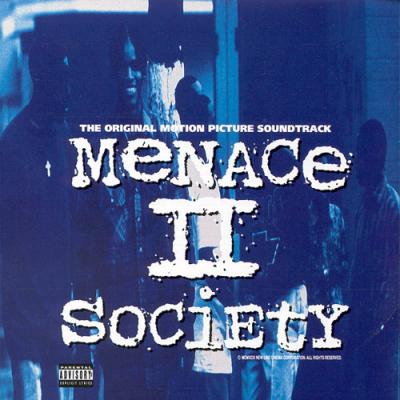
"Menace II Society" Soundtrack Lyrics
Movie • 1993
Track Listing
Spice 1
MC Eiht (from Compton's Most Wanted)
Ant Banks
Kenya Gruv
Too $hort
Mz. Kilo
Da Lench Mob
Smooth
Brand Nubian
Pete Rock and CL Smooth
Hi-Five
KRS-One
The Cutthroats f/ Guru
Underground Kings
Spice 1
"Menace II Society (The Original Motion Picture Soundtrack)" – Album Guide to Tracks and Key Scenes
Overview
What happens when a coming-of-age story decides there is no “safe way out” and lets the music sit in that truth? Menace II Society answers that by pairing one of the bleakest hood films of the 1990s with a soundtrack that refuses to soften the blow. The film follows Caine Lawson growing up in Watts and Jordan Downs, surrounded by violence, bad options and charismatic chaos in the form of O-Dog. The album mirrors that arc: West Coast menace up front, reflective cuts later, and R&B moments that feel like brief sunlight before the next storm.
On screen, Quincy Jones III’s score and a crate-digging selection of funk, soul and gangsta rap build a continuous soundscape: helicopters over the projects, house parties, late-night car rides, the hospital, the final drive-by. On disc, the official soundtrack leans heavily into hip hop and new jack swing, turning that soundscape into a stand-alone album tied to, but not limited by, the movie. Hardcore cuts from Spice 1, MC Eiht, Ant Banks, Da Lench Mob, UGK, Brand Nubian and DJ Quik sit next to smoother tracks by Hi-Five, Smooth and Kenya Gruv. The contrast is the point.
Across the film, music marks Caine’s phases: childhood under Marvin Gaye and classic soul; teenage swagger to Parliament-inspired funk; dope-game hustle under N.W.A and UGK; the doomed attempt at escape coated in R&B like “Honey Love” and “Unconditional Love.” Each shift feels deliberate. The soundtrack is not just era-accurate; it charts the story from arrival (into the life), through adaptation (learning the rules), into rebellion (striking back), and finally collapse (accepting there is no clean exit).
In genre terms, the album is primarily hip hop (West Coast gangsta, early-90s boom-bap, Texas dope-boy narratives) braided with R&B and soul. Aggressive street rap tracks push themes of fatalism, paranoia and reputation. G-funk and P-funk-inspired cuts cover bravado, partying and the illusion of control. The R&B and slow jams code the few scenes of tenderness and hope: love, family, the fantasy of leaving the hood. By the time MC Eiht’s “Streiht Up Menace” rolls over the credits, the styles have mapped almost exactly to Caine’s psychological journey.
How It Was Made
The film itself is the debut feature of Albert and Allen Hughes, shot largely on location in Watts and Jordan Downs with local residents and gang members used as extras and informal security. The score composer is Quincy Jones III (QD III), whose production company also provides several instrumental cues and funk-based source tracks inside the film. Over that, New Line Cinema and Jive Records built a dedicated hip-hop-heavy soundtrack, released in late May 1993 as a 16-track compilation under the title “Menace II Society (The Original Motion Picture Soundtrack).”
Executive producers on the album include the Hughes Brothers and Jive executives, with an unusually wide bench of producers: E-A-Ski and CMT for Spice 1, DJ Slip and MC Eiht, Ant Banks and the Dangerous Crew, D’Wayne Wiggins, Pete Rock, Cold 187um, DJ Quik, QD III himself and others. The soundtrack was conceived squarely inside the early-90s boom of “urban” films paired with cross-promotional hip-hop albums — think Boyz n the Hood, Juice, Above the Rim. Here, though, the tone skews darker and more West Coast-leaning than many of its peers.
The singles roll-out traced that strategy. Spice 1’s “Trigga Gots No Heart” (often titled “Nigga Gots No Heart” on explicit editions) was pushed as the lead single and came with a dedicated video, followed by MC Eiht’s “Streiht Up Menace” and Hi-Five’s “Unconditional Love,” each also getting video treatment that weaved in film footage. The album charted high on both the Billboard 200 and the R&B/Hip-Hop Albums charts and quickly earned gold, then platinum certification, confirming that the soundtrack had become a commercial force in its own right.
Behind the scenes, the casting and soundtrack strategy were intertwined. MC Eiht did double duty, playing A-Wax on screen and delivering the film’s narrative theme song. Spice 1 and Tupac Shakur were both initially linked to acting roles before production tensions led to changes; their music and personas, however, remained part of the project’s marketing orbit. Interviews with Eiht and Spice later underlined how closely the Hughes Brothers worked with them to keep the songs aligned with Caine’s story rather than just tacking on generic “street” records.
Tracks & Scenes
Below are key songs and musical moments — both from the official album and from non-album cues — with their placement and dramatic function. Exact timestamps vary by cut (theatrical, director’s cut, TV), so descriptions focus on scene context and story beats rather than minute-by-minute timing.
"Ghetto Bird" — Ice Cube
Where it plays: Instrumental over the opening aerial shots of Los Angeles and the projects, with the camera gliding past apartment blocks and courtyards before dropping the viewer into Caine and O-Dog’s liquor-store run. The beat sits under the helicopter sound and ambient city noise, effectively turning the police chopper into a musical motif. Non-diegetic, but blended with environmental sound.
Why it matters: It establishes surveillance and containment from the first frame. The idea that the neighborhood is constantly watched — by cops, by enemies, by the sky itself — hangs over everything Caine will do.
"Nigga Gots No Heart" (a.k.a. "Trigga Gots No Heart") — Spice 1
Where it plays: Prominently on the album as its opening salvo and folded into early sections of the movie’s soundscape around O-Dog’s reputation and the tape of the liquor-store murders. You hear it as a hard, minor-key statement of intent whenever the film leans into pure menace rather than moral questioning.
Why it matters: Lyrically, the track narrates a gunman who has numbed himself to consequence; thematically, it shadows O-Dog’s arc. On record, it sets the tone that this is not a “cautious” soundtrack — it will speak from inside the violence rather than just about it.
"Streiht Up Menace" — MC Eiht
Where it plays: Most memorably over the closing scenes and end credits. After the drive-by that kills Caine and Sharif and leaves Anthony crying in the yard, the film slips into slow-motion flashes of Caine’s life. As the credits begin, Eiht’s piano-led, mournful beat comes in, with lyrics that essentially retell Caine’s story from a first-person perspective. A remix version is also used earlier in the film over the burger-stand robbery sequence, where Caine and O-Dog jack a customer in the parking lot — there the song is diegetic, pumping from the system as violence erupts again.
Why it matters: It is the film’s thesis statement in rap form. Eiht narrates the inevitability of Caine’s end, turning what could have been a simple credits song into a second, musical epilogue.
"Dopeman (Remix)" — N.W.A
Where it plays: Under Caine’s first proper street-level crack deal, when he steps up from hanging around older dealers to running his own transaction. The track floats under dialogue and street noise as he exchanges money and vials, the low-slung groove reinforcing that this has become routine work for him.
Why it matters: It ties Caine’s reality directly back to late-80s/early-90s West Coast dope-game mythology. The film is newer than N.W.A’s classic records, but the cue makes clear that this is the generation raised on, and trapped by, that earlier era.
"Pocket Full of Stones (Port Arthur Remix)" — UGK
Where it plays: Heard in connection with Caine cooking and packaging dope in Ronnie’s kitchen and in other domestic drug-prep moments. Fans and Q&A sheets point to it and “Dopeman Remix” trading off in these sequences, with both tracks associated with cut-up flashes of baking soda, Pyrex, razors and baggies. Non-diegetic but mixed tightly with the sounds of the stove and glassware.
Why it matters: The lyrics about rising from small-time dealing to higher-level distribution mirror Caine’s ambitions. The slow, syrupy Texas drawl contrasts with the frantic cuts on screen, underlining how normalized this extremely risky work has become for him.
"Got to Give It Up" — Marvin Gaye
Where it plays: Twice, in very different emotional registers. First, at the party Caine’s parents throw in the opening flashback, the camera gliding past adults drinking, dancing and getting high while young Caine watches. Later, the same groove returns over the smoky card-table scene with Tat Lawson (Samuel L. Jackson) and his friends, just before Tat executes a man for talking slick about him. In both cases it is diegetic, coming from the house stereo.
Why it matters: The song is classic feel-good party Marvin, but here it scores the casualness of addiction and murder. The reuse of the track connects Caine’s earliest memories of “fun” to the roots of the violence that will shape him.
"Computer Love" — Zapp
Where it plays: During the barbecue scene when Caine pulls up in the white 5.0 Mustang after his graduation, circling the block with the top down. As he rolls up through the projects, the talkbox-driven hook of “Computer Love” glides out of the car speakers. Kids run alongside, people turn their heads, and the camera luxuriates in slow tracking shots of the Mustang and the crowd. Entirely diegetic; it is literally car-stereo flex music.
Why it matters: It is one of the most purely joyful feeling scenes in the film, but the song choice keeps it bittersweet — this is fantasy-romance funk about ideal love, pasted over a very fragile, short-lived sense of “making it” that Caine will not sustain.
"Atomic Dog" — George Clinton
Where it plays: At the graduation-night party where Caine and Harold walk in, fresh diplomas in hand, to a packed house full of friends and family. “Atomic Dog” bumps over cheap speakers while everyone dances and shows off, giving the sequence a joyous, almost house-party-video feel before tragedy intrudes later that same night on the drive home.
Why it matters: The groove ties the scene to the longstanding bond between P-funk and West Coast hip hop. It also marks the divide between official adulthood and the fact that, for these kids, old patterns of danger have not changed at all.
"For the Love of You (Part 1)" — The Isley Brothers
Where it plays: In the living-room dominoes scene with Caine, O-Dog, Chauncey and others. The silky Isley Brothers ballad drifts from the stereo as Chauncey mouths off and Caine’s patience snaps, leading to the pistol-whipping that further fractures the friendship. Diegetic, present as “grown folks” background music while the younger men clown around.
Why it matters: This is the soundtrack to older Black romance and indulgence, but here it plays while younger men fail to show each other any love at all. The gap between lyrics and behavior is the whole point.
"Top of the World" — Kenya Gruv
Where it plays: Mid-film at a more relaxed house gathering, over the stereo as Caine flirts and trades lines with Ilena and other women. Subtitles for the director’s cut explicitly label the cue, and you can hear the smooth R&B guitar line as the camera tracks through the room. The song plays long enough to set a mood before the conversation shifts back to business and street talk.
Why it matters: On the album, this is the breeziest track; in the film, it marks one of the last times Caine can just enjoy being young, charming and alive. It hints at a life he could have chased instead of the hustle.
"Honey Love" — R. Kelly & Public Announcement
Where it plays: Two key Ronnie-related scenes. First, during the intimate lovemaking between Caine and Ronnie, the song floats through the apartment, turning the cramped space into something tender and almost dreamlike. Later, when Ronnie quietly pushes Caine to leave for Atlanta with her and Anthony, “Honey Love” resurfaces, softer in the mix, as they talk about starting over. In both cases the track is diegetic, a slow jam intentionally put on to set a mood.
Why it matters: The lyrics and slow tempo underline the possibility of unconditional care Caine has never really had. The fact that this music surrounds the one plan that could have saved him makes its later absence in the final scenes feel cruel.
"Unconditional Love" — Hi-Five
Where it plays: Heard late in the film and heavily associated with it via the music video, which uses Menace II Society clips. In the movie, the song appears in the quieter stretch after the worst violence, as characters talk about leaving and the narrative briefly considers a softer, more R&B-colored future. The mix can vary slightly by edition, but it functions as a reflective coda rather than a high-action cue.
Why it matters: Structurally, it sits opposite “Streiht Up Menace”: one song describes the emotional promise of unconditional love, the other the inevitable pull of the streets. Together they frame the path Caine never gets to fully choose.
"You've Been Played" — Smooth
Where it plays: Later in the story, as the consequences of Caine’s choices start circling back — Ilena’s pregnancy claim, Chauncey’s betrayal, the feeling that every move has been watched. The hook, “you’ve been played,” appears in the script as background lyrics while characters talk over it, likely coming from a radio or TV in the room.
Why it matters: It is one of the most on-the-nose uses of a song title in the film. The track exists to tell the audience, in plain language, that Caine is now paying for having treated people as disposable.
"Death Becomes You" — Pete Rock & C.L. Smooth feat. YG'z
Where it plays: Used around plotting and cruising scenes, bringing an East Coast tonal shift into this very West Coast movie. The ominous horns and dense drums come in when the narrative leans into revenge and long-range consequences rather than impulsive violence.
Why it matters: As one critic noted in a retrospective, the song is among the duo’s darkest work. On the soundtrack it brings New York boom-bap gravity to a California story, reminding you this is not just a “regional” tragedy.
"Can't F*** Wit a N***a" — DJ Quik
Where it plays: In the car outside the chop shop with Caine, Stacy and Sharif, systems up while they wait and talk. The track is pure Compton party-funk, diegetic bass rattling windows as they joke around and plan the night.
Why it matters: It is the sound of clout and proximity to danger. The easy banter in the car sits on top of a track that brags about untouchability; the film will later prove how untrue that is.
End-credits reprise — "Streiht Up Menace" (Remix & Album Version)
Where it plays: Remix fragments appear under heavy action; the straight album version owns the main closing credits. The camera leaves the bodies in the yard, the neighborhood fills the frame one more time, and Eiht’s storytelling runs through the whole arc again.
Why it matters: Ending on a song that literally narrates the plot is risky; here it works because the performance is weary rather than triumphant. The track feels like the hood itself giving testimony.
Notes & Trivia
- The film’s credited composer is Quincy Jones III (QD III), but the commercial album is dominated by rap and R&B tracks produced by a separate roster of hip-hop producers.
- Three songs from the album — Spice 1’s “Trigga Gots No Heart,” MC Eiht’s “Streiht Up Menace” and Hi-Five’s “Unconditional Love” — were promoted with full music videos cut with film footage.
- The soundtrack’s CD and cassette editions differ slightly; some pressings highlight a “bonus remix” of “Trigga Gots No Heart,” and clean “radio” versions replace explicit titles.
- Several prominent songs in the film, including “Ghetto Bird,” “Honey Love,” “Atomic Dog,” “Got to Give It Up,” “Computer Love” and “For the Love of You,” never appeared on the main soundtrack album, which has annoyed completists for decades.
- “Unconditional Love” later resurfaced as the final track on Hi-Five’s 1993 album Faithful, giving the group a charting single tied first to the movie rather than their own LP.
- On the hip-hop side, “Pocket Full of Stones (Port Arthur Remix)” is one of the first widely heard national showcases for UGK, years before “Big Pimpin’.”
- MC Eiht’s performance as A-Wax reportedly grew in part from the directors wanting “real street dudes”; his theme song then doubled as a solo springboard outside his group Compton’s Most Wanted.
Music–Story Links
The soundtrack is tightly wired into Caine’s emotional and moral trajectory. Early on, the combination of “Got to Give It Up” and “Ghetto Bird” sketches his world: grown-up fun that sits right next to unpredictable violence, under a sky patrolled by police. Those cues say, without dialogue, that there is no clear separation between celebration and danger in his environment.
As Caine steps deeper into the drug trade, the needle drops harden. “Dopeman (Remix)” and “Pocket Full of Stones” are not just background; they are manuals. When we watch him bag product or make his first serious sale, the songs basically narrate the blueprint he is following, suggesting that his life has become an echo of rap records he grew up hearing.
The soul and R&B cues draw the boundary between what Caine wants and what he gets. “Top of the World” and “Honey Love” score moments where he could choose softness, stability and real connection — Ronnie’s apartment, a flirty party, the promise of Atlanta. “Unconditional Love” stretches that fantasy to its furthest point. The fact that the film ends instead with “Streiht Up Menace” seals the idea that the streets, not love, have the last word.
Even smaller choices reinforce character dynamics. When “For the Love of You” plays over the dominoes game that ends with Chauncey getting pistol-whipped, the gentle groove highlights how quick Caine is to short-circuit basic respect. When DJ Quik’s “Can’t F*** Wit a N***a” rattles the car outside the chop shop, it foreshadows Stacy and Sharif’s later attempts to escape — swagger first, then real fear.
Reception & Quotes
The soundtrack was an immediate commercial success, peaking high on the Billboard 200 and topping the R&B/Hip-Hop Albums chart before earning gold and then platinum certification. It helped solidify the model of the “all-star rap soundtrack” as a bankable product, not just an add-on to a film release.
In later retrospectives, critics and fans have consistently ranked it among the strongest hip-hop movie albums. One writer described it as a roll call of under-appreciated West Coast voices that “matched the film’s darkness with equally uncompromising records,” while noting how naturally MC Eiht and Spice 1 anchor the project. Another anniversary piece argued that the record captures a moment when labels and directors were finally treating rap soundtracks as fully curated albums rather than dumping grounds for leftovers.
Matched the film’s bleak South Central story with an album seeped in hardcore West Coast hip-hop.— Complex, on the soundtrack’s place in hip-hop cinema
One of the best films of its kind, and it came with one of the best soundtracks.— Albumism, 30th-anniversary feature
Among fans, individual favorites vary — some swear by the pure menace of “Nigga Gots No Heart,” others by the melancholy of “Streiht Up Menace” or the smooth escape of “Top of the World.” What is striking is how often people talk about discovering specific artists through this album; for many listeners outside regional scenes, Menace II Society was their first real contact with UGK, Da Lench Mob, Mz. Kilo or even Pete Rock & C.L. Smooth’s darker side.
Interesting Facts
- The official album was released on Jive in late May 1993, just days after the film’s U.S. theatrical debut, and runs a little over 69 minutes.
- Complex has repeatedly placed the soundtrack in the top tier of hip-hop movie albums, often inside the top ten of all time.
- “Streiht Up Menace” later appeared on a Compton’s Most Wanted compilation and on MC Eiht’s own best-of collection, and its instrumental resurfaces on the in-game radio station West Coast Classics in Grand Theft Auto V.
- “Unconditional Love” charted modestly on the Hot 100 but performed much better on the R&B/Hip-Hop singles chart, where it became one of Hi-Five’s last notable hits.
- R. Kelly’s “Honey Love,” used so prominently in the film, comes from his debut album and was already a No. 1 R&B single before Menace II Society, making the film’s love scenes feel plugged into contemporary radio.
- Some overseas or TV cuts of the film adjust or trim certain songs for clearance reasons, which is why long-time fans sometimes remember slightly different cue placements than the current Blu-ray or streaming versions.
- The cassette edition of the soundtrack gained a reputation among collectors because of its explicit track sequencing and the inclusion of a bonus remix, which did not always appear on later digital reissues.
- BET once ran a “Where Are They Now?” feature specifically about this soundtrack’s roster, treating the album itself as a kind of unofficial all-star team of early-90s hip hop and R&B.
Technical Info
- Title: Menace II Society (The Original Motion Picture Soundtrack)
- Film: Menace II Society (1993), directed by Albert Hughes & Allen Hughes
- Year of soundtrack release: 1993 (album street date late May)
- Type: Feature film soundtrack, compilation (various artists)
- Primary genres: Hip hop, gangsta rap, G-funk, R&B, soul
- Label: Jive Records (various CD, cassette and club editions)
- Key producers: E-A-Ski & CMT, DJ Slip, MC Eiht, Ant Banks, The Dangerous Crew, D’Wayne Wiggins, Pete Rock, Cold 187um, DJ Quik, QD III and others
- Notable singles: “Trigga Gots No Heart” (Spice 1), “Streiht Up Menace” (MC Eiht), “Unconditional Love” (Hi-Five)
- Chart performance: Top-20 on the Billboard 200 and No. 1 on the Top R&B/Hip-Hop Albums chart in 1993
- Certifications: RIAA gold within months of release, later certified platinum
- Score composer (film): Quincy Jones III (original score and instrumental cues, separate from the commercial song compilation)
- Availability: Widely available on major streaming services in explicit and “clean” editions; original physical pressings (especially cassette and club-edition CDs) are now collector items.
Questions & Answers
- Why is the Menace II Society soundtrack considered a landmark hip-hop movie album?
- Because it pairs a critically acclaimed, uncompromising hood film with a fully curated hip-hop and R&B compilation that works as an album on its own, not just as background cues.
- How closely does the album match the songs actually heard in the movie?
- The overlap is significant but not complete. Several key film cues — like “Ghetto Bird,” “Honey Love,” “Atomic Dog” and “Computer Love” — never appeared on the main commercial soundtrack, while some album-only cuts are used more briefly on screen.
- What makes MC Eiht’s “Streiht Up Menace” so important to the film?
- It functions as a musical retelling of Caine’s story and plays over the final montage and credits, giving the film a second, rap-narrated ending that cements its fatalism.
- Did any artists on the soundtrack also appear in the film?
- Yes. MC Eiht plays A-Wax, Too Short appears as Lew-Loc, and other rappers from the soundtrack’s orbit, like Pooh-Man, show up in supporting roles, tightening the link between the music and the on-screen world.
- Is the full Menace II Society musical experience available in one place?
- Not exactly. The official soundtrack covers the core hip-hop and R&B selections, but to recreate every needle drop from the film — including classic soul and funk cuts — you still have to build an expanded playlist from multiple albums.
Canonical Entities & Relations
| Subject | Relation | Object |
|---|---|---|
| Menace II Society (film) | is directed by | Albert Hughes & Allen Hughes |
| Menace II Society (film) | is scored by | Quincy Jones III (QD III) |
| Menace II Society (film) | is produced by | New Line Cinema |
| Menace II Society (The Original Motion Picture Soundtrack) | is a soundtrack to | Menace II Society (film) |
| Menace II Society (The Original Motion Picture Soundtrack) | is released by | Jive Records |
| Menace II Society (The Original Motion Picture Soundtrack) | features | MC Eiht, Spice 1, Ant Banks, Too Short, UGK, DJ Quik and others |
| MC Eiht | performs | “Streiht Up Menace” |
| MC Eiht | portrays | A-Wax in Menace II Society (film) |
| Spice 1 | performs | “Nigga Gots No Heart” on the soundtrack |
| Hi-Five | performs | “Unconditional Love” on the soundtrack |
| Kenya Gruv | performs | “Top of the World” on the soundtrack |
| Too Short | performs | “Only the Strong Survive” on the soundtrack |
| Too Short | portrays | Lew-Loc in Menace II Society (film) |
| UGK | performs | “Pocket Full of Stones (Port Arthur Remix)” on the soundtrack |
| Pete Rock & C.L. Smooth feat. YG’z | perform | “Death Becomes You” on the soundtrack |
| Brand Nubian | performs | “Lick Dem Muthaphuckas” on the soundtrack |
| DJ Quik | performs | “Can’t F*** Wit a N***a” on the soundtrack |
| R. Kelly & Public Announcement | perform | “Honey Love,” used in the film |
| Ice Cube | performs | “Ghetto Bird,” used over the opening aerial sequence |
Sources: Wikipedia film and soundtrack entries; SoundtrackINFO cue Q&A; Albumism 30th-anniversary feature; Complex hip-hop soundtrack rankings; AllMusic and MusicBrainz album data; Discogs release listings; AFI Catalog production notes; Criterion and other critical essays; Billboard and RIAA chart/certification references.
November, 15th 2025
A-Z Lyrics Universe
Cynthia Erivo Popular
Ariana Grande Horsepower
Post Malone Ain't No Love in Oklahoma
Luke Combs Good Riddance (Time of Your Life)
Green Day Bye Bye Bye
*NSYNC You're the One That I Wan
John Travolta & Olivia Newton-John I Always Wanted a Brother
Braelyn Rankins, Theo Somolu, Kelvin Harrison Jr. and Aaron Pierre The Power of Love
Frankie Goes to Hollywood Beyond
Auli’i Cravalho feat. Rachel House MORE ›