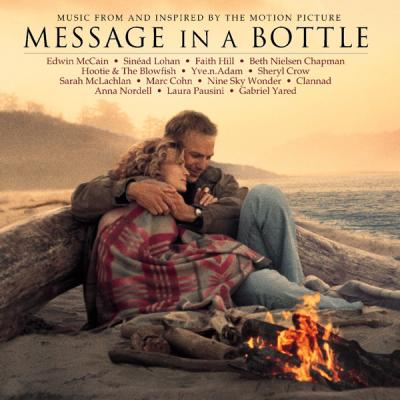
"Message in a Bottle" Soundtrack Lyrics
Movie • 1999
Track Listing
Edwin McCain
Sinead Lohan
Faith Hill
Beth Nielsen Chapman
Hootie & the Blowfish
Yve.N.Adam
Sheryl Crow
Sarah McLachlan
Marc Cohn
Nine Sky Wonder
Clannad
Anna Nordell
Laura Pausini
Gabriel Yared
Gabriel Yared
Gabriel Yared
"Message in a Bottle (Music from and Inspired by the Motion Picture)" – Album Guide to Tracks and Key Scenes
Overview
Can a soft-rock ballad make a shipwreck feel inevitable and comforting at the same time? The soundtrack to Message in a Bottle leans hard into that question. The 1999 film adapts Nicholas Sparks’s novel into a windswept romance about grief, second chances and the kind of love letter you literally pull out of the tide. Around it, the soundtrack builds a 1990s adult-contemporary bubble of Edwin McCain, Sarah McLachlan, Faith Hill and Sheryl Crow on one side, and Gabriel Yared’s serious, orchestral score on the other.
On screen, journalist Theresa Osborne (Robin Wright) finds a love letter in a bottle during a run on a New England beach and tracks down its author, North Carolina boatbuilder Garrett Blake (Kevin Costner). The film moves between her busy Chicago life and his slower, tidal routine on the coast, with Paul Newman quietly stealing scenes as Garrett’s father. The songs carry a lot of this tonal shift: heavily produced Nashville ballads and radio-soft rock for Theresa’s world; more reflective folk and Celtic colours when we’re close to the sea and to Garrett’s unresolved grief.
Composer Gabriel Yared gives the movie its spine. His score album, Message in a Bottle (Original Motion Picture Score), plays with chamber-like strings, piano and occasional choral writing, keeping big emotions on a slow simmer rather than going for obvious swells. Reviewers have noted how it sits halfway between the cool restraint of his Oscar-winning The English Patient score and the warmer, romantic palette of City of Angels — technically meticulous, but more immediately approachable than his earlier work. At key points (Theresa reading a letter, Garrett at the boatyard, the storm sequence), the songs drop away completely and Yared takes over, almost like the film hitting a more honest register.
The main song compilation, Message in a Bottle (Music from and Inspired by the Motion Picture), goes in three phases. Early tracks like Edwin McCain’s “I Could Not Ask for More”, Sinéad Lohan’s “No Mermaid” and Hootie & the Blowfish’s “Only Lonely” sketch a late-90s, VH1-ready landscape where love is big, earnest and wordy. Mid-album selections — Sheryl Crow’s “Carolina”, Marc Cohn’s “Fallen Angels”, Beth Nielsen Chapman’s “I Will Know Your Love” — lean more into rootsy Americana and reflective singer-songwriter territory. Toward the end, Clannad’s “What Will I Do” and Laura Pausini’s “One More Time” bring in Celtic and European pop ballad flavours, signalling the story’s pivot from possibility to acceptance and loss.
How It Was Made
Behind the camera, Luis Mandoki directs from Gerald Di Pego’s adaptation of Sparks’s novel, with Warner Bros. handling theatrical release. Gabriel Yared comes in as composer after his run of prestige romantic dramas in the 1990s. The producers effectively split the music brief in two: Yared handles the emotional architecture through a 17-cue score (released separately), while Atlantic/143 Records assemble a “music from and inspired by” package built around established adult-contemporary artists and country-crossover names.
The song album was released first, in early February 1999, to ride ahead of the film’s Valentine’s Day release window. It plays like a mini-sampler of late-90s radio: Edwin McCain’s Diane Warren-penned “I Could Not Ask for More” as the lead single; Faith Hill’s “Let Me Let Go”; Sarah McLachlan’s “I Love You”; Hootie & the Blowfish’s “Only Lonely”; Sheryl Crow’s gently bluesy “Carolina”; Marc Cohn’s “Fallen Angels”; plus contributions from Sinéad Lohan, Beth Nielsen Chapman, Clannad and others. According to label materials and discographic notes, producer David Foster is involved on several of the more polished ballads, especially Laura Pausini’s closing-credits song “One More Time”.
Irish band Clannad wrote “What Will I Do” specifically for the film, a slow, wistful ballad that operates almost as a musical echo of Garrett’s letters. Laura Pausini has talked in interviews and official bios about how “One More Time” was one of her first major English-language soundtrack placements, written by Richard Marx and recorded with Foster on piano. The combination of these purpose-written songs with pre-existing cuts gives the movie that then-typical 90s feel: half compilation, half bespoke score, with the more “inspired by” tracks sometimes living their main life on radio and on the album rather than in the film’s final cut.
On the score side, Yared recorded for Atlantic/Warner, with the album Message in a Bottle (Original Motion Picture Score) arriving a couple of months after the songs compilation. Film music sites note that he develops two main thematic ideas: one announced in “To All the Ships at Sea” and explored in cues like “Finding the Bottle” and “Last Letter”, and another that carries the more straightforward romantic material through tracks such as “New Dreams”. The approach is typical of Yared: moderate tempos, understated scoring, a lot of emotional work done through subtle shifts in harmony rather than big crescendos.
Tracks & Scenes
Precise timecodes vary slightly between releases and TV cuts, so the placements below are approximate — but they reflect how the major songs and several key score cues function against the picture.
"I Could Not Ask for More" — Edwin McCain
Where it plays: Used as the film’s signature love song and heavily associated with Theresa and Garrett’s time together on the North Carolina coast. The song underscores a mid-to-late-film montage of them growing closer — walking the docks, sailing, cooking, and simply existing in the same spaces without talking much. The images are warmly lit, almost postcard-like, with the camera lingering on small gestures rather than big embraces. The track plays non-diegetically, over edited scenes that likely span several days.
Why it matters: Written by Diane Warren and cut specifically for this soundtrack, the song underlines the fantasy version of their relationship — the idea that these are the “moments I’ll remember all my life” and that the existing happiness is enough. Knowing where the plot goes, that sentiment starts to feel almost painful in hindsight; the song becomes the sound of a happiness neither of them can actually hold.
"No Mermaid" — Sinéad Lohan
Where it plays: Heard early in the film as Theresa’s everyday life in Chicago is sketched in: commuting, working at the paper, navigating joint custody and a social life that never quite clicks. The song plays non-diegetically over these slices of routine, the camera often watching her from a slight distance — in corridors, on trains, on the treadmill of office life. The feel is jangly but reflective, matching her mix of competence and dissatisfaction.
Why it matters: Lohan’s lyric (“I’m no mermaid / I’m no siren”) cuts against the fantasy of idealized romance and mythic female roles. That subtext sits nicely under Theresa’s story: she’s not a dream figure washing ashore to save Garrett; she’s a real woman with a job, a child and a complicated moral position about how she found him.
"Let Me Let Go" — Faith Hill
Where it plays: Used around the middle of the movie in connection with Theresa’s unresolved feelings about her divorce and the painful sense that she may have walked into something she cannot sustain. The song plays over a quieter stretch — phone calls, solitary moments in her apartment, and images of her wrestling with whether to confess the truth about the letters. The cut keeps dialogue minimal and lets Hill’s vocal carry the emotional exposition.
Why it matters: The track’s central plea — needing permission to move on — mirrors both Theresa’s and Garrett’s arcs at different points. It is one of the more overtly country-polished songs on the album, but in context it highlights a specifically adult kind of heartbreak: not high-school melodrama, but the difficulty of releasing a damaged marriage and a dead spouse in order to risk something new.
"Only Lonely" — Hootie & the Blowfish
Where it plays: The film uses this as a bar-and-harbor mood piece in and around the Outer Banks community where Garrett lives. We hear it as background music in a social scene — people drinking, laughing, talking about Garrett’s loss more bluntly than he ever does — with the track mostly non-diegetic, treated like the sound of the jukebox or radio filling the room. Theresa watches him from across the space, trying to read whether he is available emotionally at all.
Why it matters: There is some dark humor in a song literally called “Only Lonely” playing in a room full of people who know everything about everybody. The choice underlines Garrett’s isolation: surrounded by community, but emotionally off to one side, nursing grief that the town has half-normalised.
"Carolina" — Sheryl Crow
Where it plays: Played over travel and transition material as Theresa makes repeat trips between Chicago and the Carolina coast. The imagery here is all motion — highways, ferries, small-town streets, the line where land gives way to sea. Crow’s vocal rides on a relaxed swing that contrasts with Theresa’s anxious energy; visually she’s always in motion, but the music seems content just to be there.
Why it matters: “Carolina” becomes a shorthand for the place where Garrett lives and for the version of herself Theresa can only access there. Every time the song or its guitar figure surfaces, the film quietly marks the shift from work-obsessed city life to the slower, sea-air rhythm that makes their relationship possible.
"I Love You" — Sarah McLachlan
Where it plays: Used in one of the film’s more overt romantic sequences — a quieter, intimate scene between Theresa and Garrett when they finally drop some of their armour. Lighting turns softer, the camera stays close, and McLachlan’s vocal is mixed relatively high against the dialogue, almost as if the film is briefly allowing itself to be a straight-up music video for adult romance.
Why it matters: This is the moment where the movie chooses to lean fully into the Nicholas Sparks brand of sincerity. The song’s repeated “I will be your true one” clashes with Garrett’s unresolved attachment to Catherine, which gives the scene a slightly tragic undertow if you watch it knowing the ending.
"Fallen Angels" — Marc Cohn
Where it plays: Heard around or just after the boat-christening sequence, when Garrett publicly honours his late wife Catherine and Theresa realizes, brutally, that she is still competing with a ghost. The song plays as the party winds down and Theresa retreats emotionally; there is a sense of everyone else basking in local nostalgia while she is quietly breaking apart.
Why it matters: Cohn’s world-weary delivery and the lyric about people who cannot quite save themselves line up with Garrett’s trajectory. The placement pushes against the temptation to see the christening as a purely hopeful moment; musically, it feels more like the last flare of an old love story than the first day of a new one.
"What Will I Do" — Clannad
Where it plays: Woven through late-film reflection scenes as Garrett and Theresa each confront what they might lose. It accompanies shots of the coast, empty rooms, and the small rituals of wrapping up practical affairs — Garrett tying off lines, Theresa packing, letters being folded and unfolded. The track plays non-diegetically, but with enough space in the mix that its Celtic-folk textures feel like they are filling the same air the characters are breathing.
Why it matters: Written expressly for the movie, the song functions as an emotional thesis for Garrett: a man who genuinely does not know who he is without Catherine, but who has also glimpsed the possibility of a different life with Theresa. The repeated question in the chorus — “What will I do without you?” — applies uncomfortably to both relationships at once.
"One More Time" — Laura Pausini
Where it plays: This is the end-credits song, playing after the storm sequence and the revelation of Garrett’s final letter. As Theresa walks away from the sea, letter in hand, the film fades to black and Pausini’s voice comes in over titles. The tone is lush, European pop balladry — sweeping strings, a prominent piano line and a vocal performance that sits between grief and gratitude.
Why it matters: Placing this track at the very end reframes the story as something more than a tragedy. Lyrically and musically, it stresses the idea that Theresa has been changed for the better by this short, intense relationship. It also gives the soundtrack a clean curtain call: the last word is not an anguished orchestral cue, but a song about being willing to risk love again.
Score highlight: "To All the Ships at Sea" — Gabriel Yared
Where it plays: Early in the film and on the score album, this cue serves almost as a musical prologue. It is heard over ocean imagery, the routine of Garrett’s life by the water and, in album form, introduces one of the main themes. The writing is restrained: strings and piano, with harmonies that feel slightly unresolved.
Why it matters: The title nods to old maritime radio broadcasts and underscores the film’s biggest metaphor — people sending emotional messages into the void and hoping someone is out there. Yared’s theme here is what later cues like “Finding the Bottle” and “Last Letter” build on, so you hear it whenever the story returns to the idea of love as something written and cast adrift.
Score highlight: "New Dreams" — Gabriel Yared
Where it plays: Around the period when Garrett and Theresa begin to imagine a shared future — Chicago trips, talk of changing routines, the two of them tentatively occupying the same domestic spaces. The cue is melodic and warmer than much of the earlier score, with a sense of cautious lift.
Why it matters: Many commentators single this out as the closest thing the score has to a “main love theme”. It marks the scenes where the film stops looking backward at Catherine and starts tentatively looking forward at what could be. Precisely because we know where the plot goes, the cue ends up bittersweet rather than straightforwardly hopeful.
Notes & Trivia
- There are effectively two main albums: a 16-track “music from and inspired by” compilation and a separate 17-track score album by Gabriel Yared.
- Edwin McCain’s “I Could Not Ask for More” began life here and later became a minor pop hit and a wedding favourite, then was covered on the country charts by Sara Evans.
- Clannad’s “What Will I Do” was written for the film and later folded into their own compilation releases, credited explicitly as a Message in a Bottle theme.
- Laura Pausini regularly cites “One More Time” as an early milestone in her international career — it shows up in official biographies and live-show retrospectives.
- At least one review of the song compilation openly calls it a typical late-90s “music from and inspired by” disc, while praising Yared’s separate score as the more substantial listening experience.
- The film’s soundtrack marketing leans on the contrast between gritty coastal imagery and glossy ballads; the cover art shows the sea, but the track list is almost entirely studio-polished pop, country and adult contemporary.
Music–Story Links
The easiest way to think about the soundtrack is that the songs handle the “novel cover” moments and Yared’s score handles the margins and the damage. When we see Theresa jogging on the beach, commuting in Chicago or tentatively dating again, the compilation tracks play like someone’s carefully curated CD in the background: McCain, Lohan, Faith Hill and Crow giving us lyrics that say the things she cannot quite say out loud.
Once we are firmly in Garrett’s world, the balance shifts. Hootie & the Blowfish’s “Only Lonely” and Marc Cohn’s “Fallen Angels” sketch the social and emotional landscape — docks, bars, community rituals — but the scenes that dig into his grief mostly fall under Yared’s strings and piano. The score themes linked to the letters and to the sea form a kind of private language between the film and the viewer, separate from the radio-ready sheen of the songs.
Late in the film, Clannad’s “What Will I Do” and Yared’s darker cues begin to overlap. The songs stop promising permanent happiness; they start asking whether love is survivable at all. Pausini’s “One More Time” then reframes the whole movie right at the end: the lyrics make it clear that Theresa’s experience with Garrett does not end in emotional stasis, but in a kind of bruised gratitude. In other words, the music does the same thing Garrett’s final letter does — it turns an objectively tragic ending into a story about having been changed for the better.
Reception & Quotes
The film itself drew mixed-to-poor critical notices, with a low-30s approval rating on review aggregators and complaints about its length and familiar Sparks formula. Reviewers were more generous about the technical polish: Caleb Deschanel’s coastal cinematography and Gabriel Yared’s discreet score often get singled out as elements that “dignify” material some critics otherwise dismiss.
The song compilation, though, found a more forgiving audience among both fans and some mainstream outlets. A retail write-up at the time described it as a collection of “emotive, widescreen love songs” designed to match the movie’s unabashed romanticism, while a specialist film-music site, talking about the combined package, bluntly called the main album a “vapid ‘music from and inspired by’ collection” but praised Yared’s contribution as a strong, thematic follow-up to The English Patient and City of Angels.
Composer Gabriel Yared crafts a romantic, emotional backdrop with his score for 1999’s Message in a Bottle… richly emotional and masterfully performed.
— Summary from a Barnes & Noble album overview
Gabriel Yared’s score dignifies the proceedings more than they perhaps deserve.
— Trade-press review of the film
On the fan side, the soundtrack’s reputation has largely outlived the movie’s. “I Could Not Ask for More” still appears on wedding and slow-dance playlists; Faith Hill’s “Let Me Let Go” has its own chart and award trajectory; Sarah McLachlan and Sheryl Crow have deep catalogues, but their tracks here remain part of late-90s adult-contemporary nostalgia. The score, meanwhile, tends to get rediscovered by Yared fans who work backward from The English Patient and Cold Mountain and find a quieter but rewarding entry in his filmography.
Interesting Facts
- The songs compilation runs just over 74 minutes across 16 tracks; the score album runs around 48 minutes across 17 cues, so together they cover almost as much time as the film’s 131-minute runtime.
- Discogs and retailer listings treat the song album as a 143 Records/Atlantic release, while the score album is credited specifically to Gabriel Yared under Atlantic/Warner — two different catalogue numbers, two different marketing pushes.
- Some online listings and retailer blurbs mislabel Clannad’s “What Will I Do” as “Oceans of Love”, showing how tangled soundtrack titling can get once marketing copy is recycled.
- “Only Lonely” by Hootie & the Blowfish later surfaces in Darius Rucker’s discography notes as part of his pre-solo soundtrack work, sitting there next to completely different TV and compilation appearances.
- One score reviewer jokingly warns buyers not to confuse the Yared score disc with the song compilation: one is “what the film actually sounds like moment by moment,” the other “what the studio wished it sounded like on radio.”
- Laura Pausini has performed “One More Time” in high-profile contexts like Pavarotti & Friends, which means a song written for a relatively modest romantic drama has lived a second life on big classical/pop crossover stages.
- Clannad later reissued “What Will I Do” on their own greatest-hits disc, labelling it explicitly as a Message in a Bottle theme and giving it a context outside the film.
- The movie is sometimes mistakenly assumed to use The Police’s 1979 hit “Message in a Bottle”; in fact, that song does not appear on either album or in the film — the title overlap is purely thematic.
Technical Info
- Film title: Message in a Bottle
- Year: 1999
- Film type: American romantic drama, theatrical feature
- Director: Luis Mandoki
- Primary cast: Kevin Costner (Garrett Blake), Robin Wright (Theresa Osborne), Paul Newman (Dodge Blake)
- Score composer: Gabriel Yared
- Song compilation: Message in a Bottle (Music from and Inspired by the Motion Picture) — Various Artists
- Score album: Message in a Bottle (Original Motion Picture Score) — Gabriel Yared
- Key artists on songs album: Edwin McCain, Sinéad Lohan, Faith Hill, Beth Nielsen Chapman, Hootie & the Blowfish, Yve.N.Adam, Sheryl Crow, Sarah McLachlan, Marc Cohn, Nine Sky Wonder, Clannad, Anna Nordell, Laura Pausini
- Notable tracks (songs): “I Could Not Ask for More”, “No Mermaid”, “Let Me Let Go”, “I Will Know Your Love”, “Only Lonely”, “Carolina”, “I Love You”, “Fallen Angels”, “Somewhere in the Middle”, “What Will I Do”, “I’ll Still Love You Then”, “One More Time”
- Notable tracks (score): “To All the Ships at Sea”, “New Dreams”, “Separate Lives”, “Theresa”, “Launch”, “Finding the Bottle”, “Last Letter”, “Some Lives Form a Perfect Circle”, “Message in a Bottle”, “Dear Catherine”
- Labels: 143 Records / Atlantic Records (songs album); Atlantic / Rhino / Warner Music (score album releases)
- Album release dates: songs compilation — 9 February 1999 (approx., aligned with US theatrical release); score album — 20 April 1999 (US)
- Approximate durations: songs album — ~74 minutes (16 tracks); score album — ~48 minutes (17 tracks)
- Film runtime: 131 minutes
- Production companies: Bel Air Entertainment, Di Novi Pictures, Tig Productions
- Distributor: Warner Bros. Pictures
- Release context: US theatrical release 12 February 1999; soundtrack timed around Valentine’s Day market; home video in August 1999.
- Availability: both albums are available on major streaming platforms; physical CDs circulate on catalog imprints and re-pressings.
Questions & Answers
- Are there really two different Message in a Bottle soundtracks?
- Yes. One is the various-artists songs compilation Message in a Bottle (Music from and Inspired by the Motion Picture); the other is Gabriel Yared’s orchestral score album, usually titled Message in a Bottle (Original Motion Picture Score).
- Which song plays over the end credits?
- The end credits are anchored by Laura Pausini’s “One More Time”, written by Richard Marx and produced in a classic late-90s piano-and-strings pop-ballad style. Clannad’s “What Will I Do” appears earlier in reflective scenes within the film.
- Did “I Could Not Ask for More” originate with this film?
- Yes. Edwin McCain’s version was recorded for the soundtrack and then included on his album Messenger, later becoming a modest pop hit and a staple of wedding playlists before being covered by Sara Evans on the country charts.
- Who composed the film’s score and what does it sound like?
- Gabriel Yared composed the score. It is mostly string-and-piano based, with restrained, slowly evolving themes that support the film’s coastal melancholy rather than going for big melodramatic swells.
- Is the soundtrack easy to find today?
- Both the songs compilation and the score album are on the major streaming services and digital stores. Physical CDs show up as standard catalog titles and second-hand copies; vinyl editions are not widely documented.
Canonical Entities & Relations
| Subject | Verb | Object |
|---|---|---|
| Message in a Bottle (film) | is directed by | Luis Mandoki |
| Message in a Bottle (film) | is based on novel by | Nicholas Sparks |
| Message in a Bottle (film) | stars | Kevin Costner as Garrett Blake |
| Message in a Bottle (film) | stars | Robin Wright as Theresa Osborne |
| Message in a Bottle (film) | stars | Paul Newman as Dodge Blake |
| Message in a Bottle (film) | features music by | Gabriel Yared |
| Message in a Bottle (film) | is produced by | Bel Air Entertainment, Di Novi Pictures, Tig Productions |
| Message in a Bottle (film) | is distributed by | Warner Bros. Pictures |
| Message in a Bottle (Music from and Inspired by the Motion Picture) | is released by | 143 Records / Atlantic Records |
| Message in a Bottle (Original Motion Picture Score) | is composed by | Gabriel Yared |
| “I Could Not Ask for More” | is written by | Diane Warren |
| “I Could Not Ask for More” | is performed by | Edwin McCain |
| “No Mermaid” | is performed by | Sinéad Lohan |
| “Let Me Let Go” | is performed by | Faith Hill |
| “Only Lonely” | is performed by | Hootie & the Blowfish |
| “What Will I Do” | is written and performed by | Clannad |
| “One More Time” | is written by | Richard Marx |
| “One More Time” | is performed by | Laura Pausini |
| Gothic coastal locations in Maine | stand in for | North Carolina Outer Banks setting |
Sources: AllMusic (albums); Apple Music; Spotify; Discogs; SoundtrackINFO; IMDb; Wikipedia (film, songs, artists); Barnes & Noble album overviews; MusicWeb International; Filmtracks; Warner Bros. and Nicholas Sparks wikis; artist bios for Clannad, Laura Pausini and Edwin McCain; retailer listings (Atlantic/143 Records / Atlantic score releases).
November, 15th 2025
A-Z Lyrics Universe
Cynthia Erivo Popular
Ariana Grande Horsepower
Post Malone Ain't No Love in Oklahoma
Luke Combs Good Riddance (Time of Your Life)
Green Day Bye Bye Bye
*NSYNC You're the One That I Wan
John Travolta & Olivia Newton-John I Always Wanted a Brother
Braelyn Rankins, Theo Somolu, Kelvin Harrison Jr. and Aaron Pierre The Power of Love
Frankie Goes to Hollywood Beyond
Auli’i Cravalho feat. Rachel House MORE ›