Soundtracks:  A B C D E F G H I J K L M N O P Q R S T U V W X Y Z #


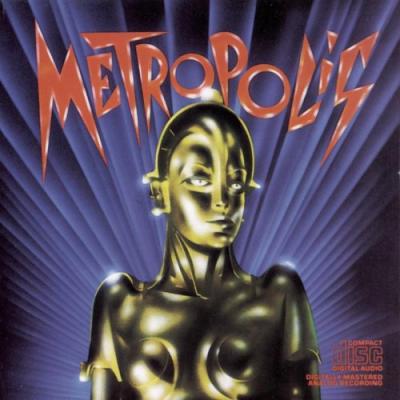
Metropolis Album Cover

"Metropolis" Soundtrack Lyrics

Movie • 2008

Track Listing


"Metropolis (Soundtrack)" – Album Guide to Tracks and Key Scenes

Fritz Lang’s Metropolis futuristic skyline used with the 2008 Metropolis soundtrack
Metropolis (1927) with the 2008 electronic Metropolis (Soundtrack) score, revisited for a new generation.

Overview

What happens when a 1927 silent sci-fi landmark gets a dark, electronic score from 2008 instead of a roaring orchestra? Metropolis (Soundtrack) by the project simply credited as Metropolis tries to answer that. It runs almost two hours and is designed to be synced to Fritz Lang’s original film cut, cue for cue, scene for scene.

The album is built as a continuous narrative rather than a collection of singles. Track titles map directly to key beats in the movie’s plot – “Gothic Skyscrapers”, “The Mediator”, “Workers of the Underworld”, “Rotwang”, “Yoshiwara’s Nightclub”, “The Heart Machine”, “Flooding the Underground City”. You can almost read the story from the playlist alone, even before you press play.

In practice, this score turns the expressionist city into a slow-burn electronic nightmare. Where Gottfried Huppertz’s original orchestral score leans on late-Romantic harmony and leitmotifs, the 2008 Metropolis (Soundtrack) favors pulsing synth bass, long pads and minimal motifs. The emotional arc is the same – arrival in the dazzling city, adaptation to its rhythms, rebellion against the machines, and eventual collapse – but the color is closer to nocturnal club music than opera pit.

Functionally, the album acts as an unofficial “modern dub” of the film: it keeps the narrative structure and scene order of the restored Metropolis versions, but reframes them with late-20th-century electronic language. You feel the same class conflict and religious imagery, just filtered through drones, sub-bass swells and mechanical drum programming instead of brass fanfares.

In terms of genres and themes, the album moves in phases. Early cues lean into ambient and cinematic downtempo for the upper city’s polished surfaces; mid-film tracks bring in heavier industrial and trip-hop inflections for the machine halls and riots; late cues move toward almost ritualistic dark ambient around the cathedral and flood. Broad strokes: electronic minimalism for control, industrial textures for exploitation, and hazy, reverb-heavy themes for the idea of “the mediator” – a bridge between head, hands and heart.

How It Was Made

Metropolis (Soundtrack) was released digitally in January 2008 by Soundtrack Classics Records as a 19-track, 1h57m album credited to Metropolis. The timing is not accidental: the previous years had seen a strong revival of interest in Lang’s film, including a major restoration and full recording of the original Huppertz score in 2001, and the discovery in 2008 of a near-complete 16mm print in Buenos Aires that enabled the 2010 “Complete Metropolis” restoration.

The 2008 album follows a pattern familiar from other Metropolis re-scores. Over the decades, the film has attracted radically different musical approaches: Huppertz’s orchestral original, Giorgio Moroder’s 1984 pop-rock version with Freddie Mercury and others, Jeff Mills’s techno Metropolis album in 2000, the New Pollutants’ electronica-orchestral Metropolis Rescore, and multiple live scores from ensembles like Alloy Orchestra and symphony orchestras. The Metropolis (Soundtrack) project sits in that lineage but aims squarely at home viewing and streaming rather than the concert hall.

Stylistically, the producers treat the score as a longform electronic suite. Each cue focuses on one location or character and uses a small set of motifs: a rising minor-third figure to signal the city’s vertical hierarchy, mechanical ostinatos for the M-Machine and the Heart Machine, and broader, almost hymn-like chords for Maria and “The Mediator”. The palette favors synths, processed percussion and deep bass over acoustic instruments, which keeps the sound consistent across the whole running time.

Because it is an unofficial modern score rather than a studio-commissioned restoration, details of the recording process are sparse in public sources. What we can confirm: it is built as a complete front-to-back playthrough of the narrative; it is delivered as a continuous listening experience without dialogue or effects; and it was issued by a label that specializes in film-centric niche releases. In other words, it is meant to be dropped under the film like a new audio layer, not cherry-picked for playlists.

Metropolis workers marching under the city, used with the 2008 electronic score
The 2008 score reimagines the march of Metropolis’s workers as a slow, grinding electronic processional.

Tracks & Scenes

Below, I walk through key cues from Metropolis (Soundtrack) and how they line up with classic moments in Fritz Lang’s film. Timestamps are approximate and based on the common ~145–148-minute restorations.

"Gothic Skyscrapers" – Metropolis
Scene: This cue is designed for the opening skyline montage, around the very start of the film, when the city’s towers dominate the frame and the workers’ shift-change begins below. Over stark images of elevators, smokestacks and clock faces, the track lays out a slow, towering synth theme that treats the skyscrapers like an organ façade. It plays non-diegetically, framing the city itself as the main “character” before any human appears.
Why it matters: It sets the album’s tone: cool, vertical, architectural. Instead of the brassy fanfare Huppertz wrote, we get a darker electronic mass that makes the city feel indifferent rather than heroic.

"Planners & Thinkers" – Metropolis
Scene: This cue belongs to the early upper-city sequences where Joh Fredersen and the planners watch the city from above, roughly 00:05–00:15. We see office towers, maps, pneumatic tubes and the ordered life of the elite. The track stretches over several minutes with a repeating, almost boardroom-like groove – steady electronic pulses, muted melodic fragments – completely non-diegetic, hovering over the glass and steel world of the “head”.
Why it matters: It sonically separates the ruling class from the workers. Where later tracks for the machine halls grind and hiss, “Planners & Thinkers” is smooth, controlled, faintly smug. The music does what the set design does visually: it makes power feel distant.

"Joh" – Metropolis
Scene: Built for scenes in Joh Fredersen’s office, this cue fits moments when Freder confronts his father after witnessing the Moloch-like machine accident (around 00:20–00:30). Joh’s office is all sharp lines, huge windows and an elevated desk; the music mirrors that with a long, slow-moving bass line and sparse motifs that sit above it like commands. Again, purely non-diegetic – we are hearing Joh’s psychological gravity, not literal sound in the room.
Why it matters: The cue locks Joh to a sound world that is cold and unyielding. Each time his theme or its harmonic language returns later in the album, you feel the weight of management intruding on the workers’ story.

"Freder" – Metropolis
Scene: This track underscores Freder’s transformation from naïve playboy in the Eternal Gardens to traumatised witness in the machine halls. In the first act, it fits around the scenes where he sees Maria with the workers’ children and then descends into the bowels of the city (roughly 00:10–00:25). The music starts more lyrical and then fractures into uneasy rhythms as he sees the machine explode and hallucinate it as the god Moloch sacrificing workers.
Why it matters: It is one of the few cues that clearly arc within a single track – innocence, shock, then moral awakening. You can hear the “mediator” being born in the middle of the chaos.

"Maria" – Metropolis
Scene: This cue ties to Maria’s appearances as a spiritual leader: the catacombs sermon, her parable of the Tower of Babel, and her calm presence among the workers (around 00:45–01:10). Instead of full religious pastiche, the 2008 score gives her gently pulsing pads, soft melodic lines and a slow harmonic rhythm. The music remains non-diegetic, floating over torches and faces in the underground church-like space.
Why it matters: Maria’s theme is where the album steps away from pure industrial textures. It gives the film a fragile hope point – not triumphant, just stubbornly luminous in a dark mix.

"The Mediator" – Metropolis
Scene: This long cue (nearly eight minutes on the album) is designed for the mediation motif: Freder’s vow to become the “heart” between head and hands, the handshake on the cathedral steps, and the final reconciliation (roughly 02:20–end). The music builds slowly from near-silence to a broad, major-mode resolution, always just a bit more restrained than a Hollywood payoff. Nothing in the scene is diegetic; the score is the only “voice” articulating the idea of mediation once the title card disappears.
Why it matters: It’s the philosophical centre of both film and album. The track also functions as a recap: motifs from earlier cues reappear, now softened, as if the city’s many conflicts have been folded into one slow, breathing chord.

"Workers of the Underworld" – Metropolis
Scene: This track lines up with images of workers trudging to and from the elevators, and with crowd shots in the machine halls before the uprising (around 00:05, and again before the riot in the last third). Heavy, almost march-like rhythms and low-register synth figures evoke boots, pistons and the weight of shift work. The cue stays non-diegetic but feels close to being something the workers could be “hearing” in their bodies.
Why it matters: It gives the undercity a communal sonic identity. Every time the camera cuts back to anonymous faces and synchronized movement, this sound world reminds you that the workers are one organism, not just extras.

"M-Machine" – Metropolis
Scene: Tied directly to the giant Heart Machine and associated engines, this cue works for scenes where Freder takes a worker’s place at the clock-like device, and later when the machine overloads (around 00:25 and 01:50–02:00). The track is full of ticking patterns and grinding textures, with occasional dissonant stabs as the pressure rises. Purely non-diegetic, but closely synced to levers and gauge movements if you line it up with the film.
Why it matters: This is where the score leans hardest into industrial and techno language. The machine stops being a backdrop and becomes the track’s “drummer”, dictating pulse and dynamic.

"Rotwang" – Metropolis
Scene: This cue belongs to the inventor’s crooked house and secret laboratory, including the creation of the Maschinenmensch – the robot double of Maria (roughly 00:35–00:50). The music shifts into more angular intervals and unstable rhythms, with eerie, filtered tones that could pass for malfunctioning circuitry. Non-diegetic, but closely matched to flickering Tesla coils and wild camera angles in Rotwang’s lair.
Why it matters: Rotwang’s theme is the album’s primary “mad science” color. Any time you hear its interval pattern bleed into other cues, you know his manipulations are echoing through the plot.

"Robotic Maria" – Metropolis
Scene: This cue sits under the scenes of the robot Maria performing in Yoshiwara nightclub and inciting the upper class to lust and chaos (around 01:20–01:35). The track picks up tempo and adds more overtly dance-able elements – a sly nod to the cabaret setting – but keeps a distinctly unsettling harmony. The music remains non-diegetic, but it functions like heightened club sound bleeding into the montage of eyes and hands reaching for her.
Why it matters: It marks the moment when the film’s religious allegory flips into a fever dream of sex and control. The 2008 score leans into that with one of its most hypnotic, looping grooves.

"Yoshiwara’s Nightclub" – Metropolis
Scene: Closely related to “Robotic Maria”, this cue can cover establishing shots of the Yoshiwara district – neon, crowds, vice – and cross-cutting between the club and the increasingly unstable machines below (roughly mid-film). The track spreads out into a smoky, reverb-heavy soundscape that hints at diegetic club music without ever quite becoming it.
Why it matters: It acts as a sonic bridge between the crisp, ordered world of “Planners & Thinkers” and the chaos of the flood cues. Pleasure, in Metropolis, is just another layer built on exploited labor; the music makes that feel physically true.

"The Heart Machine" – Metropolis
Scene: This cue is designed for the catastrophic overload sequence, where Rotwang’s sabotage and the workers’ revolt lead to the Heart Machine’s destruction and the flooding of the undercity (around 01:50–02:05). Rhythms speed up, layers stack, and the mix gets deliberately crowded. Non-diegetic, but cut to match sparks, collapsing pistons and panicked workers.
Why it matters: It is the score’s main “collapse” set-piece. On its own, it works like a mini-suite of rising tension and release; with the film, it’s almost exhausting, matching the visual overload frame by frame.

"Flooding the Underground City" – Metropolis
Scene: Following “The Heart Machine”, this track carries the evacuation of the workers’ children and the near-drowning scenes (roughly 02:00–02:10). The music thins out rhythmically but keeps deep, surging bass swells that rise and fall like waves. Non-diegetic, over shots of stairways, water pouring through corridors, and Maria and Freder shouting orders.
Why it matters: It moves the score from pure aggression into disaster-relief mode. The harmonic language stays dark, but the track’s shape focuses on effort and rescue rather than punishment.

"Burned At the Stake" / "The Roof of the Cathedral" / "Death of Rotwang" – Metropolis
Scene: These late-film cues track the mob turning against the false Maria, the attempted burning, the flight to the cathedral roof and Rotwang’s final fall (roughly 02:10–02:20). Together, they form an extended climax: pounding rhythms for the crowd, tense sustained tones for the cathedral interior, then a sharp, chaotic climax as Rotwang and Freder fight high above the city. All non-diegetic, but intercut tightly with bells, torches and close-ups of faces.
Why it matters: This trio acts like the score’s “final movement” before “The Mediator”. It closes Rotwang’s arc musically and clears space for the calmer, reconciliatory ending cue.

Non-album and trailer notes: trailers and some restorations still use other music – from Huppertz’s original orchestral themes to modern library cues. Moroder’s 1984 version famously uses pop tracks by Freddie Mercury, Bonnie Tyler, Pat Benatar and others that do not appear on the 2008 Metropolis (Soundtrack). The 2001 anime Metropolis also uses Ray Charles’s “I Can’t Stop Loving You” in its climax, again unrelated to this album.

Metropolis robot Maria transformation scene reinterpreted by the 2008 soundtrack
Robot Maria’s transformation and nightclub scenes are among the most radically reimagined moments under the 2008 electronic score.

Notes & Trivia

  • The track order on Metropolis (Soundtrack) follows the narrative flow of the restored film remarkably closely; it plays almost like a cue sheet translated into track names.
  • The album length – just under two hours – puts it between the shorter 2002 restoration and the longer 2010 “Complete Metropolis”, so syncing requires minor manual adjustment.
  • Unlike Moroder’s 1984 soundtrack, the 2008 score avoids vocals and lyrics entirely. Everything is instrumental, which keeps intertitles and imagery in the foreground.
  • Some digital storefronts tag tracks like “The Mediator” or “Workers of the Underworld” as “From films 2008”, which can mislead listeners about the film’s actual 1927 release year.
  • The album’s character-centric titles echo those of recorded Huppertz scores (“Maria with Children”, “The Legend of the Tower of Babel”), but the sound world is purely electronic.
  • Because Metropolis is now in the public domain in several territories, unofficial scores like this one can circulate more easily alongside the “official” orchestral restorations.

Music–Story Links

One useful way to hear Metropolis (Soundtrack) is as a map of power relations. “Gothic Skyscrapers” and “Planners & Thinkers” define the vertical hierarchy; “Workers of the Underworld” and “Death of the Workers” define the horizontal mass at the bottom. When those sound worlds begin to overlap – for instance, when Freder descends into the machine halls – you can literally hear the class collision as harmonies from the upper city start clashing with the underworld rhythms.

Freder’s journey is drawn as a slow modulation. His cue begins close to Maria’s harmonic language, not Joh’s, which already positions him as someone whose heart is not fully aligned with the “head”. When he takes a worker’s place at the M-Machine, fragments of the workers’ theme creep into his track; by the time we reach “The Mediator”, those elements have been reconciled into a stable, slower tempo that no longer belongs exclusively to either class.

Maria’s music, by contrast, stays remarkably consistent – the same calm, hovering chords in the catacombs, during the prediction of the mediator, and in brief flashbacks during the flood. The false Maria gets an entirely different sound in “Robotic Maria” and “Yoshiwara’s Nightclub”: busier, more syncopated, with deliberately seductive repetition. The score, in other words, never confuses the two Marias, even when the crowd does.

Rotwang’s cue threads through several tracks as a kind of musical corruption. His angular intervals and detuned timbres first appear in “Rotwang”, but they bleed into “M-Machine”, “The Heart Machine”, and even parts of “Burned At the Stake”. The implication is clear: whenever the machines and mob spin out of control, we are hearing echoes of his meddling, not just abstract technology.

Finally, “The Mediator” gathers all of these loose threads. Motivic fragments from Joh, the workers, Freder and Maria all appear in softened form. The city’s soundscape does not magically become peaceful, but the score’s final minutes feel like an uneasy truce: rhythms slow, dissonances resolve cautiously, and the last chords hold just long enough for the handshake on the cathedral steps to feel earned.

Reception & Quotes

Because Metropolis (Soundtrack) is a niche digital release, most written commentary on Metropolis music still focuses on the Huppertz original, Moroder’s 1984 pop version, and later orchestral recordings. That said, the 2008 score has quietly built a small following among listeners who like modern electronica laid over silent cinema.

One Reddit listener described this kind of modern Metropolis score as “super-creative, nocturnal electronica… a bit like a brooding take on Yello”, which captures the mood of the 2008 album quite well. Another fan compared the experience of pairing an electronic score with Lang’s images to watching “a city slowly remember it is made of people, not machines”.

Critical writing on Huppertz’s original score helps frame how far the 2008 album departs from it. A classical reviewer called the orchestral Metropolis score “a melting pot of German music in the 1920s… an astounding score, sumptuously played”, emphasising its roots in Wagner and Strauss. Movie music specialists have also praised how the original orchestration uses leitmotifs for the city, the machines and the classes in conflict.

As for the film itself, critics remain almost unanimous. Metropolis is repeatedly cited as one of the great achievements of the silent era – visually audacious, politically blunt but emotionally potent. Roger Ebert called it “one of the great achievements of the silent era… more powerful today than when it was made”. Within that canon, the 2008 Metropolis (Soundtrack) is best understood as one more interpretive layer: a modern ear re-hearing a familiar story.

On availability, the album is widely accessible in digital form (Apple Music, Tidal, various MP3 stores) and has been issued on CD by specialist retailers, sometimes under generic “Metropolis O.S.T.” labelling. Physical copies can be patchy outside Europe, but digital storefront coverage is good.

Metropolis cathedral finale as underscored by The Mediator cue
The final handshake on the cathedral steps lands on the slow resolution of “The Mediator” in the 2008 score.

Interesting Facts

  • Metropolis has inspired a long chain of alternative scores: BBC electronics in the 1970s, Moroder’s pop LP, Jeff Mills’s techno version, the New Pollutants’ Rescore and multiple live orchestral reconstructions.
  • The 2010 “Complete Metropolis” restoration uses a re-recorded Huppertz score by the Berlin Radio Symphony Orchestra and conductor Frank Strobel; unofficial scores like the 2008 album are not allowed on that edition.
  • Some later electronic scores (e.g. Mills, New Pollutants, and various live projects) explicitly treat the machines as “band members”, letting mechanical sounds drive tempo choices – a philosophy the 2008 album loosely shares.
  • Because the recovered Buenos Aires print added about 25 minutes of missing scenes, any pre-2010 score (including most electronic ones) was written for a shorter cut than the current reference version.
  • The 1984 Moroder soundtrack charted internationally in the 1980s, but licensing kept that version out of circulation for years, which arguably opened space for new unofficial scores like this one.
  • Lang’s film has been paired with everything from solo piano to choir-plus-chamber ensemble; Metropolis (Soundtrack) is one of the few to commit to all-electronic texture over nearly the entire running time.
  • Several recent experimental projects (for example, Axis Records’ 2022 Metropolis release) explicitly frame their scores as being from the machines’ “point of view”, an idea this 2008 album anticipates in its emphasis on mechanical rhythm.

Technical Info

  • Title: Metropolis (Soundtrack)
  • Year (album): 2008 (recorded 2007)
  • Film context: New electronic score for Fritz Lang’s Metropolis (1927)
  • Type: Feature film soundtrack / re-score (non-dialogue, continuous)
  • Artist credit: Metropolis
  • Label: Soundtrack Classics Records
  • Length: 19 tracks, approx. 1 hour 57 minutes
  • Core style: Electronic / ambient / industrial, instrumental only
  • Notable cue titles: “Gothic Skyscrapers”, “Planners & Thinkers”, “Joh”, “Freder”, “Maria”, “The Mediator”, “Workers of the Underworld”, “M-Machine”, “Robotic Maria”, “Yoshiwara’s Nightclub”, “The Heart Machine”, “Flooding the Underground City”
  • Relation to original score: Independent modern score; does not quote Huppertz directly but mirrors his narrative cue structure.
  • Release context: Part of a wave of renewed interest in Metropolis around the 2001 and 2010 restorations and the discovery of long-lost footage in 2008.
  • Availability: Digital streaming and download; CD releases via niche soundtrack retailers; no major vinyl edition confirmed.

Questions & Answers

Is the 2008 Metropolis (Soundtrack) based on the original 1927 score?
No. It follows the same story and scene order but uses an all-electronic palette and new themes instead of Gottfried Huppertz’s orchestral motifs.
Can I sync Metropolis (Soundtrack) with any version of the film?
You can get a decent sync with the common 2-hour restorations, but the exact alignment varies. Shorter or heavily cut versions will drift more noticeably.
How is this different from Giorgio Moroder’s Metropolis soundtrack?
Moroder’s 1984 version is full of vocal pop and rock songs and a heavily re-edited picture. The 2008 album is instrumental, darker, and designed for longer restorations.
Does the album include the famous pop songs used with Metropolis?
No. Tracks by Freddie Mercury, Bonnie Tyler, Pat Benatar and others belong to Moroder’s 1984 release, not to Metropolis (Soundtrack).
Where can I listen to Metropolis (Soundtrack) today?
It is available on major streaming platforms (often filed under “Soundtrack · 2008”) and from several digital download stores, with occasional CD pressings.

Canonical Entities & Relations

Subject Relation Object
Fritz Lang directed Metropolis (1927 film)
Thea von Harbou wrote Metropolis (1927 film screenplay and novel)
Gottfried Huppertz composed original score for Metropolis (1927 film)
Universum Film A.G. (UFA) produced Metropolis (1927 film)
Babelsberg Studio hosted production of Metropolis (1927 film)
Metropolis (Soundtrack) album provides new score for Metropolis (1927 film)
Metropolis (artist) recorded Metropolis (Soundtrack) album
Soundtrack Classics Records released Metropolis (Soundtrack) album (2008)
Berlin Radio Symphony Orchestra recorded Huppertz score for 2010 The Complete Metropolis restoration
Frank Strobel conducted Berlin Radio Symphony Orchestra for Metropolis score recordings

Sources: Wikipedia (Metropolis 1927 film; Metropolis music & restorations), Apple Music album metadata, Shazam tracklist, SilentEra home-video notes, Movie Music UK and MusicWeb reviews of Huppertz’s score, Wired feature on Metropolis restorations and Moroder, Orchestral Tools article on reframing Metropolis, Metropolis Rescore documentation, various retailer listings and listener comments (including Reddit).

November, 15th 2025


A-Z Lyrics Universe

Lyrics / song texts are property and copyright of their owners and provided for educational purposes only.