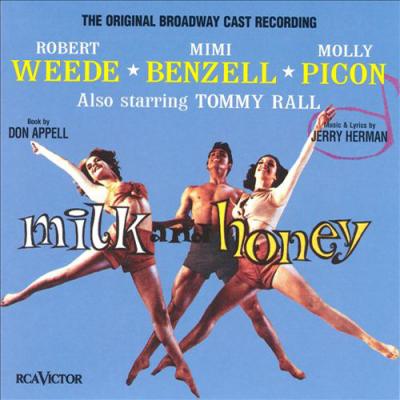
"Milk and Honey" Soundtrack Lyrics
Musical • 1961
Track Listing
"Milk And Honey – Original Broadway Cast Recording 1961" – Album Guide to Tracks and Key Scenes
Overview
What happens when a late-in-life romance plays out in a brand-new country that is still arguing with itself about what kind of home it wants to be? Milk and Honey answers that question with brass, hora rhythms and a very honest bittersweet streak. Jerry Herman’s first Broadway book musical follows Phil Arkin, an American visitor in Israel, and Ruth Stein, a widowed tourist travelling with a busload of hopeful American widows. Their tentative love affair unfolds against street protests, shepherds on city corners and a nation still stitching itself together.
The original Broadway cast album captures that tension: bright, extroverted orchestrations on the surface, with lyrics that quietly admit doubt, compromise and moral fatigue. Phil and Ruth fall for each other in a place that keeps insisting on optimism, yet the score refuses to promise an easy ending. Songs like “Shalom” and the title number are welcoming on first listen, but their counter-lines and modulations keep whispering that the “land of milk and honey” is more complicated than the postcards.
At the same time, the album is very much about community. The widows’ ensemble numbers, the farmers’ choruses on the moshav, the crowd music on Independence Day — they make the record feel like it is constantly cutting back and forth between private confession and public celebration. The recording preserves the rich cast led by Robert Weede (Phil), Mimi Benzell (Ruth) and Molly Picon (Clara), all of whom came with operatic or Yiddish-theatre weight that you can hear in the way they attack Herman’s lines.
Stylistically, the score moves in phases that mirror the narrative. Early urban scenes lean on bustling Broadway march energy; the Independence Day sequence folds in stylised Israeli folk and hora figures; the moshav and mid-life love songs sit in lyrical show-ballad territory; Clara’s comedy turns tip into quasi-Yiddish music hall. Folk-tinged dances signal national pride; lush waltzes and torchy ballads mark vulnerability and regret; sharper rhythmic numbers underline moments when the characters harden their hearts to survive.
How It Was Made
The show started when producer Gerard Oestreicher sent Jerry Herman and book writer Don Appell to Israel to gather material. Herman has recalled that he did not want to write propaganda; he wanted the beauty and the friction. The sight of American tourist widows bus-hopping through the country reportedly became the spine of the story, with Phil and Ruth created as a parallel, more intimate thread.
According to Playbill, Milk and Honey opened at the Martin Beck Theatre on Broadway on 10 October 1961 and ran for more than 540 performances, a solid run for a debut score in a season full of larger-profile shows. The musical came after Herman’s off-Broadway revues and before his better-known juggernauts Hello, Dolly! and Mame, but several commentators have argued that this early score is among his most sincere and least “slick.”
The original cast recording was produced quickly after the opening. As Masterworks Broadway notes, the album was recorded in Webster Hall, New York, in mid-October 1961 with Max Goberman conducting and George Avakian among the producers. RCA Victor released the LP; later reissues on CD and digital platforms have kept the original running order and orchestral colours, so modern listeners basically hear what 1961 audiences did, minus the scene dialogue.
On the technical side, orchestrations by Hershy Kay and Eddie Sauter bridge Broadway brass with folk-dance flourishes — clarinets and muted trumpets for city bustle, then percussion and strings pushing into pseudo-Middle-Eastern patterns for the moshav and Independence Day sequences. Choreographer Donald Saddler’s stage work is not on the album, of course, but the rhythmic clarity of tracks like “Independence Day Hora” is clearly built to support large ensemble movement.
Tracks & Scenes
Below, I focus on individual numbers as they function in the show. Timings refer to typical stage pacing and cast-album track lengths; live productions vary.
"Shalom" — Robert Weede & Mimi Benzell
Scene: Early in Act I, shortly after the opening street commotion in Jerusalem, Phil steps in to defend a Yemenite shepherd boy who is being moved on by a policeman. As the dust settles, he meets Ruth and introduces her to the word “shalom.” The song unfolds as a guided tour through the meanings of the greeting — hello, goodbye, peace — while the bustle of the city continues in the background. On the album it plays like a mid-tempo welcome, roughly three and a half minutes, non-diegetic in the theatre sense but rooted in everyday street sound.
Why it matters: “Shalom” establishes the show’s musical language and emotional stakes at once. Phil’s ease with Hebrew contrasts with Ruth’s outsider status, and the lyric folds in the idea that peace in Israel, and between these two people, might always be provisional. It also became the breakout song from the score; a pop single by Eddie Fisher helped it travel beyond the theatre world.
"Independence Day Hora" — Company
Scene: Still in Act I, Phil and Ruth keep bumping into each other as Jerusalem gears up for Independence Day. Crowds gather, flags appear, and the orchestra snaps into a driving hora that lets the full ensemble celebrate in concentric circles around the couple. Onstage, fragments of parade sound and shouted greetings make the number feel almost diegetic; on the album, you hear a compact two-minute burst of patriotic energy.
Why it matters: The song throws the private romance into a public festival, showing how intoxicating the national project can be for characters who feel adrift at home. The asymmetrical rhythms and folk-dance feel are Broadway’s simplified idea of Israeli music, but they still signal a different world from Herman’s later New York-centric scores.
"Milk and Honey" — Tommy Rall, Juki Arkin & Ensemble
Scene: On the moshav in the Negev, Phil visits his daughter Barbara and her husband David. When Phil tries to talk them into returning to Baltimore, David and his friend Adi answer with this title song, joined by neighbouring farmers. They praise the land’s beauty and potential while acknowledging its hardship; the lyrics literally balance “milk and honey” against bitter and sour realities. The number falls roughly mid-Act I and runs about three minutes on the recording.
Why it matters: This is the show’s thesis statement. Musically it’s buoyant, almost jaunty, but the counter-melody undercuts any naïve optimism. You hear Herman working out how to write a patriotic song that also admits disillusion. That tension between dream and compromise mirrors Phil’s situation: he also wants a new life, but old obligations sour the taste.
"There’s No Reason in the World" — Robert Weede
Scene: Later on the moshav, Phil dreams aloud about building a home there and sharing it with Ruth. He frames the plan as simple logic: there is “no reason in the world” they shouldn’t take this late chance at happiness. Staged as a solo in a quieter corner of the farm, away from the bustle, the song acts like his inner monologue turned outward, with the orchestra swelling as he talks himself into courage.
Why it matters: This is one of Herman’s classic argument-songs, where a character uses melody to rationalise a risky emotional choice. The warm orchestration and long, sustained vocal lines give Phil heroic weight, which makes his eventual retreat in Act II feel more painful. You can also hear the DNA of later Herman ballads here, just with less showbiz polish.
"Chin Up, Ladies" — Molly Picon & Widows
Scene: When the bus tour of American widows visits the moshav and realises that the attractive farmers are mostly married, morale crashes. Clara, the blunt and irrepressible leader of the widows, rallies them with this comedy showstopper. She parades them, drills them, scolds them, and flatters them in turn, turning disappointment into determination to keep flirting their way across Israel.
Why it matters: The number is tailored to Molly Picon’s persona: half drill sergeant, half warm aunt. It injects vaudeville timing and Yiddish-theatre flavour into the score, reminding us that the widows’ story matters just as much as Phil and Ruth’s romance. Structurally, it keeps Act I from sinking into pure romance by re-centering the ensemble and their unapologetic hunger for new lives.
"That Was Yesterday" — Mimi Benzell, Robert Weede & Ensemble
Scene: After Phil tells Ruth he has bought land to build a house, the two of them, briefly, allow themselves to act like a settled couple. This duet reflects on their past loneliness and the possibility that “yesterday” might finally be behind them. In some stagings it expands to include the ensemble, swirling around the lovers as a kind of collective memory.
Why it matters: The song is a pivot. Its sweeping, almost operetta-like structure lets Benzell’s and Weede’s voices soar together, but the lyric’s obsession with “yesterday” hints that the future is not as secure as they pretend. On the album it feels like the emotional high of Act I, which makes the later revelations about Phil’s marital status land harder.
"Let’s Not Waste a Moment" — Robert Weede
Scene: Near the end of Act I, after Barbara pushes Phil to tell Ruth the truth about his still-legal marriage, Phil turns the confession into urgency. He argues that precisely because time is short and life is messy, he and Ruth should grab what happiness they can. The song often plays at or near a wedding scene they attend, where the sight of younger people making vows forces them to confront their own desires.
Why it matters: In album sequence, this track almost fuses with “The Wedding,” creating a continuous block of music about commitment. Phil’s rhetoric sounds persuasive, but knowing that he will later reverse himself gives the number a painful irony. Musically, you can hear Herman experimenting with through-sung transitions that he would later refine in his bigger hits.
"Like a Young Man" — Robert Weede & Ensemble
Scene: At the top of Act II, Phil throws himself into work on the moshav fields. This upbeat number has him boasting that the land makes him feel “like a young man” again, trading verses with younger farmers and proving he can still carry his weight. On stage it is an energetic, almost comic attempt to outrun his moral dilemma.
Why it matters: The song is a character study in denial. The jaunty rhythms and patter sections fight against the audience’s knowledge that Phil has unresolved business with Ruth and his unseen wife. It’s also one of the clearest examples of how Herman uses work songs and marches to embody the seductive energy of nation-building.
"I Will Follow You" — Tommy Rall
Scene: When Barbara fears she may secretly long for life back in America, her husband David reassures her in this Act II ballad. He promises to follow her anywhere, even if it means leaving the moshav he loves. Staged as a relatively intimate moment between the younger couple, it contrasts with the older lovers’ inability to find a clean path forward.
Why it matters: The song functions as a mirror to Phil and Ruth. Barbara and David manage to balance personal love and national commitment; Phil and Ruth cannot. The album performance, with Tommy Rall’s clean tenor, gives the piece a sincerity that makes the older couple’s troubles feel less like fate and more like the product of their own choices.
"Hymn to Hymie" — Molly Picon
Scene: In Tel Aviv’s Café Hotok, Clara bumps into Sol Horowitz, a widower from Jerusalem. After he shows interest, she retreats into this solo, addressing her late husband Hymie and asking for permission to remarry. The number is comic but grounded: jokes and patter verses sit alongside real fear about betraying a memory.
Why it matters: “Hymn to Hymie” gives Clara interiority beyond her role as comic leader of the widows. On the album, Picon balances laughter and a catch in the throat, making the whole widows’ subplot feel less like a running gag and more like a study of how older people negotiate second chances. It also deepens the theme of loyalty — to spouses, to countries, to one’s younger self.
"As Simple as That" — Mimi Benzell & Robert Weede
Scene: Close to the end of Act II, Ruth returns to the moshav, ready to live with Phil despite the complications. Instead, he has decided that he cannot ask her to compromise her principles, and he pushes her away in this final duet. The melody is deceptively gentle, almost lullaby-like, as if trying to soften a shattering decision.
Why it matters: This is the emotional breaking point of the show. Herman resists the urge to give them a triumphant eleven-o’clock reconciliation. Instead, he writes a song where love and renunciation coexist, showing that sometimes the “mature” choice still hurts everyone involved. The cast album performance makes clear how much both characters lose here.
"Finale / Shalom (Reprise)" — Company
Scene: At Lydda Airport, the widows prepare to fly back to America. Phil and Ruth share a brief, charged farewell; he promises to go to Paris and seek a divorce from his wife. The ensemble reprises “Shalom” as plane engines swell and we see tourists leaving a country that has changed them, but not necessarily solved their problems.
Why it matters: Ending on “Shalom” undercuts any easy uplift. The word now carries every meaning we have heard — greeting, peace, goodbye — layered with experience. For a 1961 Broadway musical, that refusal to guarantee a happy ending while still sending the audience out on a hummable tune is a quietly bold structural choice.
Notes & Trivia
- Jerry Herman has described writing a counter-melody to the title song that deliberately mentions “bitter honey” and “sour milk,” so the anthem would not sound like pure propaganda.
- Molly Picon, already a star of the Yiddish theatre, reportedly proved so popular in early tryouts that Herman added “Chin Up, Ladies” specifically to give her another showcase.
- According to Masterworks Broadway, the cast album was recorded in a single session day at Webster Hall, only days after the Broadway opening, capturing the company at full performance pitch.
- The show earned multiple Tony nominations, including Best Musical and a nod for Molly Picon, but it opened in a crowded season and did not win.
- Singers outside theatre, including Eddie Fisher, released pop versions of “Milk and Honey” and “Shalom,” giving the score a brief life on early-1960s radio.
Music–Story Links
One of the striking things about Milk and Honey is how tightly the songs lock into specific turning points. “Shalom” is not just an opening tune; it becomes a musical thesis on how words in Israel carry layered meanings. Each later reprise adds another shade — curiosity in the street-scene, romantic hope after the moshav visit, resignation at the airport.
The title song, sung by David and fellow farmers, positions the land itself as a character. Its optimistic refrain is always shadowed by lines acknowledging hardship. Whenever Phil appears in scenes related to that song, you feel him measuring his own life against the farmers’ sense of mission. The melody’s return in reprise form underlines how the land outlasts individual romantic entanglements.
Clara’s numbers tie humour directly to resilience. “Chin Up, Ladies” and “Hymn to Hymie” take the widows’ fear of loneliness and turn it into comedy without dismissing the underlying grief. That tonal balance is echoed in the main plot: Phil uses witty patter in “Let’s Not Waste a Moment” to mask how near he is to breaking his own moral code.
Meanwhile, the younger couple’s “I Will Follow You” plays a sly structural role. Where Phil and Ruth remain stuck between America and Israel, past and future, Barbara and David’s song makes a clear choice: people come before place. Musically, their gentler ballad style foreshadows some of Herman’s later romantic writing, but here it functions as a quiet argument against the older generation’s paralysis.
By the time “As Simple as That” arrives, every major musical motif has picked a side. The sweeping lines that once promised new life now underscore a breakup; the airport reprise of “Shalom” wraps welcome and farewell into one unresolved chord. The album lets you hear that emotional re-weighting even without stage visuals.
Reception & Quotes
On opening, New York critics generally welcomed Milk and Honey as a warm, solidly crafted musical that treated its Israeli setting with more nuance than the title might suggest. Contemporary reports praised the “heart” of the show and singled out Molly Picon’s comic work and Herman’s melodic gift.
Later revivals, including a 1994 off-Broadway production and regional stagings, often framed the piece as a time capsule of early-statehood Israel and mid-century diasporic identity. Reviewers have tended to agree that, while some book elements feel dated, the score itself holds up remarkably well.
“Jerry Herman’s score is the best reason for reviving Milk and Honey… the songs have none of the show-business slickness of his later work.” — The New York Times (1990s revival)
“The title suggests propaganda, but the music keeps tugging toward ambivalence and compromise.” — theatre critic writing on Jerry Herman retrospectives
“Picon turns ‘Chin Up, Ladies’ into a master class in comic survival.” — regional review of a later production
In terms of album life, the original RCA Victor LP went in and out of print but has been reissued on CD and in digital form. As per Masterworks Broadway’s catalogue and cast-album databases, the recording is now available on major streaming platforms and as a download, which has quietly helped the score find new listeners among Jerry Herman completists.
Interesting Facts
- Herman’s success with Milk and Honey reportedly helped convince producer David Merrick to hire him for what became Hello, Dolly!, shifting his career onto a much larger commercial track.
- The original production ran for roughly 543 performances, a strong run for a show with no film adaptation and no later mega-hit song like “If He Walked Into My Life” or “I Am What I Am.”
- The Broadway theatre where it opened, the Martin Beck, was later renamed the Al Hirschfeld Theatre; modern audiences standing there for other shows are literally in the same physical space where “Shalom” was first heard.
- The cast album credits Metropolitan Opera singers Robert Weede and Mimi Benzell alongside musical-theatre and Yiddish-theatre veterans, making it an unusually operatic Broadway recording for its time.
- When DRG and later labels brought the album back to market, they preserved the original mono or early stereo mix rather than remixing, keeping its early-’60s sonic character.
- Some later Jerry Herman revues, such as Jerry’s Girls and An Evening with Jerry Herman, pull “Shalom” out of context, showing how the song has a second life as a standalone greeting anthem.
- Licensing is now handled through Concord Theatricals, which provides materials keyed to the original Broadway vocal and orchestral arrangements.
Technical Info
- Title: Milk And Honey – Original Broadway Cast Recording 1961
- Year: 1961 (recorded and released in the original Broadway run)
- Type: Original Broadway cast album for the musical Milk and Honey
- Composer/Lyricist: Jerry Herman
- Book (stage work): Don Appell
- Principal Vocalists: Robert Weede (Phil Arkin), Mimi Benzell (Ruth Stein), Molly Picon (Clara Weiss), Tommy Rall (David) and others from the original company
- Orchestrations: Hershy Kay and Eddie Sauter (stage score; reflected on the album)
- Conductor/Musical Director: Max Goberman
- Producers (album): including George Avakian and Joe Linhart
- Label (original release): RCA Victor
- Recording Venue: Webster Hall, New York City
- Original Broadway Run: Martin Beck Theatre, New York — opened 10 October 1961, closed 26 January 1963
- Notable Numbers on Album: “Shalom,” “Independence Day Hora,” “Milk and Honey,” “There’s No Reason in the World,” “Chin Up, Ladies,” “Like a Young Man,” “I Will Follow You,” “Hymn to Hymie,” “As Simple as That,” “Finale / Shalom (Reprise)”
- Availability: Original LP (out-of-print vintage), CD reissues, and current digital/streaming editions via Masterworks/DRG and related catalogues
- Licensing (stage show): Concord Theatricals (English-language stock and amateur rights)
Questions & Answers
- Is the Milk and Honey original cast album still available?
- Yes. The original RCA Victor recording has been reissued on CD and is available on major streaming and download platforms via the current Masterworks/DRG catalogue.
- How does Milk and Honey compare musically to Jerry Herman’s later scores?
- It sounds leaner and less brassy than Hello, Dolly! or Mame, with more folk-dance rhythms and modest orchestrations, but the melodic fingerprints and heartfelt ballads are already there.
- Does Milk and Honey use authentic Israeli musical styles?
- It uses stylised horas, folk-like modes and dance rhythms inspired by Israeli music, filtered through early-1960s Broadway orchestration rather than strict ethnomusicological accuracy.
- Has Milk and Honey been revived in recent years?
- Yes. There was a notable 1994 off-Broadway revival and later concert and regional productions, including an Australian concert staging as part of a Jerry Herman retrospective.
- Can theatres still license Milk and Honey for production?
- They can. Rights are handled by Concord Theatricals, which supplies performance materials based on the original Broadway score and script.
Canonical Entities & Relations
| Subject | Relation | Object |
|---|---|---|
| Jerry Herman | composed and wrote lyrics for | Milk and Honey (musical) |
| Don Appell | wrote the book for | Milk and Honey (musical) |
| Gerard Oestreicher | produced | original Broadway production of Milk and Honey |
| Albert Marre | directed | original Broadway production of Milk and Honey |
| Donald Saddler | choreographed | original Broadway production of Milk and Honey |
| Max Goberman | conducted | original Broadway cast recording of Milk and Honey |
| RCA Victor | released | Milk And Honey – Original Broadway Cast Recording 1961 |
| Martin Beck Theatre (Al Hirschfeld Theatre) | hosted | original Broadway run of Milk and Honey |
| Original Broadway Cast of Milk and Honey | performed | songs on the cast album |
| Concord Theatricals | licenses | stage performance rights for Milk and Honey |
Sources: Wikipedia (Milk and Honey musical), IBDB, Playbill, Masterworks Broadway, Concord Theatricals, Discogs, StageAgent, BroadwayWorld, Haaretz, Berkshire Fine Arts, various contemporary and revival reviews.
November, 15th 2025
A-Z Lyrics Universe
Cynthia Erivo Popular
Ariana Grande Horsepower
Post Malone Ain't No Love in Oklahoma
Luke Combs Good Riddance (Time of Your Life)
Green Day Bye Bye Bye
*NSYNC You're the One That I Wan
John Travolta & Olivia Newton-John I Always Wanted a Brother
Braelyn Rankins, Theo Somolu, Kelvin Harrison Jr. and Aaron Pierre The Power of Love
Frankie Goes to Hollywood Beyond
Auli’i Cravalho feat. Rachel House MORE ›