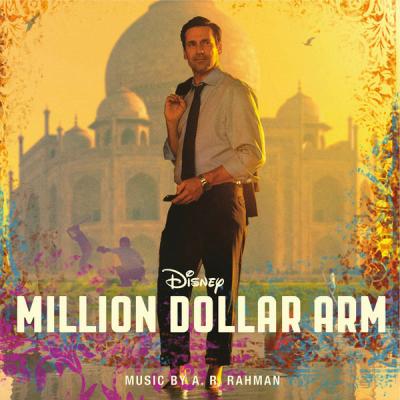
"Million Dollar Arm" Soundtrack Lyrics
Movie • 2014
Track Listing
Thrust
Diane Ransdell
Susan Boyle
Stigmata Party
Jethro Chaplin
A. R. Rahman
A. R. Rahman featuring Iggy Azalea
A. R. Rahman featuring Kendrick Lamar
Baluji Shrivastav
A. R. Rahman, Alka Yagnik, Ila Arun
A. R. Rahman VI
A. R. Rahman featuring Wale
El Toque Latino Orchestra
Axident
Wale featuring Lady Gaga
Black Sheep
The Beatards
Drake featuring Lil Wayne & Trey Songz
KT Tunstall and A. R. Rahman
Felton Rapley
J. Thoven
Wolfgang Amadeus Mozart
A . R . Rahman
"Million Dollar Arm (Original Motion Picture Soundtrack)" – Album Guide to Tracks and Key Scenes
Overview
What does a biographical baseball drama about two village kids from India really sound like when it runs through a Disney machine and an A. R. Rahman score? Million Dollar Arm answers by blending stadium synths, Punjabi hop, Tamil nostalgia and orchestral lift into a soundtrack that follows a clear emotional curve: arrival, adaptation, rebellion, and the quiet collapse of old habits. On screen, sports agent J.B. Bernstein (Jon Hamm) tries to save his failing career by running a contest in India to find cricket bowlers who can be turned into Major League pitchers. On the album, Rahman traces the same arc as the film — from brash confidence in Los Angeles to humid chaos in Mumbai, to lonely hotel rooms and floodlit tryouts.
The songs carry a lot of that journey. “Makhna” announces the search with a sticky techno-bhangra hook; “We Could Be Kings” and “Keep the Hustle” speak directly to the film’s sales pitch that talent can come from anywhere if the system lets it in. At the same time, quieter pieces like “Unborn Children” and instrumentals such as “Bobbleheads” and “Desi Thoughts” let in doubt, regret and the sense that this business experiment is trampling across actual lives. Rahman’s score never forgets that Rinku Singh and Dinesh Patel are teenagers yanked out of their language, families and sport.
What makes this soundtrack distinct inside Rahman’s Hollywood work is the way it keeps toggling between street-level texture and big, aspirational anthem writing. Crowded Indian audition scenes sit next to sleek, electronic cues backing glossy training montages in the U.S. The music never fully chooses between them, which fits a story about a man who treats India as a market first and a place full of people second — at least until he’s forced to learn better.
Genre-wise, the album moves in phases that mirror the plot. Early India material leans on bhangra, Punjabi folk touches and percussive chants; American sequences slide into hip hop and glossy pop; the actual baseball drama is mostly orchestral and hybrid electronic score. Folk colours signal community and chaos; Western pop tracks mark the lure and brutality of the U.S. sports business; meditative Tamil-rooted material like “Unborn Children” points to a longer, less commercial sense of time and consequence. The mix is not always smooth, but that friction is exactly where the film lives.
How It Was Made
Director Craig Gillespie wanted Rahman from the moment he signed on to the film and pursued him specifically for a score that could move between India and the U.S. without sounding like a travel brochure. According to several interviews, Rahman initially avoided more India-centric Hollywood projects after Slumdog Millionaire, worried about being typecast, but this “hybrid” story pulled him back. He began writing in 2013, finishing recording by early 2014, splitting work between his Chennai studios and a Los Angeles setup so he could respond quickly to edit changes.
Disney framed the album as a full song-and-score package. The label’s own press material describes seven original songs plus a body of instrumental score; Rahman co-produced with studio executives and the producers alongside the director. Collaborators were chosen jointly by Rahman and Gillespie: Iggy Azalea for the credit-track “Million Dollar Dream,” KT Tunstall for the cross-cultural single “We Could Be Kings,” Wale and Canadian pop singer Raghav for the hip hop–driven “Keep the Hustle,” and long-time associate Sukhwinder Singh for Punjabi-leaning vocals.
There is also deliberate self-sampling. “Unborn Children” is essentially “Thirakkatha Kaatukkulle” from the 1999 Tamil film En Swasa Kaatre, gently recontextualised over the film’s closing imagery of children running into an open field. Rahman has said he initially resisted reusing it, but the director and music supervisor pushed for it because the piece fit the film’s final mood so well. Another piece, “Nimma Nimma,” grew out of material he wrote for the 2012 London Olympic ceremony segment Isles of Wonder, tweaked to suit the film’s groove-heavy sequences.
Behind the scenes, the music department had to juggle original songs, library cues and Indian catalogue tracks. Jon Mooney handled music supervision, negotiating rights for Drake’s “Successful,” Lady Gaga and Wale’s “Chillin,” Susan Boyle’s “I Dreamed a Dream,” the Slumdog cut “Ringa Ringa” and classical raga material alongside Rahman’s new work. Gaayatri Kaundinya’s Hindustani vocals were layered into cues such as “Bobbleheads” and “Farewell,” partly recorded in Los Angeles sessions that began as internships and ended as featured performances.
Tracks & Scenes
(Scene timings below are relative — early, mid, late — rather than exact minute marks; track durations are taken from the commercial album.)
"Makhna" — A. R. Rahman feat. Sukhwinder Singh
Scene: “Makhna” powers one of the film’s key India search montages, as J.B. and his team criss-cross the country running the Million Dollar Arm contest in dusty cricket grounds, school fields and improvised pitching stations. Crowds swarm, banners flap, and every few seconds the montage cuts to radar guns failing to crack the needed speed. The cue runs just over three minutes on album and functions as energetic, non-diegetic backing, with percussion and bhangra-style vocals glued tightly to the editing rhythm.
Why it matters: This is the sales pitch of the movie condensed into a track — a Western agent turning Indian street energy into a brand. The glossy mix and Punjabi hook celebrate the excitement while the relentless loop underlines how transactional the process is. It also sets up later reprises of the “Spreading the Word/Makhna” motif that the Academy would briefly shortlist for Best Original Song.
"We Could Be Kings" — KT Tunstall & A. R. Rahman
Scene: “We Could Be Kings” plays over a transitional sequence as Rinku and Dinesh leave India for the United States, intercut with Brenda and J.B. struggling with what this move actually means. Airport goodbyes, plane windows and glimpses of Los Angeles freeways are cut together like a collage while KT Tunstall’s vocal rides over Rahman’s Hindi-style swaras and pulsing drums. On album it runs around three minutes, functioning as a bridge between the film’s two worlds.
Why it matters: This is the film’s most overtly aspirational piece, and it earns that tone. The lyric about “we” rather than “I” quietly shifts the story away from J.B.’s ego towards the boys’ perspective. Its nomination on the Academy’s longlist for Best Original Song confirms that, for many listeners, this track encapsulated the film’s core idea of overlooked talent rising into view.
"Keep the Hustle" — A. R. Rahman feat. Wale & Raghav
Scene: Late in the film and into the credits, “Keep the Hustle” kicks in as the boys’ tryout story resolves and we see a flurry of images — training drills, scouts’ reactions, glimpses of their eventual minor-league futures and J.B. finally learning to act like a mentor rather than a salesman. It also threads under some of the end-credits footage of the real Rinku Singh and Dinesh Patel. The track itself is a three-minute collision of synths, Indian-flavoured backing vocals and Wale’s verses.
Why it matters: If “Makhna” sells the original gimmick, “Keep the Hustle” sells the grind that follows. Critics in hip hop and pop outlets singled out this track for the way it fuses Indian motifs with electronic production and an English-language rap feature, without ever dropping the motivational, almost sports-ad tone. Structurally, it lets the film end on movement rather than pure sentimentality.
"Million Dollar Dream" — A. R. Rahman feat. Iggy Azalea & Sukhwinder Singh
Scene: “Million Dollar Dream” is held back as a special payoff: it plays prominently over the main end credits, after the boys’ fates are revealed and the narrative has closed on J.B. and Brenda’s relationship. On screen, stylised graphics and behind-the-scenes footage of the players’ real-life training bleed into shots of the actors, while the track oscillates between Punjabi choruses and Iggy Azalea’s verses about risk, money and ambition.
Why it matters: Disney clearly saw this as the marquee single — it got lyric videos and an awards push. Lyrically it leans more on generic hustle language than on the specifics of the story, but that makes it function like a radio-ready epilogue. Hearing Sukhwinder’s voice, familiar from earlier Rahman hits, over a Hollywood sports-film credit roll creates a deliberate echo of Slumdog Millionaire without copying “Jai Ho.”
"Unborn Children" / "Thirakkatha Kaatukkulle" — A. R. Rahman, P. Unnikrishnan, K. S. Chithra
Scene: Towards the very end of the film, a re-orchestrated version of this 1990s Tamil song emerges over gentle images of kids playing in open fields, echoing the idea that the real stakes of these deals fall on young people whose futures are still unwritten. It may also be heard in softer interludes in India, smoothing transitions between wider landscape shots and intimate character scenes.
Why it matters: This is one of the most emotionally direct moments in the score. By reusing a pre-existing track steeped in Tamil film nostalgia, Rahman sneaks in a different time scale — a reminder that the world existed before this contest and will go on after the headlines fade. Many reviewers singled out “Unborn Children” as the album’s standout piece.
"Bobbleheads" — A. R. Rahman (score cue)
Scene: “Bobbleheads” underscores a comedic yet tense sequence when Rinku and Dinesh first pitch in front of cynical American coaches, with a deal that if they throw hard enough, they’ll win baseball bobblehead dolls. The cue weaves plucked guitar, light percussion and wordless female vocals around the sound of thudding balls and clicking radar guns, giving the scene a slightly dreamlike quality even as everyone on screen anxiously watches the speed readouts.
Why it matters: The track shows Rahman’s ability to keep things playful without losing emotional stakes. The boys might be playing for toys, but the adults are watching their entire investment hanging on each throw. Gaayatri Kaundinya’s alaps, heard here and elsewhere in the score, add a layer of cultural continuity — the sound of home hovering over an unfamiliar sport.
"Lucknow" — A. R. Rahman (score cue)
Scene: Earlier, during J.B.’s travels through northern India to scout contestants, “Lucknow” provides musical connective tissue between location shots: narrow lanes, rooftop kites, busy intersections, roadside cricket games. The orchestration mixes orchestral strings with tabla-like patterns and a relaxed melodic line, keeping the sequence moving while letting the camera take in texture.
Why it matters: As a stand-alone track, “Lucknow” is a short travelogue; in context, it signals that the film at least tries to see India as more than a backdrop to an American business problem. It’s one of the places where Rahman’s world-music reputation is put to straightforward narrative use.
"Nimma Nimma" — A. R. Rahman feat. Jaspreet Jasz
Scene: “Nimma Nimma” appears in a high-energy Indian sequence, likely linked to crowd excitement around the Million Dollar Arm tryouts — horns blaring, banners waving, contestants lining up, villagers reacting when someone finally hits the required speed. The song’s spruced-up version of a prior Olympic cue rides over the chaos with pounding percussion and call-and-response vocals.
Why it matters: Even listeners who find the track conventional Punjabi-pop agree that it does its job in the film: it makes the contest feel like a hybrid of a circus and a national event. Because it is essentially repurposed material, it also underlines how the movie leans into existing images of “vibrant India” for effect.
"Spreading the Word / Makhna (score variation)" — A. R. Rahman
Scene: This cue supports J.B.’s marketing push as he sells the Million Dollar Arm idea to sponsors, local officials and media in both countries. Quick-cut montages of TV spots, newspaper headlines and crowds watching roadside tryouts are underpinned by the “Makhna” motif, with a slightly more orchestral and anthemic twist.
Why it matters: The Academy’s music branch considered this hybrid cue for Best Original Song, which is telling. It is essentially the film boiled down to three elements — a hook, a beat and a montage of salesmanship — and it shows how Rahman uses repetition to turn a plot device into a musical brand.
"What Lies Beneath" — A. R. Rahman feat. Kendrick Lamar (in-film only)
Scene: An unreleased collaboration, “What Lies Beneath”, reportedly surfaces in a brief U.S. sequence, layering Kendrick Lamar’s voice into Rahman’s production while J.B. struggles with the boys’ poor early performances and his own financial stress. The track stays mostly in the background, audible under dialogue in a way that rewards attentive listeners rather than demanding centre stage.
Why it matters: The song’s very status — present in the film, absent from the commercial album — fits its title. It hints at a version of the project where Rahman pushed even further into contemporary American hip hop, then pulled back for marketing reasons. For soundtrack collectors it has become a small, slightly mythic part of the film’s musical story.
Non-album & source cues: "Ringa Ringa", "Chillin", "Successful" and more
Scene: Beyond Rahman’s originals, the movie threads in a run of existing tracks: a brief sample of “Ringa Ringa” from Slumdog Millionaire in an Indian street sequence; Drake’s “Successful” and Wale/Lady Gaga’s “Chillin” around J.B.’s slick Los Angeles life; classic raga recordings and Latin lounge pieces like “Katrina” and “Mi Lindo Divan” in hotel lobbies and restaurants. These appear as diegetic or semi-diegetic cues — audible on radios, in bars, or in-world sound systems.
Why it matters: These placements situate the story within a broader musical landscape. The Slumdog callback is a wink at Rahman’s earlier breakthrough; the U.S. hip hop cuts mark J.B. as a man who sells aspirational lifestyles; the traditional and lounge tracks in India and the States underline how many different kinds of background music this story moves through on its way to a baseball diamond.
Trailer & TV spot music: "Can’t Hold Us" and trailer cues
Scene: The main trailers for Million Dollar Arm lean heavily on Macklemore & Ryan Lewis’s “Can’t Hold Us,” using its piano hook and chant chorus to punch up shots of pitching contests and underdog training. At least one TV spot swaps in the epic-library cue “Breaking Through” by Audiomachine for slow-motion emotional beats and triumphant pitches.
Why it matters: None of this music appears in the film or on the album, but it shaped how audiences first met the project. The marketing looks more like a generic underdog sports movie; the actual film and Rahman’s score are more hybrid and tonally odd. For fans of trailer music, these cues form a separate mini-soundtrack to the film’s release campaign.
Notes & Trivia
- The commercial album bundles both songs and score: seven vocal-driven tracks plus a run of instrumental cues, all credited to A. R. Rahman.
- Rahman himself has said he tried not to “telegraph” emotions, letting actors carry key feelings while the score nudges rather than underlines.
- “Nimma Nimma” began life in the London 2012 Olympic ceremony sessions; for this film it was remixed with a punchier beat and slightly altered arrangement.
- “Unborn Children” is a straight lift of “Thirakkatha Kaatukkulle,” a Tamil song from 1999 — the director and music supervisor apparently fought to keep it.
- Walt Disney Records rolled out singles (“Makhna,” “We Could Be Kings,” “Keep the Hustle,” “Million Dollar Dream”) online ahead of the film to build recognition.
- Gaayatri Kaundinya went from intern to featured vocalist on the score, recording alaps that ended up both in the film and on the album.
- Kendrick Lamar’s contribution does not appear on the soundtrack; it remains locked inside the film’s mix and fan discussions.
Music–Story Links
The music in Million Dollar Arm closely tracks J.B. Bernstein’s shifting understanding of what he is doing. Early on, brash pieces like “Makhna” and the “Spreading the Word” variations are essentially ad jingles for his scheme, played loud over montages of him pitching the contest and basking in attention. By the time the boys fail their first U.S. tryout, those big, swaggering cues have been replaced by more introspective score tracks such as “Never Give Up” and “Desi Thoughts,” mirroring his growing guilt.
For Rinku and Dinesh, the songs function like sonic markers of where they are in their journey. In India, they move inside rhythm-heavy, vocally dense cues that feel connected to their own culture, even when filtered through Disney production. Once they land in Los Angeles, the soundscape flips: the boys stand in silence and traffic noise while glossy American hip hop and pop tracks play over J.B.’s meetings, emphasising their isolation. When pieces like “We Could Be Kings” finally let their perspective into the mix, the film’s emotional point of view widens.
Brenda’s influence on J.B. is traced musically as well. Scenes where she pushes him to treat the boys more like human beings often sit under softer, more acoustic passages, with Indian instruments blending into gentle guitar and piano. Those cues rarely become songs in their own right, but they change the emotional temperature of the film whenever she appears or when J.B. acts on her advice.
The late-film use of “Unborn Children” and of slower, more contemplative score material signals a final tonal shift. The story stops being about whether J.B. will save his company and starts being about what kind of adults these boys might become, and how long the ripples of this reality show will last. The choice to close on a piece written years earlier for a very different film drives home that idea of consequences echoing beyond a single season or contract.
Reception & Quotes
Critically, the soundtrack drew a broad range of responses. Mainstream film reviewers often praised Rahman’s contribution as a key part of the movie’s energy, noting how wall-to-wall songs helped keep what could have been a very talky story moving. Some drew direct comparisons to Slumdog Millionaire, arguing that while Million Dollar Arm lacks a breakout hit like “Jai Ho,” it offers a more relaxed, hybrid palette.
Specialist music press tended to be kinder. Several soundtrack reviewers highlighted the opening run of songs and the warm, tuneful score tracks like “Bobbleheads” and “Farewell,” calling the album “off the beaten track” for a Disney sports film and praising its willingness to lean into Indian textures. Others pointed out that the hip hop–inflected cues made the album feel very much of its 2014 moment.
There were also dissenting voices. A few Indian reviewers described the score as “a mishmash” — not in quality, but in the way it pulls ideas from everywhere without settling on a single identity, and complained that no one song quite stands on its own outside the film. That said, even some of these mixed reviews conceded that the background score lifts scenes that might otherwise feel flat.
“Jubilant wall-to-wall is the song score by Oscar-winning composer A. R. Rahman.” — Variety
“A mishmash of elements that fuse Indian music with the big synth of electronica, all set under Wale’s boss lyrics.” — Vibe on “Keep the Hustle”
“Overall the album works, not just as a soundtrack, but also as an audio, triumphing on some meditative moments.” — Indian Express
“Another remarkable Hollywood score from A. R. Rahman… fun songs, pleasant and very listenable score.” — Movie Wave
On the awards side, the Academy’s music branch shortlisted the film for Best Original Score, and three songs — “Million Dollar Dream,” “Spreading the Word/Makhna,” and “We Could Be Kings” — made the longlist for Best Original Song, although none went on to a final nomination.
Interesting Facts
- The soundtrack’s official genre tag is “World music,” but between Drake, Iggy Azalea, KT Tunstall and Wale it also functions as a mini 2010s pop–hip hop sampler.
- Disney’s marketing used a separate suite of songs and trailer cues (Macklemore, Audiomachine), so a fan trying to collect every piece of music associated with the film has to chase three different “albums.”
- “We Could Be Kings” marks one step in KT Tunstall’s pivot towards soundtrack work; she has said she actively sought out film collaborations at this stage of her career.
- “Keep the Hustle” brought together Rahman, Wale and Raghav — an Indian film composer, a D.C. rapper and a Canadian R&B singer — on a single Disney sports track.
- Susan Boyle’s version of “I Dreamed a Dream” from Les Misérables turns up briefly in the film, a strange but effective counterpoint to a story about talent shows and second chances.
- Rahman wrote many more musical ideas than the film could fit; some reviews mention that the album feels like a condensed sampler of a much larger sonic world.
- Gaayatri Kaundinya’s vocal lines in “Bobbleheads” were originally recorded for a single scouting moment but impressed the director enough that they were moved to the film’s opening.
- The UK and U.S. digital releases of the album share the same track listing, but different stores have used slightly different cover art crops of Jon Hamm against an Indian skyline.
Technical Info
- Title: Million Dollar Arm (Original Motion Picture Soundtrack)
- Film: Million Dollar Arm (2014)
- Type: Film soundtrack — songs and original score
- Composer / Primary Artist: A. R. Rahman
- Lyricists (selected): A. R. Rahman, KT Tunstall, Vairamuthu, Iggy Azalea (Amethyst Kelly), Wale (Olubowale Akintimehin), Jaspreet Jasz and others
- Featured performers (selected): Sukhwinder Singh, KT Tunstall, Iggy Azalea, Wale, Raghav, P. Unnikrishnan, K. S. Chithra, Jaspreet Jasz, Gaayatri Kaundinya (vocals in score)
- Director (film): Craig Gillespie
- Writer (film): Tom McCarthy
- Music Supervisor: Jon Mooney
- Studios: Panchathan Record Inn and AM Studios (Chennai); Panchathan Hollywood Studios (Los Angeles)
- Label: Walt Disney Records
- Recording period: 2013 – February 2014
- Album release: 13 May 2014 (digital), followed by CD later in May 2014
- Languages on album: English, Hindi, Punjabi, Tamil
- Approximate album length: around 45 minutes across 16 tracks
- Film runtime: 124 minutes
- Studios / Producers (film): Walt Disney Pictures, Roth Films, Mayhem Pictures
- Notable songs used in marketing & film (selection): “Makhna,” “We Could Be Kings,” “Million Dollar Dream,” “Keep the Hustle,” “Nimma Nimma,” “Unborn Children,” “Bobbleheads,” plus licensed tracks such as “Ringa Ringa,” “Successful,” “Chillin,” and “I Dreamed a Dream.”
- Awards context: Score and three songs (“Million Dollar Dream,” “Spreading the Word/Makhna,” “We Could Be Kings”) were shortlisted by the Academy but did not receive nominations.
- Availability: Widely available on major streaming services and digital stores; physical CD issued by Walt Disney Records.
Questions & Answers
- Is the Million Dollar Arm soundtrack mostly songs or instrumental score?
- It is roughly split. The front half is built around seven vocal tracks, while the back half focuses on instrumental cues that cover the baseball drama and emotional beats.
- Do all the songs from the movie appear on the commercial album?
- No. Some source tracks and at least one high-profile collaboration (“What Lies Beneath” with Kendrick Lamar) are heard only in the film mix, not on the album.
- Which songs were pushed for awards consideration?
- Disney promoted “Million Dollar Dream,” “Spreading the Word/Makhna” and “We Could Be Kings” for the Oscars; all three made the longlist for Best Original Song.
- How does Rahman’s score here compare to Slumdog Millionaire?
- It shares the hybrid East–West approach but is more relaxed and sports-oriented, with fewer pure dance numbers and more cues built around training, travel and internal conflict.
- Where can I legally listen to the Million Dollar Arm soundtrack?
- Walt Disney Records has released it on major streaming platforms and digital music stores, and the CD edition remains findable through standard retailers and second-hand markets.
Canonical Entities & Relations
| Subject | Relation | Object |
|---|---|---|
| Million Dollar Arm (film) | is scored by | A. R. Rahman |
| Million Dollar Arm (Original Motion Picture Soundtrack) | is soundtrack to | Million Dollar Arm (film) |
| A. R. Rahman | composed and produced | Million Dollar Arm (Original Motion Picture Soundtrack) |
| Walt Disney Records | released | Million Dollar Arm (Original Motion Picture Soundtrack) |
| Craig Gillespie | directed | Million Dollar Arm (film) |
| Tom McCarthy | wrote screenplay for | Million Dollar Arm (film) |
| Jon Mooney | served as music supervisor on | Million Dollar Arm (film) |
| KT Tunstall | co-wrote and performed | “We Could Be Kings” |
| Iggy Azalea | featured on | “Million Dollar Dream” |
| Wale | featured on | “Keep the Hustle” |
| Rinku Singh and Dinesh Patel | are portrayed in | Million Dollar Arm (film) |
| Walt Disney Pictures | produced | Million Dollar Arm (film) |
| Walt Disney Studios Motion Pictures | distributed | Million Dollar Arm (film) |
| Jon Hamm | plays | J.B. Bernstein in Million Dollar Arm |
| Million Dollar Arm (Original Motion Picture Soundtrack) | features song | “We Could Be Kings” |
| Million Dollar Arm (Original Motion Picture Soundtrack) | features song | “Million Dollar Dream” |
| Million Dollar Arm (Original Motion Picture Soundtrack) | features cue | “Bobbleheads” |
Sources: Wikipedia (film & soundtrack entries), Disney Wiki, Walt Disney Records / PR Newswire materials, Academy of Motion Picture Arts and Sciences lists, Variety, Vibe, Indian Express, Movie Wave, Musicaloud, Daily Bruin, Soundtrakd, IMDb, Adtunes trailer-music forum.
Disney made a film about baseball. Dedicated to all lovers of this sport, which is popular strictly within the USA, because other countries simply do not understand it. It is the same as the Indonesian rupiah currency – popular only in Indonesia. Have you seen this currency in any other country or your native one? No? That's because it is limited within the geographical borders. The same as baseball is limited by the US only. In India, where we are sent with the protagonist according to the plot, the currency is rupiah, also, by the way. Spending $ 25 million on film, the box office managed to gain only USD 38 M. This fact once again proves that the progressive world does not love movies about the unprogressive part of our globe. The same happened with Rock the Kasbah, which has collected only USD 2.5 M for nearly a month of rental. But here it is at least a minimum return on the budget. In both the first and second films, they are talking about the fact that someone from the USA travels to a third-world country and finds a local talent there. Someone finds the future of baseball, while other finds a singer. Anyway, the spiritual experiences of the protagonist and his protégé (in both cases, that is interesting – based on real events) have not become the highlight of the evening. A good solution was to invite A. R. Rahman to do the soundtrack – a man who has received 3 Oscars for his work, 2 – for Slumdog Millionaire. In total, he has over 120 awards and 130 nominations. Colossally productive personality! Sounding turned out good. Susan Boyle (with her I Dreamed A Dream); Chillin’ by Lady GaGa; Katrina. All these are small parts of the great sound collected here. We encourage you to buy this collection on iTunes to enjoy its extraordinary sound, with a focus on Asia, magical and mysterious.November, 15th 2025
'Million Dollar Arm': IMDb, WikipediaA-Z Lyrics Universe
Cynthia Erivo Popular
Ariana Grande Horsepower
Post Malone Ain't No Love in Oklahoma
Luke Combs Good Riddance (Time of Your Life)
Green Day Bye Bye Bye
*NSYNC You're the One That I Wan
John Travolta & Olivia Newton-John I Always Wanted a Brother
Braelyn Rankins, Theo Somolu, Kelvin Harrison Jr. and Aaron Pierre The Power of Love
Frankie Goes to Hollywood Beyond
Auli’i Cravalho feat. Rachel House MORE ›