Soundtracks:  A B C D E F G H I J K L M N O P Q R S T U V W X Y Z #


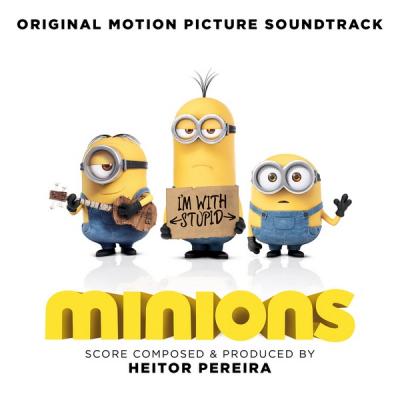
Minions Album Cover

"Minions" Soundtrack Lyrics

Cartoon • 2015

Track Listing


"Minions (Original Motion Picture Soundtrack)" – Album Guide to Tracks and Key Scenes

Minions 2015 official trailer frame with Kevin, Stuart and Bob walking through London
Minions (2015) — a 1960s London caper scored with vintage pop and Heitor Pereira’s punchy orchestral writing.

Overview

How do you score characters who mostly talk in nonsense syllables? Minions solves that by letting the music do a lot of the talking. The 2015 prequel follows Kevin, Stuart and Bob as they leave their failed masters behind, land in 1968 New York and then London, and end up working for supervillain Scarlet Overkill. The soundtrack has to cover prehistoric slapstick, Beatlemania-era London and full-on heist chaos — all while keeping the Minions’ babble clear in the mix.

The film leans hard on 1960s rock and pop — The Turtles, The Rolling Stones, The Doors, The Kinks, The Who, The Beatles, Donovan, Van Halen’s “Eruption” as a cheeky out-of-period gag — wrapped around Heitor Pereira’s original score. The songs sell the era and the jokes; the score glues the story together, giving Scarlet a groove-heavy villain theme and the Minions their own manic action motifs. As one soundtrack review put it, the orchestral writing alone is “a wild and gregarious approach” that works best if you already like these yellow agents of chaos.

The narrative arc — arrival → adaptation → rebellion → collapse — is mirrored cleanly in the music. The early “tribe” scenes are scored with choir pastiche and Minion-choir standards (“We Wish You a Merry Christmas,” “Aura Lee”). The adaptation phase in New York uses Stones and TV themes to show how out of place the Minions are. London brings in heavier rock (“Break On Through,” “You Really Got Me,” “My Generation”) as they get swept up in Scarlet’s villain circus. When everything falls apart around the Tower of London, Pereira’s score takes over with big, brassy cues like “Minion Mission,” “King Kong Kevin,” and “Minions Victory.”

Stylistically, the soundtrack splits into three broad zones. First: diegetic Minion music — choir practice, Christmas carols, the Yetis’ vaudeville number, the Hypno-Hat performance of “Hair.” Second: era-defining needle-drops from rock, pop, TV and classical — The Turtles’ “Happy Together,” The Doors, The Beatles, Elgar, “Ride of the Valkyries.” Third: Pereira’s score, built to feel like a “classic action film” with 60s spy and British jazz flavors. According to one Film Music Reporter piece, the score sessions even used vintage microphones associated with The Beach Boys and Sinatra, just to keep that period patina consistent.

How It Was Made

Heitor Pereira was already the musical voice of the Despicable Me franchise when he took on Minions, but this was the first time he carried the score without Pharrell Williams. According to an interview on the soundtrack’s development, he approached the project as if he were scoring a straight 60s action caper and then dropped the Minions into it. That meant fully orchestrated, rhythmically busy cues rather than wall-to-wall comedy stings.

The score was recorded in Los Angeles at the Newman Scoring Stage and EastWest Studios with a large orchestra and choir: strings, a sizable brass section, multiple saxophones including bass sax, a 40–50-voice choir, rhythm section and percussion. To capture a 1960s British jazz / spy sound, Pereira brought a jazz ensemble into the room — woodwinds, clarinets, piccolos, brass and drums — and recorded them together instead of isolating sections. He has said that this approach, plus the use of vintage microphones, was his way of paying homage to the engineers and session players of that era.

Because the Minions speak in a patchwork of languages and phonetic nonsense, Pereira deliberately pulled back in some dialogue-heavy scenes to give their voices room. In one featurette he explains that he and the filmmakers almost built a “dictionary” of Minion sounds and then wrote music that followed the same repetitions and patterns. Scarlet Overkill, by contrast, gets a focused theme: “hard, powerful and mean but with a groove,” built around her movements in sequences like the villain tryouts at Villain-Con and the Tower of London heist.

On the album side, there are actually two slightly different experiences. Minions: Original Motion Picture Soundtrack (crediting Pereira as artist) carries the full score and a few key source cues, running just over an hour. Consumer-facing digital releases under the title Minions (Original Motion Picture Soundtrack) bundle Pereira’s cues with a curated selection of 1960s songs and Minion-sung covers, landing around 55 minutes. Both came out through Back Lot Music in July 2015 alongside the film’s release.

Minions trailer shot of Scarlet Overkill on stage at Villain-Con with dramatic lighting
Heitor Pereira gives Scarlet Overkill a groove-driven villain motif that matches her showy villain-con persona.

Tracks & Scenes

Below are key songs and cues, with their major on-screen moments. Timings are approximate and can shift slightly between releases, but the story beats stay the same.

"Happy Together" — The Turtles
Where it plays: Over the opening “history of the Minions” montage. We watch the tribe march through time — serving T. rex, Dracula, Napoleon and others, always accidentally ruining everything — while the song plays non-diegetically. The visuals are bright and slapstick, but the lyrics about being “happy together” underline how devoted the Minions are to whatever boss they choose.
Why it matters: It is the film’s thesis in one cue: adorable creatures whose idea of happiness involves finding the worst possible leader. The contrast between sunny pop and escalating disaster is part of why this sequence sticks in memory.

"We Wish You a Merry Christmas" — Houseman / The Minions
Where it plays: A winter montage at the Arctic cave, where the Minions appear to have finally found a safe, if dull, home. First we hear a more traditional recording as they enjoy snow games and build a community; later, a Minion-sung version plays when they celebrate having a “safe place” after so many failed masters.
Why it matters: It sells the idea that stability bores them. The tune is familiar and cosy, but the visuals show their energy collapsing. That boredom is what pushes Kevin to leave the tribe and search for a new villain.

"Aura Lee" — Pierre Coffin
Where it plays: During Minion choir practice in the cave. Rows of Minions stand up straight, trying to sing a polite, old-fashioned melody, while one or two fall out of line or drift into nonsense syllables. The performance is diegetic, with their voices carrying the music while the camera drifts down the rows like a choirmaster’s eye.
Why it matters: It’s an early, gentle way of showing that they are trying to be “good” but are wired for mischief. Using a 19th-century tune in a 2015 cartoon also hints at the film’s habit of pulling from all over musical history when it thinks the joke needs it.

"19th Nervous Breakdown" — The Rolling Stones
Where it plays: As Kevin, Stuart and Bob arrive in 1968 New York. The riff kicks in over shots of yellow cabs, neon lights, Times Square and the trio gawking at everything. The song is non-diegetic but cut tightly to the bustle of Manhattan at night.
Why it matters: It nails the “fish out of water” shock. The Rolling Stones track is pure mid-60s energy, and throwing the Minions into that sound instantly clarifies the time period without any exposition.

"Bewitched" / TV themes medley
Where it plays: When the trio discover television in their cheap New York apartment, flipping channels between The Saint, Bewitched and The Dating Game. Each theme tune plays briefly as they mimic what they see on screen — spy poses, magic nose-wiggles, cheesy dating-show reactions.
Why it matters: It’s a neat shorthand for how much Western pop culture they miss by living underground. Musically, it’s also a quick tour through 60s TV scoring styles, which Pereira’s own work then picks up and expands into full cues.

"Ride of the Valkyries" — Budapest Symphony Orchestra
Where it plays: Stuart, hitchhiking alone, is picked up by an elderly woman driving a car that becomes more terrifying with every passing second. As she barrels down the road, Wagner’s “Ride of the Valkyries” blares, synced loosely to each dangerous turn and near-miss.
Why it matters: The joke is simple — an old lady driving like an air-cavalry attack — but tying it to one of cinema’s most overused “battle” themes keeps adults in on the gag while kids just enjoy the chaos.

"I'm a Man" — The Spencer Davis Group
Where it plays: Over the Nelson family’s police chase. The Minions have accidentally hitched a ride with the Nelsons, a seemingly ordinary US family who turn out to be enthusiastic criminals. As they outrun police cars and swap seats mid-chase, “I’m a Man” blasts on the soundtrack, non-diegetic but sitting on top of tire squeals and dialogue.
Why it matters: It’s the first time the Minions find modern humans who genuinely impress them. The 60s blues-rock swagger matches the Nelsons’ attitude and acts as a bridge from the cold Arctic monotony to the colorful villain culture of Villain-Con.

"Break On Through (To the Other Side)" — The Doors
Where it plays: When the Minions reach Villain-Con in Orlando. The song kicks in as they walk through the convention center doors into a sea of cosplaying bad guys, booths and stages. It’s non-diegetic, used as pure mood-setting while the camera glides over the convention chaos.
Why it matters: The lyric hook — “break on through to the other side” — is on the nose, but it works. This is the moment they step into the professional villain world, and the cue underlines that the story has crossed a threshold.

"Make ’Em Laugh" — Donald O’Connor / Minions
Where it plays: First, a Minion-style rendition is used when the tribe tries to entertain their new Yeti masters. Later we hear the original Donald O’Connor recording from Singin’ in the Rain over the same gag in some edits and promo use. The Minions put on a full vaudeville show — pratfalls, slapstick — to the song, until their antics get the Yeti leader killed by falling ice.
Why it matters: It sets up the film’s running idea that their instinct to please is genuinely dangerous. The choice of a classic Hollywood musical number also underlines how much of Minions is really a cartoon about show business and the appetite for spectacle.

"Purple Haze" — The Jimi Hendrix Experience
Where it plays: In Scarlet Overkill’s lair, where Stuart discovers a Jimi Hendrix–style guitar. The famous riff plays as he lifts it, the camera framing the guitar like Excalibur, then again when he starts noodling dramatically, utterly convinced he’s a rock god.
Why it matters: It’s a quick character beat: Scarlet has impeccable villain taste, and Stuart is susceptible to any form of cool branding. The mix of Hendrix’s riff and Minion antics is also one of the clearest visual–musical jokes in the film.

"Peter and the Wolf, Op. 67 (Allegro)" — St. Petersburg Radio & TV Symphony Orchestra
Where it plays: Scarlet reads a twisted bedtime story to the Minions, using the Peter and the Wolf recording as a kind of soundtrack inside the scene. The cue is diegetic — coming from a record or player — while she repositions herself as the “hero” in the narrative, making the Minions the naive villagers.
Why it matters: Using a piece designed to assign themes to characters is a sly move. It quietly frames Scarlet’s manipulations as just another kind of cartoon scoring, while also reinforcing the storybook vibe of the London sequences.

"Hair" — Gavin Creel / Will Swenson & Tribe; The Minions
Where it plays: In the Tower of London, Stuart uses the Hypno-Hat to control the palace guards. Under its influence they burst into a performance of “Hair” from the musical of the same name, complete with choreography and belting. The Minions effectively stage a Broadway number in the middle of a heist.
Why it matters: This is the soundtrack at its most blatant and most fun. It ties the 1960s counterculture directly into the plot and shows how music, in this world, can literally override authority. According to the fan and OST listings, this is one of the cues most often replayed in isolation.

"You Really Got Me" — The Kinks
Where it plays: During the crown chase through London streets. After the heist, the crown bounces from carriage to car to motorcycle while Kevin, Stuart and Bob scramble to recover it. “You Really Got Me” drives the entire sequence, matching every swerve and near-miss, with the song mixed loud over traffic noise.
Why it matters: It’s the closest the movie gets to a straight music video: classic British rock plus cartoon chaos plus London landmarks. The riff also fits Scarlet’s obsessive hold over the Minions at this point — she “really has” them.

"The Letter" — The Box Tops
Where it plays: In a montage of the Minions travelling across the world (Australia, India and beyond) as they head toward England. The song sits non-diegetically over shots of ships, planes, trucks and the trio adapting to each country’s quirks in a few quick gags.
Why it matters: The tune is shorter and punchier than some of the other 60s choices, which fits the hop-cut montage. It also has that restlessness that matches the Minions’ strong desire to get “to their baby” — in this case, their next master.

"My Generation" — The Who
Where it plays: After Bob is accidentally crowned King of England, he, Kevin and Stuart explore the royal palace. They race down halls, slide on banisters, mess with priceless items and in general behave like kids left in charge of the house. “My Generation” plays over the montage, with the chorus hitting as they shout and pose in royal outfits.
Why it matters: It locks down the film’s perspective: these are childlike characters rebelling inside a deeply traditional institution. The song’s famous “hope I die before I get old” line is an ironic backdrop to the idea of a Minion on the throne.

"Theme from The Monkees" — The Minions
Where it plays: Sung by the Minions as they unknowingly walk toward a dungeon under Scarlet’s fortress. They march and harmonize, doing a parody of the Monkees’ TV-show walk, even as the path gets darker and more threatening.
Why it matters: It’s a nice example of music undercutting danger. The characters are having fun; the audience can see the trap coming. The choice of the Monkees, a manufactured band built for TV, also fits the film’s obsession with packaged pop culture.

"Rocky Road to Dublin" — The Dubliners
Where it plays: Kevin, separated from the others and shrunk back down after his “King Kong” moment, takes refuge in a bar. There he finds the former Queen Elizabeth engaged in an arm-wrestling competition, pint in hand, with this traditional Irish song blasting in the background.
Why it matters: It’s one of the film’s more specific cultural jokes, and it reinforces the idea that Elizabeth in this universe is a brawler, fully capable of reclaiming her throne.

"Taps" — The Minions
Where it plays: After Kevin appears to sacrifice himself during the climactic confrontation, the surviving Minions hum “Taps” in tribute. They gather solemnly, tiny hands on hearts, in a mock-military ceremony. The cue is diegetic and played for both humor and real feeling.
Why it matters: It shows how much the tribe mythologises its own heroes. Even in parody, the musical language of mourning lands, and it gives the scene a moment of genuine pathos before the inevitable comic reversal.

"Got to Get You into My Life" / "Love Me Do" / Beatles nods
Where they play: Several Beatles songs appear in the film and its credits. “Got to Get You into My Life” and “Love Me Do” are used in the London sections and end credits; one key gag has the Minions crossing Abbey Road just as the Beatles do, with the song playing as a wink. The music is non-diegetic but synced tightly to the visual reference.
Why it matters: These cues tie the Minions directly into 60s pop mythology. The Abbey Road moment in particular is a quick way of saying: the Minions have been lurking at the edge of every famous cultural event, even if we never noticed.

"Mellow Yellow" — Donovan / "Revolution" — The Beatles / "Talkin’ ’Bout a Revolution" — Minions
Where they play: “Mellow Yellow” and “Revolution” anchor different parts of the closing credits, while a post-credits stinger has the Minions singing “Talkin’ ’Bout a Revolution” in their own nonsense-heavy style. The screen fills with extra gags and cameo shots as these tracks roll.
Why it matters: It’s the soundtrack’s last bit of wordplay. Songs about revolution and mellow trips playing over the aftermath of a failed coup, sung by henchmen who will eventually work for Gru, underline how much of the film is about who gets to be in charge of all this chaos.

Trailer-only songs: "Under Pressure" — Queen & David Bowie; "Foxy Lady" — Jimi Hendrix
Where they play: Outside the film proper, the marketing leans heavily on “Under Pressure” and “Foxy Lady.” They score trailer cuts built around Kevin’s leadership, the London heist imagery and slapstick bits from Villain-Con. These tracks are not in the feature itself but are strongly associated with how audiences first met the movie.
Why they matter: Like many modern family films, Minions uses one musical identity for the film and a slightly different one for the trailers. The marketing cues push a broader, more familiar classic-rock palette to grab attention quickly.

Minions trailer action montage with London chase and Scarlet Overkill in her jetpack
On screen, the 60s songs and Pereira’s score turn London into a playground for chases, heists and botched revolutions.

Notes & Trivia

  • Several widely heard cues in the film — including Minion versions of “We Wish You a Merry Christmas,” “Auld Lang Syne” and excerpts from Peter and the Wolf — are not included on the main soundtrack album, a point noted on fan wikis and soundtrack databases.
  • The opening “Universal Fanfare” is performed by the Minions and counts as the first Minion-ised variant of the Universal logo in the franchise.
  • Because the film leans so heavily on licensed 1960s tracks, the score-only album Minions: Original Motion Picture Soundtrack is often recommended by reviewers for listeners who want Pereira’s writing without the needle-drops.
  • According to an “Behind the Music” feature, Pereira deliberately avoided drowning Minion dialogue in music, treating their phonetic patterns almost like another instrument to arrange around rather than noise to cover.
  • The soundtrack peaked in the top 10 of Billboard’s Top Soundtracks chart, which is relatively high for a mostly score-based release in a kids’ franchise.

Music–Story Links

Musically, the film is structured around the Minions’ search for a master. “Happy Together,” the cave carols and “Aura Lee” belong to the tribe era, where music reflects routine and group identity more than individual action. Once Kevin, Stuart and Bob step into New York, external songs take over — TV themes, Stones, Doors — to signal that they are entering someone else’s culture.

Scarlet’s arrival at Villain-Con marks a pivot: from that point on, Pereira’s score and the rock cues share the spotlight. “Break On Through” and “I’m a Man” set up the glamor and adrenaline of villain life; “Scarlet Overkill,” “Scarlet’s Fortress” and “Minions In the U.S.A.” sketch her control of the narrative. Whenever Scarlet is on stage literally or metaphorically, the groove tightens and the brass hits harder.

The London section goes further by using songs as emotional shortcuts. “Hair” lets the Minions weaponise counterculture to break into monarchy. “You Really Got Me” and “My Generation” turn the crown chase and palace hijinks into music-driven set pieces about rebellion and misplaced power. Traditional cues like “Rule Britannia” and “Pomp and Circumstance” then swing the pendulum back toward order when Bob briefly becomes king.

Kevin’s apparent sacrifice and the bar scene with “Rocky Road to Dublin” underline that the soundtrack is not just a jukebox. When the Minions hum “Taps,” it’s funny, but it also shows how they build mythology out of music. The Beatles and Donovan tracks over the credits then place that mythology alongside real-world pop icons, suggesting that the Minions have always been background players in human history.

Reception & Quotes

Critical response to the music split along two lines. Some reviewers praised Pereira’s score as one of his most energetic animated works, highlighting cues like “Minion Mission” and “King Kong Kevin” for their layered action writing and inventive use of choir. Others argued that, taken on album without the film, the constant short cues and manic energy could feel exhausting, recommending it primarily for fans who already liked the characters.

The use of 1960s hits drew both praise and criticism. A few commentators called the selection “lazy shorthand” for the era — big, obvious songs rather than deep cuts — while others countered that obviousness is part of the joke in a broad family comedy. What most agreed on is that the songs do a lot of work in anchoring the time period for younger viewers who have no inherent sense of what 1968 sounded like.

Within soundtrack circles, Minions is often cited as the film where Pereira proved he could carry this universe on his own. According to one Filmtracks review, the score is “a nice treat for fans” precisely because it embraces wild shifts of tone and never pretends to be subtle. Another online review described it as “one of the best animated scores of the year” for the way it balances full orchestral writing with stylistic nods to Henry Mancini, Lalo Schifrin and John Barry.

“The orchestral portion is over 45 minutes of tightly spotted mayhem — wild, yes, but meticulously built.”
— paraphrasing a Filmtracks review
“The movie’s 60s needle-drops are big and obvious, but for kids they’re a crash course in classic rock.”
— summary of era-focused commentary
“Pereira delivers one of the most energetic scores of his career, frequently stealing focus from the gags on screen.”
— adapted from an Unger the Radar write-up
Minions trailer frame of Kevin towering over London as a giant after the climax
By the finale, Pereira’s score takes the lead — brass, choir and all — as Kevin goes full “King Kong Kevin” over London.

Interesting Facts

  • The main score album, credited to Heitor Pereira, runs about 67 minutes, while many consumer digital editions that combine songs and score clock in closer to 55 minutes and omit several cues heard in the film.
  • Some song usages (Minion “We Wish You a Merry Christmas,” “Auld Lang Syne,” certain classical excerpts) appear in the movie but never made it onto any official album, which is why fan-maintained sites list more tracks than the CD or download shows.
  • The Beatles songs and Donovan’s “Mellow Yellow” were high-profile licensing gets; their presence underlines how much confidence Universal and Illumination had in the film’s global reach.
  • “Universal Fanfare” is technically part of the soundtrack, and marks one of the rare occasions where the Universal logo music is diegetically performed by characters within the film’s world.
  • The soundtrack’s peak at #9 on Billboard’s Top Soundtracks chart is modest compared with the film’s billion-dollar box office, but solid for a largely instrumental release.
  • Pereira recorded with a jazz ensemble in the same room as the orchestra to capture a 60s British jazz club feel, rather than recording sections separately and stitching them together in the mix.
  • Several later Illumination projects reuse the idea of Minion-ized or character-sung studio idents, but Minions is where that experiment scaled up.
  • Because of the film’s heavy use of 60s hits, it often appears on curated “introduction to classic rock for kids” playlists, sitting next to non-film compilations.

Technical Info

  • Title: Minions: Original Motion Picture Soundtrack (score); commonly issued as Minions (Original Motion Picture Soundtrack) in consumer editions
  • Film: Minions (2015), directed by Pierre Coffin and Kyle Balda
  • Year of soundtrack release: 2015 (July 10)
  • Type: Film soundtrack (original score plus multiple licensed songs)
  • Composer: Heitor Pereira
  • Primary performers (songs): The Turtles, The Rolling Stones, The Doors, The Kinks, The Who, The Beatles, Donovan, The Dubliners, Van Halen, The Box Tops, various Minion-voiced tracks by Pierre Coffin and cast
  • Label: Back Lot Music
  • Recorded at: Newman Scoring Stage (20th Century Fox Studios, Los Angeles), EastWest Studios and related Los Angeles venues
  • Genre tags: Film score, soundtrack, 1960s rock, pop, easy listening, jazz-inflected action
  • Album length: Approx. 1:07:11 for the full score album; ~55 minutes for some song+score digital versions
  • Chart performance: Reached the top 10 on the US Billboard Top Soundtracks chart
  • Notable cues: “Minions Through Time,” “Minion Mission,” “King Bob,” “King Kong Kevin,” “Minions Victory,” “Greatest Renegade Unveiling (Gru)”
  • Availability: Widely available on major streaming services and as digital download; physical CD releases vary by region.

Questions & Answers

Who composed the score for Minions, and how is it different from the earlier Despicable Me soundtracks?
Heitor Pereira composed the score, this time without Pharrell Williams. The earlier films lean on Pharrell’s songs and groove; Minions leans more on fully orchestrated, 60s-flavored action scoring plus a heavy dose of period rock and pop.
What song plays over the opening history-of-the-Minion sequence?
That montage is set to “Happy Together” by The Turtles. It follows the Minions through prehistoric times, the Middle Ages and more as they repeatedly destroy their masters while the song insists they are “happy together.”
Which track is used when Stuart hypnotizes the palace guards?
The guards break into the musical number “Hair,” originally from the 1967 musical, performed here in both cast and Minion versions. Stuart uses the Hypno-Hat to trigger the song during the Tower of London break-in.
Is every song from the film on the official soundtrack album?
No. Several pieces — including Minion performances of “We Wish You a Merry Christmas,” “Auld Lang Syne” and some classical excerpts — appear in the film but not on the main album, which focuses primarily on Pereira’s score and a subset of the licensed songs.
What music is used in the tail-end credits and post-credits scenes?
The very end relies on a mix of 60s tracks such as Donovan’s “Mellow Yellow” and Beatles cuts, and a post-credits scene has the Minions singing “Talkin’ ’Bout a Revolution” in their own style.

Canonical Entities & Relations

Subject Relation Object
Heitor Pereira composed score for Minions (2015 film)
Minions: Original Motion Picture Soundtrack is soundtrack to Minions (2015 film)
Minions: Original Motion Picture Soundtrack was released by Back Lot Music
Pierre Coffin co-directed Minions (2015 film)
Kyle Balda co-directed Minions (2015 film)
Brian Lynch wrote screenplay for Minions (2015 film)
Sandra Bullock voices Scarlet Overkill
Jon Hamm voices Herb Overkill
Pierre Coffin voices Kevin, Stuart and Bob
The Turtles perform “Happy Together” used in the opening sequence
The Rolling Stones perform “19th Nervous Breakdown” used for the New York arrival scene
The Doors perform “Break On Through (To the Other Side)” used for the Villain-Con arrival
The Kinks perform “You Really Got Me” used during the London crown chase
The Who perform “My Generation” used in the palace-exploration montage
The Beatles perform songs such as “Got to Get You into My Life” and “Love Me Do” used in London/credits scenes
Donovan performs “Mellow Yellow” heard in closing credits
The Dubliners perform “Rocky Road to Dublin” used in the pub scene
Queen & David Bowie perform “Under Pressure” used in marketing trailers
Universal Pictures distributed Minions (2015 film)
Illumination Entertainment produced Minions (2015 film)

Sources: film and soundtrack entries on general-reference sites; label and retailer listings for the album; cue-by-cue song breakdowns on specialist soundtrack databases; composer interviews and featurettes on the making of the score; and long-form soundtrack reviews discussing Heitor Pereira’s approach and the 1960s song selections.

Minions movie, first of all, is light and entertaining. In its story, as old as the world – obtaining the world domination by arrogant evil genius – somehow Minions were driven, these strange, unnatural, but cute creatures. Music for the film is very active (as This Bastard's Life), and also a slightly weird (like Night Boat to Cairo). By its styles, this music is already familiar to us over the past cartoons with minions by jazz (there is also a punk-jazz and funk-jazz, for example, Keep It Comin' Love ) and rock. Again, good music by by Aerosmith allows you to experience the power of sound, like the Smashing Pumpkins do too, playing good quality rock. Rock fans are lucky with this collection of songs, as they will find in the collections other "sharks" of this musical genre too, which has already firmly entered their names in the hall of rock fame. Despite rampant facetiousness of what is happening on the screen, music producers have fulfilled their duties mega-qualitatively and made such a powerful soundtrack for the film, so we want to ask them to do every soundtrack in the world for every movie. Even to the worst of films ever, because such as quality sound literally pulls the film out of the quagmire of nothingness where else they could dive. If you will not watch the movie, then, at least, listen to the music for it. Recommend!

November, 15th 2025

More on IMDb, Wikipedia
A-Z Lyrics Universe

Lyrics / song texts are property and copyright of their owners and provided for educational purposes only.