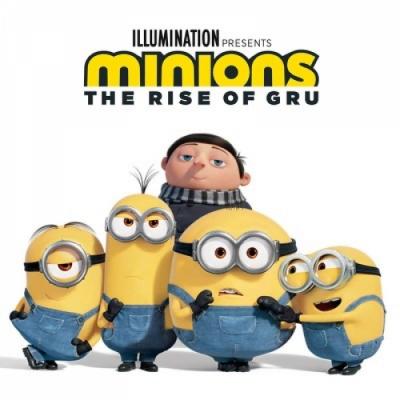
"Minions: The Rise of Gru" Soundtrack Lyrics
Cartoon • 2022
Track Listing
Diana Ross
Brittany Howard
St. Vincent
BROCKHAMPTON
Kali Uchis
Caroline Polachek
Thundercat
Phoebe Bridgers
Bleachers
Weyes Blood
Gary Clark Jr.
H.E.R.
Tierra Whack
Verdine White
Jackson Wang
The Minions
G.E.M.
Yeat
Beastie Boys
The Rolling Stones
"Minions: The Rise Of Gru (Original Motion Picture Soundtrack)" – Album Guide to Tracks and Key Scenes
Overview
How do you score a kid villain’s origin story without losing the bite of 1970s counterculture? Minions: The Rise of Gru answers that by turning the whole film into a glittery, slightly unhinged mixtape. Set in 1976, the movie tracks 11¾-year-old Gru in San Francisco as he dreams of joining the supervillain crew Vicious 6, while his chaos-prone Minions turn every plan into slapstick disaster. The soundtrack leans into that tension: songs swing between swagger and sincerity as fast as Gru swings between ego and insecurity.
The album, released as Minions: The Rise Of Gru (Original Motion Picture Soundtrack), treats the film less like a cartoon and more like a concept compilation. Contemporary artists rework funk, soul, soft rock and disco staples from the 1970s, then drop them straight into tightly storyboarded gags: airport heists, kung fu lessons, botched robberies, fake funerals. Original score cues by Heitor Pereira stitch the needle-drops together so the music never feels like random playlist shuffle; it behaves like a mischievous narrator.
In the film mix you also get classic recordings such as The Rolling Stones’ “You Can’t Always Get What You Want”, Ramones’ “Blitzkrieg Bop” and John Williams’ “Main Title & First Victim” from Jaws, plus a children’s-chorus remake of Pharrell and Pereira’s “Despicable Me” theme. Not all of those land on the compilation album, but they shape how the covers are heard: the movie constantly cross-wires “serious” rock history with slapstick yellow agents of chaos.
Stylistically, the soundtrack moves in phases. Funk and disco (Diana Ross with Tame Impala, St. Vincent, BROCKHAMPTON) signal villain swagger and city-scale spectacle. Soft rock and 70s ballads (Phoebe Bridgers on “Goodbye to Love”, Linda Ronstadt’s “You’re No Good”) underline Gru’s lonely ambition and the fragile bond with his Minions. Punk and hard rock (Ramones, Ted Nugent) crash in whenever mayhem peaks. Bossa nova and jazz (“Desafinado”, “Wave”, Boccherini’s “Minuet”) color the Chinatown detour and the film’s more stylized martial-arts sequences. The result is a kids’ cartoon that sounds like someone hijacked a classic-rock radio station for 87 minutes.
How It Was Made
The album is officially credited as Minions: The Rise of Gru (Original Motion Picture Soundtrack), released July 1, 2022 through Decca. Jack Antonoff serves as the main producer and curator. The concept is simple on paper and tricky in practice: invite a cluster of modern alt-pop and indie names—Diana Ross with Tame Impala, Phoebe Bridgers, St. Vincent, Kali Uchis, Bleachers, Thundercat, H.E.R., Weyes Blood, Jackson Wang and others—to cover 70s staples in a way that still feels playful enough for a Minions film.
Recording stretched over the pandemic years, roughly 2020–2022, in parallel with the film’s remote animation process. Antonoff and co-producers Mikey Freedom Hart, St. Vincent, RZA and Pereira pull from funk, soul, bossa nova, classic rock and soft rock catalogs, then filter them through each artist’s own style. “Turn Up the Sunshine” began as a Diana Ross session piece and became the flagship single for the soundtrack, with Antonoff and Kevin Parker (Tame Impala) building a bright, bass-heavy disco track that could work both in-film and on radio.
Heitor Pereira, long-time composer for the Despicable Me universe, handles the original score album released shortly after the song compilation. His cues weave in motifs from “Despicable Me” and new villain themes, while special versions of “Bad Moon Rising” and “You Can’t Always Get What You Want” are performed in-character by Steve Carell and Pierre Coffin on the score release. It is an unusual split: one album that plays like a curated 70s party, and another that covers the narrative underscoring and character-driven performances.
Licensing-wise, the project is ambitious for a family animation. The rights stack ranges from Rolling Stones and Ramones to Creedence and John Williams, plus multiple classical recordings and Brazilian standards. You can feel that weight in the mix: despite the Minions’ chaos, the music supervision is tight, with almost every song hitting a specific joke, montage beat or emotional turn.
Tracks & Scenes
Below are key cues from the film and album, grouped by how they hit on screen. Timestamps are approximate, based on the 1h 27m runtime.
"Shining Star" — Brittany Howard feat. Verdine White
Where it plays: Around 1', over the opening sequence in Gru’s 70s suburb. We see lava lamps, muscle cars and bell-bottoms while Minions weave through the neighborhood on their way to Gru’s lair. The track is non-diegetic, functioning as a curtain-raiser that drops us straight into the decade’s color and rhythm.
Why it matters: It immediately frames Gru’s world as funk-steeped rather than generic cartoon fluff. Howard’s gritty vocal over Verdine White’s bass punches up the idea that this kid genuinely idolizes the era’s larger-than-life supervillains and pop stars.
"Bang Bang" — G.E.M.
Where it plays: Around 6', in the stylized opening titles focusing on the Vicious 6 and their big heist before Gru enters the story. The Nancy Sinatra staple is re-cut here as an explosive Mandarin-English cover while animated typography and comic-book panels show the villains at work.
Why it matters: It sells the Vicious 6 as true 60s/70s pulp villains while also nodding to the franchise’s global audience. The gunshot-like drum hits sync with smash cuts, making the sequence feel closer to a Bond opening than a kids’ comedy.
"Main Title & First Victim" — John Williams
Where it plays: About 9', when Gru and several Minions sneak into a cinema showing Jaws. The original Williams cue plays diegetically from the theater speakers as Gru soaks in the menace on screen, then mentally files it under “career goals”.
Why it matters: It aligns Gru’s childhood imagination with one of the defining movie monsters of the 70s. The famous two-note motif becomes a kind of aspirational soundtrack for his dream of becoming “properly” scary.
"Fly Like an Eagle" — Thundercat
Where it plays: Around 15', over a montage of Gru’s “training” as he tests gadgets, sprints through back alleys and uses Minions as crash-test dummies. The track sits non-diegetically but matches his rhythm: bass lines slide as Gru repeatedly fails and tries again.
Why it matters: The original Steve Miller Band version is pure soft-rock uplift; Thundercat’s slick, slightly weirder update keeps that sense of aspiration but adds a nerdy virtuoso edge that fits a kid building weapons in his bedroom.
"Hollywood Swinging" — BROCKHAMPTON
Where it plays: Roughly 26', during the robbery at Villain-Con when Gru steals the Zodiac Stone from the Vicious 6 after they dismiss him. The groove kicks in as he darts through crowds, uses Minions as impromptu tools and pulls off the heist in plain sight.
Why it matters: Funk horns and group shouts mirror both the carnival atmosphere of the convention and the Minions’ group energy. The song makes Gru’s first real villain move feel cool, not just clumsy.
"All the Young Dudes" — Mott the Hoople
Where it plays: Around 29', with Gru hiding out in a vehicle after escaping Villain-Con. Minions hum and sing along in the back, turning the glam-rock anthem into their own off-key road song.
Why it matters: It casts Gru and the Minions as a ragtag band of misfits rather than a master with henchmen. The song’s youth-revolt DNA lines up with Gru’s decision to go against his villain idols.
"Get Down Tonight" — KC & The Sunshine Band
Where it plays: Around 32', at the birthday party where Otto has traded the Zodiac Stone for a Pet Rock. Gru storms the suburban chaos while the track thumps from the party speakers. Decorations, lava lamps and roller skates blur into a disco nightmare for him.
Why it matters: The upbeat groove is completely at odds with Gru’s panic. That contrast makes the scene funnier and underlines how casually the human world treats what, to Gru, is an object of mythical power.
"Goodbye to Love" — Phoebe Bridgers
Where it plays: Also around 32', when Gru breaks with the Minions after the disaster and is quickly captured. The Carpenters ballad becomes a quiet, modern-indie lament as he separates himself from the only “family” he has, believing they held him back.
Why it matters: Bridgers leans into the song’s melancholy, giving a real emotional center to a story that could otherwise feel purely slapstick. It signals that Gru’s ego has a cost.
"Blitzkrieg Bop" — Ramones
Where it plays: Around 36', when the Minions chase the neighborhood kid who ended up with the Pet Rock. The punk classic rips in as the boys hop fences, slam doors and barrel through backyards, with the Minions perpetually three steps behind.
Why it matters: The song injects pure kinetic chaos. Its “Hey! Ho! Let’s go!” chant functions almost like the Minions’ internal chorus as they finally commit to fixing their mistake.
"On the Beautiful Blue Danube, Op. 314" — Johann Strauss II (classical recording)
Where it plays: Roughly 40', over the infamous airplane sequence in which the Minions impersonate pilots and accidentally fly a commercial jet. The waltz floats calmly while everything in the cockpit goes wrong: wrong levers, upside-down manuals, screaming passengers.
Why it matters: It is classic counterpoint comedy. Elegant Viennese waltz versus total aviation incompetence. The music’s smooth triple-time makes the slapstick feel balletic rather than frightening.
"Vehicle" — Gary Clark Jr.
Where it plays: Around 45', during a street chase involving Gru, Wild Knuckles, the Minions and multiple vehicles weaving through San Francisco. The song is non-diegetic but mixed loud, riding on guitar riffs and horns.
Why it matters: The original 1970 horn-rock hit was practically written for car chases. Clark Jr.’s version adds grit and modern bite, turning the scene into a mini-heist movie.
"Funkytown" — Lipps Inc.
Where it plays: Around 52', in a kung fu training sequence where the Minions secretly pipe in music while being drilled by Master Chow. As they slide into the beat, their kicks occasionally sync to the synth hits.
Why it matters: The song is basically a thesis statement for the film’s tone—dreams of a “Funkytown” future powered by ridiculous optimism. The contrast between disciplined martial arts and a neon disco song amplifies both.
"More, More, More" — Andrea True Connection
Where it plays: About 53', as Wild Knuckles decides not to drop Gru into certain doom and instead recruits him around the house. Gru awkwardly helps with chores and small-time criminal tasks while the disco groove rolls.
Why it matters: It wraps a morally grey mentorship in pure hedonistic polish. The song treats criminal apprenticeship like a dancefloor flirtation, undercutting the danger with camp.
"Dance to the Music" — H.E.R.
Where it plays: Around 54', on the road trip where Otto hitches a ride to San Francisco with the biker uncle of the boy who took the stone. The track plays over the montage of them bonding across miles of highway.
Why it matters: It turns Otto’s detour into a mini-buddy movie. The Sly & The Family Stone classic becomes a bridge between generations, sung by a modern R&B star who keeps the communal feel intact.
"You Can’t Always Get What You Want" — The Rolling Stones
Where it plays: Around 1h 19', during the aftermath of the staged funeral sequence. Gru and Wild Knuckles drive away, having faked a tragic ending to slip out from under the villains’ and police’s noses.
Why it matters: The song works on three levels: a joke about elaborate fake deaths, a commentary on Gru not quite getting his dream villain career, and a genuine note of warmth about found family.
"Turn Up the Sunshine" — Diana Ross feat. Tame Impala
Where it plays: About 1h 20', first as Otto arrives at the Chinese New Year parade with the Zodiac Stone, then again in the end credits before the final songs. Neon dragons, fireworks and Minions in improvised outfits move in time with the bass line.
Why it matters: This is the album’s lead single and spiritual mission statement. It literally scores the moment when Gru’s selfish plan turns into a group rescue effort, and the lyrics about collective light land without feeling heavy-handed.
"Funkytown" — St. Vincent
Where it plays: Around 1h 23', in the closing and early credits, as the Minions celebrate surviving yet another catastrophe. The arrangement is darker and more synthetic than the Lipps Inc. version, leaning into St. Vincent’s art-pop sensibility.
Why it matters: It sends the audience out on a weirder, more modern note, reminding you that this is not just nostalgia tourism but a reinterpretation of those hits.
"You’re No Good" — Linda Ronstadt
Where it plays: About 1h 25', just as Gru meets a young Dr. Nefario in the music store and receives an important gadget. We only hear part of the song as they talk.
Why it matters: It is a neat joke—using a breakup song as Gru quietly breaks from his childhood idols and begins toward the future Despicable Me persona. It also signals that the story is sliding toward the next chapter of the franchise.
Trailer & non-album highlights
Outside the film itself, the marketing used additional tracks. Beastie Boys’ “Sabotage” and Eminem’s “Lose Yourself” drive different main trailers, while Yeat’s single “Rich Minion” powers the Lyrical Lemonade teaser and the #Gentleminions suit-and-bananas meme. “Rich Minion” never appears on the official soundtrack album, but it heavily shaped how online audiences remember the movie’s sound.
Notes & Trivia
- The soundtrack album and the film’s full music list do not match; several in-film classics (Ramones, Rolling Stones, some score variations) are absent from the compilation.
- According to one detailed scene-by-scene breakdown site, the “Blue Danube” airplane gag clocks in at roughly the film’s halfway mark, underscoring peak Minion chaos with ultra-formal waltz.
- The score album released shortly after the song compilation includes in-character performances of “Bad Moon Rising” and “You Can’t Always Get What You Want” by Steve Carell and Pierre Coffin.
- The curated covers album sits in the official Despicable Me soundtrack chronology between Despicable Me 3 and the later Despicable Me 4 releases.
- Some classical cues like Boccherini’s “String Quintet in E Major: Minuet” are used very briefly on screen, but they help sell Criminal Records—the music store in the film—as a believable 70s hub.
- The soundtrack’s production roster—Antonoff, St. Vincent, RZA, Pereira—quietly mirrors the film’s story about unusual collaborators forming an unlikely team.
Music–Story Links
Gru’s character arc—from arrogant fanboy to leader who actually cares about his crew—is mirrored by the way songs move from solo fantasy to group energy. Early cues like “Fly Like an Eagle” play over montages where he trains alone, treating the Minions more like props than partners. By the time “Shining Star” and “Hollywood Swinging” frame the Villain-Con heist, the Minions’ physical comedy starts doing most of the work while Gru clings to the fantasy of being taken seriously.
When he abandons the Minions and is captured, “Goodbye to Love” steps in as musical conscience. It underlines that this is not just a setback in his villain résumé but a betrayal of the only people who believe in him. Later, the Minions’ pursuit scenes backed by “Blitzkrieg Bop” and other high-velocity tracks show them earning their place as co-heroes: the music is on their side, even when Gru has written them off.
The final stretch ties it all together. “You Can’t Always Get What You Want” plays after the fake funeral, as Gru and Wild Knuckles drive away. At that point, Gru’s dream of joining the Vicious 6 is gone, replaced by something less glamorous but more stable: a mentor, loyal Minions and the first hints of the future lab. Immediately after, “Turn Up the Sunshine” shifts the emotional register from melancholy to celebration, reinforcing that Gru’s new life—imperfect and improvised—is better than the one he thought he wanted.
Even the Minions’ own performance of “Cecilia”, banging on lab machinery as percussion, says something about the story. They recycle the world’s leftovers into a makeshift band and, by extension, into a family. The soundtrack is constantly doing this: taking canonical 70s songs and re-contextualizing them as tools for small, oddball characters trying to find their place.
Reception & Quotes
Critically, the soundtrack landed in a “good but not flawless” zone. A major music outlet gave the album a slightly above-average score, praising the ambition and artist lineup while arguing that not every cover justifies its existence. Some tracks (like St. Vincent’s “Funkytown”) were singled out as bold reinventions; others were described as pleasant but safe.
Another review from a college radio station highlighted how well the album supports the film’s themes of teamwork and friendship, noting that the rotating vocalists echo the way characters take turns stepping into the spotlight. To them, the record showed how a kids’ movie could act as a gateway into a wider slice of 70s music history for younger listeners.
As one review from a pop-culture site put it, the soundtrack is “stacked” with big-name features and sometimes feels like a flex: a way to show that even the silliest franchise entries can host serious pop craft. More mainstream coverage tended to focus on “Turn Up the Sunshine” as a stand-alone summer single, noting how it consciously channels the disco energy of Ross’s classic work while staying modern.
Among fans, the discourse skewed online and ironic. The Yeat-powered “Rich Minion” trailer, the #Gentleminions TikTok trend and meme posts from indie-music communities ended up boosting the soundtrack’s profile far beyond usual family-animation chatter. For a while, joking that the Rise of Gru album was “AOTY” almost became its own micro-genre of meme.
Interesting Facts
- Lead single trajectory: “Turn Up the Sunshine” was released weeks before the movie, charted modestly, and later picked up extra life as a stand-alone Ross/Tame Impala collaboration.
- Bossa nova corner: Kali Uchis’ “Desafinado” and tracks like Jobim’s “Wave” deepen the Chinatown sequences, giving the film a hazy, analog-world travel feel.
- Album vs. trailers: Beastie Boys’ “Sabotage”, Eminem’s “Lose Yourself” and Yeat’s “Rich Minion” are all heavily used in trailers but do not appear on the main soundtrack album.
- Score album add-ons: Pereira’s separate score release includes a “Minions: The Rise of Gru Score Suite” and alternate performances not heard on the covers compilation.
- Classical deep cuts: The Boccherini “Minuet” and other classical snippets briefly surface around the music-store setting, reinforcing Gru’s obsession with sound and gadgets.
- Vinyl and CD variants: Physical editions on Decca often feature retro-styled artwork that mimics 70s compilation LPs, underlining the album’s crate-digging concept.
- Kids’ soundtrack trend: Later think-pieces on pop in children’s movies frequently namecheck St. Vincent’s “Funkytown” as an example of high-caliber artists doing work for animated franchises.
- Global flavor: G.E.M., Jackson Wang and other non-US artists reflect the franchise’s worldwide reach, turning what could have been pure American nostalgia into something more international.
Technical Info
- Title: Minions: The Rise Of Gru (Original Motion Picture Soundtrack)
- Year: 2022
- Type: Soundtrack album for animated feature film
- Main producers: Jack Antonoff (primary); additional production by Mikey Freedom Hart, St. Vincent, RZA, Heitor Pereira on select tracks
- Score composer: Heitor Pereira
- Lead single: “Turn Up the Sunshine” — Diana Ross feat. Tame Impala
- Core concept: Contemporary artists cover 1970s funk, soul, rock and pop for use in film scenes set in 1976 San Francisco
- Label: Decca Records (with Verve/Universal involvement on some editions)
- Album length: ~58 minutes (19 tracks on standard edition)
- Notable in-film only placements: “You Can’t Always Get What You Want” — The Rolling Stones; “Blitzkrieg Bop” — Ramones; in-universe versions of “Bad Moon Rising” and “Despicable Me” theme
- Availability: Streaming on major platforms (Spotify, Apple Music, YouTube Music); physical CD and some vinyl releases via Decca/Universal.
Questions & Answers
- Is “Turn Up the Sunshine” an original song written for Minions: The Rise of Gru?
- Yes. It was written by Jack Antonoff, Kevin Parker, Sam Dew and Patrik Berger and recorded by Diana Ross with Tame Impala specifically for the soundtrack, then used in the parade sequence and end credits.
- Are all the songs heard in the film included on the official soundtrack album?
- No. Some needle-drops, like the Rolling Stones’ “You Can’t Always Get What You Want” and Ramones’ “Blitzkrieg Bop”, appear in the movie but not on the covers compilation, while Yeat’s “Rich Minion” is a trailer-only single.
- What song do the Minions themselves perform in the movie?
- They tackle Paul Simon’s “Cecilia” in their own gibberish style, banging on lab machinery as percussion. It functions as a bonding moment and a running gag about their love of turning noise into music.
- Which track plays during the chaotic airplane sequence?
- The scene leans on “On the Beautiful Blue Danube” as the Minions impersonate pilots and barely keep the plane in the air. The elegant waltz makes their incompetence even funnier.
- Where can I listen to the Minions: The Rise of Gru soundtrack today?
- The album is available on major streaming platforms (Spotify, Apple Music, YouTube Music) and on CD or occasional vinyl pressings. The score album by Heitor Pereira is listed separately.
Canonical Entities & Relations
| Subject | Relation | Object |
|---|---|---|
| Minions: The Rise of Gru (film) | is prequel to | Despicable Me (film) |
| Minions: The Rise of Gru (film) | features character | Felonious Gru |
| Minions: The Rise of Gru (Original Motion Picture Soundtrack) | is soundtrack to | Minions: The Rise of Gru (film) |
| Jack Antonoff | produced | Minions: The Rise of Gru (Original Motion Picture Soundtrack) |
| Heitor Pereira | composed score for | Minions: The Rise of Gru (film) |
| Diana Ross | performed | “Turn Up the Sunshine” |
| Tame Impala | collaborated on | “Turn Up the Sunshine” |
| Yeat | performed | “Rich Minion” |
| “Rich Minion” | was used in trailer for | Minions: The Rise of Gru (film) |
| Decca Records | released | Minions: The Rise of Gru (Original Motion Picture Soundtrack) |
Sources: Wikipedia (film & soundtrack entries); Soundtrakd scene list; IMDb soundtrack credits; Screen Rant song breakdown; TheWrap/Newsweek soundtrack coverage; WERS album review; Pitchfork review; Slashfilm song essay; official streaming listings (Apple Music, Spotify); marketing coverage on trailer music and the “Rich Minion” campaign; Vogue/other commentary on pop in kids’ films.
November, 15th 2025
A-Z Lyrics Universe
Cynthia Erivo Popular
Ariana Grande Horsepower
Post Malone Ain't No Love in Oklahoma
Luke Combs Good Riddance (Time of Your Life)
Green Day Bye Bye Bye
*NSYNC You're the One That I Wan
John Travolta & Olivia Newton-John I Always Wanted a Brother
Braelyn Rankins, Theo Somolu, Kelvin Harrison Jr. and Aaron Pierre The Power of Love
Frankie Goes to Hollywood Beyond
Auli’i Cravalho feat. Rachel House MORE ›