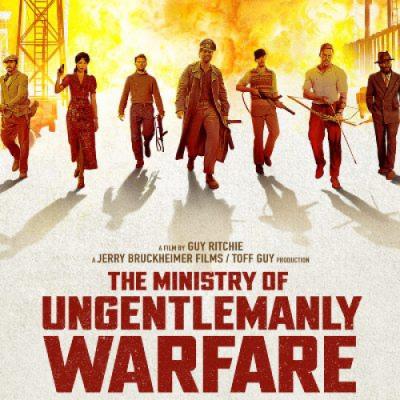
"Ministry of Ungentlemanly Warfare" Soundtrack Lyrics
Movie • 2024
Track Listing
"The Ministry of Ungentlemanly Warfare (Original Motion Picture Soundtrack)" – Album Guide to Tracks and Key Scenes
Overview
How do you score a World War II mission where the heroes behave like comic-book outlaws and the enemy never sees the punchline coming? The Ministry of Ungentlemanly Warfare answers with a soundtrack that treats sabotage as a stylish art form. Guy Ritchie’s film follows Gus March-Phillipps and his motley SOE unit as they sail toward Operation Postmaster — a covert strike against an Axis supply ship — and the music turns that journey into a swaggering, whistle-led march.
The film itself is a deliberately heightened take on real events: Winston Churchill authorises a deniable “dirty war” unit; Brigadier Gubbins pulls together killers, gamblers and charmers; and agents Marjorie Stewart and Richard Heron run an undercover game on the Nazi command on Fernando Po. The soundtrack leans into that pulp-adventure tone. Instead of solemn WWII gravitas, we get cimbalom riffs, Morricone-style whistles, brawny choirs and big-band jazz cues that sound like they escaped from the coolest club in 1941.
Composer Chris Benstead treats the score as a three-way handshake between spaghetti western, 1960s spy thriller and smoky jazz club. The main theme follows the team from recruitment to raid, shifting from laconic whistle to full-ensemble bravado as their operation escalates. When the narrative cuts to the casino floor — Marjorie seducing Heinrich Luhr under watchful Nazi eyes — the palette flips to finger-snapping swing and bossa nova, and suddenly war feels like a rigged card game played to the bandstand.
Across the film, the soundtrack tracks a simple arc: arrival, adaptation, rebellion, collapse — then aftermath. Early cues underline the team as charming misfits stepping into a nearly hopeless war. Mid-film action cues push harder into percussion and male chorus as the mission spins out of “authorized” control. In the climax, when ships burn and loyalties snap, the music becomes harsher and more dissonant before resolving into a surprisingly warm coda for Churchill’s final “thank you.” Genre-wise, you can roughly map the phases like this: western twang for rugged independence, 60s-style spy writing for planning and subterfuge, and 40s jazz for seduction, bluffing and moral gray zones.
How It Was Made
On paper, this is a British WWII action comedy; on the staff paper, it is a love letter to Ennio Morricone and John Barry. Benstead has worked repeatedly with Guy Ritchie and Jerry Bruckheimer, and here he sets himself a very specific challenge: build a modern, punchy action score that still feels like it could sit on a shelf next to classic Italian western LPs and Cold War spy thrillers. Reviews have consistently pointed out those influences — especially the Morricone-esque whistles, guitars and gruff male vocals, plus Barry’s trademark cimbalom colour for espionage tension.
The score was recorded and released as The Ministry of Ungentlemanly Warfare (Original Motion Picture Soundtrack), a 22-track album running just over 54 minutes. Filmtrax handled the album release, first digitally and then on physical CD, positioning it squarely in the “film score / western / spy / jazz” niche rather than a generic action OST. The production credits underline how crafted it is: orchestration by Giles Thornton, mixing by Fiona Cruickshank, album production by Benstead himself.
Behind the scenes, the music design mirrors the film’s split structure. For the commando team at sea and in the docks, Benstead leans into guitars, whistles, choirs and muscular percussion — sometimes with church organ or strange woodwind colours layered in. For Marjorie and Heron’s casino operations, he writes in-period jazz source cues that can function both as background diegetic music and as thematic commentary on deception, seduction and gambling with lives. According to Movie Music UK, he explicitly set out to merge Morricone’s western vocabulary with Barry-like spy textures and swing-era jazz rather than simply pastiche one style.
Licensing-wise, the film also threads in a few key pre-existing tracks: Lalo Schifrin’s “The School Bus” from Dirty Harry, a performance of Kurt Weill and Bertolt Brecht’s “Die Moritat von Mackie Messer” (“Mack the Knife”), and Chopin’s “Raindrop” prelude. These cues sit on top of Benstead’s score like knowing winks to classic cinema and classical repertoire — familiar but repurposed in a pulp-war context.
Tracks & Scenes
Below is a curated selection of key cues and songs — not a full tracklist — with a focus on where and how they work in the film.
"A Team of Misfits" — Chris Benstead
Scene: Effectively the main title, this cue plays over the early montage that sets up Gus March-Phillipps, Gubbins and the ragtag commandos being assembled. The music starts almost bare — a lonely whistle and spare guitar over shots of dossiers, maps and low-lit offices — then gradually adds percussion and cimbalom as the team coalesces and the mission codenamed Operation Postmaster is teased. Non-diegetic, it frames the group as Western-style gunslingers being quietly deputised for an unofficial war.
Why it matters: This is the score’s mission statement. The whistled theme becomes the musical identity of the unit, returning whenever the film asks you to root for them as chaotic heroes rather than standard soldiers.
"Train Game" — Chris Benstead
Scene: Early in the story, Marjorie Stewart and Richard Heron travel by train on their way to the mission, scouting contacts and feeling out each other’s methods. “Train Game” plays as a light-footed caper cue — brushed drums, bass and sly brass accents — over tracking shots in the corridor, exchanged glances in compartments, and glimpses of documents changing hands. The music stays non-diegetic but feels close enough in style that you could imagine it coming from a carriage radio.
Why it matters: This establishes the film’s second mode: espionage as a playful hustle. Whenever the plot shifts from gunfights to cons and card tricks, the soundtrack slides into this jazzy register.
"Heron’s Casino Bar" — Chris Benstead
Scene: On Fernando Po, much of the infiltration runs through Heron’s gambling hall. This cue is heard during an early party sequence where the jazz band is in full swing and Nazi officers, local elites and undercover agents all share the same smoky room. The music is diegetic: we see the band on stage, complete with historically-anachronistic drum kit hardware if you’re watching closely, while Marjorie works the room and Heron quietly manages the tables.
Why it matters: It’s the sonic blueprint for the casino: light on the surface, dangerous underneath. The infectious groove makes the space feel like a game — which is exactly how the spies treat it — even as critical information and loyalties shift in the background.
"Beer Bossa" — Chris Benstead
Scene: Later in the casino, when the party thins out and conversations turn more intimate, “Beer Bossa” slides in as slower, more sultry source music. The camera lingers on small details — a glass being refilled, a hand brushing a holster, a nervous glance to the balcony — while the bossa rhythm keeps the atmosphere relaxed enough that the SS officers drop their guard. The tune can be heard both in the foreground near the bar and muffled in side rooms, grounding the entire sequence in the club’s soundscape.
Why it matters: This track shows how carefully the film balances tone: the mission is on a knife-edge, but the band is playing something you might dance to. That contrast makes the eventual violence land harder.
"Die Moritat von Mackie Messer (Mack the Knife)" — Kurt Weill & Bertolt Brecht; performed in-film by Eiza González
Scene: At a costume party in the casino, Marjorie takes the stage to sing “Mack the Knife” in German, locking eyes with Heinrich Luhr while officers and collaborators look on. It’s fully diegetic: the band plays behind her, waiters freeze for a moment as she hits certain lines, and the lyrics about a charming killer double as a pointed warning. The performance grows more intense as the scene cuts between her on stage and Gus’s crew moving into position at the harbour.
Why it matters: This is one of the film’s clearest music–story pivots. The song’s narrative — about a predator masked by charm — mirrors Marjorie’s own cover and foreshadows Luhr’s fate. It also underlines how much of the mission depends on her performance skills, not just guns.
"Operation Postmaster" — Chris Benstead
Scene: As the raid itself begins — boats sliding into position, charges being set, sentries distracted — “Operation Postmaster” kicks in with pounding bass, layered percussion and wordless male choir. The cue stays non-diegetic and propulsive, carrying us through intercut shots of the harbour, engine rooms, and command posts in both British and Axis perspectives. When explosions start, the choir surges rather than the music dropping out, so the soundscape feels like a ritual rather than chaos.
Why it matters: This is the core action cue, the payoff for all the planning themes. It wraps the mission in mythic scale, making a relatively small naval operation feel like the climax of an outlaw legend.
"Apple Rescue" — Chris Benstead
Scene: Before the main mission, Gus diverts to rescue Geoffrey Appleyard from Gestapo custody. “Apple Rescue” underscores a gritty break-in sequence — tight corridors, flashlights, frantic close-quarters combat. Brass stabs and sharp rhythmic figures track each sudden move, while a more lyrical version of the main theme briefly appears as Appleyard realises who has come for him.
Why it matters: This cue sells the team’s competence. It takes the same musical DNA as “A Team of Misfits” but frames it as lethal efficiency instead of rakish charm, showing the other side of their legend.
"U-Boat Contretemps" — Chris Benstead
Scene: Midway through the operation, there is a tense stand-off around the U-boat resupply network — ships manoeuvre, radio operators shout over one another, and the risk of exposure spikes. “U-Boat Contretemps” adds an almost ecclesiastical organ sound over the usual percussion, as if the ocean itself were a hostile cathedral. Non-diegetic, it pulls the camera’s viewpoint up and out, making the tactical board feel like a chessboard observed by unsentimental gods.
Why it matters: The organ colour subtly reminds us that beyond this one operation lies the larger Battle of the Atlantic. The mission is a small piece of a much bigger, almost abstract war machine.
"A Bag Full of Nazi Hearts" — Chris Benstead
Scene: Late in the film, when the team’s violence is at its most direct and uncompromising, this cue drops in with heavy, distorted textures and brutal rhythmic hits. We see close-ups of hand-to-hand fighting, sabotage in confined ship interiors and the aftermath of gunfights. The music is non-diegetic but feels physically oppressive, almost like industrial sound design layered onto the orchestra.
Why it matters: The title and sound together cut through any romanticism. For all the swagger and banter, the film eventually shows the cost of what these men do; this cue is where the score stops winking.
"Absconding with the Duquesa" — Chris Benstead
Scene: Once the mission shifts from “sinking” to “stealing” the Italian ship, “Absconding with the Duquesa” plays over a set-piece that alternates between frantic improvisation on deck and controlled chaos in the engine room. Rhythmic motifs borrowed from earlier tracks return in more triumphant, full-bodied form as the crew pulls off the theft against long odds.
Why it matters: This is one of the soundtrack’s big “victory lap” cues, tying together various motifs into a single, crowd-pleasing burst. It reinforces the idea that the mission succeeds not because it was authorised, but because this specific group of misfits refuses to lose.
"Churchill’s Gratitude" — Chris Benstead
Scene: Near the end, in a quieter aftermath sequence, Gus and his team face the bureaucratic consequences of their unsanctioned success — and then, unexpectedly, leniency. “Churchill’s Gratitude” is a restrained, guitar-led piece with warm harmonies as we hear or see the Prime Minister’s approval and the group’s unofficial elevation into a permanent “ministry.” It plays over shots of the men regrouping, and over glimpses of what their future wartime work will entail.
Why it matters: After so much bombast, this cue humanises the group again. It’s a reminder that under the myth there were real people who had to live with what they’d done — and that the establishment will happily use them again.
"The Ministry of Ungentlemanly Warfare" — Chris Benstead
Scene: The end-credits cue, it functions as a summation: main theme on whistle, Morricone-style guitars, cimbalom, choir, jazz percussion and vocal grunts all cycling through one last time as text cards explain the real post-war fates of the characters. The film cuts between archival-style stills, dramatized epilogues and the rolling credit list while the music never stops strutting.
Why it matters: It leaves you with the impression that you’ve just watched a legend being minted. The cue sells the idea that this story could sit alongside classic war capers and westerns on your shelf.
"The School Bus" — Lalo Schifrin
Scene: Borrowed from the Dirty Harry soundtrack, this cue appears as a needle drop during a planning and gearing-up montage, bridging old-school 1970s cop-movie funk with WWII commandos cleaning weapons and loading gear. It is non-diegetic and obviously anachronistic, which is the point — the film briefly treats its own heroes like urban antiheroes from another cinematic era.
Why it matters: The reference links Gus’s crew to a later tradition of morally flexible “law enforcers” in film. It also signals that Ritchie and his team are comfortable pulling from the wider history of action cinema, not just war movies.
"Preludes, Op. 28: No. 15 in D-Flat Major 'Raindrop'" — Frédéric Chopin, performed by Nikolai Lugansky
Scene: Chopin’s “Raindrop” prelude appears briefly as elegant background music in an interior sequence on the Axis-controlled side — likely a gramophone or radio in a refined setting, playing over hushed conversation between officers and collaborators. The gentle repeated notes of the piece contrast with the harsh decisions being discussed and the violence about to unfold elsewhere.
Why it matters: It’s a classic ironic-classical needle drop: culture and cruelty in the same room. The track also broadens the soundtrack’s palette beyond jazz and western influences, reminding us that European art music still played on while the continent tore itself apart.
Notes & Trivia
- The score was conceived as a deliberate homage to Ennio Morricone’s spaghetti western style and John Barry’s 1960s spy scores, including cimbalom-heavy textures.
- Marjorie’s “Mack the Knife” performance was originally scripted in English; on set, Ritchie pivoted to have it sung in German for extra dramatic impact.
- In the Heron’s Casino Bar party scene, the jazz drummer uses a modern Istanbul-brand cymbal — a fun anachronism spot for gear-obsessed viewers.
- The soundtrack album is released by Filmtrax, who also handle several of Benstead’s other collaborations with Guy Ritchie.
- Chopin’s “Raindrop” prelude is one of the very few pieces of 19th-century classical music dropped into an otherwise mid-20th-century, jazz-heavy sound world.
Music–Story Links
The easiest way to read this score is to map specific styles to specific factions and jobs. Gus’s commando core gets the western-spy hybrid: whistles, guitars, cimbalom and choir. Whenever they plan, move or improvise in the field, that sound returns, signalling that this is their story and their legend. “A Team of Misfits,” “Operation Postmaster,” “Apple Rescue” and “Absconding with the Duquesa” all fall into this bucket, charting the mission from recruitment to completion.
Marjorie and Heron, by contrast, live in the jazz-and-bossa universe. “Train Game,” “Heron’s Casino Bar,” “Beer Bossa” and “Heron’s Hop” sketch the world of gambling halls, stage acts and quiet conversations under chandeliers. When the film cuts to these cues, the stakes are more psychological than ballistic: secrets traded, loyalties tested, identities performed.
The villains and establishment sit somewhere between the two. Classical drops like Chopin’s “Raindrop” and the more austere suspense cues (“Trick Up Sleeve,” “The First Domino Falls”) tend to track high-ranking officers and senior command. They create a veneer of order that the heroes constantly undermine. Meanwhile, “A Bag Full of Nazi Hearts” and similar cues show what happens when those worlds collide and the violence becomes impossible to dress up as a game.
Finally, “Churchill’s Gratitude” acts as a bridge between the clandestine and the official. Its warmer tone and stripped-back arrangement underline that, for all the deniability, the British state quietly depends on precisely this kind of “ungentlemanly” work — and is willing to look the other way when it succeeds.
Reception & Quotes
Critically, the film’s music has been one of its most consistently praised elements. Reviewers who were lukewarm on the plotting or pacing still singled out the score’s energy, its Morricone/Barry blend and the sheer fun of the jazz sequences. Among soundtrack specialists, the album has even been called a standout among 2024 film scores.
Benstead’s long-running collaboration with Guy Ritchie helps here: he clearly understands the director’s taste for rhythmic, motif-driven scoring that can sit under fast dialogue and clipped editing. Listeners have also noted how well the album plays on its own — something closer to an old-fashioned concept LP than a purely functional modern action score.
“A wonderful piece of musical retrospective… Morricone westerns, John Barry spy capers and 1940s jazz in a single, swaggering package.” — Movie Music UK
“Loads of composers have copied Morricone; I’m not sure I’ve ever heard it done better than here.” — Movie Wave
“The soundtrack… a fair bit of easy-listening jazz, with a ride cymbal sound that really stood out.” — user comment on r/drums
“Great soundtrack for a great movie. Worth adding to your collection.” — customer review on a retail listing
On the availability side, the full 22-track album is on major streaming platforms and as a digital purchase, with a later CD pressing for collectors. There is, as of now, no separate release of Eiza González’s “Mack the Knife” performance, which exists only in-film and in unofficial clips.
Interesting Facts
- The digital soundtrack dropped in early May 2024, just weeks after the film’s theatrical launch, with 22 cues running about 54 minutes.
- A dedicated CD edition followed later via Filmtrax/BFD, marketed specifically under the genres “Film Score / Western / Spy / Jazz.”
- The album’s opening whistle motif was immediately compared by reviewers to iconic Morricone themes like “L’arena” and “The Ecstasy of Gold.”
- Benstead’s score for The Ministry of Ungentlemanly Warfare has already shown up on year-end lists and awards shortlists from specialist soundtrack sites.
- The Chopin “Raindrop” prelude used here joins a long list of films and shows that have repurposed that piece in very different tonal contexts.
- Eiza González has talked publicly about having to switch her “Mack the Knife” performance into German on the day of shooting — including specific accents on key words.
- The same creative team (Ritchie, Benstead, Bruckheimer) also collaborated on other recent projects, making this score feel like part of an informal “Ritchie music universe.”
- The film’s mix gives Benstead’s score plenty of headroom: explosions are loud, but the musical details — cimbalom hits, organ flourishes — remain clearly audible.
Technical Info
- Title: The Ministry of Ungentlemanly Warfare (Original Motion Picture Soundtrack)
- Film: The Ministry of Ungentlemanly Warfare (2024, feature film)
- Year of film: 2024
- Year of album release (digital): 2024
- Type: Original Motion Picture Score with a few licensed songs
- Composer / Primary Artist: Chris (Christopher) Benstead
- Notable featured works: “Die Moritat von Mackie Messer (Mack the Knife)” (Weill/Brecht), “The School Bus” (Lalo Schifrin), “Raindrop” prelude by Frédéric Chopin
- Label: Filmtrax Ltd. (digital and later CD editions)
- Runtime (album): approx. 54 minutes, 22 tracks
- Key cues highlighted by reviewers: “A Team of Misfits,” “Operation Postmaster,” “Heron’s Casino Bar,” “Officers Fancy Dress,” “A Bag Full of Nazi Hearts,” “The Ministry of Ungentlemanly Warfare”
- Availability: Major streaming platforms (Spotify, Apple Music, etc.), digital download, and physical CD via Filmtrax/BFD
Questions & Answers
- Is the soundtrack mostly score or mostly songs?
- It is primarily Chris Benstead’s instrumental score, with a few carefully chosen source tracks like “Mack the Knife,” “The School Bus” and Chopin’s “Raindrop.”
- Does Eiza González actually sing “Mack the Knife” in the film?
- Yes. She performs a sultry, in-character version in German during a key casino party sequence, used diegetically as part of Marjorie’s cover.
- How does this score differ from Benstead’s other work with Guy Ritchie?
- Compared with The Gentlemen or Wrath of Man, this one leans harder into spaghetti western homage and big-band jazz, while still keeping the punchy rhythmic writing he’s known for.
- Can you listen to the album without seeing the film?
- Very much so. The album is structured with clear themes and set-pieces; reviewers regularly mention how well it plays as a standalone listening experience.
- Where can I legally get the soundtrack?
- It’s on major streaming services worldwide and sold digitally; a CD release from Filmtrax/BFD is available through specialist soundtrack retailers and online shops.
Canonical Entities & Relations
| Subject | Verb | Object |
|---|---|---|
| Guy Ritchie | directs | The Ministry of Ungentlemanly Warfare (film) |
| Christopher (Chris) Benstead | composes score for | The Ministry of Ungentlemanly Warfare (film) |
| Christopher (Chris) Benstead | writes and produces | The Ministry of Ungentlemanly Warfare (Original Motion Picture Soundtrack) |
| Filmtrax Ltd. | releases | The Ministry of Ungentlemanly Warfare (Original Motion Picture Soundtrack) |
| Jerry Bruckheimer Films | produces | The Ministry of Ungentlemanly Warfare (film) |
| Black Bear Pictures | co-produces | The Ministry of Ungentlemanly Warfare (film) |
| Lionsgate | distributes | The Ministry of Ungentlemanly Warfare (film) in the United States |
| Amazon MGM Studios / Prime Video | distributes | The Ministry of Ungentlemanly Warfare (film) in the United Kingdom and selected territories |
| Henry Cavill | plays | Gus March-Phillipps in The Ministry of Ungentlemanly Warfare |
| Eiza Gonz\u00e1lez | plays | Marjorie Stewart in The Ministry of Ungentlemanly Warfare |
| Eiza Gonz\u00e1lez | performs | \u201cDie Moritat von Mackie Messer (Mack the Knife)\u201d in Heron\u2019s casino sequence |
| Operation Postmaster | inspires plot of | The Ministry of Ungentlemanly Warfare (film) |
| Damien Lewis | writes | Churchill\u2019s Secret Warriors (book basis for the film) |
| Fr\u00e9d\u00e9ric Chopin | composes | Preludes, Op. 28: No. 15 in D-Flat Major \u201cRaindrop\u201d used in the film |
| Lalo Schifrin | composes | \u201cThe School Bus\u201d used in The Ministry of Ungentlemanly Warfare |
Sources: Wikipedia (EN/DE/ES) entries on the film; Movie Music UK soundtrack review; Movie Wave soundtrack review; official album listings on Apple Music, Amazon and Discogs; Filmtrax label credits; NME coverage of the soundtrack; Soundtrakd track credits; HighDefWatch Blu-ray review; Motion Picture Association feature on the film’s cinematography; ET interview segments with Eiza Gonz\u00e1lez; Reddit user comments and retail user reviews.
November, 15th 2025
A-Z Lyrics Universe
Cynthia Erivo Popular
Ariana Grande Horsepower
Post Malone Ain't No Love in Oklahoma
Luke Combs Good Riddance (Time of Your Life)
Green Day Bye Bye Bye
*NSYNC You're the One That I Wan
John Travolta & Olivia Newton-John I Always Wanted a Brother
Braelyn Rankins, Theo Somolu, Kelvin Harrison Jr. and Aaron Pierre The Power of Love
Frankie Goes to Hollywood Beyond
Auli’i Cravalho feat. Rachel House MORE ›