Soundtracks:  A B C D E F G H I J K L M N O P Q R S T U V W X Y Z #


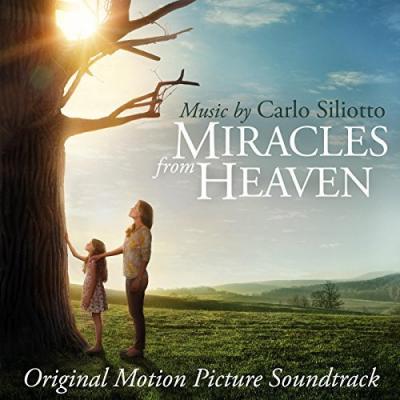
Miracles from Heaven Album Cover

"Miracles from Heaven" Soundtrack Lyrics

Movie • 2016

Track Listing


"Miracles from Heaven (Original Motion Picture Soundtrack)" – Album Guide to Tracks and Key Scenes

Miracles from Heaven trailer frame with Christy and Anna Beam looking out across a Texas field
Miracles from Heaven (2016) – trailer imagery that set the tone for faith, fear, and quiet everyday miracles.

Overview

How do you score a miracle that arrives in the middle of exhaustion, debt, and medical paperwork? Miracles from Heaven answers with a soundtrack that keeps one foot in everyday life and one in the numinous. Carlo Siliotto’s orchestral score and a small cluster of contemporary Christian and pop songs follow the Beam family through diagnosis, collapse, and unexpected healing, always trying to sound like real people’s lives rather than a sermon.

The film tells the true story of young Annabel Beam and her parents Christy and Kevin, whose world shrinks to hospitals and waiting rooms after Anna develops a rare digestive disorder. Long trips from rural Texas to Boston Children’s Hospital, fights with insurance, and a marriage stretched by distance all play out while Siliotto’s strings trace grief, doubt, and stubborn hope. Around that core, songs by Third Day, Cam, Howie Day, Clayton Anderson, and Rachel Platten add flashes of radio reality: church worship, road-trip radio, and trailer-ready empowerment pop.

The official album — Miracles from Heaven (Original Motion Picture Soundtrack), released by Madison Gate Records in March 2016 — is almost entirely score: 30 cues in under 50 minutes, written and conducted by Siliotto, with just the film’s pop/rock songs appearing on separate singles and playlists. The music as heard in the film is broader: live worship from Third Day on screen, Cam’s “Here Comes the Sun” on the airport tarmac, Howie Day’s “Collide” on the road to Boston, Rachel Platten’s “Fight Song” blasting through trailers and TV spots.

Across the story you can feel a simple arc in the music: arrival, adaptation, rebellion, collapse. Early cues like “A Happy Family” and “First Night” sound warm and domestic — woodwinds, piano, and small string gestures as Christy narrates a life that feels ordinary, even blessed. As Anna’s condition worsens, the score thins out; tremolo strings and minor-key piano dominate titles like “Loss of Faith” and “Dear God”. After the fall into the cottonwood tree and the medically inexplicable recovery, the music doesn’t suddenly turn triumphant; instead, themes from “Heaven” and “No Pain” return gentler, as if the score is still a little stunned by what just happened.

Stylistically, the soundtrack cycles through several clear layers: lyrical orchestral writing for faith, doubt, and family; modern worship rock (Third Day) for communal belief; country-pop (Clayton Anderson) and mainstream adult pop (Howie Day) for everyday American life; and a single blast of empowerment pop (“Fight Song”) in marketing to frame the film as a broad, inspirational drama. Soft strings and piano cover interior moments; live band and vocals take over whenever the community of the church becomes a character in its own right.

How It Was Made

Italian-born composer Carlo Siliotto scored Miracles from Heaven after a run of character-driven dramas; the assignment was to write music that could sit inside a faith-based film without feeling like “church music.” The sessions took place in Los Angeles with a full studio orchestra — detailed Madison Gate Records notes list sections of violins, violas, cellos, winds, brass, and harp — and a handful of featured soloists on guitar, piano, and clarinet. The cues were recorded and mixed into relatively short movements (mostly under three minutes), then stitched throughout the film to keep emotion present but never overwhelming.

The album tracklist reads like a plot outline: “A Happy Family”, “First Night”, “First Hospital”, “Loss of Faith”, “The Church”, “The Fall”, “No Pain”, “My Beautiful Daughter”, “Dear God”. Siliotto leans heavily on a simple, ascending string motif that can sound like prayer or worry depending on harmony and tempo. A review at MovieMusicUK points out how subtle the score is compared with some of his flashier work, but also notes how much melodic warmth is packed into these short cues.

On the song side, the filmmakers and music team drew on contemporary Christian rock and country-leaning pop that would plausibly be playing in small-town Texas churches and cars in the late 2000s. Georgia band Third Day not only provide two tracks (“Soul on Fire” and “Your Words”) but also appear on screen as the worship band leading a Sunday service at the Beams’ church. Cam recorded a bright-country cover of George Harrison’s “Here Comes the Sun” for the airplane scene, while Indiana singer-songwriter Clayton Anderson contributed “Right Where I Belong” for a sunlit picnic sequence; his parents have since talked publicly about hearing their son’s song in that scene.

The marketing department added one more musical layer: Rachel Platten’s “Fight Song” in trailers and TV spots. The Christian Post and other outlets flagged this immediately — it framed the film as an empowerment story as much as a miracle narrative, even though the track plays a much larger role in promotion than in the film’s actual runtime.

Behind the scenes style shot from Miracles from Heaven with camera crew in a hospital corridor
Carlo Siliotto’s score was recorded with a full studio orchestra and then woven carefully under hospital and family scenes.

Tracks & Scenes

What follows are key cues and songs, how they’re used, and why they matter. Scene descriptions are based on documented placements and the film’s structure rather than guesswork about exact seconds on the clock.

"Heaven" — Carlo Siliotto
Where it plays: The main theme appears near the beginning and again after Anna’s fall, framing Christy’s narration about believing in miracles. We hear it as the family is still healthy — sunlight over the Texas countryside, kids climbing trees, simple table conversations — and later, in a softer, almost stunned variation as doctors admit Anna’s condition has inexplicably improved. The cue is fully non-diegetic, sitting under voiceover and montage.
Why it matters: This is the score’s thesis statement. The melody is gentle rather than grand, which fits a story where the miracle happens to a quiet family in the middle of nowhere. When it comes back after the accident, it makes the healing feel like a continuation of the same love that carried them through the illness, not some sudden deus ex machina.

"A Happy Family" — Carlo Siliotto
Where it plays: Early in the film, as Christy introduces the Beams’ life — kids running around the yard, Kevin juggling work and play, church community scenes — “A Happy Family” underlines what is about to be threatened. The cue uses bright strings, piano, and warm woodwinds, underpinning quick cuts between domestic moments and church gatherings.
Why it matters: The title is almost cruel in hindsight. By laying down this musical image of warmth and stability, the score gives the later “First Hospital” and “Loss of Faith” cues something concrete to contrast against. You can hear what’s been lost.

"First Night" / "First Hospital" — Carlo Siliotto
Where they play: These two cues bracket Anna’s early symptoms and the family’s first serious encounter with the medical system. “First Night” follows Christy as she starts to realize Anna’s pain is not just a stomach bug: a late-night bathroom run, a worried mother watching her child sleep, the camera lingering on a swollen belly. “First Hospital” takes over as they sit under fluorescent lights, wait for test results, and begin hearing phrases like “chronic intestinal pseudo-obstruction” for the first time.
Why they matter: Siliotto cuts back the orchestra here — more solo piano, more tremolo strings, less harmony. The music doesn’t “tell us what to feel” so much as mirror the numbness of bad news. It’s one of the points where the film feels more like a grounded medical drama than an inspirational story.

"Loss of Faith" — Carlo Siliotto
Where it plays: Mid-film, Christy reaches a low point: exhausted from constant trips to Boston, shut out by doctors who won’t return calls, and stung by church members implying that her family’s suffering might be tied to sin. As she quietly tells Kevin she doesn’t know if she can believe anymore, “Loss of Faith” hums underneath — slow strings, a fragile main theme fragment that never quite resolves.
Why it matters: The cue is honest. It doesn’t resolve into a major-key “but it will be okay” coda. For a few minutes, the score lets Christy’s doubt stand without correcting her. That restraint is part of why reviewers singled the music out as more nuanced than typical faith-based fare.

"The Motorbike" — Carlo Siliotto
Where it plays: A short but vivid cue that scores Anna’s ride on Kevin’s motorbike, one of the few moments where she feels almost normal. Wind in her hair, camera low to the road, quick shots of her smiling despite the pain. The music picks up tempo and introduces light percussion, echoing the sense of borrowed freedom.
Why it matters: These small “escape” moments make the illness sequences hit harder. You remember that under the tubes and tests there is a kid who just wants to ride on the back of a motorbike with her dad.

"The Aquarium" — Carlo Siliotto
Where it plays: During Anna’s day out with Angela in Boston — the aquarium visit she missed with her class — the score leans into wonder: shimmering high strings, flowing arpeggios, and gentle woodwind lines as fish and rays drift past the glass. Dialogue drops away in places; we stay on Anna’s face as she forgets about pain for a moment.
Why it matters: The scene marks a pivot from pure suffering to glimpses of grace. The music suggests that this “little” kindness from a stranger might be as much a miracle as the dramatic tree fall later on.

"The Fall" — Carlo Siliotto
Where it plays: The film’s central event — Anna falling three stories inside a hollow cottonwood tree — is scored with a mix of sound design and focused orchestral writing. As she climbs with her sister, the music is almost absent, letting natural sounds carry tension. When the branch gives way, low strings and percussion hit like a single, brutal breath, then thin out into suspended chords while rescuers work to reach her.
Why it matters: Siliotto stays on the human scale. There’s no huge “miracle blast”. Instead, the cue emphasizes time stretching: the long wait while firefighters cut into the tree, Christy’s prayers at the base, the uncertainty that hangs until Anna speaks.

"No Pain" / "My Beautiful Daughter" — Carlo Siliotto
Where they play: After the fall, as doctors realize Anna’s digestive disorder appears to have vanished, “No Pain” plays under clinical conversations and tentative tests. “My Beautiful Daughter” follows Christy as she watches Anna run and eat normally again — backyard scenes, pizza at the table, laughter that had vanished for months.
Why they matter: These cues answer “Loss of Faith” musically. The same motifs return, but now they resolve. Importantly, the music still feels humble; it doesn’t claim to explain the miracle, only to honor what it means to the family.

"The Church" / "Dear God" — Carlo Siliotto
Where they play: Late in the film, Christy stands before her church and tells the story — the years of pain, the unseen kindnesses, the fall, the healing. “The Church” supports her testimony with a slow, hymn-like progression, while “Dear God” underscores closing voiceover about everyday miracles and the real Beam family epilogue clips over the credits.
Why they matter: Together, these cues anchor the film’s theological point: the miracle isn’t just that Anna was healed, but that small mercies were happening all along. The music connects those dots without preaching.

"Here Comes the Sun" — Cam
Where it plays: Early in the film, as Christy and Anna board a flight from Texas to Boston, Cam’s country-inflected cover of “Here Comes the Sun” plays over shots of the plane on the tarmac, boarding lines, and aerial views of cloud tops. It functions partly as diegetic (airport and cabin speakers) and partly as montage glue over a travel sequence.
Why it matters: The song choice is pointed. Using a hopeful, sun-drenched Beatles classic precisely when the family is heading toward grueling tests gives the trip a double meaning: they are chasing a “sun” that may or may not break through the medical gloom.

"Collide (Chris Lord-Alge Mix)" — Howie Day
Where it plays: In a travel montage tied to “Traveling to Boston,” this radio mix of “Collide” plays as the Beams juggle flights, taxis, and hotel rooms to reach Dr. Nurko’s clinic. We see highway signs, Boston skylines, and Anna dozing against car windows while Christy checks appointments on her phone.
Why it matters: “Collide” is a song about imperfect people crashing into each other and still holding on. Here it becomes an anthem for a family colliding with a healthcare system that is both lifesaving and exhausting. The familiar early-2000s pop texture also grounds the story firmly in its time.

"Collide" — Howie Day
Where it plays: A shorter use of the original album version appears later in the film, tucked behind dialogue as Christy and Anna navigate another leg of their medical journey. It’s easy to miss unless you know what you’re listening for — a brief, almost subliminal reminder of the earlier travel montage.
Why it matters: The reprise turns “Collide” into a motif for movement and uncertainty. Whenever the Beams are in transit, life feels shaky; the song’s chord progression quietly mirrors that instability.

"Right Where I Belong" — Clayton Anderson
Where it plays: During a relaxed picnic scene back home in Texas, after some of the worst may be behind them, the family spreads blankets under a big sky, kids run through the grass, and Anderson’s upbeat country-pop track plays on a portable speaker. Shots of fried chicken, paper plates, and sun through tree branches emphasize how ordinary the moment is — and how precious.
Why it matters: The title does most of the work. After months of hospitals and hotel rooms, “right where I belong” means home, surrounded by the people who walked through the valley with you. It’s one of the soundtrack’s most grounded uses of a licensed song.

"Soul on Fire" — Third Day
Where it plays: In a lively church sequence, Third Day appear on screen as the worship band leading the congregation in “Soul on Fire.” The camera cuts between the band on stage, parishioners singing with hands raised, and the Beams sitting in the pews — at first engaged, later in the film slightly more distant as Christy’s faith wavers.
Why it matters: This is the film’s clearest picture of communal faith. The lyrics about wanting one’s heart to “burn for” God echo Christy’s desire to believe even when experience argues otherwise. Having the real band physically there blurs the line between movie and live worship for many viewers.

"Your Words" — Third Day feat. Harvest
Where it plays: Later in the story, “Your Words” is used over a reflective stretch that intercuts Christy’s observations with images of Anna living a more normal life — playing outside, goofing with her sisters, quiet car rides where nobody is rushing to the ER. The song is non-diegetic, spread across a chapter of the film rather than pinned to a single shot.
Why it matters: The track’s chorus about God’s words giving life and hope fits the film’s shift from angry questions to a more settled, if still puzzled, trust. It also bridges the gap between Sunday-morning worship and weekday survival.

"Fight Song" — Rachel Platten
Where it plays: Platten’s anthem is most prominent in marketing: the main theatrical trailer cuts key scenes of Christy’s struggle and Anna’s determination to “fight” for life to the hook of “This is my fight song…”. In the film itself, any use is brief and secondary to Siliotto’s score.
Why it matters: Even if it barely appears in the movie, “Fight Song” strongly colors how many viewers remember the story. It reframes a specific Christian miracle narrative as a more general tale of resilience, which helped the film reach audiences who might never pick up the book.

Hospital corridor scene from Miracles from Heaven with Christy pushing Anna in a wheelchair
Score cues like “First Hospital” and “Loss of Faith” sit quietly under the Beams’ long journeys through sterile corridors.

Notes & Trivia

  • The official album is almost pure score — 30 cues by Carlo Siliotto — while the five headline songs (“Soul on Fire”, “Right Where I Belong”, “Collide”, “Your Words”, “Here Comes the Sun”) are typically accessed via separate artist releases and playlists.
  • Third Day’s on-screen church performance of “Soul on Fire” makes them both soundtrack artists and cameo performers, a detail some Christian press outlets highlighted enthusiastically.
  • Clayton Anderson’s parents publicly celebrated hearing his song “Right Where I Belong” in the picnic scene, confirming the placement long before most soundtrack sites updated their listings.
  • Cam’s “Here Comes the Sun” is not the Beatles original but a country-pop interpretation tailored to the film’s tone and the airplane-boarding sequence.
  • Rachel Platten’s “Fight Song” became so associated with the trailers that many viewers assume it plays through the climactic miracle itself, even though the film leans on orchestral score there.

Music–Story Links

The soundtrack does more than decorate scenes; it maps the Beam family’s emotional and spiritual shifts.

In the opening act, cues like “A Happy Family” and songs like “Here Comes the Sun” present the Beams as an ordinary, slightly idealized small-town family. The music is consonant, relaxed, full of acoustic guitar and warm strings. As Anna’s symptoms escalate, the palette changes: “First Hospital” and “Loss of Faith” thin out the harmony and pull melodies up into fragile high strings, while radio songs recede into the background. The world gets smaller, and so does the music.

Travel music defines the middle stretch. “Collide” and its radio mix, plus the Boston-set score cue “The Aquarium”, mark each trip north as a mix of grind and grace. Whenever we hear those tracks, the plot is moving — literal planes and cars, but also Christy’s growing willingness to challenge doctors and systems. The songs make travel feel like both a burden and a lifeline.

Church scenes carve out their own musical space. When Third Day lead “Soul on Fire”, the band and congregation sound larger than anything else in the film. That’s deliberate: it’s the one place Christy is supposed to feel held, which is why later shots of her sitting silently in the same pew land so hard. The music stays the same; she’s the one who has changed.

After the tree fall, the score doesn’t explode. Instead, the miracle is scored with pieces whose titles read almost like prayers: “No Pain”, “My Beautiful Daughter”, “Dear God”. Those cues, paired later with “Your Words”, tie the supernatural event back to the everyday kindnesses Christy remembers in her final church speech — the doctor who took them seriously, the waitress who picked up their tab, Angela’s tour of Boston. Musically, the film argues that all of those were “miracles” on the same continuum.

Reception & Quotes

Critical response to Miracles from Heaven was mixed overall, but the music drew steady praise from both mainstream and Christian reviewers. The film itself sits in the “average reviews, A+ audience” band on aggregate sites: critics often admired Jennifer Garner’s performance while critiquing the script’s preachier turns.

Soundtrack-focused commentary took a different angle. One review at MovieMusicUK described Siliotto’s score as “subtler and less ostentatious than some of his other works, but full of beauty,” pointing to cues like “Heaven” and “The Fall” as examples of how to score faith without bombast. CrossRhythms highlighted the emotional impact of the music and called out Third Day’s church cameo as one of the film’s stand-out moments for Christian audiences.

General film critics rarely dug deep into individual tracks, but several noted how the score underlined Christy’s exhaustion more than it did abstract spirituality. Variety and The Hollywood Reporter both described the movie as a “wholesome, crowd-pleasing drama” and mentioned that the craft — including cinematography and music — helped ground what might otherwise have felt like pure melodrama. On the other side, some outlets like The Guardian slammed the film as overly preachy; even there, the music rarely bore the brunt of the criticism.

Among fans, the main soundtrack conversation has centered on availability and association. Many people first encountered “Your Words” and “Soul on Fire” via promotional videos that intercut Third Day performances with film clips, while others still mentally hear “Fight Song” over the movie’s highlight moments because of the trailer. The official score album, meanwhile, has gained a quiet following among listeners who enjoy thematic, emotional writing in the tradition of other faith-adjacent dramas.

“A subtler, less ostentatious score than some of Siliotto’s other works, but one that contains more than its fair share of beauty.” — MovieMusicUK, on the score

“Third Day also make an appearance in the film, leading worship at the Beams’ church, singing ‘Soul on Fire’.” — CrossRhythms, on the film’s music

“A wholesome, crowd-pleasing drama… whose subject is faith and gratitude.” — The Hollywood Reporter, on the film overall

“Makes the most out of an outstanding performance from Jennifer Garner, but… preaches to the choir.” — Rotten Tomatoes critics consensus

Closing montage from Miracles from Heaven with the Beam family together outdoors
End scenes and epilogue cards are scored with cues like “My Beautiful Daughter” and “Dear God”, emphasizing everyday grace over spectacle.

Interesting Facts

  • The official score album runs about 49 minutes with 30 tracks, making each cue compact enough to mirror specific story beats without feeling fragmentary.
  • Recording took place at The Village in Los Angeles with a large session orchestra; the album credits list full string, wind, brass, and harp sections plus soloists on piano and guitar.
  • Third Day leveraged the film tie-in by releasing videos for “Your Words” and “Soul on Fire” that mix performance footage with scenes from the movie.
  • “Here Comes the Sun” in the film is Cam’s cover, but many fans assume it is the Beatles original until they check the credits.
  • The Madison Gate Records site lists detailed orchestral personnel, which is unusually transparent for a mid-budget studio drama.
  • Rachel Platten’s “Fight Song” shows up in some soundtrack databases for the film even though its major presence is in the trailers, not the narrative itself.
  • The soundtrack’s five key songs form their own mini-EP on some streaming playlists, effectively separating “church and road-trip music” from the orchestral underscore for listeners.
  • Because the score cues are titled after plot moments, the tracklist can function as a light spoiler for anyone reading it before seeing the film.

Technical Info

  • Title: Miracles from Heaven (Original Motion Picture Soundtrack)
  • Film: Miracles from Heaven (2016)
  • Year of soundtrack release: 2016 (album release March 11, 2016)
  • Type: Film soundtrack — original score with separate associated songs
  • Primary composer: Carlo Siliotto (music composed, orchestrated, and conducted)
  • Orchestral soloists (selected): Mike Lang (piano), George Doering (guitars), Elizabeth Wilson (viola), Stuart Clark (clarinet)
  • Principal songs in the film: “Soul on Fire” (Third Day), “Right Where I Belong” (Clayton Anderson), “Collide” (Howie Day), “Your Words” (Third Day feat. Harvest), “Here Comes the Sun” (Cam), “Fight Song” (Rachel Platten, mainly trailers)
  • Primary label: Madison Gate Records (under license from Columbia Pictures Industries)
  • Core score cues (selected): “Heaven”, “A Happy Family”, “First Night”, “First Hospital”, “Loss of Faith”, “The Motorbike”, “The Aquarium”, “The Fall”, “No Pain”, “My Beautiful Daughter”, “The Church”, “Dear God”
  • Recording location: The Village (Los Angeles), with full studio orchestra
  • Running time: ~49 minutes for the album
  • Release context: Issued in conjunction with the film’s March 2016 theatrical run; digital and streaming editions followed the CD release.
  • Availability: The score album is available on major streaming platforms (Apple Music, Spotify, others); the songs by Third Day, Cam, Howie Day, Clayton Anderson, and Rachel Platten are available on their respective artist releases and curated playlists.

Questions & Answers

Who composed the Miracles from Heaven score?
Italian composer Carlo Siliotto wrote, orchestrated, and conducted the original score, which makes up the bulk of the official soundtrack album.
Which songs by Third Day are in Miracles from Heaven?
The film uses Third Day’s “Soul on Fire” (performed on screen as the church worship band) and “Your Words”, which appears later over a reflective stretch of the story.
What song plays when the Beams board the plane to Boston?
Cam’s country-pop cover of “Here Comes the Sun” plays during the airplane-boarding sequence, underscoring the family’s hopeful trip to see Dr. Nurko.
Where does Howie Day’s “Collide” appear in the movie?
“Collide” and its radio mix are used during travel montages tied to the Beams’ journeys to Boston, playing over shots of planes, highways, and city streets.
Is Rachel Platten’s “Fight Song” actually in the film?
“Fight Song” is closely associated with the movie through trailers and promotion. Any use in the film itself is brief; the narrative leans mainly on Siliotto’s score and the worship/road songs.

Canonical Entities & Relations

Subject Relation Object
Carlo Siliotto composed the original score for Miracles from Heaven (2016 film)
Miracles from Heaven (Original Motion Picture Soundtrack) is the primary soundtrack album for Miracles from Heaven (2016 film)
Miracles from Heaven (Original Motion Picture Soundtrack) was released by Madison Gate Records
Columbia Pictures produced Miracles from Heaven (2016 film)
Affirm Films co-produced Miracles from Heaven (2016 film)
Third Day performed “Soul on Fire” used in Miracles from Heaven
Third Day performed “Your Words” used in Miracles from Heaven
Cam performed “Here Comes the Sun” used in Miracles from Heaven
Howie Day performed “Collide” used in Miracles from Heaven
Clayton Anderson performed “Right Where I Belong” used in Miracles from Heaven
Rachel Platten performed “Fight Song” featured in Miracles from Heaven marketing
Patricia Riggen directed Miracles from Heaven (2016 film)
Madison Gate Records is a label associated with Sony Pictures Entertainment

Sources: Madison Gate Records album page and credits; Apple Music and Spotify album entries; MoviesOST and Soundtrakd song listings; Wikipedia and studio notes on the film and soundtrack; CrossRhythms, MovieMusicUK, Variety, The Hollywood Reporter, and Christian Post reviews and features; public posts from Christy Beam and Third Day on specific song placements.

November, 16th 2025

More on Wikipedia, IMDb
A-Z Lyrics Universe

Lyrics / song texts are property and copyright of their owners and provided for educational purposes only.