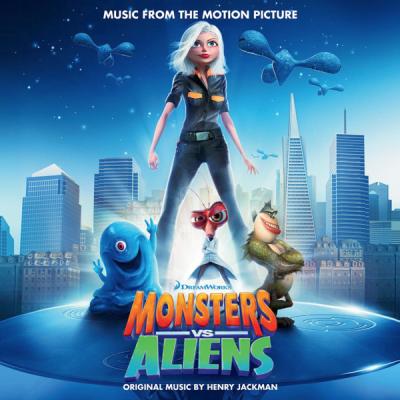
"Monsters Vs Aliens" Soundtrack Lyrics
Cartoon • 2009
Track Listing
Henry Jackman
The Buchanan Brothers
The Exciters
Henry Jackman
Henry Jackman
The B-52's
Henry Jackman
Henry Jackman
Henry Jackman
Henry Jackman
Henry Jackman
Little River Band
Henry Jackman
Henry Jackman
Henry Jackman
Sam The Sham & The Pharaohs
Henry Jackman
Henry Jackman
Henry Jackman
Sheb Wooley
"Monsters vs. Aliens (Music from the Motion Picture)" – Album Guide to Tracks and Key Scenes
Overview
What happens when a B-movie homage gets a blockbuster budget and a score that treats every joke like life and death? Monsters vs. Aliens answers that with brass fanfares, surf-rock guitars and a surprising amount of heart.
The film follows Susan Murphy, a Modesto bride-to-be who is hit by a quantonium meteorite on her wedding day and grows into the 49-foot Ginormica. Locked away with a gelatinous blob (B.O.B.), mad scientist Dr. Cockroach, fish-ape The Missing Link and towering Insectosaurus, she’s drafted by the U.S. military to stop alien overlord Gallaxhar. The soundtrack has to juggle this arc — from small-town romance to intergalactic crisis — without losing the comedy.
Composer Henry Jackman leans into that contrast. The score swings between widescreen orchestral heroism and sly sci-fi pastiche. Old jukebox singles, slick ’80s rock and campy novelty tunes puncture any chance of self-importance. The album mirrors Susan’s journey: it starts grounded in retro Americana, explodes into space-opera bombast, then circles back to something like emotional normality, just bigger and weirder.
Across the film, styles map cleanly to story beats. Retro country-gospel and girl-group pop sketch Susan’s pre-meteor comfort zone. Arena rock and synth-driven cues fuel the first contact panic. Funky organ riffs and novelty hits mark the monsters’ chaos, while Jackman’s symphonic writing underpins genuine transformation — the moment Susan accepts that Ginormica isn’t a curse but her real self. The soundtrack’s trick is that it laughs at B-movie clichés and still lets the emotions land.
How It Was Made
The core of the soundtrack is Jackman’s score, his first major animated feature after years as an additional composer in the Remote Control camp. He writes big: full orchestra, choir, electronics, the works. The cues we hear on album (“A Giant Transformation”, “A Wedding Interrupted”, “The Battle at Golden Gate Bridge”, “The Ginormica Suite” and others) track the film’s structure with classic leitmotif technique — Ginormica’s rising, stepwise theme, Gallaxhar’s harsher chromatic figure, and a goofy march for the military brass.
The production team recorded at AIR Lyndhurst in London, a favorite room for large-scale orchestral film scores. Additional music came from Matthew Margeson, with Gavin Greenaway conducting and a regular Hollywood post-production crew handling editing and mixing. The result is a score that sounds bigger than a mid-2000s animated comedy usually would, matching the film’s IMAX and 3D ambitions.
The official album mixes Jackman’s cues with licensed songs: 1960s girl-group pop (“Tell Him”), 1940s country-gospel (“When You See (Those Flying Saucers)”), classic rock (“Who’s Crying Now”), novelty rock (“Purple People Eater”) and more. Lakeshore Records packaged it as a hybrid: part score sampler, part mixtape of the film’s needle-drops. Some tracks used prominently in the movie — like Journey and Aqua cuts — appear in the film but not on every physical edition, one of those small headaches for completist collectors.
Trailer and promo music came from outside libraries. Production track “Bug Fluid” by Immediate Music powered one of the teasers and later turned up on the DVD menus. It never appears on the commercial album, but it’s part of how audiences first experienced the film’s energy: aggressive brass, manic percussion and that slightly tongue-in-cheek “this is epic” trailer feel.
Tracks & Scenes
Below are key songs and cues, tied to specific scenes and approximate timestamps. Times refer to the feature film, not trailers.
“When You See (Those Flying Saucers)” — The Buchanan Brothers
Where it plays: Around 0:01, during the opening Antarctic observatory sequence. Two bored technicians drift through a quiet night until their instruments suddenly react to a massive object entering Earth’s atmosphere. The vintage gospel-country track rolls over the snowbound establishing shots, its apocalyptic lyrics cheekily foreshadowing the incoming meteor and the alien plot that will follow.
Why it matters: It sets the film’s tone in seconds — old-timey doomsday music against high-tech radar screens. We’re in a parody of 1950s UFO cinema, and the soundtrack says so out loud.
“Tell Him” — The Exciters
Where it plays: About 0:03, in Susan’s wedding-morning montage. She sits under hair dryers, gets her nails done and stares at herself in the mirror, half excited, half anxious. The song continues as she steps out of the salon, meets her emotional father and heads into the church, where her future mother-in-law fusses over her dress.
Why it matters: Brassy girl-group pop frames Susan as a classic romantic heroine whose life is still defined by marriage. The track becomes a contrast point later, when Ginormica’s identity stops revolving around Derek.
“Who’s Crying Now” — Journey
Where it plays: Around 0:22, in a brief cutaway to a young couple parked in the woods. The song plays on their car radio as they cuddle and talk, unaware that the alien robot will soon crash into their quiet night. The mood is easy, nostalgic, almost syrupy — on purpose.
Why it matters: The smooth rock ballad lulls both characters and viewers just long enough for the robot’s arrival to feel like a rude punchline. It’s a fake-out scare straight from slasher films, but scored with soft-rock instead of ominous strings.
“Axel F” — Harold Faltermeyer
Where it plays: Roughly 0:25. On the National Mall, the President walks out alone to greet the towering alien robot. Instead of a formal address, he sits at a synthesizer and bangs out the “Axel F” riff, trying to win the robot over with an improvised retro jam session. The tune is fully diegetic — he’s actually playing it — with comic timing hinging on his clumsy fingers and terrified advisors watching on.
Why it matters: A theme forever linked to ’80s cop comedy drops into a first-contact standoff. It undercuts the threat, sends up presidential bravado and signals that this White House is in way over its head.
“Reminiscing” — Little River Band
Where it plays: Around 0:32. In the monster prison, the team play cards in their sterile underground cell, trying to kill time. The soft yacht-rock groove hums in the background as B.O.B. misreads social cues, Link postures and Dr. Cockroach toys with some dubious experiment. It sounds like an easy-listening radio station leaking into a classified facility.
Why it matters: The track’s title and dreamy mood underline how out of time these “monsters” are — stuck replaying the past while the world moves on without them. It also deepens the joke that Area 51 has the same boring downtime as any office.
“Wooly Bully” — Sam the Sham and The Pharaohs
Where it plays: Around 0:51, at the government base pool party before the Golden Gate mission. Link belly-flops into the pool, B.O.B. tries to flirt with gelatin dessert, and Dr. Cockroach weaponizes the punch into a small explosion. Human guests flee, soldiers panic, and the monsters have the time of their lives amid neon lights and chaos.
Why it matters: The garage-rock organ riff turns the scene into a chaotic dance of bodies and splashes. It sells the monsters as exuberant, dangerous and oddly lovable — they break things, but they know how to throw a party.
“Roses Are Red” — Aqua
Where it plays: About 1:14, aboard Gallaxhar’s ship. Dr. Cockroach breaks into a manic, disco-lit dance routine on a multi-colored circular platform to hack the color-coded security system. The candy-pop Eurodance track blares while he spins, slides and taps each glowing panel with increasingly wild moves.
Why it matters: It turns what could have been a dry hacking sequence into full cartoon absurdity. Hyper-synthetic ’90s pop in the middle of a sterile alien warship perfectly captures the film’s habit of puncturing sci-fi grandiosity with bubblegum.
“Planet Claire” — The B-52’s
Where it plays: Around 1:25, over the first stretch of end credits once the story resolves. After Ginormica and the monsters have saved Earth and embraced their outsider status, the surf-spy groove and deadpan vocals play against stylized credit graphics.
Why it matters: The band’s retro-futurist aesthetic matches the movie’s entire project: riffing on 1950s alien paranoia with a knowing, campy wink. Ending here feels like the film tipping its hat to its musical ancestors.
“Purple People Eater” — Sheb Wooley
Where it plays: Around 1:30, later in the credits. The novelty hit about a “one-eyed, one-horned flying purple people eater” chimes in as the character animation wraps up and the credits roll through the technical crew.
Why it matters: It’s pure monster-movie nostalgia and a final joke: in a film already full of gelatin blobs and insect kaiju, the classic novelty monster shows up as a kind of spiritual cousin over the credits.
Score highlight: “A Giant Transformation” — Henry Jackman
Where it plays: In the film, this cue underpins Susan’s meteor impact and growth into Ginormica. The music starts almost tentatively as she’s struck, then swells into a brassy, rhythmically driving statement as her body expands, the church collapses and chaos erupts around Modesto.
Why it matters: It’s the cue that defines the film’s musical language: a straight-faced superhero transformation sound for what is, visually, a slapstick disaster. That tension gives the movie much of its charm.
Notes & Trivia
- The opening track choice, “When You See (Those Flying Saucers)”, comes from 1947, decades earlier than the film’s setting, deepening the retro UFO-panic vibe.
- “Reminiscing” quietly links this film with other Paul Rudd/Seth Rogen projects — it also appears in Knocked Up and later in The Other Guys.
- The President’s “Axel F” gag is one of the rare times a major studio uses the original Faltermeyer theme as literal diegetic performance by a character.
- “Roses Are Red” by Aqua was so obscure in this context that soundtrack Q&A sites spent years pinning down the title and artist.
- Trailer music “Bug Fluid” became familiar enough that some viewers assumed it was part of Jackman’s score, despite being separate library music.
Music–Story Links
The film’s first ten minutes use songs almost like chapter headings. “When You See (Those Flying Saucers)” labels the incoming threat as a pulp-era event, while “Tell Him” marks Susan’s life as still locked into romantic expectation. The meteor impact that follows literally smashes those sound worlds together — old-time apocalypse meets modern wedding pop — and Jackman’s score steps in as the new, unified voice of Ginormica.
Journey’s “Who’s Crying Now” plays just before the giant robot lands, a sly nod to Susan’s later emotional break with Derek. At that early point, the film uses the song as generic romantic wallpaper for a random couple; afterward, Susan’s arc answers its question. When she walks away from Derek near the end, the score, not a pop song, has the last word, signaling that this is her story now.
Inside the monster facility, “Reminiscing” sits under scenes of boredom and banter, while Jackman’s motifs introduce each monster with mock-heroic flair. The pop track tells us the world has shelved these creatures in the past; the orchestral writing insists they still matter. That tension pays off in the Golden Gate Bridge sequence, where the monsters get a full action cue worthy of straight superheroes.
“Roses Are Red” is almost weaponized against Gallaxhar’s ship. Rather than a tense infiltration score, Dr. Cockroach literally dances his way through the security system to candy-pop. It turns the scientist into a trickster figure — brains and rhythm instead of brute force — and keeps the alien base from ever feeling too grim.
Finally, “Planet Claire” and “Purple People Eater” bookend the credits with music from bands and eras that built the very idea of kitschy monster and alien stories. The film closes by folding its own characters back into that larger pop-culture lineage.
Reception & Quotes
Critically, the soundtrack drew steady, if not rapturous, praise. Reviewers highlighted the energy and scale of Jackman’s score, noting how it combined classic sci-fi brass writing with a lighter, more playful rhythmic drive than many contemporaries. The mixture of score and songs was often described as eclectic but coherent.
“As lush and lively as one might expect, using orchestra, choir and electronics to give the fantastical story a human core.” — movie music review site on Jackman’s score
“Fourteen tracks of original music plus six wildly different songs; somehow it holds together and stays fun even away from the film.” — one album review summarizing the listening experience
Commercially, the film was a solid box-office success, and the album circulated widely on CD and digital platforms. Later digital releases standardized a 20-track running order, while some early listings reported a longer total running time, suggesting slightly different mastering or regional variants. For many younger listeners, this album was an introduction to older catalog tracks like “Reminiscing” and “When You See (Those Flying Saucers)”.
Among fans, specific cues built minor cult followings. “The Ginormica Suite” and “The Battle at Golden Gate Bridge” are often singled out for their mix of genuine heroism and tongue-in-cheek B-movie menace, while the President’s “Axel F” moment is one of the most replayed scenes in clip compilations.
Interesting Facts
- The film was DreamWorks Animation’s first feature produced directly in stereoscopic 3D, and the score was mixed with that multi-format rollout in mind.
- “When You See (Those Flying Saucers)” predates rock ’n’ roll; its use here revived interest in a long-out-of-print single from a country-gospel duo.
- Library cue “Bug Fluid” doesn’t appear in the film itself, only in marketing and on the DVD menu, but many viewers still associate it strongly with the franchise.
- “Reminiscing” turns up in several other projects featuring Paul Rudd or Seth Rogen, making its appearance here a quiet in-joke for soundtrack nerds.
- Some editions credit the album artist simply as “Various Artists”, while others foreground Jackman as the primary name, even though half a dozen outside songs appear.
- Later streaming versions list 20 tracks and a sub-50-minute runtime, while physical CD references give a total nearer an hour, depending on territory.
- The B-52’s connection is thematic as well as musical: their playful, retro-sci-fi image mirrors the film’s marketing and poster art.
- Novelty song “Purple People Eater” makes this perhaps the only major studio feature to close with a double bill of B-52’s surf-psych and 1950s monster pop.
- The game adaptation of Monsters vs. Aliens used a separate score by Jim Dooley, so Jackman’s themes don’t dominate every spin-off in the franchise.
- Jackman would go on to score other effects-heavy projects like X-Men: First Class and Big Hero 6, refining some of the orchestral language heard here.
Technical Info
- Title: Monsters vs. Aliens (Music from the Motion Picture)
- Year: 2009
- Type: Film soundtrack — hybrid of original score and licensed songs
- Primary composer: Henry Jackman
- Additional music: Matthew Margeson (score contributions)
- Recorded at: AIR Lyndhurst Studios, London (orchestral score)
- Label: Lakeshore Records (catalog LKS 34069 on CD editions)
- Core contents: Selection of Jackman’s cues (including “A Giant Transformation”, “A Wedding Interrupted”, “Meet the Monsters”, “The Battle at Golden Gate Bridge”, “The Ginormica Suite”) plus period songs such as “When You See (Those Flying Saucers)” and “Tell Him”
- Commercial songs in the film (selection): “When You See (Those Flying Saucers)”, “Tell Him”, “Who’s Crying Now”, “Axel F”, “Reminiscing”, “Wooly Bully”, “Roses Are Red”, “Planet Claire”, “Purple People Eater”
- Length: commonly listed as ~47–66 minutes depending on edition and track indexing
- Release context: Issued in March 2009 alongside the film’s theatrical run; later reissued on digital/streaming platforms
- Availability: Widely available on major digital services; original CD pressings circulate on the collector market
- Notable placements: President’s “Axel F” keyboard scene; Susan’s transformation cue; Golden Gate Bridge battle; Dr. Cockroach’s “Roses Are Red” color-pad dance; end-credits pairing of “Planet Claire” and “Purple People Eater”
Questions & Answers
- Who composed the main score for Monsters vs. Aliens?
- Henry Jackman wrote the original score, with additional music by Matthew Margeson and a large orchestral and choral ensemble recorded in London.
- What song plays when the President jams on the keyboard in front of the alien robot?
- He bangs out the famous synth riff from Harold Faltermeyer’s “Axel F”, performed diegetically on a portable keyboard as a bizarre peace offering.
- Which tracks open the film before Susan’s transformation?
- The movie starts with “When You See (Those Flying Saucers)” over the Antarctic observatory, then shifts to “Tell Him” during Susan’s wedding-morning preparations.
- What music do we hear over the end credits?
- The first stretch of end credits features “Planet Claire” by The B-52’s, followed by novelty hit “Purple People Eater” as the credits continue.
- Is the complete film song list available on the official album?
- Most key songs and several major score cues appear on the Lakeshore Records release, but some versions differ slightly and not every film needle-drop is included.
Canonical Entities & Relations
| Subject | Relation | Object |
|---|---|---|
| Monsters vs. Aliens (2009 film) | produced by | DreamWorks Animation |
| Monsters vs. Aliens (2009 film) | directed by | Conrad Vernon & Rob Letterman |
| Monsters vs. Aliens (2009 film) | music by | Henry Jackman |
| Monsters vs. Aliens (Music from the Motion Picture) | is soundtrack of | Monsters vs. Aliens (2009 film) |
| Monsters vs. Aliens (Music from the Motion Picture) | released by | Lakeshore Records |
| Henry Jackman | composed score for | Monsters vs. Aliens (2009 film) |
| The Buchanan Brothers | performed song | “When You See (Those Flying Saucers)” |
| The Exciters | performed song | “Tell Him” |
| Little River Band | performed song | “Reminiscing” |
| The B-52’s | performed song | “Planet Claire” |
| Sheb Wooley | performed song | “Purple People Eater” |
| Immediate Music | produced trailer cue | “Bug Fluid” for Monsters vs. Aliens teaser |
| Monsters vs. Aliens (2009 film) | distributed by | Paramount Pictures |
| Monsters vs. Aliens (2009 film) | set partly in | Modesto, California |
Sources: IMDb soundtrack listings; official album credits (Lakeshore Records); AllMusic album overview; Apple Music album metadata; soundtrack guide sites with scene descriptions; film transcripts and franchise wikis; published score reviews.
November, 16th 2025
A-Z Lyrics Universe
Cynthia Erivo Popular
Ariana Grande Horsepower
Post Malone Ain't No Love in Oklahoma
Luke Combs Good Riddance (Time of Your Life)
Green Day Bye Bye Bye
*NSYNC You're the One That I Wan
John Travolta & Olivia Newton-John I Always Wanted a Brother
Braelyn Rankins, Theo Somolu, Kelvin Harrison Jr. and Aaron Pierre The Power of Love
Frankie Goes to Hollywood Beyond
Auli’i Cravalho feat. Rachel House MORE ›