Soundtracks:  A B C D E F G H I J K L M N O P Q R S T U V W X Y Z #


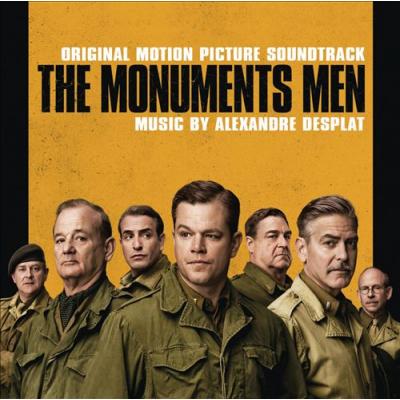
Monuments Men, The Album Cover

"Monuments Men, The" Soundtrack Lyrics

Movie • 2014

Track Listing


"The Monuments Men (Original Motion Picture Soundtrack)" – Album Guide to Tracks and Key Scenes

The Monuments Men trailer frame with Clooney, Damon and the squad walking through a war-torn European square
The Monuments Men movie soundtrack – wartime art-rescue mood, 2014

Overview

Can a war movie about middle-aged art historians really carry a whistled march and a Christmas standard without collapsing into schmaltz? The Monuments Men soundtrack says yes — by leaning fully into old-fashioned war-movie scoring and then slipping in one of the most quietly devastating needle-drops in recent World War II cinema.

The film follows Frank Stokes (George Clooney) as he assembles a team of curators, architects and historians — the “Monuments Men” — to rescue European art from the Nazis. The plot hops from FDR’s office to basic training, battlefield hospitals, occupied Paris and finally the salt mines of Germany and Austria. Alexandre Desplat’s score acts as the glue: a jaunty British-style march for the team, noble brass for the mission, and suspense figures for Nazi encounters and mine infiltrations. On album, those ideas play as a self-contained World War II adventure suite; in the film they keep a loose, episodic story feeling coherent.

The record ends with something different: Nora Sagal’s intimate version of “Have Yourself a Merry Little Christmas”, first heard when Bill Murray’s character receives a recording from home in the middle of the Battle of the Bulge. It’s a small, almost domestic moment, but it reframes the whole film — suddenly this isn’t just about statues and paintings, it’s about the lives and ordinary rituals those objects outlast.

Desplat writes in clear genre phases. The main march — all side-drum, trumpets and whistling — covers the recruitment, training and camaraderie beats, very much in the lineage of The Bridge on the River Kwai and The Great Escape. For the art itself he uses almost liturgical textures (low woodwinds, strings and chorale writing) in cues like “Ghent Altarpiece” and “Castle Art Hoard”. When the story turns darker — the sniper sequence, the Nero Decree, the mine infiltrations — the harmony shifts, the rhythms tighten and the orchestration grows more jagged. Period source songs (“Night and Day”, “You Always Hurt the One You Love”, “Have Yourself a Merry Little Christmas”) sit on top of this orchestral bed as little pockets of civilian life peeking through the war.

How It Was Made

George Clooney brought Alexandre Desplat back after The Ides of March and asked him for something consciously retro: a score that would feel at home next to 1950s–60s World War II pictures. According to Desplat, the project immediately suggested the big symphonic tradition of Maurice Jarre and Elmer Bernstein — robust orchestral writing, memorable marches, and a balance of sentiment and grit rather than modern gritty minimalism.

Desplat recorded the score over just two days at Abbey Road Studios in London with the London Symphony Orchestra, reportedly around a 100-plus piece ensemble. The sessions covered 25 cues in roughly 16 hours of studio time, with Desplat conducting and long-time collaborators handling orchestration and engineering. That compressed schedule partly explains the score’s unified sound: you hear the same players, room and setup throughout, which makes the album feel like a single continuous wartime suite rather than a patchwork.

He built several interlocking themes: a mission fanfare (solo trumpet and side drum) used whenever Stokes’s big idea is foregrounded, a jaunty “Monuments Men” march that can turn comic or heroic depending on orchestration, a solemn motif for sacred art, and darker material for Nazi officers and the mines. Cues like “The Roosevelt Mission”, “Opening Titles” and “Basic Training” introduce these elements one by one before Desplat starts recombining them in more complex ways in “Into Bruges”, “Siegen Mine”, “Heilbronn Mine” and the nine-minute “Finale”.

The source songs were licensed separately. “Night and Day” (Cole Porter, performed by Patrick Péronne) and “You Always Hurt the One You Love” (The Mills Brothers) appear as period diegetic music — you hear them as the characters hear them, usually on gramophones or radios. “Have Yourself a Merry Little Christmas” sits in both worlds: it’s a recording within the story, but the mix gradually pushes it into the emotional foreground until it functions like score.

The official album, The Monuments Men (Original Motion Picture Soundtrack), came out through Sony Classical in early February 2014 with 25 tracks and a running time of about 60 minutes. Abbey Road and London Symphony credits are prominent in the packaging; Desplat and Dominique Lemonnier are listed as producers, which fits his usual hands-on approach.

The Monuments Men trailer still showing the art-rescue squad marching through wartime Europe
The Monuments Men – assembling the art rescue squad, as scored by Alexandre Desplat

Tracks & Scenes

The film doesn’t have a huge list of pop songs, but the few it uses land hard. Most of the musical storytelling comes from Desplat’s cues. Below, some of the key moments and how the music works on screen. Timing is described in story terms rather than exact timecodes — the emphasis is on function, not stopwatch detail.

“The Roosevelt Mission” — Alexandre Desplat
Where it plays: Early in the film, as Frank Stokes presents his proposal to President Roosevelt and lays out the stakes: Europe’s art versus the Nazi looting machine. The cue opens with side-drum and a noble solo trumpet as Stokes walks the President through slides of destroyed churches and statues. As FDR agrees to the plan, strings and brass swell into a compact, mission-statement flourish over shots of cathedrals and paintings at risk.
Why it matters: This is the “thesis” cue. It frames the entire operation as a legitimate military mission, not a vanity project, and the music sells the idea that saving art is strategically and morally important.

“Opening Titles” — Alexandre Desplat
Where it plays: Immediately after the mission is authorised, over the title card and a sequence of Stokes recruiting his team across the United States and Britain. We cut between lecture halls, museums and workshops as each future Monuments Man gets tapped for service. The cue’s jaunty march, with its whistling and woodwind figures, syncs with these introductions and the on-screen credits.
Why it matters: The music instantly sets the tone: this is a lighter, character-driven World War II story closer to The Great Escape than to Saving Private Ryan. It also gives the squad a shared identity before they even meet.

“Basic Training” — Alexandre Desplat
Where it plays: During the comic boot-camp montage where the older, out-of-shape art experts struggle through basic drills: jogging badly, firing rifles, mangling army slang. The cue uses a slightly clumsy variation on the mission motif, with tuba, piccolo and percussion underlining every stumble and missed step.
Why it matters: It humanises the team. They look ridiculous next to regular soldiers, and the music leans into that, but you also hear the same noble theme trying to break through — a reminder that their purpose is serious even when they’re not very soldierly.

“Normandy” — Alexandre Desplat
Where it plays: As the team arrives in France after D-Day. We see war-scarred beaches, rows of white crosses and the reality of the casualties that preceded their arrival. The cue slows the main ideas down into a more reflective version: strings carry the line, brass stays restrained, and the snare becomes more of a heartbeat than a march.
Why it matters: It’s the point where the film quietly asks if this mission is worth men’s lives. The score doesn’t answer; it just holds that question for later.

“Ghent Altarpiece” — Alexandre Desplat
Where it plays: The team studies photographs and documents about the Ghent Altarpiece and the Madonna of Bruges, then later stands in front of empty spaces where those works used to hang. Desplat introduces a quasi-religious, chorale-like motif for woodwinds and strings that recurs whenever these specific masterpieces are discussed or glimpsed.
Why it matters: The cue shifts the emotional focus from the men to the art itself. It treats the altarpiece as a character with its own sacred aura, not just an expensive object.

“Sniper” — Alexandre Desplat
Where it plays: During the tense church-roof sequence when one of the team is pinned down by a young German sniper. We see stone staircases, shattered stained glass and the cat-and-mouse between soldier and sniper. The cue pushes forward with off-kilter piano figures, muted brass hits and tapping percussion while the camera moves through cramped, shadowy spaces.
Why it matters: It’s one of the few outright suspense/action set-pieces. The music keeps the film from tipping into full-on war-movie brutality; it stays tense but still recognisably within the lighter Monuments Men sound world.

“Into Bruges” — Alexandre Desplat
Where it plays: As the team sneaks through Bruges streets under curfew, trying to protect the Madonna statue from being shipped out. The cue chugs along on bass clarinet and strings while the men move in and out of alleys and church doors, occasionally pausing on details like sandbagged sculptures and stacked crates.
Why it matters: It’s sneaking music, but still thematic. The mission motif appears in minor mode, reminding you that this is the same idealistic project as in “The Roosevelt Mission”, just now under real threat.

“Claire & Granger” — Alexandre Desplat
Where it plays: Over scenes between James Granger (Matt Damon) and Claire Simone (Cate Blanchett) in Paris — evening walks, awkward dinners in her flat, the moment she finally chooses to trust him and hands over her records of Nazi looting. The cue starts as a tender waltz for strings and harp, then later develops into a more urgent statement when their alliance finally clicks.
Why it matters: It’s the emotional centre for the film’s civilian side. The music softens the tone around Claire without turning her into a stock love interest; instead it emphasises mutual respect and the vulnerability involved in sharing evidence.

“Siegen Mine” / “Heilbronn Mine” — Alexandre Desplat
Where it plays: Across several sequences where the Monuments Men explore German mines packed with stolen art and Nazi gold. Headlamps sweep over statues, paintings and piles of frames; we see lists, swastika crates and the sheer scale of the theft. The cues use low strings, pizzicato figures and gradually swelling brass to chart the mix of danger and awe as the team ventures deeper underground.
Why it matters: These tracks are where the score embraces full adventure scoring. You feel the thrill of discovery, but the slightly uneasy harmony keeps reminding you that this treasure sits on top of enormous human loss.

“Finale” — Alexandre Desplat
Where it plays: Near the end of the film, during the Altaussee salt-mine sequence as the team races to save the Ghent Altarpiece, the Madonna of Bruges and other works before the mine can be destroyed or seized by the Soviets. The cue runs through action writing, lyrical recollections of earlier themes and a final, almost ceremonial recap of the mission fanfare as the artworks are brought out into daylight.
Why it matters: It’s the musical summing-up. Almost every major theme gets a nod: the mission brass, the Ghent motif, the Monuments Men march, the Claire & Granger waltz. You hear the whole journey compressed into nine minutes.

“Have Yourself a Merry Little Christmas” — Nora Sagal (feat. Alexandre Desplat & London Symphony Orchestra)
Where it plays: In one of the film’s quietest scenes, set during the Battle of the Bulge. Richard Campbell (Bill Murray) receives a vinyl recording from home with his granddaughter singing “Have Yourself a Merry Little Christmas”. He takes it to the camp PA hut so the whole unit can hear, then steps into the makeshift shower block as the song plays over the loudspeakers. The camera stays on his face and the other soldiers’ reactions while the young voice sings Sinatra-era lyrics about friends gathering and troubles being miles away, even as snow falls and the war grinds on outside.
Why it matters: This is the emotional outlier and the track most viewers remember. The song grounds the film in ordinary family life and quietly undercuts the macho adventure tone. As several commentators have noted, the use of the later, revised lyrics introduces a little historical inaccuracy but amplifies the bittersweet mood.

“Night and Day” — Patrick Péronne
Where it plays: Heard in the film as diegetic background music, performed in a vintage piano style that fits the 1940s setting. It surfaces during one of the quieter interludes away from the front — an officers’ club / mess-hall type environment — briefly suggesting the romantic, pre-war world all these men are trying to defend.
Why it matters: As a Cole Porter standard, it brings in the wider tradition of American popular song that the Monuments Men implicitly see as part of the culture worth saving, even if the scene itself is small.

“You Always Hurt the One You Love” — The Mills Brothers
Where it plays: Used briefly as period source music from a record player or radio, contrasting the easy crooning style with the fatigue and damage around the characters. Exact placement is short and low-key, but it stands out because the lyric cuts against the camaraderie on screen.
Why it matters: The song’s title and mood echo the film’s undercurrent that even “good” armies and liberators can damage what they intend to protect — a subtle touch in a movie otherwise focused on heroic recovery.

Composite of Monuments Men scenes including a snow-covered camp and the salt mine art rescue
Key musical moments – from the Christmas camp scene to the Altaussee mine rescue

Notes & Trivia

  • Alexandre Desplat has a cameo as Emile, a French resistance operative who helps Matt Damon’s character — one of the rare cases of a composer scoring his own acting scene.
  • The soundtrack’s final track, “Have Yourself a Merry Little Christmas”, is technically a source song but is packaged on the album alongside the score rather than on a separate “songs from” release.
  • The lyrics used in the Christmas scene match Sinatra’s 1950s rewrite rather than the darker 1944 original, which several nitpickers flagged as a historical error.
  • Desplat recorded the entire score at Abbey Road with the London Symphony Orchestra in roughly 16 hours of studio time, which is brisk even by Hollywood standards.
  • The main Monuments Men march deliberately evokes Malcolm Arnold’s River Kwai and Ron Goodwin-style war marches, right down to the whistling in the end credits.
  • The official album includes all 25 cues, but only “Have Yourself a Merry Little Christmas” represents the film’s source-music side; “Night and Day” and “You Always Hurt the One You Love” are absent.
  • Because the film is based on the non-fiction book by Robert M. Edsel and Bret Witter, several cue titles (“Ghent Altarpiece”, “Altaussee”, “Castle Art Hoard”) map directly onto documented historical episodes.

Music–Story Links

The score constantly ties specific musical ideas to story beats. The mission fanfare — first heard in “The Roosevelt Mission” — comes back whenever Stokes has to justify the project to sceptical commanders, linking a motif to the theme that art is worth risk. Whenever the film cuts to empty museum walls or crates of stolen paintings, that fanfare appears in slower, more fragile versions, as if asking whether the cause still holds.

The Monuments Men march functions almost like a character theme. In “Opening Titles” and “Basic Training” it plays lightly, with whistling and comic instrumentation, underscoring how out of their depth the team is. Later, in cues like “Gold!”, “Heilbronn Mine” and “Finale”, the same melody appears with fuller brass and weightier percussion as the characters grow into their roles. You can track the squad’s confidence just by listening to how that tune is orchestrated.

Desplat also uses distinct musical colours for the art. “Ghent Altarpiece” and “Castle Art Hoard” share that reverent, almost sacred aura; the harmony relaxes, the tempo slows and the orchestration opens up, as if the camera and the score are both taking a breath. Whenever the Nazis are involved — Viktor Stahl, the Nero Decree, the booby-trapped mines — you hear sharper string ostinatos, muted horns and colder harmonies. The clash between those sound worlds mirrors the film’s central conflict: preservation versus destruction.

The Christmas song scene re-centres the story. Up to that point, the music mostly deals in marches and suspense. Dropping in “Have Yourself a Merry Little Christmas” reframes the mission as something that matters to ordinary families back home, not just curators and generals. The fact that Desplat lets the track play almost unbroken — no underscoring, no cutting to another cue — makes it feel like a small, sacred interruption in the war narrative.

Reception & Quotes

The film itself received mixed reviews; the score, much less so. Critics tended to agree that Desplat delivered exactly what Clooney wanted: an unapologetically old-school World War II score with a strong main theme and clear emotional signposting. Some listeners found the jaunty march a little too cheerful given the subject matter, but even they usually praised the craftsmanship and thematic clarity.

Soundtrack reviewers repeatedly pointed out how densely thematic the album is, with the mission, Monuments Men, Nazi and art motifs being developed across cues rather than dumped and forgotten. The nine-minute “Finale” and the “End Credits” whistling version of the main theme were singled out as highlight tracks for stand-alone listening. The Christmas song at the end divided opinion: some loved the warm, nostalgic close; others felt it belonged more to the film than to the album’s musical arc.

Desplat’s merry main theme may divide listeners, but as a throwback to classic WWII scores it’s both affectionate and smartly constructed.
— soundtrack review commentary
The music is intentionally vintage: a lighthearted marching-drum-and-woodwind score that recalls an earlier era of war movies.
— contemporary film criticism
As an album, it’s a rich, nostalgic suite — from brassy mission statements to reverent art cues and a cosy Christmas sign-off.
— album review summarising the score

On the commercial side, the album has stayed in quiet circulation: digital on major platforms, a CD issue via Sony Classical, and occasional appearances of cues like “Claire & Granger” and “The Roosevelt Mission” on “best of Desplat” and “film scores for work” playlists. It didn’t become a hit in the way some of his later work did, but among soundtrack collectors it’s generally regarded as a solid, very replayable entry in his 2014 run alongside The Grand Budapest Hotel and Godzilla.

Title card frame of The Monuments Men used in marketing materials for the soundtrack
Title branding that also appears on The Monuments Men soundtrack artwork

Interesting Facts

  • The album clocks in at about 60:32 — comparatively generous for a single-disc film score from a major studio in 2014.
  • “Have Yourself a Merry Little Christmas” appears as the final track on the album but plays earlier in the film, so the record effectively gives you an epilogue that’s already happened on screen.
  • Physical releases use the Sony Classical catalogue number 88843-022512 for the CD issue.
  • The official track order matches the rough narrative flow, but not every cue is strictly chronological — “End Credits” and the Christmas track function more as a coda than a literal final scene.
  • Desplat’s recurring “sneaking” figure (pizzicato strings plus soft percussion) in “Siegen Mine” and “Heilbronn Mine” became a small in-joke among fans who spotted echoes of it in his later thrillers.
  • All three featured songs — “Have Yourself a Merry Little Christmas”, “Night and Day” and “You Always Hurt the One You Love” — are mid-20th-century standards, which keeps the source-music palette firmly within the film’s period even when the exact lyric version is anachronistic.
  • The score was one of several Desplat works cited when he won Film Composer of the Year at the World Soundtrack Awards the same year.
  • A handful of later compilation albums credit “Night and Day (From the Movie ‘The Monuments Men’)” and “You Always Hurt the One You Love (From ‘The Monuments Men’)” as separate tracks, effectively spinning the film’s source cues into their own mini-singles.
  • The French marketing sometimes pushed the film under the title Monuments Men – Ungewöhnliche Helden / local equivalents, but the English-language album title remained consistent worldwide.

Technical Info

  • Title: The Monuments Men (Original Motion Picture Soundtrack)
  • Year: 2014
  • Type: Feature film soundtrack / orchestral score album
  • Film: The Monuments Men (2014), directed by George Clooney, based on the book by Robert M. Edsel and Bret Witter
  • Composer: Alexandre Desplat
  • Performers: London Symphony Orchestra (various cues), conducted by Alexandre Desplat
  • Recording dates: October 22–23, 2013
  • Recording studio: Abbey Road Studios, London
  • Label: Sony Classical (Columbia Pictures Industries Inc. / 20th Century Fox under exclusive license)
  • Album length: ~60:32, 25 tracks
  • Key cues: “The Roosevelt Mission”, “Opening Titles”, “Ghent Altarpiece”, “Basic Training”, “Sniper”, “Into Bruges”, “Claire & Granger”, “Siegen Mine”, “Heilbronn Mine”, “Castle Art Hoard”, “Finale”, “End Credits”
  • Songs used in film: “Have Yourself a Merry Little Christmas” (Nora Sagal), “Night and Day” (Patrick Péronne), “You Always Hurt the One You Love” (The Mills Brothers)
  • Album-only song credit: “Have Yourself a Merry Little Christmas (feat. Nora Sagal)” as track 25
  • Release formats: Digital (streaming and download) and CD
  • Notable awards context: Desplat’s 2014 output including The Monuments Men contributed to his Film Composer of the Year win at the World Soundtrack Awards.

Questions & Answers

Is The Monuments Men soundtrack mostly songs or mostly score?
It’s almost entirely orchestral score by Alexandre Desplat. Only one vocal track, “Have Yourself a Merry Little Christmas” with Nora Sagal, appears on the main album.
Where exactly does “Have Yourself a Merry Little Christmas” play in the film?
During a Battle of the Bulge sequence, when Bill Murray’s character receives a record from home with his granddaughter singing; he plays it over the camp loudspeakers while he showers.
Why does the Christmas song’s lyric get called a “goof” by some viewers?
Because the film is set in 1944 but uses the softer, revised lyrics popularised later by Frank Sinatra, which didn’t exist yet at the time of the Battle of the Bulge.
How does Desplat’s score differ from more modern World War II scores?
Instead of gritty sound design and minimal motifs, he goes for full themes, classic marches and a brighter orchestral palette that consciously echoes 1950s and 1960s war movies.
Is the album a good standalone listen if you haven’t seen the film?
Yes, if you enjoy thematic orchestral scores. The clear march, recurring motifs and long “Finale” make it easy to follow an emotional arc even without the visuals.

Canonical Entities & Relations

Alexandre Desplat composed and conducted the score for The Monuments Men (Original Motion Picture Soundtrack)
London Symphony Orchestra performed the orchestral score for The Monuments Men (Original Motion Picture Soundtrack)
Sony Classical released The Monuments Men (Original Motion Picture Soundtrack) on CD and digital platforms
George Clooney directed and starred in The Monuments Men (2014 film)
Grant Heslov co-wrote and produced The Monuments Men (2014 film)
Robert M. Edsel and Bret Witter wrote the book The Monuments Men: Allied Heroes, Nazi Thieves and the Greatest Treasure Hunt in History
The Monuments Men (2014 film) is based on The Monuments Men: Allied Heroes, Nazi Thieves and the Greatest Treasure Hunt in History
The Monuments Men (Original Motion Picture Soundtrack) is the soundtrack album for The Monuments Men (2014 film)
Nora Sagal performed “Have Yourself a Merry Little Christmas” on The Monuments Men soundtrack
Patrick Péronne performed “Night and Day” used in The Monuments Men film
The Mills Brothers performed “You Always Hurt the One You Love” used in The Monuments Men film
Cole Porter wrote “Night and Day” featured in The Monuments Men
Hugh Martin and Ralph Blane wrote “Have Yourself a Merry Little Christmas” featured in The Monuments Men
Columbia Pictures & Fox 2000 co-produced The Monuments Men (2014 film)
Studio Babelsberg co-produced and hosted production for The Monuments Men (2014 film)

Sources: Wikipedia, IMDb, MusicBrainz, Apple Music, Spotify, Movie Music UK, Music Behind the Screen, Maintitles, MovieMusic.com, Soundtrakd, eCartelera, Jerry Garrett blog, Holiday Film Reviews, MovieMistakes, Variety and other contemporary reviews and label notes.

November, 16th 2025

'The Monuments Men' is a 2014 war film directed by George Clooney, and written and produced by Clooney and Grant Heslov: More info on Wikipedia and IMDb
A-Z Lyrics Universe

Lyrics / song texts are property and copyright of their owners and provided for educational purposes only.