Soundtracks:  A B C D E F G H I J K L M N O P Q R S T U V W X Y Z #


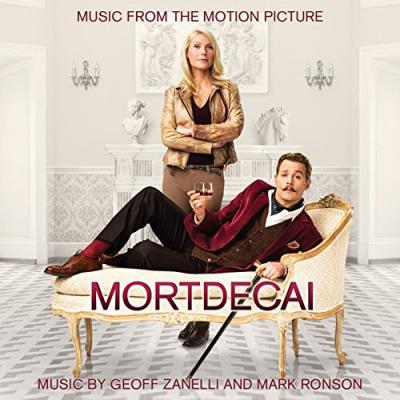
Mortdecai Album Cover

"Mortdecai" Soundtrack Lyrics

Movie • 2015

Track Listing


"Mortdecai (Original Motion Picture Soundtrack)" – Album Guide to Tracks and Key Scenes

Mortdecai official trailer still with Johnny Depp as Charlie Mortdecai
Mortdecai – theatrical trailer still used as visual key art for the soundtrack, 2015

Overview

What happens when a 2010s Johnny Depp caper decides it wants to sound like a lost 1960s spy movie? The answer is the Mortdecai soundtrack: a glossy, brassy, slightly ridiculous score that takes the film’s chaotic art-heist plot more seriously than the script ever does.

The 2015 film follows aristocratic art dealer and conman Charlie Mortdecai as he chases a stolen Goya painting rumoured to hide the key to Nazi gold. Around him orbit MI5 suits, Russian gangsters, LA billionaires and his far more competent manservant Jock. The music has to juggle all that — and it does so by leaning hard into retro caper language: spy horns, cheeky organs, surfy guitars and strutting bass lines.

Mark Ronson and Geoff Zanelli share composing duties, stitching together an almost nonstop tapestry of cues that underline Mortdecai’s self-image as a suave gentleman rogue, even while the visuals show us a fussy coward with a problematic moustache. The score pushes the film toward stylish farce, trying to frame every pratfall as part of a swinging, bespoke-suited universe rather than just another broad gag.

Where the narrative bounces between Hong Kong, London and Los Angeles, the music keeps a clear trajectory: arrival, adaptation, rebellion, collapse. The early cues play things reasonably straight, selling the danger under the comedy. Mid-film tracks get looser and more cartoonish as Mortdecai gets in over his head. By the end credits, pop songs and big, polished arrangements are effectively dancing on the grave of his dignity.

In genre terms, the album pivots between 60s-style spy jazz, light funk, lounge-pop and straight orchestral score. Brass-and-organ grooves signal Mortdecai’s bluster; tremolo guitars and walking bass lines stand in for old-school espionage cool; faux-classical touches underline the art-world setting; and two vocal numbers (“Johanna” and “Heart’s a Liar”) push things into retro pop-soul territory. The blend is intentionally anachronistic — the music sounds like the film wants to be, not quite the film it actually is.

How It Was Made

Composer Geoff Zanelli and producer–songwriter Mark Ronson came to Mortdecai with different toolkits. Zanelli brought traditional film-scoring experience; Ronson brought DJ culture, British guitar pop and a knack for retro pastiche. Together, they were hired to give David Koepp’s film a musical identity big enough to compete with Johnny Depp’s moustache.

According to La-La Land Records, which issued the physical album, the pair were tasked with crafting a “beautiful musical tapestry” for this broad art-heist comedy — a polite way of saying the music had to hold together a very tonally unstable movie. They split duties but kept their names on most tracks, so cues slide easily from orchestral writing into rhythm-section riffs without feeling like needle-drops from another project.

Two songs sit at the centre of the plan: “Johanna” (sung by Miles Kane) and “Heart’s a Liar” (sung by Rose Elinor Dougall). As NME reported at the time, Ronson pulled in Kane and Dougall specifically to front these 60s-flavoured pop pieces, which could live both in the film and as stand-alone tracks. They were written with hooks first, then woven into the score architecture so that their harmonic and rhythmic ideas echo through the instrumental cues.

Recording took place at high-end facilities (Abbey Road is credited on the album packaging), with a full band, brass and strings layered over the core rhythm tracks. The brass is tight and punchy, often mixed almost like a pop record rather than a traditional score. David Koepp himself wrote the liner notes for the album release, which underlines how much the production saw the music as a selling point — even once it became obvious the film itself might underperform.

Behind the scenes, the guiding concept was simple: treat Mortdecai like a debonair 1960s sleuth and score him accordingly, even when the scene on screen is mostly Depp falling over furniture. You can hear that philosophy especially in cues like “Spinoza”, “Open Your Balls” and “The Heist”, where the arrangement stays slick and controlled while the visuals are chaotic.

Mortdecai trailer frame highlighting the caper-comedy tone
The trailer leans on the same brassy, retro energy that defines the Mortdecai score.

Tracks & Scenes

Public cue sheets and chronological score guides are a bit scattered for Mortdecai, but they broadly agree on how the main cues line up with the story. Below are the key pieces and how they sit against the film; where exact timestamps are known, they are noted, and where they are inferred from cue order and plot, that is flagged.

“Hong Kong” — Geoff Zanelli & Mark Ronson
Where it plays: Chronological cue lists place this track under the cold open in Hong Kong, as Mortdecai and Jock try (and mostly fail) to negotiate with gangster Fang before bolting through the neon-lit streets. The music hits the ground at a sprint: big brass stabs, skittering percussion and sly organ figures wrapping the brawl in exaggerated spy-movie glamour.
Why it matters: It sets the template for the entire score — Mortdecai hears his life as a suave caper, even when everything on-screen is falling apart.

“Spinoza” — Geoff Zanelli & Mark Ronson
Where it plays: Placed mid-album and titled after the art smuggler, this cue aligns with Mortdecai’s visit to Spinoza’s world, then the subsequent shootout when Emil Strago crashes the party. The cue reportedly stretches across the barbed conversation and into the gunfire, letting slinky bass lines and guitar licks turn abruptly into sharper, more percussive writing as shots ring out.
Why it matters: It’s one of the score’s clearest “crime thriller” moments, reminding you there is genuine danger under all the mugging.

“Los Angeles” — Geoff Zanelli & Mark Ronson
Where it plays: As the plot jumps to the United States, this short cue tags Mortdecai’s arrival in LA and his first proper dealings with Milton Krampf. The music leans less on sly English whimsy and more on a breezy, sunlit caper feel — lighter drums, more open harmony, a little West Coast polish layered over the spy framework.
Why it matters: It underlines that the story has shifted into a new phase: the stakes are bigger, but Mortdecai is now far from home and well out of his depth.

“Georgina” — Geoff Zanelli & Mark Ronson
Where it plays: The cue title and album order match Georgina Krampf’s scenes at her father’s mansion, particularly the seduction attempt where she toys with Mortdecai while Strago moves in on the painting. The music plays the situation as knowingly sexy-but-silly: swaggering bass, suggestive horn fills and a slight lounge swing as Mortdecai flails between temptation and panic.
Why it matters: It’s a character piece in miniature — Georgina’s control of the room feels baked into the groove, while Mortdecai’s discomfort is heard in the little rhythmic stutters.

“The Heist” — Geoff Zanelli & Mark Ronson
Where it plays: This track lines up with the overlapping attempts to steal the Goya during Krampf’s party. The cue switches nimbly between Mortdecai and Jock’s bumbling plan, Strago’s more lethal intentions and the general chaos of the soirée. Snare riffs and sharp brass bursts give it an almost cartoon-heist flavour, but the harmonic movement stays surprisingly tense underneath.
Why it matters: It’s the soundtrack doing the heavy lifting to make the central caper feel like an actual caper — with structure, build and payoff.

“Open Your Balls” — Geoff Zanelli & Mark Ronson
Where it plays: This cue scores the Moscow-set sequence built around Mortdecai’s absurd line, “Have you heard the expression, ‘open your balls’?” The dialogue exchange lands around the 50-minute mark, with the music mixing Russian-flavoured choral elements and the main Mortdecai theme into a bizarre, swaggering march while Mortdecai and Jock try to bluff their way through a deadly meeting.
Why it matters: It perfectly captures the film’s tone at its best: genuinely stylish music wrapped around very juvenile humour, the seriousness of one making the other funnier.

“Curiously Interspersed with Erotic Dreams” — Geoff Zanelli & Mark Ronson
Where it plays: A short, punchy cue that soundtrack reviewers have compared to pure Austin Powers, this piece underlines Mortdecai’s more lecherous fantasies and innuendo-driven exchanges. On the album it plays like concentrated 60s pastiche — organ, brass, and a knowing rhythmic wink — and in the film it tends to crop up when the jokes tilt into double entendre and bedroom farce.
Why it matters: It’s the clearest statement of the score’s comedy strategy: if the joke is smutty, make the music even more arch and playful.

“Johanna” — Geoff Zanelli & Mark Ronson feat. Miles Kane
Where it plays: “Johanna” is used prominently over the opening end credits, effectively functioning as the film’s theme song. A big, stomping beat, guitar riffing and Kane’s vocals turn Johanna into a 60s pop heroine in her own right, even though the film mostly shows her exasperated with Mortdecai’s moustache and schemes.
Why it matters: It reframes the movie you just watched as a kind of off-kilter romance — the music suggests Johanna might be the real emotional centre, not Charlie.

“Heart’s a Liar” — Geoff Zanelli & Mark Ronson feat. Rose Elinor Dougall
Where it plays: After “Johanna” kicks off the credits, “Heart’s a Liar” slides in to carry them home, with a retro 60s-soul feel and Dougall’s smooth vocal riding over a mid-tempo groove. Some score breakdowns note that an edited chunk of “Questionable Attack, Jock” is also woven into the very tail end of the credits alongside it.
Why it matters: The tune gives the film a surprisingly bittersweet final texture — lyrics about deceit and mixed signals bounce against Mortdecai and Johanna sharing a bathtub, still not entirely on the same page.

“In the Bathtub” — Geoff Zanelli & Mark Ronson
Where it plays: As the title hints, this cue scores the final scene, where Mortdecai and Johanna soak in a bath with the real Goya hanging nearby. The writing is more relaxed and romantic than most of the score, but still nudges in a little comic woodwind and pizzicato to remind you that these two are only ever moments away from another argument.
Why it matters: It’s the closest the film comes to sincerity, and the music follows suit — briefly letting the characters feel like real people, not just cartoon archetypes.

“Two Princes” — Spin Doctors
Where it plays: The 1993 alt-rock hit appears in the film as a licensed needle-drop; official credits and soundtrack databases list it, though public sources do not agree on one precise timestamp or scene. Viewers usually encounter it as a flash of jangly 90s radio-pop cutting through the otherwise orchestrally dominated soundscape.
Why it matters: Dropping a very recognisable 90s single into such a 60s-obsessed score briefly snaps you out of the retro fantasy — a reminder that this is a modern, post-ironic caper riffing on earlier eras.

“Toccata and Fugue in D minor” — Johann Sebastian Bach
Where it plays: Bach’s over-the-top organ piece makes a cameo, leaning into the gothic weight of high art and old Europe that the plot keeps invoking. It tends to surface around moments when paintings, cathedrals or the sheer pomp of Mortdecai’s world need to feel absurdly grand.
Why it matters: It’s a kind of musical in-joke: the most melodramatic baroque organ work imaginable dropped into a movie that already treats art history like a cartoon.

Mortdecai trailer shot of Johnny Depp and Paul Bettany in an action scene
Action beats are scored like glossy 60s capers, even when the jokes are broad slapstick.

Notes & Trivia

  • The album appears under two near-identical titles in circulation: Mortdecai (Original Motion Picture Soundtrack) for digital releases and Mortdecai (Music From the Motion Picture) for the La-La Land CD.
  • Director David Koepp wrote the liner notes for the physical soundtrack, something directors don’t always do even on composer-driven projects.
  • Geoff Zanelli and Mark Ronson had worked in overlapping circles before; this project formally pairs film-score craft with a chart-topping producer’s retro instincts.
  • The “Open Your Balls” cue gets its name directly from Mortdecai’s baffling line of dialogue, which has since become a minor cult quote among fans.
  • Chronological score enthusiasts have mapped out the cue order so you can watch the film with the album playing in perfect sequence.
  • While the film flopped theatrically and critically, the soundtrack continues to circulate on streaming platforms without much of that baggage.
  • “Johanna” and “Heart’s a Liar” both credit multiple songwriters, reflecting the collaborative process between Ronson, Zanelli and their featured vocalists.

Music–Story Links

The easiest way to understand this score is to track how it treats Mortdecai’s self-image. Whenever he believes he is the hero of a glamorous caper, the music obliges: swaggering horns, almost Bond-like harmonies, and funky rhythm guitar. When reality catches up, the orchestration tends to undercut him with abrupt stops, comic woodwind and exaggerated stings.

For example, in the Hong Kong prologue, Mortdecai behaves like a seasoned hustler; “Hong Kong” plays along, selling him as a slick operator. But when negotiations fall apart and Jock has to drag him out, the music pivots to more frantic patterns — still stylish, but now clearly laughing at his panic. The same pattern recurs in “The Heist” and “Spinoza”: Mortdecai’s voice-over and bravado push one direction, the score ever so slightly mocks him.

Johanna gets a different treatment. Her presence often softens the orchestration, even when she’s furious. Strings come forward, harmonic progressions get smoother, and themes from “Johanna” turn up in subtler form during domestic scenes. The bathtub cue (“In the Bathtub”) in particular plays like a cleaned-up, wordless cousin of the song “Johanna” — a musical hint that, under all the farce, their relationship is supposed to be the emotional anchor.

Jock, the hyper-competent manservant, often inherits the straightest action writing. In chases and fights where he does most of the work, the score briefly drops the wink and plays things almost like a conventional action film, with more driving percussion and fewer comedic accents. When Mortdecai barges in, the motifs attached to him — abrupt brass pops, cartoonish glissandi — reappear and puncture the tension.

The licensed songs sit at strategic points. “Two Princes” is essentially a blast of external pop culture, reminding you that this is a knowing pastiche rather than a sincere period piece. The Bach needle-drop, meanwhile, overplays the “fine art” side of the plot so heavily that it becomes a gag in itself — the music saying, “Yes, we know this is ridiculous.” And the closing song pairing of “Johanna” and “Heart’s a Liar” reframes the ending as romantic caper rather than pure failure, even though the characters are still financially ruined.

Reception & Quotes

The film itself landed hard with critics — Rotten Tomatoes keeps it near the bottom of Depp’s filmography, and major reviewers called it everything from “psychotically unfunny” to “an anachronistic mess”. The soundtrack, however, tends to get more measured responses; even negative film reviews often single out the music as one of the few consistently enjoyable elements.

Some soundtrack-focused reviewers argue the album plays better away from the images, where you can just enjoy the grooves without having to track the jokes. Others see it as an interesting outlier in Ronson’s catalogue: a project that leans less on guest rappers and pop singers, more on instrumental craft and pastiche.

“The movie may not work, but the music has a confident 60s swagger it never quite earns on screen.”

Paraphrased from soundtrack review coverage

“Heart’s a Liar” feels like it wandered in from a cooler film — retro, catchy, and only loosely tethered to the chaos it’s scoring.

Paraphrased from online OST commentary

Fans are sharply split. Some viewers on user-review platforms compare Mortdecai to an off-brand Austin Powers and see the score as intentionally leaning into that lineage. Others find the mismatch between high-gloss music and flat jokes jarring. But even detractors frequently admit that, as background listening, the album is oddly charming.

In practical terms, the soundtrack has stayed quietly available: digital editions sit on major platforms; the La-La Land CD presses have become something of a collectible; and individual tracks such as “Johanna”, “Heart’s a Liar” and “Open Your Balls” circulate on playlist-style uploads. For a “failed” film, the music has had a healthy afterlife.

Mortdecai trailer moment focusing on Johnny Depp's moustache and comic tone
Critics panned the film but often acknowledged the lively, hyper-stylised score.

Interesting Facts

  • The album credits Geoff Zanelli and Mark Ronson jointly on most cues, but the featured songs highlight their guests — Miles Kane and Rose Elinor Dougall — in the titles.
  • “Open Your Balls” is one of the few modern film cues whose title is a direct quote from a single throwaway joke in the script.
  • David Koepp’s liner notes are effectively the director arguing for the film’s tone, using the music as his main evidence that it was meant as a full-on farce.
  • La-La Land’s CD edition emphasises that this is a Lionsgate production, foregrounding the studio more than many independent score albums do.
  • The chronological cue breakdowns place the album almost entirely in story order, making it unusually easy to sync to a rewatch.
  • The collaboration quietly predates Ronson’s huge Uptown Special-era visibility in film music, making Mortdecai a kind of test run for his later soundtrack work.
  • While not prominent in marketing, the soundtrack’s use of Bach’s “Toccata and Fugue in D minor” situates Mortdecai’s world in the exaggerated, almost haunted end of the art canon.
  • Some retailers file the album under Ronson alone, others under Zanelli, and some under “Various Artists”, which has led to minor metadata chaos on different platforms.
  • The CD packaging notes Abbey Road studio staff in the credits, underlining that this very silly movie still got the full prestige recording treatment.

Technical Info

  • Title: Mortdecai (Original Motion Picture Soundtrack) / Mortdecai (Music From the Motion Picture)
  • Film: Mortdecai (2015), US action-comedy / caper film
  • Year of soundtrack release: 2015 (digital and CD)
  • Composers: Mark Ronson, Geoff Zanelli (co-composed score and co-wrote songs)
  • Key vocal tracks: “Johanna” (feat. Miles Kane), “Heart’s a Liar” (feat. Rose Elinor Dougall)
  • Key additional recordings: “Two Princes” (Spin Doctors), “Toccata and Fugue in D minor” (J.S. Bach)
  • Label / distributors: Digital release under Lionsgate-related imprints; CD release via La-La Land Records
  • Recording: Orchestral and band elements recorded in high-end London studios (Abbey Road credited in packaging)
  • Primary styles: 1960s spy-caper pastiche, orchestral comedy score, retro pop-soul
  • Availability: Widely streaming (major music platforms); CD in print or easily found via specialist soundtrack retailers; no widely publicised official vinyl edition.

Questions & Answers

Who composed the Mortdecai soundtrack?
Mark Ronson and Geoff Zanelli co-composed the score and co-wrote the main songs, including “Johanna” and “Heart’s a Liar”.
What style of music does the Mortdecai score use?
It leans on 60s spy and caper tropes — bold brass, organ, surfy guitars and light funk — with touches of orchestral comedy and retro soul.
Which songs play over the end credits of Mortdecai?
The end credits open with “Johanna” (feat. Miles Kane), then move into “Heart’s a Liar” (feat. Rose Elinor Dougall), intercut with a little score material.
Is the Mortdecai soundtrack available on streaming platforms?
Yes. The full album is available on major streaming services and as a digital download, alongside a La-La Land Records CD edition.
Does “Two Princes” by Spin Doctors actually appear in the film?
Yes. The song is credited on official soundtrack listings and cue sheets, though public sources don’t pin down one definitive on-screen timestamp.

Canonical Entities & Relations

Subject Relation Object
David Koepp directed Mortdecai (2015 film)
Eric Aronson wrote screenplay for Mortdecai (2015 film)
Kyril Bonfiglioli wrote source novel for Mortdecai (adapted from “Don’t Point That Thing at Me”)
Johnny Depp starred as Charlie Mortdecai in Mortdecai (2015 film)
Gwyneth Paltrow starred as Johanna Mortdecai in Mortdecai (2015 film)
Ewan McGregor starred as Alistair Martland in Mortdecai (2015 film)
Paul Bettany starred as Jock Strapp in Mortdecai (2015 film)
Olivia Munn starred as Georgina Krampf in Mortdecai (2015 film)
Jeff Goldblum starred as Milton Krampf in Mortdecai (2015 film)
Mark Ronson co-composed score for Mortdecai (Original Motion Picture Soundtrack)
Geoff Zanelli co-composed score for Mortdecai (Original Motion Picture Soundtrack)
Miles Kane performed vocals on “Johanna” from the Mortdecai soundtrack
Rose Elinor Dougall performed vocals on “Heart’s a Liar” from the Mortdecai soundtrack
Spin Doctors performed “Two Princes” as licensed song in Mortdecai
Lionsgate distributed Mortdecai (2015 film)
La-La Land Records released CD edition of Mortdecai (Music From the Motion Picture)
Hedsor House (Buckinghamshire) served as filming location for Mortdecai (2015 film)

Sources: Wikipedia, IMDb, La-La Land Records, Apple Music, Spotify, Discogs, Chrono-Score, Soundtrakd, Ringostrack, NME, SandwichJohnFilms soundtrack review, major film-review outlets and user-review aggregators.

Music collection has only six tracks and one of them – instrumental (Sun And Steel). The second is very active, made by Tom Jones. Third – chic by the voice of Big Spender and in the pop genre. Fourth – Two Princes is rock, which is known to very many people. Fifth performed by Miles Kane. And sixth performed by a woman with a strong convex voice, carry name “Heart's A Liar”. So small soundtrack, so it is possible to describe it all completely, without forgetting any of the composition. This meet infrequently. Typically, the average size of soundtrack ranges from 15 to 25 songs. This movie miserably failed at the global box office, collecting just over 30 million, with a budget of 60. In addition, this is the only work with Johnny Depp’s failure. Despite the fact that two of his films were evaluated by critics and audiences cool enough, they collected more money than was invested in their production. Here, rather, a question is in the absence of a sufficiently strong advertising support for Depp, and this is the first line of failure. Well, nobody is perfect. Even such a thorough actor may have minor setbacks. We wish all pleasant viewing and listening!

November, 16th 2025

Read more about 'Mortdecai' on IMDb and Wikipedia
A-Z Lyrics Universe

Lyrics / song texts are property and copyright of their owners and provided for educational purposes only.