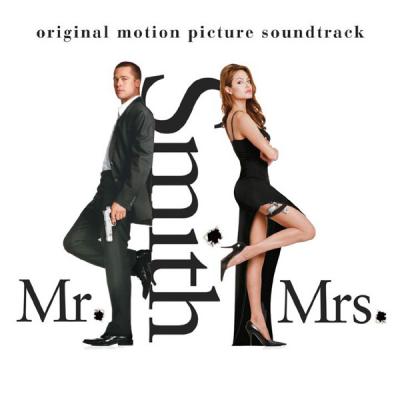
"Mr. & Mrs. Smith" Soundtrack Lyrics
Movie • 2005
Track Listing
The J. Geils Band
Poison
Soft Cell
Alana D
Charles Wright & The Watts 103rd Street Rhythm Band
Joe Strummer & The Mescaleros
Magnet feat. Gemma Hayes
Nouvelle Vague
8mm
Pink Martini
John Powell
Voodoo Glow Skulls
Stine J.
Righteous Brothers
Air Supply
Atreyu
Captain & Tennille
“Mr. & Mrs. Smith: Original Motion Picture Soundtrack” – Album Guide to Tracks and Key Scenes

Overview
What happens when a bored suburban couple secretly working as assassins collide with their own marriage? That paradox lies at the heart of Mr. & Mrs. Smith (2005). The soundtrack captures that collision: domestic normality vs lethal professionalism, intimacy vs violence. The music shifts between slick action beats and sly romantic gestures, underscoring both the marital tension and the explosive thrills.
The mood of the film is playful yet dangerous. On one hand you have New Wave, 1980s pop and glam-rock songs (e.g., “Tainted Love”, “Love Stinks”) that evoke a slightly ironic tone; on the other the original score by John Powell brings in orchestral drive with a pronounced Latin flavour for the Bogotá sequence and spaghetti-western-inspired chase cues. The result: a hybrid of romantic-comedy sensibility and full-tilt action score.
The narrative arc of the music mirrors the film arc: the “arrival” of John and Jane into their marriage, the “adaptation” of discovering each other’s real business, the “rebellion” as they turn guns on each other and then together, and the “collapse” of the illusion of normal life. Songs with background memory (e.g., early coupling) shift into cues for shootouts and escape sequences.
Genre-wise: the pop/rock songs operate as diegetic or transitional elements — domestic scenes, car rides, shopping sprees. The score handles the action-romance: Latin rhythms for the Bogotá flirtation, slick strings and percussion for chases, slower melodies for reconciliation. Thematically, the Latin edge signals both exotic encounter and underlying passion; the pop hits anchor everyday life turned upside-down.
How It Was Made
John Powell, long-running collaborator with director Doug Liman (as on The Bourne Identity), provided the original score for the film. :contentReference[oaicite:4]{index=4} The composition often leans into Latin-percussion and guitar textures — especially in the “Bogotá” themed cues. One review describes the score as “in the vein of earlier light-hearted action efforts… with a healthy dose of synthesizers to embellish the funky modern edge”. :contentReference[oaicite:5]{index=5}
In parallel, a licensed compilation album of songs (pop, rock, 80s nostalgia) was released on June 7 2005, by Lakeshore Records for the US market. :contentReference[oaicite:7]{index=7} The score album followed on June 28 2005. :contentReference[oaicite:8]{index=8}
Musical supervision required balancing the cheeky marital comedy tone with high-octane action sequences. The Latin cues serve as connective tissue — from the Bogotá flashback to the final chase. Licensing older pop hits (e.g., “Tainted Love”) helped anchor the film’s domestic, ironic self-awareness. While there are no disclosed major licensing crises, the dual release (song compilation + score) suggests a clear separation of music types for marketing.

Tracks & Scenes
“Love Stinks” — The J. Geils Band
Where it plays: Early in the storyboard eating breakfast, Jane remarks their marriage feels stale — this track plays as John drives off to work.
Why it matters: The ironic pop-tone hints at the marital dissatisfaction beneath the surface before the secret-agent revelation.
“Tainted Love” — Soft Cell
Where it plays: John and Jane’s first joint “cover job” in Bogotá; the shuffle from domestic to espionage.
Why it matters: The 80s synthpop aura reflects the film’s playful yet artificial domestic façade slipping into real danger.
“Making Love Out of Nothing at All” — Air Supply
Where it plays: During the minivan chase scene as Jane chides John for crooning in the car while bullets fly.
Why it matters: The mismatch – soft romantic anthem vs high-speed action – undercuts expectations and reinforces the duality of their lives. (Note: the version in film may differ from album release.)
“Assassin’s Tango” — John Powell
Where it plays: Late in the final gun-battle/dance sequence in the KostMart store – the tango rhythm emerges as John and Jane move through the aisles, guns drawn, converging both as lovers and killers.
Why it matters: This cue crystallises the film’s core: tango as dance of intimacy and violence. The Latin flavour pays off here. :contentReference[oaicite:9]{index=9}
“Mondo Bongo” — Joe Strummer & The Mescaleros
Where it plays: The Bogotá rain-hotel bar scene when John and Jane first sense mutual interest.
Why it matters: The track’s rhythm grounds the initial hook-up in exotic locale; though not on the main album in some regions. :contentReference[oaicite:10]{index=10}

Music–Story Links
When John and Jane discover they’ve been hired to kill each other, the soundtrack shifts from domestic pop (comfortable, ironic) to high-tension action cues. The transition is marked musically by moving from songs like “Baby Baby” (domestic early scene) into score cues like “Office Work” and “Desert Foxes” (John’s assassin world). The Latin cues – especially “Bogotá”, “Tango De Los Asesinos” – link the flashback locale to the core of their now intertwined professional lives. As the couple move from adversaries to partners, the final cue “The Next Adventure” signals a new chapter beyond the film’s closing credits.
Reception & Quotes
The score received mixed to favorable remarks: “The movie’s soundtrack includes an odd collection of song placements, though composer John Powell’s score maintains a strong Latin identity throughout the film.” :contentReference[oaicite:11]{index=11} One review:
“Several cues have a definite Latin edge … which comes to a head during the daringly sexual dance piece ‘Tango De Los Asesinos’.” – Jonathan Broxton. :contentReference[oaicite:12]{index=12}Another user-review:
“The music by John Powell is best described as Latin action … the whole score seems to be hung up on the Latin vibe.” – ListeningGroove. :contentReference[oaicite:13]{index=13}The song compilation likewise got attention for its nostalgic and ironic song choices.
Availability: The song compilation album (Various Artists) was released June 7 2005, the score album June 28 2005. The soundtrack is available on major streaming services and in CD format. :contentReference[oaicite:14]{index=14}
Notes & Trivia
- The song “The Girl From Ipanema” (by Alana D.) plays during an elevator scene but is not listed on all official soundtrack editions. :contentReference[oaicite:15]{index=15}
- The Latin flavour in the score stems from the Bogotá sequence and was intentionally used to connect romance + action. :contentReference[oaicite:16]{index=16}
- The soundtrack album features mostly retro/pop songs and only one original Powell cue (“Assassin’s Tango”). :contentReference[oaicite:17]{index=17}
- The end-credits cue “The Next Adventure” is the final track of the score and signals their partnership as assassins. :contentReference[oaicite:18]{index=18}
- In some international editions a different bonus track by KansasCali appears instead of one of the Pink Martini songs. :contentReference[oaicite:19]{index=19}
Technical Info
| Field | Detail |
|---|---|
| Album Title | Mr. & Mrs. Smith: Original Motion Picture Soundtrack (Various Artists) |
| Score Album Title | Mr. & Mrs. Smith: Original Motion Picture Score |
| Year | 2005 |
| Film | Mr. & Mrs. Smith (directed by Doug Liman) |
| Composer (Score) | John Powell |
| Music Supervisor / Label | Supervision by Lakeshore Records release |
| Score Release Date | June 28 2005 :contentReference[oaicite:20]{index=20} |
| Soundtrack Release Date | June 7 2005 :contentReference[oaicite:21]{index=21} |
| Notable Tracks | “Love Stinks”, “Tainted Love”, “Assassin’s Tango” |
| Genres | Pop, Pop‐Rock, New Wave, Latin action score |
| Format / Availability | CD, digital streaming (Spotify/Apple etc) :contentReference[oaicite:22]{index=22} |
Questions & Answers
- Why two separate albums (songs + score)?
- The songs compilation caters to the pop/rock facets of the film, while the score album focuses exclusively on John Powell’s orchestral work — a marketing and aesthetic separation.
- Is the tango cue “Assassin’s Tango” available on the soundtrack CD?
- Yes — although only one original Powell cue appears on the songs compilation; the full cue and others are on the score album. :contentReference[oaicite:23]{index=23}
- Which song plays during the minivan chase scene?
- It’s “Making Love Out of Nothing at All” by Air Supply (or its variant) superimposed on the action. :contentReference[oaicite:24]{index=24}
- Is all the music heard in the film included on the albums?
- No — some tracks (e.g., certain incidental cues or regional exclusives) are omitted from both releases. :contentReference[oaicite:25]{index=25}
- Why does the score have a Latin feel despite it being a U.S. action film?
- Because one of the early key scenes is the Bogotá mission, and composer Powell used Latin rhythm and instrumentation to reflect both place and romantic-spy undertones. :contentReference[oaicite:26]{index=26}
Sources: Wikipedia, Filmtracks.com, MoviemusicUK, ScreenRant, AllMusic
November, 16th 2025
A-Z Lyrics Universe
Cynthia Erivo Popular
Ariana Grande Horsepower
Post Malone Ain't No Love in Oklahoma
Luke Combs Good Riddance (Time of Your Life)
Green Day Bye Bye Bye
*NSYNC You're the One That I Wan
John Travolta & Olivia Newton-John I Always Wanted a Brother
Braelyn Rankins, Theo Somolu, Kelvin Harrison Jr. and Aaron Pierre The Power of Love
Frankie Goes to Hollywood Beyond
Auli’i Cravalho feat. Rachel House MORE ›