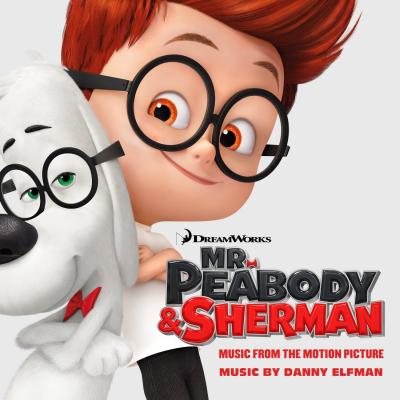
"Mr. Peabody & Sherman" Soundtrack Lyrics
Movie • 2014
Track Listing
Danny Elfman
Danny Elfman
Danny Elfman
Danny Elfman
Danny Elfman
Danny Elfman
John Lennon
Danny Elfman
Danny Elfman
Danny Elfman
Danny Elfman
Danny Elfman
Danny Elfman
Danny Elfman
Danny Elfman
Danny Elfman
Danny Elfman
Danny Elfman
Danny Elfman
Danny Elfman
Danny Elfman
Danny Elfman
Grizfolk
“Mr. Peabody & Sherman: Music from the Motion Picture” – Album Guide to Tracks and Key Scenes
Overview
What happens when a perfectionist super-genius dog scores his own time-travel chaos with a full orchestra, samba standards, classic rock and Pitbull? In this film, the soundtrack turns that question into a running joke and a genuine emotional spine.
On paper, Mr. Peabody & Sherman is a light family time-travel comedy about an adoptive father and son fixing history. In practice, the music keeps reminding us it is really about whether a dog can be a “good enough” dad. Danny Elfman’s score wraps Sherman's school anxieties, Ms. Grunion’s bureaucratic menace and the film’s historical set pieces into a coherent musical arc: bright, brassy science-adventure on the surface, with a softer piano-and-sax theme for the fragile bond underneath.
The soundtrack album, “Mr. Peabody & Sherman: Music from the Motion Picture”, is primarily Elfman’s score, plus a handful of key songs: John Lennon’s “Beautiful Boy (Darling Boy)”, Grizfolk’s end-credits anthem “Way Back When”, and in some territories Peter Andre’s “Kid” over the credits. Around them, Elfman threads motifs for the WABAC machine, the panic of temporal collapse and Peabody’s own carefully controlled emotions, often switching tone mid-cue as history literally falls apart.
The film uses music diegetically whenever it can. Peabody improvises through Gershwin, Hendrix and didgeridoo in a single dinner-party stunt; Beethoven gets caught at a New York vending machine with Pitbull on the soundtrack; time rips open over Manhattan while Elfman’s “History Mash-Up” piles styles on styles. These choices make the film’s thesis very plain: history is noisy, contradictory and fun, and this dog has rehearsed all of it.
Stylistically the score moves in phases. Early “indie-bright” orchestral pop and samba colors sell Sherman's naïve excitement. Revolutionary France and Troy lean on brassy, almost war-movie writing to underline that the stakes are real, not just cartoon danger. For father-son beats, Elfman drops into warm, slightly nostalgic piano and woodwinds — a sound world closer to family drama than slapstick. Then the final act ramps into hybrid action: big percussion, choir and sly quotations from classical and pop cues to signal that every era is colliding at once.
How It Was Made
The score was written by Danny Elfman, working with director Rob Minkoff and DreamWorks Animation after his runs with Disney and Blue Sky. The album is officially billed as “Mr. Peabody & Sherman: Music from the Motion Picture”, released by Relativity Music Group in early 2014 as a 23-track, roughly 50-minute score album with “Way Back When” as its closing song.
Elfman recorded the music at AIR Studios in London with a large orchestra and choir (Metro Voices), then mixed it in Hollywood and Santa Barbara. Orchestrators like Steve Bartek and John Ashton Thomas, and additional music contributors including Paul Mounsey and Chris Bacon, helped shape the dense action writing and the more intimate family cues. The result feels polished but not sterile — the brass is punchy, the choir has bite, and the quieter piano lines keep their human touch.
Song-wise, the film pulls from several catalogs. John Lennon’s “Beautiful Boy (Darling Boy)” is licensed as the emotional core of Peabody’s memories of raising Sherman. Grizfolk’s “Way Back When” turns the closing titles into a pop-rock epilogue about looking back at adventures. For the UK release, Peter Andre wrote the original song “Kid” for the end credits, built around a father-son lyric perspective, even though that track did not make the standard soundtrack album.
Beyond album cuts, the production layers in famous pieces for jokes and texture: Ary Barroso’s samba evergreen “Aquarela do Brasil”, George Gershwin’s “Rhapsody in Blue”, Jimi Hendrix’s “Purple Haze”, Ondřej Smeykal’s didgeridoo piece “Tezka Radost”, Pitbull’s “Pause”, and even a Michael Kamen cue from Brazil in a background gag. The music department had to balance these source cues against Elfman’s original themes so that the film never feels like a jukebox but still rewards anyone who recognizes the references.
Tracks & Scenes
Below are key cues and songs, with how they play in the film. This is not the full tracklist, but it covers the main musical story beats, including non-album and trailer songs.
“Mr. Peabody’s Prologue” — Danny Elfman
Where it plays: Over the opening montage as Peabody narrates his life story: rejected as a puppy, throwing himself into science, athletics and invention, and finally adopting baby Sherman. The cue runs through this compressed biography and lands on their present-day New York penthouse life. Non-diegetic, roughly the first few minutes of the film, with music tightly synced to visual gags of Peabody’s achievements.
Why it matters: Introduces the main Peabody theme — clever, fast, but in a major key that keeps things warm. It tells the audience that this is not just a parody genius, but a lonely dog who chose control over chaos until Sherman arrived.
“Reign of Terror!” — Danny Elfman
Where it plays: In Revolutionary France when Peabody and Sherman land in the middle of a guillotine scene and have to escape Robespierre and the crowd. Strings saw, brass blare and percussion ticks away like a clock as they improvise their way to the WABAC. Non-diegetic, covering a compact action sequence that lasts a couple of minutes.
Why it matters: This is Elfman doing straight adventure scoring, but with rhythmic snaps and comic stabs that echo the film’s “history lesson, but fun” tone. It also hints at the danger Sherman's curiosity can unleash if left unchecked.
“The Drop Off” — Danny Elfman
Where it plays: As Peabody walks Sherman to his first day of school. The cue starts with confident, almost strutting brass as Peabody tries to treat it like any other problem he can solve, then thins out as Sherman hesitates at the school gates. Non-diegetic, around early school scenes before Sherman clashes with Penny.
Why it matters: Musically underlines that Peabody is out of his comfort zone; world-saving is easy, parenting in the human world is not. The theme quietly hands emotional focus from Peabody to Sherman.
“Beautiful Boy (Darling Boy)” — John Lennon
Where it plays: In a mid-film flashback montage where Peabody remembers raising Sherman — feeding him, teaching him history, sharing quiet moments in their penthouse. The original Lennon recording plays over these warm, slightly idealized vignettes. Non-diegetic, laid in full enough to anchor the memory sequence.
Why it matters: The choice of song — written by Lennon for his own son — makes the adoptive bond explicit. It is the one moment where Peabody’s emotional life is allowed to be completely unguarded, and the source track does the heavy lifting.
“Dinner Party” / “Aquarela do Brasil” — Danny Elfman & Ary Barroso
Where it plays: During the big dinner party at Peabody’s Manhattan penthouse, when the Petersons arrive. “Aquarela do Brasil” (in Elfman’s arrangement) breezes in as a sophisticated samba while Peabody cooks, pours drinks and performs flawless small talk, turning his home into a cosmopolitan showroom. As the evening escalates, the track flows around dialogue and sets up his later instrument-switching stunt. Mostly non-diegetic, with hints of diegetic feel as the party ambience swells.
Why it matters: The light samba underscores how choreographed Peabody’s life is. Every step, every garnish has a rhythm, and that control is exactly what the WABAC adventure will shatter.
“Rhapsody in Blue” — George Gershwin (Peabody’s piano performance)
Where it plays: Still at the dinner party, when Paul Peterson dismisses Peabody’s classical playing. Peabody sits at the grand piano and rips into “Rhapsody in Blue” with full showman flair. The camera cuts between him, the awed guests, and Sherman watching his dad juggle charm and insecurity. Diegetic — we see Peabody playing; the film may layer in fuller orchestral support on the track, but it is presented as his performance.
Why it matters: Ties Peabody to a specifically New York tradition of urbane, jazzy modernism. It also sets up the gag where Paul asks for “something with more rock,” pushing Peabody into genres he did not plan to show off.
“Purple Haze” — Jimi Hendrix / “Tezka Radost” — Ondřej Smeykal
Where it plays: Immediately after Gershwin, Peabody pivots to Jimi Hendrix’s “Purple Haze” on guitar (or its animated equivalent), then to didgeridoo over “Tezka Radost”, and even flamenco and bagpipes, as Paul keeps changing his mind: “I meant rock-’n’-roll… flamenco… bagpipes… didgeridoo.” Each shift is comically short — a bar or two — but the soundtrack sells them as real musical changes, not just sound effects. Fully diegetic, with exaggerated acoustics to keep the jokes sharp.
Why it matters: This is the film’s core character gag in miniature: Peabody will master any discipline to please humans, even if it means hopping genres like a jukebox. The music makes his insecurity audible.
“Zumba” — source cue (Peabody invents the dance)
Where it plays: In a brief early gag reel of Peabody’s achievements, we see him “invent” the Zumba fitness program. A high-energy Latin-pop groove blasts over a montage of exaggerated exercise moves. The track itself is not on the official album; it functions as a parody of branded workout music. Diegetic within the gag (Peabody is demonstrating the routine), but mixed like a music-video.
Why it matters: It sets up the later use of “Pause” and other contemporary sounds, and quietly mocks how easily genuine creativity gets folded into commercial fitness culture — something a control-freak dog would absolutely exploit.
“Off to Egypt” / “The Wedding Exodus” — Danny Elfman
Where it plays: When Sherman and Penny first impulsively take the WABAC to Ancient Egypt, “Off to Egypt” scores their arrival amid pyramids and hieroglyphs, mixing exotic scales with the main theme. “The Wedding Exodus” kicks in as Peabody infiltrates Tutankhamun’s child-wedding and engineers a chaotic escape through collapsing tombs and crowds. Non-diegetic, spanning the middle of the film’s first big historical set piece.
Why it matters: These cues lock in the pattern: new era, new color, same core relationship problem (Sherman trying to impress Penny). The music sells both the danger and the absurdity of a kid nearly marrying a pharaoh.
“The Flying Machine” — Danny Elfman
Where it plays: In Renaissance Florence, as Sherman and Penny test Leonardo da Vinci’s flying machine. The cue starts with a delicate, almost tinkling texture in the workshop, then expands into soaring strings and brass as they glide over the city at sunset, before crashing through the Duomo. Non-diegetic but synced closely to the aerial choreography, giving the scene its sense of genuine wonder before the joke landing.
Why it matters: This is the film’s most lyrical set-piece. The music lets us feel Sherman’s joy separate from Peabody’s control, which is why the later arguments about trust and independence land emotionally.
“Trojan Horse” / “War / Disaster” — Danny Elfman
Where it plays: Late in the film, when the trio get caught inside the Trojan Horse and then in the middle of the Trojan War. “Trojan Horse” covers stealthy build-up inside the wooden construct, with tense ostinatos and low brass. “War / Disaster” explodes as they tumble into the battle and the plan falls apart, using choir and heavy percussion as history literally collapses under them. Non-diegetic, some of the most aggressive writing in the score.
Why it matters: These tracks raise the stakes from time-travel hijinks to something closer to apocalyptic disaster. You can feel Elfman leaning toward his big action mode, which helps justify Sherman’s fear that he might lose Peabody for real.
“Pause” — Pitbull
Where it plays: In a late montage after the time-rip over New York, we briefly see Beethoven at a vending machine in modern Manhattan while “Pause” blasts. The track also echoes the Zumba association: a modern, club-ready beat overlaid on historical figures wandering through Times Square. Non-diegetic but clearly tied to the gag (the joke is that Beethoven is now soundtracked by Pitbull).
Why it matters: This needle-drop is pure anachronistic humor and brand synergy, but it fits the film’s theme: history will always be remixed by the present, sometimes in ridiculous ways.
“History Mash-Up” — Danny Elfman
Where it plays: During the climactic sequence when the space-time continuum tears open and historical figures and landmarks spill into New York: the Trojan Horse rolling down streets, pyramids in the skyline, Einstein chatting with cops. The cue jumps between styles — fanfares, faux-ancient modalities, national anthems quotes — while keeping a strong through-line pulse. Non-diegetic, layered under chaos and dialogue.
Why it matters: It’s the score’s thesis statement: everything in history colliding, musically and visually, with Peabody and Sherman at the center trying to stitch it back together.
“I’m a Dog Too” — Danny Elfman
Where it plays: At the emotional climax, when Sherman publicly defends Peabody against Ms. Grunion and the authorities, insisting that he is his father. The cue brings back the sentimental theme on solo piano, then builds it with strings and soft choir as the crowd of historical figures rallies behind them. Non-diegetic, carrying the film through its most openly sentimental stretch.
Why it matters: This is where the score drops the irony. The title itself echoes Sherman accepting that Peabody is “a dog” in the eyes of the world but also his real parent. The music treats that realization with straight-faced sincerity.
“Fixing the Rip” / “Back to School” — Danny Elfman
Where it plays: “Fixing the Rip” underscores the final race to repair the temporal breach, with tense rhythms that gradually resolve into triumphant statements of the main theme as the WABAC gambit works. “Back to School” closes the narrative loop as Sherman returns to school, now confident, with Penny as a friend and the Peabody-Sherman relationship secure. Non-diegetic, with a quieter coda that gently lands the story.
Why it matters: These cues turn abstract sci-fi mechanics into something legible: the music tells us when things are about to collapse, and when the emotional repair has succeeded.
“Aquarela do Brasil (Coda)” — Danny Elfman & Ary Barroso
Where it plays: Over the epilogue images of historical figures returning to their time periods — but with modern artifacts and jokes (selfies, fast food, etc.). The familiar samba theme comes back, stitched with other musical quotations, as if history itself has been permanently remixed. Non-diegetic over montage and early credits.
Why it matters: It musically confirms the film’s last gag: even after “fixing” history, tiny paradoxes remain. The score doesn’t fight this; it celebrates it.
“Way Back When” — Grizfolk
Where it plays: Over the main theatrical end credits, starting as the picture cuts out of the story into graphic credits. A mid-tempo indie-rock track with nostalgic lyrics about youth and adventure, matching animated silhouettes of Peabody, Sherman and the historical figures. Non-diegetic end-credits song, usually played long enough to feel like a full music video.
Why it matters: Acts as the pop translation of Elfman’s themes: “we went way back when, and it was messy but worth it.” It also gives the film a radio-friendly calling card outside score-collector circles.
“Kid” — Peter Andre
Where it plays: In UK (and some international) releases, “Kid” replaces “Way Back When” over the end credits. The song leans into pop-soul, with lyrics that mirror Peabody’s perspective on Sherman and the joys and fears of raising a child. Non-diegetic, full-song play over credits in that version.
Why it matters: It reinforces the father-son theme for markets where Peter Andre is a recognizable name. Curiously, it lives more in marketing and regional cuts than on the core soundtrack album.
Trailer songs: “Pompeii” — Bastille; “Hey Now” — Martin Solveig & The Cataracs feat. Kyle
Where it plays: In pre-release trailers, not in the film itself. “Pompeii” provides the chanted hook and pounding drums for the main US trailer, cut to quick shots of time-travel chaos. “Hey Now” shows up in international spots, giving a more electro-club vibe to the historical montage. Non-diegetic marketing use only.
Why it matters: These tracks sold the movie as high-energy family comedy first, score-driven time-travel romp second. They also primed audiences for the idea that the film would mash eras and genres.
Notes & Trivia
- The score album is officially credited to Danny Elfman, but some storefronts list it as a “Various Artists” release because of the Lennon and Grizfolk tracks.
- The recording sessions at AIR Studios in London used a large choir, then often buried it subtly under brass and percussion for extra weight.
- The “Amazing Mr. Peabody” track on the album is essentially a scored comedy sketch of Stephen Colbert’s character shouting out instruments for Peabody to play.
- “Way Back When” later became a minor calling card for Grizfolk; the band still references the film connection when talking about their early years.
- The soundtrack album’s running order broadly follows the film, so listening straight through gives a compressed version of the narrative arc.
- “Zumba” and several short gag cues are not on the standard album, turning the disc into a slightly more traditional score experience than the film itself.
Music–Story Links
The simplest way to hear this soundtrack is as Peabody’s inner life. In dialogue he stays dry and confident; in the music he is constantly on the edge of panic. Whenever Sherman is in danger — the guillotine, Tut’s tomb, the Trojan cliff fall — Elfman tilts his main motif into minor, crowding it with fast string writing as if Peabody’s mind is racing through contingency plans.
“Beautiful Boy (Darling Boy)” acts as a musical proof that Peabody’s fatherhood is real, not an experiment. The film could have underscored that flashback with original score, but by importing Lennon’s track it connects Peabody’s feelings to a long cultural lineage of vulnerable fathers. The choice also makes Ms. Grunion’s bureaucratic threats feel colder; we hear how much Peabody stands to lose.
The dinner-party performance sequence, with “Rhapsody in Blue” followed by “Purple Haze”, “Tezka Radost” and more, mirrors Peabody’s social predicament. In story terms he is auditioning for Paul and Patty’s approval as a parent. In musical terms he is sprinting through 20th-century genres to prove he belongs at every table — a dog trying to be all human things at once.
Whenever Penny pushes Sherman toward risk, the score often follows her lead. The Da Vinci flying scene is scored with open, romantic harmony, inviting us to share her thrill. Later, when she drags Sherman into the Trojan War, the music stays exciting but adds harsher brass and choral punches, hinting that her appetite for adventure can go too far for a seven-year-old boy.
In the final act, “History Mash-Up” and “I’m a Dog Too” work together. The first insists that everything — every era, every figure — is crashing into the present; the second insists that this chaos only matters because two people (or a person and a dog) care about each other. Musically, one track fractures style, the other stabilizes it. That tension is the film’s whole story in miniature.
Reception & Quotes
The film itself landed in the “pleasant surprise” zone for many critics: not a box-office smash, but widely described as witty, fast and more emotionally grounded than expected. Review aggregators place it around the high-50s/low-60s on critic scales, with notably stronger audience grades.
The score drew particular praise from film-music reviewers, who highlighted Elfman’s ability to juggle cartoon energy with sincere thematic writing. One outlet noted that the album “mixes a bit of Elfman and a bit of [John] Powell in a blender,” pointing to its blend of rhythmic drive and lyrical themes. Another longform review called it “one of the better modern Elfman family scores, stuffed with ideas but still coherent front to back.”
“There’s an awful lot of unexpected fun to be had once the film hits its stride.”
Peter Bradshaw, The Guardian
“A fairly consistent stream of sight gags and vocal slapstick, even as the plot veers wildly down a wormhole in the time-space continuum.”
Mark Kermode, The Observer
“The score is lively with great melodies… themes that work in the many settings and arrangements throughout.”
Music Behind the Screen
“A solid product… forty minutes of Elfman score, alongside a few source songs and tangos.”
Best Original Scores blog
The film’s music also picked up awards-circuit attention. Danny Elfman received a nomination for Best Original Score in an Animated Film at the Hollywood Music in Media Awards, and Peter Andre’s “Kid” was nominated in the song category, underlining how central the father-son theme felt to the soundtrack’s identity.
Interesting Facts
- The standard album ends with Grizfolk’s “Way Back When”; the extended edition adds Peter Andre’s “Kid” as a bonus track even though it is UK-specific in the film.
- “Pause” by Pitbull, best known as a Zumba anthem, briefly underscores Beethoven at a New York vending machine — a layered in-joke about fitness branding and classical music.
- Russian-language documentation of the soundtrack explicitly lists when each Elfman cue appears, making it one of the more thoroughly annotated modern animated scores.
- The score recording credits name AIR Studios in London and Technicolor at Paramount in Hollywood, a common pipeline for big animated films in the 2010s.
- A cue from Michael Kamen’s score to Brazil (“Central Services/The Office”) is reportedly quoted in the film, tying one time-travel satire to another.
- Because the soundtrack mixes John Lennon, Grizfolk and Elfman, some digital platforms tag it as both “Film Score” and “Stage & Screen” to catch broader searches.
- A separate album exists for The Mr. Peabody & Sherman Show Netflix series, but it uses different composers and a more television-friendly palette.
- Despite the film’s underperformance theatrically, the score remains in print physically and digitally, which is not guaranteed for mid-2010s animated soundtracks.
- The soundtrack’s MusicBrainz release group ties together US and European CD pressings, which sometimes show different label branding (Relativity vs Sony Classical).
- Elfman’s work here sits chronologically between American Hustle and Big Eyes, showing his quick pivot from stylized crime drama to bright family fare.
Technical Info
- Title (film): Mr. Peabody & Sherman (2014)
- Title (album): Mr. Peabody & Sherman: Music from the Motion Picture
- Year of film: 2014
- Year of album release: 2014 (CD and digital editions in late February / early March)
- Type: Original motion picture score with selected songs
- Primary composer: Danny Elfman
- Additional music/orchestrations: Paul Mounsey, Chris Bacon, Peter Bateman, John Ashton Thomas and others credited on album notes
- Key songs in film: “Beautiful Boy (Darling Boy)” (John Lennon), “Way Back When” (Grizfolk), “Kid” (Peter Andre, regional), “Pause” (Pitbull), “Rhapsody in Blue”, “Purple Haze”, “Tezka Radost”, “Aquarela do Brasil”, “Zumba” gag cue
- Label(s): Relativity Music Group (primary); some physical editions co-branded with Sony Classical
- Recording: Score recorded at AIR Studios, London; mixed at Technicolor at Paramount and Sound Waves SB
- Album duration: About 50 minutes for the core programme (roughly 23 tracks), plus ~3 minutes if “Kid” is included
- Release context: Issued shortly before the film’s US theatrical release; later followed by a separate soundtrack for the Netflix spin-off series
- Availability: Widely available on major digital music platforms and on CD; exact availability varies by region and retailer
- Chart notes: Not a major pop-chart presence; reception is stronger within film-music circles than in mainstream rankings.
Questions & Answers
- Is “Beautiful Boy (Darling Boy)” actually used in the film or only on the album?
- It is used in the film itself during a flashback montage of Peabody raising Sherman, and it also appears on the official soundtrack album.
- Why isn’t Peter Andre’s “Kid” on every version of the soundtrack?
- “Kid” plays over the UK end credits, but the core international album was configured around the US version, which ends with Grizfolk’s “Way Back When.” Some extended or regional editions add “Kid” as an extra track.
- Which notable pieces heard in the film are missing from the standard album?
- The Zumba gag cue, some very short genre riffs from the dinner party, and certain licensed snippets (like the Hendrix and didgeridoo fragments) are not presented as standalone tracks on the score album.
- How does Elfman’s score reflect the different historical periods?
- Each era gets its own color — French Revolution with sharp brass and snare-drum martial writing, Egypt with modal inflections, Renaissance Florence with soaring strings and harp — while the main Peabody/Sherman themes weave through them.
- Is the soundtrack worth hearing if I have not seen the movie?
- Yes. It plays as a compact, energetic adventure score with clear recurring themes and a few well-placed songs. Some jokes land better with the visuals, but the album stands on its own as modern Elfman.
Canonical Entities & Relations
| Subject | Relation | Object |
|---|---|---|
| Rob Minkoff | directed | Mr. Peabody & Sherman (film) |
| Danny Elfman | composed score for | Mr. Peabody & Sherman: Music from the Motion Picture (album) |
| DreamWorks Animation | produced | Mr. Peabody & Sherman (film) |
| PDI/DreamWorks | co-produced | Mr. Peabody & Sherman (film) |
| Relativity Music Group | released | Mr. Peabody & Sherman: Music from the Motion Picture (album) |
| Grizfolk | performed | “Way Back When” (song) |
| John Lennon | wrote and performed | “Beautiful Boy (Darling Boy)” (song) |
| Peter Andre | wrote and performed | “Kid” (song) |
| Pitbull | performed | “Pause” (song) |
| Ary Barroso | composed | “Aquarela do Brasil” (song) |
| Ty Burrell | voiced | Mr. Peabody (character) |
| Max Charles | voiced | Sherman (character) |
| Ariel Winter | voiced | Penny Peterson (character) |
| New York City | serves as primary setting for | present-day scenes in Mr. Peabody & Sherman |
| AIR Studios, London | hosted recording sessions for | Mr. Peabody & Sherman score |
| Technicolor at Paramount | handled mixing for | Mr. Peabody & Sherman score |
Sources: Wikipedia (film and soundtrack entries); Russian-language Wikipedia track notes; Film Music Reporter; AllMusic; MusicBrainz and Discogs listings; Music Behind the Screen blog; Best Original Scores review; DreamWorks and Universal/DreamWorks wikis; Mediastinger credits notes.
November, 16th 2025
'Mr. Peabody & Sherman' is a 2014 American 3D computer-animated comic science fiction comedy. Get more info: IMDb, WikipediaA-Z Lyrics Universe
Cynthia Erivo Popular
Ariana Grande Horsepower
Post Malone Ain't No Love in Oklahoma
Luke Combs Good Riddance (Time of Your Life)
Green Day Bye Bye Bye
*NSYNC You're the One That I Wan
John Travolta & Olivia Newton-John I Always Wanted a Brother
Braelyn Rankins, Theo Somolu, Kelvin Harrison Jr. and Aaron Pierre The Power of Love
Frankie Goes to Hollywood Beyond
Auli’i Cravalho feat. Rachel House MORE ›