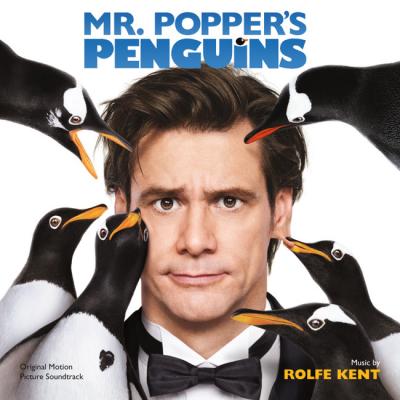
"Mr. Popper's Penguins" Soundtrack Lyrics
Movie • 2011
Track Listing
Rolfe Kent
Rolfe Kent
Rolfe Kent
Rolfe Kent
Rolfe Kent
Rolfe Kent
Rolfe Kent
Rolfe Kent
Rolfe Kent
Rolfe Kent
Rolfe Kent
Rolfe Kent
Rolfe Kent
Rolfe Kent
Rolfe Kent
Rolfe Kent
Rolfe Kent
Rolfe Kent
Rolfe Kent
Rolfe Kent
Rolfe Kent
Rolfe Kent
Rolfe Kent
Rolfe Kent
Rolfe Kent
Rolfe Kent
Rolfe Kent
The Beatles
Jule Styne, Sammy Cahn
Erwin Lehn
Syd Dale
Vern Gosdin
Steve Sidwell
Jeff Cardoni
Daniel May, Marc Ferrari
Vanilla Ice
"Mr. Popper's Penguins (Original Motion Picture Soundtrack)" – Album Guide to Tracks and Key Scenes
Overview
What do you score a midlife crisis with penguins in a Manhattan penthouse? A wall of pop hits, or an old-fashioned orchestral comedy score with a few icy needle drops? Mr. Popper's Penguins quietly chooses the second option, wrapping Jim Carrey’s slapstick in a surprisingly classic, melodic package.
The film follows high-powered real-estate closer Tom Popper, whose life is built on slick pitches, ruthless negotiations and childhood abandonment issues he never quite processed. Six penguins crash into that life – literally – forcing him to juggle a career-making deal for Tavern on the Green with a rapidly thawing heart. The soundtrack’s job is to keep the whole thing light, bouncy and family-friendly while still charting Popper’s shift from shark to softie.
Rolfe Kent’s score leans on nimble strings, woodwind flourishes and comic stabs, but it is not just mickey-mousing. Under the jokes runs a clean emotional arc: bright, brisk city cues for Popper the dealmaker; more lyrical, waltz-like material for the birds and his kids; and slightly bittersweet harmonies when his father’s absence surfaces. Around that, a small ring of songs – a Beatles wink, a holiday standard, Vanilla Ice, lounge and library cuts – punctuate big set-pieces rather than dominate the film.
What makes the album distinct is that it feels more like a traditional family-film score than a 2010s “song dump.” The licensed material is minimal but pointed. The orchestral palette evokes old studio comedies; the Chaplin cues go even further back, tying Popper’s chaos to silent-era slapstick. When the film does bring in pop vocabulary – the swagger of “Ice Ice Baby,” a crooner-style “Let It Snow,” slick library funk like “Go Get It” – it is to underline a specific joke or character beat, not to chase the charts.
In genre terms, you can hear the soundtrack moving in phases. Early on, bright “indie-adjacent” score writing (plucked strings, light percussion) mirrors Popper’s brittle, performative charm. As the penguins take over, the music slides into cartoonish orchestral comedy and faux-classical elegance, especially around Van Gundy and the Chaplin material, to sell surface polish versus inner mess. Finally, the ending leans on warm, almost sentimental family-movie scoring, only to be undercut – cheerfully – by 90s rap nostalgia in the credits. The arc is simple, but it works.
How It Was Made
The score for Mr. Popper's Penguins is by British composer Rolfe Kent, known for character-focused comedies like Sideways, Election, About Schmidt and Up in the Air. He specializes in music that sits between straight orchestral writing and sly, slightly ironic light jazz. That toolkit fits Popper: the music has to smile at the absurdity of indoor penguins but still believe in his emotional turnaround.
The film’s orchestral score was recorded on the 20th Century Fox scoring stage in Century City with roughly a 78-piece orchestra. That gives the album more weight than its feather-light tone might imply; even the zany cues have full brass and string sections behind them. You can hear that scale in the opening “Radio Chat/The Streets of New York” cue on the album, which plays like a compact overture: city bustle, career tension, and a hint of wistful nostalgia for Popper’s explorer father bundled into a few minutes.
One quirky element is the explicit use of silent-era film music. The production licensed cues from several Charles Chaplin features – including The Circus, The Gold Rush, Shoulder Arms and Modern Times – and intercut them with printed clips from those films. Contemporary reviewers noted that the movie at one point “acts cruel” by showing Chaplin’s genius next to CGI penguin slapstick, but musically the intent is clear: to place Popper’s mayhem in the lineage of classic physical comedy.
The other eyebrow-raising clearance is “Lucy in the Sky with Diamonds.” On screen, Popper drops the opening lines in a conversation with Angela Lansbury’s Selma Van Gundy, turning Beatles surrealism into a sales pitch for his development. Critics pointed out that the film only talks about Beatles songs rather than blasting them at full volume. The soundtrack album, however, credits an orchestral version associated with the London Symphony Orchestra and arranger Andrew Pryce Jackman, underscoring how closely music and movie-business licensing are intertwined here.
The official album, titled Mr. Popper's Penguins (Original Motion Picture Soundtrack), compiles 27 score cues plus selected songs. It was released digitally in June 2011 under the Hollywood Records banner and physically on CD by Varèse Sarabande, continuing that label’s long-running relationship with Kent’s work. As with many family titles of the period, the album privileges the original score; the source songs and Chaplin cues are represented more by credit than by full-length reproduction.
Tracks & Scenes
Precise timestamp data for every cue differs slightly between releases and home-video cuts, so think of the timings below as approximate waypoints rather than frame-accurate notes. Where coverage disagrees, I flag the uncertainty.
“Ice Ice Baby” — Vanilla Ice
Where it plays: The best-documented placement is over the closing credits: after the family’s Antarctic trip and Popper’s emotional resolution, the film cuts to credits while “Ice Ice Baby” kicks in, turning the last impression into a knowingly goofy ice-themed gag. Some reports also mention a short in-film dance bit with Popper and the penguins tied to the track, but coverage consistently agrees that the full song headline is in the end crawl. Expect it roughly from the 92-minute mark onward, non-diegetic, blasting over black and credit text while we see graphical or live-action footage of the birds.
“Let It Snow! Let It Snow! Let It Snow!” — Jule Styne & Sammy Cahn (popular crooner-style recording)
Where it plays: A snippet is used around the sequence where Popper transforms his upscale apartment into a winter playground for his kids and the penguins. The song functions as a Christmas-card frame for what is, essentially, a snow-day fantasy in the middle of Manhattan: staircases turned into slides, fake drifts piled against designer furniture, and penguins belly-flopping through the chaos. It is non-diegetic – the characters do not acknowledge it – but it tracks the montage-like rhythm of the scene and likely runs for 30–60 seconds in the mid-film stretch.
“Lucy in the Sky with Diamonds” — orchestral version associated with London Symphony Orchestra
Where it plays: On screen, the most prominent use of “Lucy in the Sky with Diamonds” is actually verbal: Popper riffs on the song’s opening lines when pitching his plan for Tavern on the Green to Selma Van Gundy, turning psychedelic imagery into sales language about vision and transformation. Critics who tracked the film closely argue that Beatles recordings are referenced more than heard, and there is no consensus that a full performance of “Lucy” plays loudly in the mix. On album, though, the orchestral cover functions as a stand-alone track that reflects the aspirational, slightly dreamy side of Popper’s developer persona. Any in-film audio, if present, is subtle and short – closer to a motif than a showcase.
“Go Get It” — Jeff Cardoni
Where it plays: Credited both as writer and performer, Cardoni’s track appears in the film as upbeat, groove-based source music underscoring Popper’s professional world – most likely in one of the office or negotiation montages where he is chasing the Tavern on the Green deal. Exact scene breakdowns differ slightly between cue lists, but it is used non-diegetically to keep energy up while Popper works the phones, strides through glass corridors and lays out his pitches. Expect it in the first third of the movie, with a fairly short on-screen presence (under a minute) as part of a larger sequence.
“Piano Lounge” — Daniel May & Marc Ferrari
Where it plays: As the title suggests, this piece functions as elegant background source in upscale interiors – particularly in restaurant and bar settings around Tavern on the Green. You hear it as Popper tries to impress clients and, later, when he attempts to re-woo his ex-wife in a more refined setting. The track is diegetic: it stands in for the anonymous pianist or lounge band that would logically be playing in the room, and it stays low in the mix so dialogue can dominate.
“Sweet N’ Lo” — Erwin Lehn
Where it plays: This vintage library cue appears on the soundtrack as a slice of mid-century light music – the kind of thing you might associate with old TV variety shows or cocktail parties. In the movie, it is used briefly as background in one of the adult-only spaces (boardrooms, private lounges) before the penguins really take over the soundscape. Its exact placement is short and functional, non-diegetic and easily missed unless you listen for it.
“Doo Wah Dooh Wah” — Syd Dale
Where it plays: Another library gem, “Doo Wah Dooh Wah” brings brassy, swinging big-band color to sequences where Popper is almost, but not quite, in control – for example, escorting Van Gundy through his penguin-proofed apartment or staging events that are one mishap away from collapse. It is non-diegetic, functioning as “underscoring that sounds like source,” and it tends to cut out quickly once visual chaos takes over.
“Set ’Em Up Joe” — Werner Tautz
Where it plays: This track, with its classic bar-room title, is associated with more old-school, adult environments, likely heard faintly in scenes hinting at Popper’s father’s generation and their haunts. Given how little screen time it gets, it functions more as a textural nod to the past than as a set-piece cue: a few seconds of jukebox or lounge music that ground the story in a lineage of New York deal-makers.
“Spin Spin” — Steve Sidwell
Where it plays: “Spin Spin” is a tightly-arranged, brass-forward piece that fits the film’s more frenetic montages – especially those where Popper is literally spinning plates: juggling calls, hiding penguins from building staff and placating his children. The cue works like musical caffeine, keeping the momentum up while the plot piles complications onto him.
Chaplin film cues — Charles Chaplin
Where they play: The movie incorporates licensed cues from Chaplin’s silent features (notably The Circus, The Gold Rush, Shoulder Arms and Modern Times) alongside actual clips from those films. You hear them in sequences that explicitly show Chaplin on screen – for example, when Van Gundy watches or references classic cinema – as non-diegetic score that becomes momentarily diegetic once characters visibly react to the footage.
Notes & Trivia
- Rolfe Kent’s score for Mr. Popper’s Penguins won a BMI Film Music Award, putting it alongside his better-known work even though the movie itself had mixed reviews.
- The soundtrack credits both Hollywood Records (for the digital album) and Varèse Sarabande (for the CD), a fairly common split for family titles of that era.
- Critics noted that Beatles songs are name-checked on screen but not blasted at full volume, despite licensing an orchestral “Lucy in the Sky with Diamonds” for the album.
- Several Chaplin films are credited for musical cues, even though only brief clips make it into the final cut – an unusual amount of classic-cinema clearance for a kids’ comedy.
- “Ice Ice Baby” has become a minor running joke in soundtrack writing; this film is often cited as one of its more “on the nose” later-life placements.
Music–Story Links
The easiest way to hear the soundtrack is to follow Popper’s character arc. At the start, cues like “Radio Chat/The Streets of New York” paint him as a slick operator. The harmony is busy but emotionally neutral; there is hustle, not warmth. It is only when the penguins arrive that Kent’s writing opens up into broader melodies and gentler orchestrations, mirroring Popper’s forced vulnerability.
Popper’s attempts to impress Van Gundy lean heavily on source-style music: “Piano Lounge,” “Sweet N’ Lo,” and “Set ’Em Up Joe” frame him as a man who performs refinement without really feeling it. When that performance cracks – penguins in tuxedoed dining rooms, ice slides through designer interiors – the score leans into cartoon timing instead of sophisticated background, undercutting his façade note by note.
The Beatles reference and the Chaplin cues both signal, in different ways, that Popper’s story is about learning from the past without being trapped by it. Quoting “Lucy in the Sky with Diamonds” in a sales pitch shows how he has turned youthful imagination into corporate patter; the Chaplin clips remind him (and us) that physical comedy once existed without cruelty or cynicism. The music’s job is to make those echoes explicit without stopping the film to explain them.
By the finale, when Popper chooses his family and the penguins over his career, the score loosens into honest, sentimental writing – broad string lines, major-key cadences that do not wink at the audience. Then “Ice Ice Baby” crashes in over the credits, yanking the tone back toward playful irreverence. It is as if the film is saying: yes, the lesson matters; but you are still here for dancing penguins.
Reception & Quotes
The film itself landed squarely in “mixed but audience-friendly” territory: critics hovered around the middle of the scale, while family audiences and CinemaScore polling were kinder. The music followed that pattern. Reviewers rarely attacked Kent’s score outright; instead, they either ignored it (as serviceable) or praised its warmth compared to the broader slapstick surrounding it.
Some critics were harsher about the way popular songs and Chaplin excerpts were used. One prominent review complained that the dialogue resorts to forced references, such as Carrey’s “Lucy in the Sky with Diamonds” pitch line, calling it a sign of desperation. The same piece argued that dropping Chaplin clips into a CGI penguin movie only reminded viewers how much sharper the old comedy was.
Family-oriented outlets, on the other hand, tended to mention the soundtrack mainly in passing, noting the relative absence of offensive lyrics and the upbeat tone of the credits song. For them, “Ice Ice Baby” was less a cultural flashpoint and more a surprisingly tame closer compared to edgier contemporary comedies.
“Along with many other components of this miserable experience the dialogue is insignificant, except when it’s peppered with strange nudges at classic rock songs.” Nick Allen, The Scorecard Review
“The worst of the profanity… is heard during the closing credits song, ‘Ice Ice Baby’ by Vanilla Ice. It’s refreshing to see a comedy that isn’t really vulgar.” Just Love Movies
“For reasons presumably ice-related, ‘Ice Ice Baby’ is the closing-credits song for 2011’s Mr. Popper’s Penguins.” music columnist reflecting on the track’s soundtrack life
Interesting Facts
- The score was recorded on the historic Fox scoring stage in Los Angeles with a full 78-piece orchestra, unusual firepower for a relatively small-scale family comedy.
- The official soundtrack album runs about 58 minutes and contains 27 tracks, most of them score cues rather than songs.
- Varèse Sarabande’s CD edition carries catalogue number 302 067 103 2, making it part of the label’s long line of early-2010s studio score releases.
- “Go Get It” is one of the few non-Kent tracks on the album performed by a contemporary film composer (Jeff Cardoni) rather than a pop act or library orchestra.
- The film’s Chaplin cues are listed not just generically but by individual films, including The Circus, The Gold Rush, Shoulder Arms and Modern Times.
- On discography lists, Mr. Popper’s Penguins often sits between Kent’s work on Charlie St. Cloud and Downsizing, showing how he shifted between intimate drama and broad comedy in that period.
- In some markets, a stage musical adaptation later appeared with its own separate cast recording, so searching for “Mr Popper’s Penguins soundtrack” now can surface both the 2011 film score and theatrical songs.
- The soundtrack’s digital edition is still available on major platforms, but the physical CD can be comparatively harder to find, drifting in and out of print like many early-2010s scores.
Technical Info
- Title: Mr. Popper's Penguins (Original Motion Picture Soundtrack)
- Year: 2011
- Type: Feature film score and selected songs
- Primary composer: Rolfe Kent
- Additional featured writers/performers: Vanilla Ice; John Lennon & Paul McCartney (songwriters); Jule Styne & Sammy Cahn; Erwin Lehn; Syd Dale; Werner Tautz; Steve Sidwell; Jeff Cardoni; Daniel May & Marc Ferrari; Charles Chaplin (original film cues)
- Film director: Mark Waters
- Main cast (film): Jim Carrey, Carla Gugino, Angela Lansbury, Clark Gregg, Madeline Carroll, Maxwell Perry Cotton
- Music supervision / song clearances: Not prominently credited in public summaries; clearances include Beatles publishing, Chaplin film scores, and pop/library labels for source tracks.
- Recording: 20th Century Fox scoring stage, Century City, California; approximately 78-piece orchestra.
- Labels: Hollywood Records (digital release); Varèse Sarabande (CD release, catalogue 302 067 103 2).
- Album length: Approx. 58 minutes; 27 tracks on the standard edition.
- Release context: Issued around the film’s June 17, 2011 theatrical release, alongside the movie’s family-comedy marketing push.
- Notable placements: “Ice Ice Baby” over closing credits; “Let It Snow! Let It Snow! Let It Snow!” in the snow-palace apartment sequence; Beatles “Lucy in the Sky with Diamonds” referenced in dialogue; Chaplin cues accompanying on-screen clips.
- Chart / awards notes: Score recognized with a BMI Film Music Award; the film performed solidly at the box office but the album itself was a niche collectors’ item rather than a chart topper.
Questions & Answers
- Is the Mr. Popper's Penguins soundtrack mostly pop songs or orchestral score?
- It is primarily an orchestral score by Rolfe Kent, with a small cluster of licensed songs (like “Ice Ice Baby” and “Let It Snow”) used at key moments.
- Which song plays over the end credits of the film?
- The best-documented closing-credits song is “Ice Ice Baby” by Vanilla Ice, which kicks in after the story resolves and runs over the main end crawl.
- Are the Beatles actually heard, or only referenced?
- On screen, “Lucy in the Sky with Diamonds” is mainly quoted in dialogue rather than played in full. An orchestral version appears on the album, but critics noted that Beatles tracks are more talked about than loudly featured in the mix.
- What is special about the Chaplin music in the soundtrack?
- The film licenses cues from several Chaplin films and pairs them with vintage clips, creating a deliberate echo between classic silent slapstick and the penguin antics.
- Is the soundtrack album still available today?
- Yes. Digital versions remain on major music platforms, while the original Varèse Sarabande CD surfaces mainly through specialty retailers and second-hand sellers.
Canonical Entities & Relations
| Subject | Verb | Object |
|---|---|---|
| Mr. Popper's Penguins (film) | is directed by | Mark Waters |
| Mr. Popper's Penguins (film) | is based on | Mr. Popper's Penguins (1938 children’s book) |
| Mr. Popper's Penguins (film) | stars | Jim Carrey |
| Rolfe Kent | composed score for | Mr. Popper's Penguins (film) |
| Rolfe Kent | is primary artist of | Mr. Popper's Penguins (Original Motion Picture Soundtrack) |
| Hollywood Records | released | digital edition of Mr. Popper's Penguins (Original Motion Picture Soundtrack) |
| Varèse Sarabande | issued CD of | Mr. Popper's Penguins (Original Motion Picture Soundtrack) |
| 20th Century Fox | distributed | Mr. Popper's Penguins (film) |
| Davis Entertainment | produced | Mr. Popper's Penguins (film) |
| Dune Entertainment | co-produced | Mr. Popper's Penguins (film) |
| Tom Popper Jr. (character) | is protagonist of | Mr. Popper's Penguins (film) |
| Tavern on the Green (New York restaurant) | appears as key location in | Mr. Popper's Penguins (film) |
| Central Park, New York City | contains | Tavern on the Green |
| “Ice Ice Baby” (song) | is performed by | Vanilla Ice |
| “Ice Ice Baby” (song) | plays over end credits of | Mr. Popper's Penguins (film) |
| “Lucy in the Sky with Diamonds” (song) | is written by | John Lennon & Paul McCartney |
| Charles Chaplin | composed cues used in | Mr. Popper's Penguins (film) |
Sources: Wikipedia entries for film and book; Apple Music album listing; Discogs release and master pages; Ringostrack and Soundtrakd song/credit lists; contemporary reviews from The Scorecard Review and Just Love Movies; later commentary on “Ice Ice Baby” soundtrack uses.
November, 16th 2025
'Mr. Popper's Penguins', an American family comedy film on the Web: Internet Movie Database, WikipediaA-Z Lyrics Universe
Cynthia Erivo Popular
Ariana Grande Horsepower
Post Malone Ain't No Love in Oklahoma
Luke Combs Good Riddance (Time of Your Life)
Green Day Bye Bye Bye
*NSYNC You're the One That I Wan
John Travolta & Olivia Newton-John I Always Wanted a Brother
Braelyn Rankins, Theo Somolu, Kelvin Harrison Jr. and Aaron Pierre The Power of Love
Frankie Goes to Hollywood Beyond
Auli’i Cravalho feat. Rachel House MORE ›