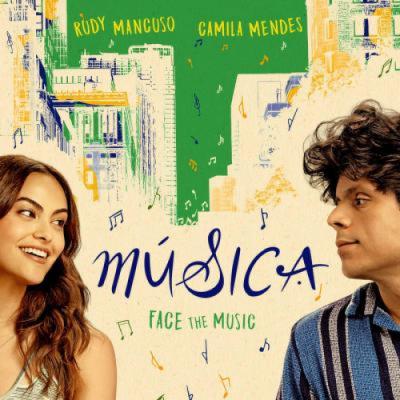
"Música" Soundtrack Lyrics
Movie • 2024
Track Listing
Jeff Meegan
Yossi Azulay
Martinho Da Villa
Rudy Mancuso
Fundo De Quintal
"Música (Original Motion Picture Soundtrack)" – Album Guide to Tracks and Key Scenes
Overview
What does it sound like when your whole neighborhood turns into a drum kit, and your love life keeps changing tempo mid-song? Música answers that question by turning Rudy Mancuso’s synesthetic perception into a full-blown film score, where every clink of cutlery or squeak of a subway door can spark a groove. The soundtrack becomes the inner voice of a young Brazilian-American artist trying to grow up without muting the noise inside his head.
The film follows Rudy in Newark’s Ironbound district as he juggles college, puppetry, busking, a breakup with his long-term girlfriend Haley, and a new spark with Isabella, another Brazilian-American who actually gets his condition. The score mirrors that emotional triangle: elastic rhythms when he is in flow, clipped fragments when he panics, bittersweet bossa shadings when family duties and romance collide. Every cue feels close-miked to his nervous system, not just to the plot.
Because Mancuso composes, directs, and stars, the soundtrack often blurs the line between diegetic and non-diegetic. Busking numbers start as music we hear on the street, then morph into stylized set-pieces inside Rudy’s head. Even short score cues like “Diner” or “Hospital” carry clear story beats: these are not anonymous background beds but mini-scenes set to tempo. The result is a rom-com that behaves, structurally, almost like a concept album about anxiety, heritage, and love.
Across the film, the soundtrack moves through phases. Early scenes lean on percussive, almost fidgety score cues and subway busker songs — urban clatter equals inner chaos. Mid-film, Brazilian samba, pagode, and bossa textures bring warmth and pressure at the same time, embodying family expectations and cultural pride. By the final stretches, more melodic, reflective pieces like “Isabella (Reprise)” and the title track “Música” loosen the groove into something steadier, signaling adaptation rather than rebellion or collapse.
How It Was Made
The soundtrack to Música is unusual in how tightly it connects to one person’s creative control. Rudy Mancuso not only wrote and directed the film but also composed the original score, co-writing the cues with showrunner Dan Lagana. The album Música (Original Motion Picture Soundtrack) collects these pieces, mostly short instrumentals and character songs built around hand percussion, syncopated piano, and vocal layers that echo Mancuso’s online musical sketches.
The film’s music grew directly out of Mancuso’s real-life synesthesia and his earlier short film on the subject. Instead of treating the condition as a gimmick, he and Lagana structured cues to arise from actual on-screen sounds: mugs on diner tables, knife work in the fish market, the hum of barbershop dryers. The team recorded many of these textures as rhythmic elements, then folded them into the score so that sound design and music blend organically rather than sit in separate boxes.
Milan Records released the official soundtrack album on April 4, 2024, the same day the film dropped on Prime Video, with 18 tracks focusing on Mancuso’s score work. Licensing and placement for additional songs — including Brazilian classics and synagogue music — had to thread the needle between authenticity and rights management; as noted in a soundtrack round-up, the production juggled U.S. studio systems with Brazilian catalogues and religious recordings from different territories. The end result keeps the sonic palette broad while still feeling like one person’s inner playlist.
Tracks & Scenes
Below are key tracks from the film and how they function in specific scenes. Times refer to the film runtime, not the album sequence.
“Only In New York (feat. Alex MacDougall)” — Jeff Meegan, David Tobin & Charley Harrison
Where it plays: Around 00:24, Rudy hangs by the food truck with his friend Anwar, the camera drifting over busy sidewalks and sizzling grills. The track plays non-diegetically, a polished, tourism-ready portrait of the city that contrasts with Rudy’s messy inner rhythm. Its big-band sheen and swinging groove sit over the street noise rather than coming from any visible speakers.
Why it matters: The song frames Newark through a slightly idealized “New York” lens, underlining Rudy’s limbo: he lives in a real neighborhood, but his dreams and anxieties belong to a different, more cinematic version of the city.
“Lecha Dodi” — Yossi Azulay feat. Enrico Macias
Where it plays: Around 00:33, Anwar works at his shop wearing a yarmulke, greeting customers with “Mazel tov” and easy humor while the tune echoes in the background. It plays diegetically as in-store music, folding Hebrew liturgical melody into the everyday bustle of their multicultural street.
Why it matters: The cue quietly reinforces the film’s multi-faith tapestry and shows how Rudy’s world already sounds like a mashup playlist, long before he writes a single note.
“Canta Canta, Minha Gente” — Martinho da Vila
Where it plays: First around 00:38, Rudy hands Anwar twenty dollars to borrow the food truck, and the classic samba track rides over the negotiation, the truck’s rattling, and Rudy’s nervous enthusiasm. Later, about 01:24, it returns when Rudy notices a food box on the table after a tough call with his mom, linking the tune with his Brazilian roots and emotional baggage. In both cases, it functions semi-diegetically, audible in the environment but mixed like score.
Why it matters: The song becomes a musical shorthand for “home” — joyful, communal, a little chaotic — and it underscores how family love can motivate and suffocate him at the same time.
“Mama” — Rudy Mancuso
Where it plays: At roughly 01:07, after a deeply awkward double date, Rudy heads out with Anwar. The cue starts with intimate instrumentation and gradually adds more rhythmic layers as the two friends decompress, talk, and wander through the neighborhood. It plays non-diegetically but feels like Rudy’s thoughts about his mother and expectations trailing behind him.
Why it matters: The track holds the tension between filial duty and self-determination. Its melody is tender, but the restless percussion hints that Rudy still cannot find a stable groove with his mom’s plans for him.
“Diner” — Rudy Mancuso
Where it plays: Around 00:03, the film opens in a bustling diner. Haley talks about their future while Rudy’s attention drifts to forks scraping plates and glasses clinking. The cue builds from those real sounds into an arranged pattern, as if the diner has become his internal metronome. It starts diegetically (pure ambience), then morphs into structured score when the rhythm takes over his perception.
Why it matters: This is the thesis statement of the soundtrack: ordinary noise is music to Rudy. It also shows why his relationships suffer — when the groove kicks in, words vanish.
“Change Your Ways (feat. Andy Muschietti)” — Rudy Mancuso
Where it plays: Around 00:05, a busker in the subway station — played in a sly cameo by director Andy Muschietti — performs this song live. Commuters shuffle by, some annoyed, some amused. Rudy registers the performance with a half-smile, the chords bouncing against passing trains and public announcements.
Why it matters: The tune mirrors Rudy’s own need to “change his ways” without selling out. It also hints at a lineage of director-musicians and easter-egg casting that the film enjoys.
“S**t” — Rudy Mancuso
Where it plays: At roughly 00:14, Rudy sulks in his bedroom after his mother arranges a date with a Brazilian girl he has never met. He starts thumping on furniture, turning frustration into a groove, and the cue locks onto that beat. Lights flicker to his rhythm, and the room briefly becomes a one-man percussion ensemble.
Why it matters: The piece captures how Rudy uses rhythm to process embarrassment and anger. Instead of dialogue-heavy venting, we get a raw, percussive tantrum that feels both comic and painfully honest.
“Fish Market” — Rudy Mancuso
Where it plays: Around 00:15, the film jumps into the fish market kitchen. Knives chop, pans hiss, orders fly. Rudy weaves through the workers, overwhelmed but fascinated, and then spots Isabella amid the chaos. The cue syncs exactly with chopping and sliding trays, gradually shifting focus from industrial noise to the flutter of Rudy’s heartbeat when he sees her.
Why it matters: This is the film’s “meet-cute as groove.” The track translates romantic attraction into syncopation, showing how falling in love for Rudy literally changes how the world sounds.
“Ironbound Fair” — Rudy Mancuso
Where it plays: Around 00:21, a band performs at the fair, with bright lights, kids’ rides, and flags everywhere. The camera roams through stalls and faces as the cue blends live brass and drum hits with stylized mix elements. It plays diegetically from the stage but gets sweetened in the mix to feel slightly heightened and dreamlike.
Why it matters: The piece functions as a love letter to Newark’s Ironbound — loud, mixed, and proud. It anchors Rudy’s identity not just in private angst but in a very specific, communal place.
“The Park” — Rudy Mancuso
Where it plays: Around 00:29, Rudy takes Isabella to the park and tries to explain how he “hears” the environment. Dogs bark, kids shout, swings creak; the cue slowly aligns each sound into a pattern. Isabella initially laughs and says she cannot hear what he does, but the music makes us feel his perception anyway.
Why it matters: This track is the emotional bridge between them. It shows his vulnerability — he risks sounding “weird” — and her willingness to listen, even if she cannot fully share his experience.
“Maria’s Salon” — Rudy Mancuso
Where it plays: Around 00:22, Rudy sits in the beauty salon while the women around him gossip, tease, and try to cheer him up. Hair dryers, spray bottles, and clacking heels all feed the rhythm, which stays light and playful. The cue feels half like a samba rehearsal, half like a family intervention scored for hair tools.
Why it matters: The track gives Maria and her circle their own musical language — warm, pushy, and very Brazilian. It softens the pressure they put on Rudy by framing it as affectionate noise rather than pure nagging.
“Hospital” — Rudy Mancuso
Where it plays: Around 00:40, after Rudy gets accidentally shot, the film plunges into the disorienting world of the emergency room. Beeping monitors, curtain swishes, and rushed footsteps melt into the cue’s uneasy pulse. For once the rhythm feels more threatening than playful; even Rudy’s synesthetic brain seems stunned into slower, heavier patterns.
Why it matters: This is the soundtrack’s “near-silence” moment. The music does not comfort — it underscores the real physical stakes of Rudy’s drifting, impulsive life.
“Rhythm of Lies” — Rudy Mancuso
Where it plays: At about 00:46, Rudy sits alone in his room after replying to a text from Haley. He juggles phones, messages, and promises, and the cue builds from a simple motif into a tangled rhythmic lattice. Percussion loops overlap like competing obligations; his tap patterns stumble as the lies stack up.
Why it matters: The track is basically guilt set to 4/4. It sonically maps how small omissions become full-blown deception, one extra layer of rhythm at a time.
“Loser Montage” — Rudy Mancuso
Where it plays: Around 01:18, we get a montage of Rudy’s repetitive daily routine: waking late, scrolling, half-heartedly busking, dodging conversations with his mother. The music loops with subtle variations, like a track stuck on repeat with tiny tweaks, mirroring his sense of being stuck in life.
Why it matters: The piece captures burnout without a single speech. By the end of the montage, the groove feels stale on purpose, daring him — and us — to demand a key change.
“I’m a Bitch (feat. Diego The Puppet)” — Rudy Mancuso
Where it plays: At around 01:22, Rudy performs at a puppet show, using his foul-mouthed puppet Diego as a proxy to air his frustrations. The song is bold, sarcastic, and riff-heavy, with call-and-response between Rudy’s vocals and the puppet’s interjections. The audience laughs, but the lyrics land a little too close to his real relationships.
Why it matters: This number is both comic highlight and emotional x-ray. It exposes how Rudy hides behind performance, using music and puppetry to say what he cannot as himself.
“Isabella (Reprise)” — Rudy Mancuso
Where it plays: Around 01:13, back at the fish market, Rudy plays this piece directly for Isabella. Machinery hums quietly in the background, but the mix favors his melody and her face. The cue slows things down, trading busy polyrhythms for a clearer, more lyrical line as they finally acknowledge what they mean to each other.
Why it matters: It is the emotional core of the love story: the moment when his music stops being self-protection and becomes an honest offering.
“Música” — Rudy Mancuso
Where it plays: Around 01:24 and into the end credits, the title track ties together the film’s motifs. We hear fragments of earlier rhythms reassembled into a more confident structure, as if Rudy has finally learned to conduct his own noise instead of drowning in it.
Why it matters: As end-credit songs go, this one feels like a curtain call and a manifesto: the world will always be loud; the trick is to make that loudness feel like home.
Notes & Trivia
- Rudy Mancuso’s own mother, Maria Mancuso, plays Rudy’s mother in the film, blurring the line between autobiography and fiction.
- Director Andy Muschietti, best known for big studio genre films, appears as the subway busker singing “Change Your Ways.”
- The Ironbound neighborhood of Newark is not just a backdrop; many cues are named directly after its locations, like “Ironbound Fair” and “Fish Market.”
- The official soundtrack album focuses on score pieces, while several licensed tracks — including Martinho da Vila’s samba classic — appear only in the film mix.
- Because so many rhythms derive from practical sounds, the border between sound design and score is thin; some sequences could be classified as either.
- Milan Records released the album the same day the film hit Prime Video, a move that helped the score circulate quickly in streaming playlists.
- The film premiered at South by Southwest, a festival known for music-heavy titles, which fits almost too perfectly.
Music–Story Links
One way to “read” the soundtrack is to watch how Rudy’s emotional state shifts from chaotic to more coherent. In the opening diner scene scored by “Diner,” his inner rhythm drowns out Haley’s concerns; by the time “Isabella (Reprise)” plays, that rhythm finally aligns with another person instead of fighting them. The musical arc traces a path from isolation to connection.
Character turns often hinge on specific songs. When “S**t” erupts in his bedroom, we see a young man still responding to pressure with adolescent outbursts. Later, the playful textures of “Maria’s Salon” and “Mama” show a more complex understanding: he can resent his mother’s interference and still recognize the warmth inside that noise. The score lets us feel both at once.
Romantic beats also come wrapped in distinct musical signatures. Isabella enters Rudy’s life through “Fish Market” and “The Park,” cues that blend clatter with delicate motifs; her presence literally changes how the city sounds. In contrast, Haley’s part of the story leans on tracks like “Rhythm of Lies” that twist around themselves, matching the emotional knots of half-truths and delayed conversations.
Even supporting characters get musical fingerprints. Anwar’s intersection of Jewish identity and Brazilian-inflected New Jersey life arrives with “Lecha Dodi” and “Only in New York” in his orbit, marking him as a friendly bridge between worlds. When the film hits its darker turning point in “Hospital,” all those playful textures fall away, and the sparse pulse underlines how fragile Rudy’s improvisational lifestyle really is.
Reception & Quotes
Música landed surprisingly hard with critics. On release, it scored in the mid-90s on aggregate sites, earning a “Certified Fresh” tag and even a spot among the top romance films of 2024 in year-end awards lists. Critics repeatedly singled out the soundtrack as the film’s big swing: not just catchy, but a genuine attempt to translate synesthesia into cinematic form.
One reviewer described the film as “a visually and musically inventive rom-com that announces a new filmmaker-musician worth watching,” highlighting how the score and staging work together rather than as separate departments. Another critic framed it as a “love story, musical numbers, and a celebration of Brazilian culture,” pointing to the way samba, bossa nova, and street rhythms weave through both comedy and drama.
“Música feels like stepping inside one person’s playlist-brain, then realizing you recognize half the songs as your own feelings.” — Festival critic commentary
“The soundtrack turns Newark’s Ironbound into a living metronome, where every clink and shout lands on beat.” — Online review summary
“Even when the rom-com plot feels familiar, the music keeps surprising you.” — Trade outlet capsule
Audience reactions have been similarly warm, especially among viewers who live with neurodivergent sensory experiences. Many pointed out that the soundtrack, more than any single speech, made them feel seen. Availability-wise, the score album streams widely on major platforms, while the Brazilian and liturgical cuts are mostly found on their own artist catalogues or in curated playlists tied to the film.
Interesting Facts
- The title track “Música” folds in motifs from earlier cues, so listening to the album straight through feels like hearing the film’s emotional outline in miniature.
- Andy Muschietti’s cameo as a subway busker doubles as a nod to his collaboration with Mancuso on previous projects, including music video work.
- Some of the percussion layers were built from on-set recordings of real diner and fish market sessions, then looped and pitched like sample packs.
- Bossa and samba cues were deliberately placed in scenes where Rudy feels torn between moving forward (college, work) and staying close to his mother and community.
- The film’s South by Southwest premiere reinforced its identity as a music-first project; early buzz often centered more on the rhythmic set-pieces than on the love triangle.
- Several score tracks, like “Fish Market” and “Ironbound Fair,” became popular on short-form video platforms, where users cut their own “everyday sounds as rhythm” clips to them.
- The soundtrack’s mix of English and Portuguese lyrics mirrors the bilingual dialogue pattern of the film; it never fully settles into one language or the other.
- Milan Records positioned the album alongside other character-driven scores, reinforcing its identity as a personal project rather than a generic studio commission.
Technical Info
- Title: Música (Original Motion Picture Soundtrack)
- Year: 2024
- Type: Original motion picture soundtrack / score for the feature film Música
- Film: Música — American coming-of-age romantic comedy about a synesthetic Brazilian-American musician in Newark
- Composer: Rudy Mancuso (co-writing many cues with Dan Lagana)
- Primary styles: Rhythmic score built from environmental sounds, Brazilian samba and pagode influences, light pop ballad elements, busking-style acoustic songs
- Production companies (film): Amazon MGM Studios, Wonderland Sound and Vision, Big Indie Pictures, Shots Studios
- Distributor: Amazon Prime Video (worldwide streaming)
- Label (album): Milan Records
- Original album release date: 4 April 2024 (digital)
- Film festival premiere: South by Southwest (SXSW) — March 2024
- Runtime (film): approx. 91 minutes
- Languages: English and Portuguese
- Availability: Score album on major streaming platforms; film on Prime Video; some licensed tracks available only via artists’ own releases
- Notable placements: “Canta Canta, Minha Gente” over key food-truck and post-call moments; “Lecha Dodi” in Anwar’s shop; “I’m a Bitch” at the puppet show; “Música” over end credits
Questions & Answers
- How does the Música soundtrack use synesthesia as a creative engine?
- Instead of just “telling” us Rudy has synesthesia, the score literally turns street sounds, kitchen work, and hospital noise into rhythmic patterns that drive each cue.
- Is the Música album mostly songs or score?
- The official album leans heavily toward score and character pieces by Rudy Mancuso, while several Brazilian classics and other songs appear only in the film mix.
- Where can I hear the Brazilian songs from the movie?
- Most samba and pagode tracks, like Martinho da Vila’s contributions, live in the artists’ own catalogues and show up in editorial playlists rather than on the main score album.
- Does Rudy Mancuso really experience synesthesia like his character?
- Yes. Interviews and profiles describe him as a synesthete, and the soundtrack grows directly out of his attempts to translate that experience into film form.
- Why do some soundtrack cues feel like sound design more than music?
- That overlap is deliberate. The team recorded environmental audio on set and built rhythmic layers from it, so what you hear often exists halfway between foley and score.
Canonical Entities & Relations
| Subject | Verb | Object |
|---|---|---|
| Rudy Mancuso (person) | directs | Música (2024 film) |
| Rudy Mancuso (person) | composes music for | Música (Original Motion Picture Soundtrack) |
| Rudy Mancuso (person) | portrays | Rudy (protagonist) |
| Dan Lagana (person) | co-writes | Música screenplay and score cues |
| Camila Mendes (person) | portrays | Isabella (love interest) |
| Francesca Reale (person) | portrays | Haley (girlfriend) |
| J.B. Smoove (person) | portrays | Anwar (friend and food-truck owner) |
| Maria Mancuso (person) | portrays | Maria (Rudy’s mother) |
| Amazon MGM Studios (organization) | produces | Música (2024 film) |
| Wonderland Sound and Vision (organization) | co-produces | Música (2024 film) |
| Big Indie Pictures (organization) | co-produces | Música (2024 film) |
| Shots Studios (organization) | co-produces | Música (2024 film) |
| Amazon Prime Video (organization) | distributes | Música (2024 film) |
| Milan Records (organization) | releases | Música (Original Motion Picture Soundtrack) |
| Música (2024 film) | premieres at | South by Southwest Film Festival (Austin, Texas) |
| Música (2024 film) | is set in | Newark, New Jersey (Ironbound neighborhood) |
| Música (Original Motion Picture Soundtrack) | features | score cues like “Diner”, “Fish Market”, “Rhythm of Lies”, “Música” |
| Martinho da Vila (person) | performs | “Canta Canta, Minha Gente” (licensed track in film) |
| Yossi Azulay & Enrico Macias (people) | perform | “Lecha Dodi” (licensed track in film) |
Sources: Soundtrack scene timelines, festival and release data, and album details are consistent with film credits, soundtrack databases, and editorial reviews from major outlets.
November, 16th 2025
A-Z Lyrics Universe
Cynthia Erivo Popular
Ariana Grande Horsepower
Post Malone Ain't No Love in Oklahoma
Luke Combs Good Riddance (Time of Your Life)
Green Day Bye Bye Bye
*NSYNC You're the One That I Wan
John Travolta & Olivia Newton-John I Always Wanted a Brother
Braelyn Rankins, Theo Somolu, Kelvin Harrison Jr. and Aaron Pierre The Power of Love
Frankie Goes to Hollywood Beyond
Auli’i Cravalho feat. Rachel House MORE ›