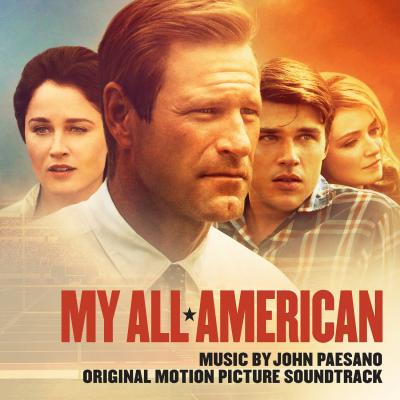
"My All American" Soundtrack Lyrics
Movie • 2015
Track Listing
Don Covay
The Outsiders
Stix Randolph
Buck Owens
Alan Gordon and Garry Bonner
Tommy Roe
The 13th Floor Elevators
The Razorback Marching Band
Sam The Sham
Sir Douglas Quintet
Jeremy Sweet
Billy Walker
The University of Texas Longhorn Band
The University of Texas Longhorn Band
The University of Texas Longhorn Band
The University of Texas Longhorn Band
"My All American (Original Motion Picture Soundtrack)" – Album Guide to Tracks and Key Scenes

Overview
What does a college fight song have in common with a cancer ward? In My All American, the answer is simple — both are scored as acts of courage. The 2015 film tells the story of Texas Longhorns safety Freddie Steinmark, while the accompanying soundtrack album frames his journey in brass, snare rolls and strings that swell right up to the operating-room doors.
The movie itself is a straightforward biographical sports drama: high school overachiever Freddie fights his size, wins a scholarship to the University of Texas, becomes a defensive standout and then runs into the opponent he cannot tackle — osteosarcoma. The score by John Paesano and a tapestry of 1960s source songs try to make that path feel less like a history lesson and more like standing on the sideline, shoulder pad to shoulder pad, as everything unravels and somehow still uplifts.
Across the film, the soundtrack acts as a kind of emotional narrator for head coach Darrell Royal’s memories. Opening cues place us in Royal’s older perspective, talking to a young reporter; from there the music follows his recollection back through Freddie’s high-school fields, Austin dorm rooms, the “Game of the Century” versus Arkansas, and the quieter hospital corridors that follow. The album mirrors that arc, building from compact, punchy cues into longer, heavier tracks as the story darkens.
What distinguishes this soundtrack is how overtly it leans into classic sports-score language — bold brass fanfares, rhythmic ostinatos, heroic themes — but offsets that with period needle-drops: garage rock, country hits, marching-band standards and college fight songs. That combination pushes the film away from generic “inspirational” wallpaper and closer to a specific time and place: late-1960s Texas, where stadium culture and small-town piety overlap on Friday nights.
In genre terms, you can almost chart Freddie’s arc as a series of musical phases. Early high-school scenes run on brisk orchestral writing with a hint of youthful optimism; the university practices introduce more aggressive, almost martial brass and drum lines to match the grind of training. Classic 60s pop and garage rock — songs like “Wooly Bully”, “She’s About a Mover” and “Happy Together” — color social scenes and road moments with period swagger, while country tracks such as “I’ve Got a Tiger by the Tail” reflect the rural, working-class roots around him. By the final act the score retreats towards strings, piano and slower thematic statements, underscoring illness, faith and the way Freddie’s example outlives his playing career.
How It Was Made
The score was written by American composer John Paesano, best known today for the Maze Runner films and later work on the Spider-Man games, but at the time still in the phase of building a reputation in sports and inspirational drama. Here he delivers a full, orchestral score released as a standalone album under Sony’s classical/soundtrack imprint. The recording clocks in at just under 62 minutes and was produced as a traditional cue-based film score rather than a compilation of songs.
Structurally, the album follows the film in chronological order. Cue titles — “High School”, “Lakewood Game”, “University of Texas”, “Arkansas First Half”, “Coach’s Halftime Speech”, “Texas Wins”, “Bad News” and the closing “My All American” — read almost like chapter headings for Freddie’s biography. That makes the record unusually easy to navigate if you know the story; each track effectively tags a distinct narrative beat.
Stylistically, the writing sits in a lineage of big, brassy American sports scores: strong main themes, clear harmonic progressions, and a preference for melodic statements over sound design. One review specifically called out how clearly you can hear the influence of Jerry Goldsmith’s football work — think Rudy, but scaled up a notch in bombast for the Longhorns’ stadium environment. At the same time, Paesano weaves in gentler cues for home scenes and romantic moments with Linda, usually led by strings and piano.
On the song side, music supervisor Randall Poster — a veteran known for his work with filmmakers like Wes Anderson — clears and curates the period cuts. The film uses 1960s pop, rock, country and regional tunes: “Pony Time”, “Wooly Bully”, “Time Won’t Let Me”, “She’s About a Mover”, “Sweet Pea”, “Funny How Time Slips Away”, “Earthquake”, “Happy Together”, “I’ve Got a Tiger by the Tail”, “Remo Warrior” and multiple college fight songs by the University of Texas Longhorn Band and the Razorback Marching Band. Not all of these appear on the score album; some remain film-only or are documented mainly via lyric archives and soundtrack databases.
The promotional campaign adds another layer: the first main trailer makes heavy use of third-party trailer music. Early in the spot you can hear “Elevate” by Gyom, a dramatic hybrid-orchestral track from the Position Music catalog, and from about the last minute onward, Tyrone Wells’ song “Overcome” kicks in, laying a vocal anthem over quick-cut football and hospital imagery. Those tracks sit alongside Paesano’s score but live only in marketing materials, not on the official album.
Tracks & Scenes
Because some official cue placements and timestamps are not exhaustively documented in public databases, the descriptions below focus on clearly identifiable moments signposted by cue titles, plot structure and known song credits, rather than minute-and-second timecodes. Where exact timings are unclear, that is noted rather than guessed.
“Coach Remembers Freddie” — John Paesano
Where it plays: This opening cue supports the frame story: an older Darrell Royal being interviewed by a student reporter about his greatest player. The music starts understated, almost nostalgic, under quiet dialogue in Royal’s office, then slowly introduces the main theme as he names Freddie Steinmark and the film dissolves into extended flashback. The cue is relatively short, matching the prologue.
Why it matters: It establishes that the story will be told through Royal’s memory, not just Freddie’s perspective, and introduces the core theme that will return in both triumphant and tragic contexts.
“High School” — John Paesano
Where it plays: Used over early scenes of Freddie in Colorado, training with his father, attending classes and playing high-school football with his friend Bobby. The cue sits over practice drills, family dinners and the first sense that he is undersized but relentless. The music shifts between light rhythmic writing for the training and warmer harmonies for home life.
Why it matters: It paints Freddie’s work ethic as something built long before the University of Texas calls, contrasting small-scale fields with big-league dreams.
“Lakewood Game” — John Paesano
Where it plays: During one of Freddie’s key high-school games, often referred to as the Lakewood matchup. The cue underlines a full game sequence: crowd noise, snaps of the ball, and repeated defensive stands where Freddie’s tackling starts to stand out to the coaches in the stands. Pacing alternates between tense, stuttering rhythms between plays and fuller thematic hits when big tackles land.
Why it matters: This is where the film signals that scouts and Coach Royal’s staff are beginning to see something special, turning a local game into a turning point for Freddie’s future.
“University of Texas” / “Full Ride” — John Paesano
Where it plays: These back-to-back cues cover the move to Austin: arrival on campus, seeing the stadium, meeting new teammates and hearing about the scholarship offer. You typically hear them over shots of the burnt-orange crowd, marching band rehearsals and the first impressions of a much larger football machine.
Why it matters: Musically, this is where the score widens out; brass gets bigger, percussion becomes more militaristic, and the main theme now feels like a team anthem instead of a private melody.
“First Practice” / “Second Practice” — John Paesano
Where it plays: These cues track Freddie’s early practices under Coach Royal. We see drills under a hot Texas sun, mistakes, corrections and incremental respect from teammates. The camera often stays tight on Freddie’s face as he absorbs hits and gets back up; the music keeps a relentless forward motion, mirroring that grind.
Why it matters: They sonically encode the “heart over size” theme — the music never collapses into pity, even when Freddie is clearly overmatched physically.
“Texas Vs” — John Paesano
Where it plays: This cue underscores one of the Longhorns’ key regular-season games, cutting between offensive drives, defensive stands and sidelines strategy. Camera work focuses on the chaos at field level, with the score providing a clear structure as the game narrative swings back and forth.
Why it matters: It’s one of the album’s more expansive action pieces, and it smooths what could have felt like disconnected play-by-play into a single, rising musical arc.
“Arkansas First Half” / “Coach’s Halftime Speech” — John Paesano
Where it plays: In the film’s re-creation of the 1969 “Game of the Century” against Arkansas, the first cue covers the tense, mistake-ridden first half. At halftime, as the team regroups in the locker room, the music briefly thins out to let the coach’s speech breathe, then swells when he calls on perseverance and discipline.
Why it matters: The pair form the core of the film’s sports-movie engine: doubt, regrouping and renewed belief, all while Freddie begins to feel worsening pain in his leg.
“Freddie Caught Holding” / “Texas Wins” — John Paesano
Where it plays: These cues span the decisive Arkansas sequence: a controversial holding call against Freddie that briefly makes him the villain in the stadium’s eyes, and the final Longhorns comeback and victory. The music alternates between harsh, dissonant bursts for the penalty and a cathartic restatement of the main theme when Texas closes out the win.
Why it matters: They embody the film’s idea that Freddie’s legacy is not just about clean heroism; even his lowest public moment is folded into the legend when people remember his overall heart and drive.
“Bad News” / “Coach Tells Team” — John Paesano
Where it plays: After medical tests confirm Freddie’s cancer, the score shifts into these slower, more solemn cues. We see hospital rooms, worried parents, Linda’s shock and the brutal reality of an amputation. In parallel, another cue follows Coach Royal informing the team, with a quiet, almost reverent atmosphere in the locker room.
Why it matters: The music deliberately avoids syrupy sentiment; it strips away percussion and keeps harmonies relatively simple, making room for raw performances rather than manipulating tears.
“My All American” — John Paesano
Where it plays: The final cue plays over the closing montage and epilogue: Freddie’s later impact, archival stills, and Royal’s summing up of what the young player meant to him and to the program. The theme reaches its fullest orchestration here, functioning as a eulogy more than a victory song.
Why it matters: It reframes the title line — “my All American” — as a personal, relational statement, not a statistic or award, underlining what the film most wants to say.
Songs & diegetic moments
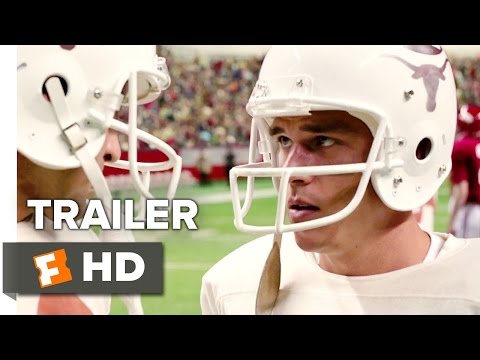
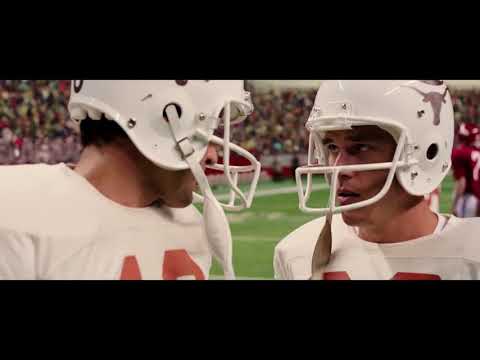
“Texas Fight” — The University of Texas Longhorn Band
Where it plays: Heard diegetically at home games, with the Longhorn Band on the field and the crowd chanting along. The film uses it over marching formations, players running out of the tunnel and cutaways to the student section.
Why it matters: It anchors the movie in a very specific collegiate culture; this isn’t a generic “State” team, it’s the UT program, with all of its rituals and noise.
“Texas Texas Yeehaw” / “Full Cadence Run” / “Cadence #1” — The University of Texas Longhorn Band
Where it plays: Various pre-game, in-game and post-game marching-band cadences and chants, generally heard as on-screen performance during campus or stadium scenes.
Why it matters: These cues give the film texture: you hear snare lines and shouted refrains behind dialog, making the stadium sequences feel more like a real Saturday in Austin.
“Arkansas Razorbacks Fight Song Medley” — The Razorback Marching Band
Where it plays: During the Arkansas game scenes, usually when the camera shifts to the opposing crowd and sideline.
Why it matters: It gives the climactic game a sense of being contested territory, not just another home-crowd celebration.
“Pony Time” — Don Covay
Where it plays: Used as a period dance/party track in early sections of the film, likely during lighter social scenes around the team and friends. It comes from the early-60s dance-craze era and is treated as source music rather than score.
Why it matters: It helps sell the era — jukebox energy, simple groove, teenagers blowing off steam before the more serious chapters of Freddie’s life.
“Wooly Bully” — Sam the Sham & the Pharaohs
Where it plays: Dropped into one of the more chaotic, celebratory moments around football success — think locker-room goofing or post-game celebrations — with its shouted count-off and organ riff spilling over quick cuts.
Why it matters: The song’s rough, garage-band sound contrasts nicely with Paesano’s polished orchestral writing, reminding us that Freddie’s world is still young, loud and a bit messy even in the shadow of big-time football.
“She’s About a Mover” — Sir Douglas Quintet
Where it plays: Used in a Texas-set context, often to accompany driving shots, parties or campus life. Its Tex-Mex rock feel meshes with the regional setting more than a random national hit would.
Why it matters: It is one of the soundtrack’s more locally flavored choices, grounding the movie in a particular musical geography, not just the national charts.
“Time Won’t Let Me” — The Outsiders
Where it plays: Appears over a montage where time accelerates — practices, games, dates with Linda and the sense that the season is racing by. Exact timestamps vary by cut, but it is used as non-diegetic energy under dissolved shots.
Why it matters: Lyrically and sonically, it foreshadows the way Freddie is always racing the clock, even before he knows it.
“Sweet Pea” — Tommy Roe
Where it plays: Heard during a light, romantic beat between Freddie and Linda — a dance, a date or a small-town gathering early in their relationship.
Why it matters: It frames their bond as something bright and innocent, which later contrasts sharply with hospital scenes underscored only by score.
“Funny How Time Slips Away” — Billy Walker (song by Willie Nelson)
Where it plays: Used as reflective source music in a quieter section, likely tied to moments when characters look back on how fast Freddie’s rise has been. The crooning vocal sits low in the mix.
Why it matters: The title could not be more on-the-nose for a story that rushes from high-school games to life-altering surgery in just a few seasons.
“Earthquake” — 13th Floor Elevators
Where it plays: Briefly, in a scene needing a sharper, more psychedelic edge — a student-life beat, or a hint of the broader 60s counterculture on campus.
Why it matters: It’s one of the few song choices that nods to the wilder side of the decade, even though the film largely stays inside a clean-cut, conservative bubble.
“Happy Together” — written by Alan Gordon & Garry Bonner
Where it plays: The film uses the pop standard in some form (the lyrics are documented with the soundtrack), most likely over a montage or gentle romantic scene involving Freddie and Linda.
Why it matters: The irony is hard to miss: the upbeat hook about lifelong togetherness sits in a story where that promise cannot be fulfilled in the usual way.
“I’ve Got a Tiger by the Tail” — Buck Owens
Where it plays: Slotted into a football-adjacent moment, playing up the idea of facing something powerful and barely under control — an opponent, a season, or even Freddie’s rising fame.
Why it matters: It’s a clever thematic fit for a defensive back trying to hang on in a league of bigger bodies.
“Remo Warrior” — Stix Randolph & Bart K. Hendrickson
Where it plays: Used more like underscore but with a rock edge, likely over intense training or game action.
Why it matters: It’s an example of the soundtrack blurring lines between pure score and licensed track, keeping the energy level high without always reverting to orchestra.
Trailer-only tracks
“Elevate” — Gyom (Position Music)
Where it plays: Dominates roughly the first minute of at least one theatrical trailer, over quick-cut shots of childhood training, early college practices and slow-motion tackles. The track is not present in the film itself.
Why it matters: It shows how marketing leans on modern trailer-music tropes — big risers, percussion drops — even when the actual film score is more traditional.
“Overcome” — Tyrone Wells
Where it plays: Kicks in later in that trailer, especially over images of surgery, rehab and Freddie cheering from the sidelines post-operation.
Why it matters: As the title suggests, it sells the film as an “overcoming adversity” story in under a minute, condensing the emotional arc more bluntly than the film and album do.
Notes & Trivia
- The score album is a pure orchestral release: none of the 1960s pop or country songs appear on it, despite their prominence on screen.
- The album was released on Sony’s classical/soundtrack label within weeks of the film’s U.S. theatrical debut, with a running time just under 62 minutes.
- Most cue titles double as plot summaries, so listening blind you can (roughly) reconstruct the film’s story beat by beat.
- The movie’s marketing leaned on modern trailer tracks — Gyom and Tyrone Wells — that never show up in the main feature.
- Among critics, the score has often been singled out as a highlight even by reviewers who disliked the film itself.
Music–Story Links
When Royal tells a reporter that Freddie “was my All American”, the opening cue immediately backs him up: “Coach Remembers Freddie” introduces a noble but slightly fragile theme that feels less like a team anthem and more like one man’s private memory. As that theme reappears during home scenes, big games and hospital moments, the music quietly insists that the same character is present in all three.
The practice cues (“First Practice”, “Second Practice”) play a structural role beyond pure montage backing. Their relentless drive, with repeated rhythmic figures and very little harmonic wandering, mirrors Freddie’s self-image: keep moving, keep hitting, do not overthink. When the score finally allows that rhythm to break — particularly in “Bad News” — the silence between notes hits harder precisely because we have been trained to expect constant motion.
Game cues like “Texas Vs”, “Arkansas First Half” and “Texas Wins” are built around variations on the main theme, but they also subtly adjust the harmony and orchestration to track Freddie’s body. Early in the season, the brass voicings are clean, confident, almost swaggering; as his leg deteriorates, the same motifs come back in darker colors, with lower strings and less sparkle, even when the team itself is winning.
The choice of songs also maps onto character positioning. “Pony Time” and “Sweet Pea” wrap Freddie, Linda and their circle in the sort of all-American, clean teen-pop image that the film clearly endorses. By contrast, tracks like “Earthquake” hint at a version of the 1960s that barely appears on screen — a reminder that there was a louder, stranger world just off camera, one the characters largely ignore.
Fight songs and cadences are treated almost like a collective character. “Texas Fight” and the Longhorn Band cadences are diegetic, but because they appear so often underneath emotional turning points — players running out of the tunnel, Royal giving instructions, the camera finding Freddie on the sideline with his crutches — they end up functioning like a second score. In a sense, the film has two musical narrators: Paesano’s orchestra and the band in the stands.
Reception & Quotes
The film itself received mixed-to-negative reviews from critics, with several outlets complaining about its conventional structure and overt sentimentality, even as audiences graded it much more warmly. Within that context, the score often emerges as a point of consensus praise, mentioned as one of the elements that lifts the material above pure formula.
One specialist soundtrack site described the score as one of the more bombastic football scores of its era and highlighted its clear debt to Jerry Goldsmith’s classic sports writing, while still treating that influence as a strength rather than a flaw. A film-music awards roundup the following year singled it out with an honorable mention among the year’s stronger dramatic scores.
The orchestral score beautifully captures the essence of friendship, love and the pursuit of one’s dreams, turning a familiar sports story into something emotionally bigger. — user review on a soundtrack database
As a sports score it’s easy to appreciate: bold themes, big crescendos and a beating heart you can follow from the first cue. — review on a dedicated film-music site
By contrast, some general-audience reviewers felt the mixture of pop songs and score cues could be on-the-nose. One comment on a European soundtrack listing argued that certain songs did not always match the tone of the scenes and occasionally pulled them out of the film. That kind of complaint is relatively rare, but it does underline that not every viewer hears the period cuts as seamless.
The soundtrack, like the film, plays the uplift straight — but it’s hard to deny the charge when the horns and drums kick in on those goal-line stands. — paraphrased from a newspaper review
Interesting Facts
- The physical CD and digital score album follow the story order very closely, which is not always the case with sports-film soundtracks.
- The cue “Texas Wins” is short but has become the go-to track on streaming platforms for listeners who want the “victory hit” without playing the whole album.
- Gyom’s “Elevate” and Tyrone Wells’ “Overcome” are effectively part of the extended soundtrack ecosystem, but exist only in trailers and artist catalogs, not on any official My All American album.
- The Longhorn Band’s presence in the music mirrors their cultural role at the real University of Texas — they are treated almost as co-stars in stadium sequences.
- Because many of the film’s songs are older catalog titles, fans often rediscover 60s tracks like “She’s About a Mover”, “Sweet Pea” and “Time Won’t Let Me” through fan-made playlists rather than an official song compilation.
- The score has cropped up in “best sports scores of the 2010s” lists among film-music enthusiasts, even when the film itself is absent from broader best-sports-movie rankings.
- Several European library and retail listings categorize the album under “Stage & Screen” rather than “Pop/Rock” or “Easy Listening”, which affects how it’s discovered in some catalog systems.
- The soundtrack release helps document the film’s structure even for people who have never seen it — the track names alone map out Freddie’s life from “High School” to “Welcome Back”.
Technical Info
- Title: My All American (Original Motion Picture Soundtrack)
- Film: My All American (2015 biographical sports drama)
- Year of soundtrack release: 2015 (CD/streaming rollout around the U.S. theatrical release)
- Type: Film score album (orchestral), with separate in-film use of licensed songs
- Composer: John Paesano
- Music supervisor (film): Randall Poster
- Main label: Sony Classical / Sony Masterworks (European and North American distribution)
- Running time: Approximately 61–62 minutes for the score album
- Key orchestral cues: “Coach Remembers Freddie”, “High School”, “Lakewood Game”, “University of Texas”, “Texas Vs”, “Arkansas First Half”, “Coach’s Halftime Speech”, “Freddie Caught Holding”, “Texas Wins”, “Bad News”, “My All American”
- Notable licensed songs in film: “Pony Time”, “Wooly Bully”, “Time Won’t Let Me”, “She’s About a Mover”, “Sweet Pea”, “Funny How Time Slips Away”, “Earthquake”, “Happy Together”, “I’ve Got a Tiger by the Tail”, “Remo Warrior”, “Texas Fight”, “Texas Texas Yeehaw”, “Arkansas Razorbacks Fight Song Medley”
- Trailer-only tracks: “Elevate” (Gyom, Position Music) and “Overcome” (Tyrone Wells) in at least one main trailer
- Release context: Coincided with the film’s U.S. theatrical run; the score later appeared on major streaming services as a standalone album.
- Availability: Widely available on streaming platforms (often under the “Original Motion Picture Score” label) and on CD via soundtrack retailers and online marketplaces.
- Chart/award notes: Not a mainstream chart hit, but cited in specialist film-music circles and given honorary mentions in year-end score lists.
Questions & Answers
- Is the My All American soundtrack mainly score or songs?
- The official album is almost entirely John Paesano’s orchestral score. The 1960s songs used in the film are licensed separately and, for the most part, are not part of the album.
- Can I get all the movie’s songs, including “Wooly Bully” and “Happy Together”, on one official release?
- No single, official compilation brings the score and every song together. Fans usually rely on fan-curated playlists combining the Paesano album with individual catalog tracks from streaming services.
- How does this score compare to other football films like Rudy or Hoosiers?
- Tonally it sits in the same inspirational space — big themes, clear emotional signposts — but leans a bit more into stadium-scale bombast, with heavier brass and percussion during game sequences.
- Are the trailer songs part of the canonical soundtrack?
- They are part of the wider musical identity of the project, but not of the official score album. “Elevate” and “Overcome” are licensed for marketing and live on their own releases.
- Does the music emphasize the faith element of Freddie’s story?
- The film’s writing and imagery address faith directly; the score mostly approaches it indirectly, using uplifting harmonies and warm string writing rather than overt religious musical tropes.
Canonical Entities & Relations
| Subject | Relation | Object |
|---|---|---|
| My All American (film) | is directed by | Angelo Pizzo |
| My All American (film) | is based on | Courage Beyond the Game: The Freddie Steinmark Story by Jim Dent |
| My All American (film) | is scored by | John Paesano |
| My All American (film) | is produced by | Anthem Productions |
| My All American (film) | is produced by | Paul Schiff Productions |
| My All American (film) | is distributed by | Clarius Entertainment |
| Freddie Steinmark (character) | is portrayed by | Finn Wittrock |
| Darrell Royal (character) | is portrayed by | Aaron Eckhart |
| Linda Wheeler (character) | is portrayed by | Sarah Bolger |
| Gloria Steinmark (character) | is portrayed by | Robin Tunney |
| My All American (Original Motion Picture Soundtrack) | is composed by | John Paesano |
| My All American (Original Motion Picture Soundtrack) | is released by | Sony Classical / Sony Masterworks |
| Randall Poster | serves as | music supervisor on My All American |
| University of Texas Longhorn Band | performs | “Texas Fight” and related cadences |
| Razorback Marching Band | performs | “Arkansas Razorbacks Fight Song Medley” |
| Gyom | composes | “Elevate” for use in My All American trailer |
| Tyrone Wells | performs | “Overcome” in My All American trailer |
| My All American (film) | features character | Freddie Steinmark |
| My All American (film) | takes place at | University of Texas at Austin and Cotton Bowl (1960s) |
Sources: Wikipedia entries for the film and composer; specialist soundtrack listings (MovieMusic, Discogs, Filmmusicreporter); song-credit databases (Soundtrakd, AZ Lyrics); reviews and articles from major outlets including Rotten Tomatoes, Variety, The Guardian, Metacritic, Dove, MovieMusicUK and user-reviewed soundtrack sites; official streaming album pages and trailer music credits from label and artist communications.
An inspiring movie for those who rotates in sports and in general who admires stories about strong people who prevails various difficulties (and even serious physical injuries) to reach what they are strive for. Especially for those who like American football and everything connected with it. For those who is inspired by these life stories, especially if they are played through the prism of many characters that are very vital, serious and focused on success. The average difference between the age of the film, which was released in 2015 and songs collected in its soundtrack here is about 50 years. Many of the songs came out in the 1960s (for example, Pony Time) and latter is hard to find in the gathering (but you can and Texas Fight is an example of finding). Bright personalities, such as Buck Owens or Billy Walker – those people who are liked by many. Not only individuals, but by whole generations of Americans who take them as preachers of new directions or of very high-quality sound. Wooly Bully – one of songs-riddles here. In the picture, dressed like Oriental Sheikhs (or rather a parody of them), people that play on various musical instruments with the background of some studio, which decorated like an oasis in the desert with a girl, standing like a statue. Melody is so-so interesting, but even if you compare their visual creativity with the usual rock song You Don't Understand Me by Roxette (clip on which was filmed in the real desert), you can immediately see where the studio is with little sand, and where is real desert with real palm trees and other vegetation. Or clip on a song by Madonna, Frozen, which also occurs partly in the desert – the difference stridently obvious, in order not to give a preference to band who performed Wooly Bully. The collection is vintage.November, 16th 2025
Find more info on Wikipedia, visit movie profile on IMDb, RottenTomatoes.comA-Z Lyrics Universe
Cynthia Erivo Popular
Ariana Grande Horsepower
Post Malone Ain't No Love in Oklahoma
Luke Combs Good Riddance (Time of Your Life)
Green Day Bye Bye Bye
*NSYNC You're the One That I Wan
John Travolta & Olivia Newton-John I Always Wanted a Brother
Braelyn Rankins, Theo Somolu, Kelvin Harrison Jr. and Aaron Pierre The Power of Love
Frankie Goes to Hollywood Beyond
Auli’i Cravalho feat. Rachel House MORE ›