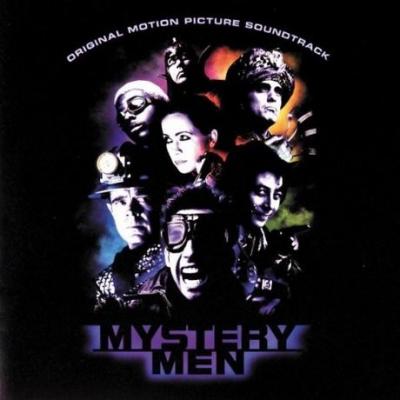
"Mystery Men" Soundtrack Lyrics
Movie • 1999
Track Listing
John Oszajca
Smash Mouth
Dub Pistols
Terry Bradford
Freak Power
Jill Sobule
Michael Franti
Spy
Citizen King
Violent Femmes
Moloko
The Trammps
The Bee Gees
Ben Stiller
htmlКопировать код
"Mystery Men (Original Motion Picture Soundtrack)" – Album Guide to Tracks and Key Scenes
Overview
What happens when a cult superhero comedy leans on disco anthems, alt-rock, and a Grammy-nominated hit that most people now associate with an ogre? The Mystery Men soundtrack answers that by turning Champion City into a jukebox of misfit heroics and deep-cut party tunes.
The film follows Mr. Furious, the Shoveler, the Blue Raja and their equally hapless recruits as they try to rescue Captain Amazing and stop Casanova Frankenstein’s “Psycho-frakulator.” The songs shadow that arc: arrival, adaptation, rebellion, collapse. Early cues underline how out of their depth the heroes are; mid-film tracks lean into swagger and disco camp; the end-credits run becomes a small, scrappy victory parade scored by Smash Mouth and underground favorites.
The album itself, Mystery Men (Original Motion Picture Soundtrack), is a various-artists collection released by Interscope in mid-1999. It fuses late-90s alternative rock (“All Star” by Smash Mouth), college-radio singer-songwriter work (Jill Sobule), conscious hip-hop and soul (Michael Franti & Spearhead), big-room electronica (Moloko, Dub Pistols), along with disco and funk catalog cuts. Parallel to it sits a separate orchestral score by Stephen Warbeck with additional music by Shirley Walker, which only got a full archival release decades later.
What makes this soundtrack distinct is how aggressively it leans into clashing tones. Disco chest-thumpers score a supervillain’s lair, a Puccini aria floats over fart jokes, and a punk classic about the death of heroes plays while bargain-bin superheroes audition in someone’s backyard. The songs are not just needle-drops; they are punchlines, character notes, and sometimes the only “cool” these losers ever get.
Across the film the genres map neatly onto themes: scruffy alt-rock and ska-tinged tracks for the team’s everyday frustration and underdog grind; glittering 70s disco for the villain’s nostalgia-soaked decadence; earnest folk-pop and socially conscious hip-hop around the ending to hint that, under the parody, the film still believes in small-scale heroism. That mix of irony and sincerity is the core of the album’s appeal.
How It Was Made
Behind the scenes, the music for Mystery Men came together in two parallel lanes: Stephen Warbeck’s orchestral score and a label-driven song compilation assembled around a handful of marquee tracks.
Warbeck composed the score on a tight schedule, reportedly in under a month, and recorded it at Sony’s scoring stage with a broad palette of instruments: standard orchestra plus Hungarian cimbalom and tárogató and even bouzouki. That eclectic instrumentation mirrors Champion City’s jumble of retro futurism, comic-book neon, and blue-collar mundanity. When late-stage re-edits reshaped the cut, Warner Bros. and Universal brought in veteran composer Shirley Walker to write additional cues and reshape Warbeck’s material so it still hit the action and comedy beats cleanly.
On the song side, Interscope packaged Mystery Men (Original Motion Picture Soundtrack) as a showcase: new artist John Oszajca opens with “Back in 1999,” Smash Mouth’s “All Star” anchors the pop-rock, and Kel Mitchell (who plays Invisible Boy) appears as a rapper on “Who Are Those Mystery Men” with the M.A.F.T. Emcees. Producer Mark Mothersbaugh contributes “The Mystery Men Mantra,” bridging between his Devo pedigree and the film’s comic-book absurdism.
The choice of “All Star” as the lead single was calculated. The song was freshly recorded for Smash Mouth’s album Astro Lounge, then licensed as the soundtrack’s flagship track and built into a McG-directed music video that cross-promoted the film with cast cameos. The track exploded on radio and charts, effectively making Mystery Men the song’s cinematic debut even though most later remember it from Shrek.
Years later, the score got its own cult afterlife: a limited 2-CD expansion pairing Warbeck’s and Walker’s cues surfaced via La-La Land Records, followed by a lengthy digital edition (Music From the Motion Picture) that finally let fans hear the film’s orchestral architecture without explosions and fart jokes on top.
Tracks & Scenes
Below are key songs and how they play against the film’s images. I am focusing on placements that are well-documented in reviews, scripts, or soundtrack notes rather than guessing at every background needle-drop.
“All Star” — Smash Mouth
Where it plays: The song is woven through the film’s identity, but its defining use is in the final scene and into the end credits. After the team defeats Casanova Frankenstein and stumbles out of the collapsing mansion, a swarm of reporters demands a team name. They argue, shouting half-baked suggestions into microphones beneath a ruined skyline. As the camera pulls back and the argument turns into a victory bicker, the opening riff of “All Star” crashes in and carries us over the credits. The track also drove the marketing and appears prominently in the tie-in music video that uses footage of the heroes recruiting the band’s singer as a “superhero.”
Why it matters: It turns a parody ending into an anthem. The lyrics about “all that glitters is gold” and being an outcast turned champion fit these B-list heroes a little too well, blurring sincere empowerment with late-90s irony.
“Who Are Those Mystery Men” — Kel and the M.A.F.T. Emcees feat. Romaine Jones
Where it plays: Midway through the end-credits suite, after “All Star” has done its heavy lifting, this track kicks in over stylized titles and hero logos. On home-video releases, an extended version appears as a bonus music-video feature, with Kel Mitchell mugging in-character and quick-cut clips of the film’s set-piece gags.
Why it matters: It reframes the heroes from losers into a hype crew’s subject. Lyrically it chants them into existence; structurally it bridges the studio’s need to sell a soundtrack album and the film’s running joke that nobody knows, or respects, this team.
“Sometimes” — Michael Franti & Spearhead
Where it plays: This track appears in the back half of the credits roll, when many viewers are already leaving the auditorium. On video it is more noticeable: the camera has long since left the characters; the scroll slows, and “Sometimes”’s mellow, thoughtful groove takes over from the louder alt-rock that precedes it.
Why it matters: Tonally this is the soundtrack’s soft landing. The song’s lyrics about resilience and mixed emotions offer a surprisingly earnest coda to a film that spends two hours dunking on superhero clichés.
“The Mystery Men Mantra” — Mark Mothersbaugh
Where it plays: Early in the film, during the nursing-home robbery sequence, as Mr. Furious, the Shoveler and the Blue Raja attempt to stop the Red Eyes gang at a seniors’ party. The cue rides under their shambolic fight choreography, following every failed attack and pratfall while Captain Amazing later swoops in and effortlessly mops up.
Why it matters: Mothersbaugh’s cue sets the tonal blueprint: faux-heroic brass and chant-like rhythms that keep getting undercut by slapstick. It tells us these are “real” heroes only inside their own heads.
“No More Heroes” — Violent Femmes (cover of The Stranglers)
Where it plays: Over the superhero audition sequence, when the core trio tests out would-be recruits in a suburban backyard. As the Waffler, Pencilhead, Son of Pencilhead and various oddballs show off their “powers,” this jagged punk-derived track drones over the montage, lending the failed auditions a sneer they definitely have not earned.
Why it matters: The irony writes itself: a song lamenting the absence of real heroes scoring a line-up of absolute also-rans. It also marks the film’s most overt nod to late-70s punk within a very 1999 track list.
“Planet Claire” — The B-52s
Where it plays: During the introduction of the Spleen at a roadside gathering, as the heroes seek new allies. The B-52s’ surf-spy guitars and spacey organ line drift over the scene while the camera pushes in on Paul Reubens’ character, turning his flatulent “curse” into something hilariously over-scored, like a drive-in sci-fi reveal gone wrong.
Why it matters: The track nails the Spleen’s tone: he is simultaneously gross and weirdly glamorous in his own imagination. The song is a cult classic in its own right, so using it here adds another layer of cult-within-cult.
“Night Fever” — Bee Gees
Where it plays: In Casanova Frankenstein’s resurrected disco room. After his escape from the asylum, he returns to his mansion and opens a preserved 70s dance hall. As the mirror ball descends and the lights flare, “Night Fever” booms through the space while Casanova and his henchman Tony P soak in the nostalgia; Tony even busts out full Travolta-style moves for a moment.
Why it matters: This is the clearest declaration of the villain’s aesthetic: disco as religion. The song’s silky strings and falsetto contrast hard with the heroes’ shabby thrift-store costumes and give the Disco Boys’ mantra (“Disco is not dead, disco is life!”) real musical weight.
“Disco Inferno” — The Trammps
Where it plays: Also associated with the Disco Boys’ appearances and Casanova’s parties. In the gang-summit and lair sequences, when villains mill around under colored lights and champagne, “Disco Inferno” pumps from the sound system along with other 70s staples, turning a criminal conspiracy into a retro dance floor.
Why it matters: The pun is almost too on-the-nose, given Casanova’s later attempts to literally burn the city. It underscores how much of his menace is theatrical; he is staging a revival tour as much as a doomsday plot.
“A Fifth of Beethoven” — Transmutator (arr. of Walter Murphy)
Where it plays: In one of the mansion party / lair passages, folded into the diegetic music mix with “Disco Inferno” and “Night Fever.” We get quick glimpses of the dance floor and villains moving through the crowd while this disco-classical hybrid plays under dialogue and sound effects.
Why it matters: The track is both tongue-in-cheek high culture and pure kitsch, exactly like Casanova’s whole persona. It also hints at the film’s structure: classical superhero tropes chopped up and turned into something brasher and sillier.
“Play That Funky Music” — Wild Cherry
Where it plays: Briefly during social scenes and parties in Champion City, especially when the film wants to underline that these characters think they are far cooler than they really are. The song bleeds in and out quickly, competing with crowd noise and visual gags.
Why it matters: Lyrically it is about a white musician trying to “play that funky music” and failing; that maps neatly onto heroes who are always a little off-beat when they try to act like real superheroes.
“O Mio Babbino Caro” — Giacomo Puccini, performed by Miriam Gauci
Where it plays: Over one of the film’s broadest running jokes involving overpowering smell and misplaced romance. The aria’s soaring, operatic pleading drifts over a scene that quickly devolves into slapstick, using the mismatch between high art and low comedy as the gag.
Why it matters: This is the score’s classiest needle-drop on paper and its crudest in context. The film loves this dissonance: real emotion is constantly fighting through ridiculous circumstances.
“Gangsters” — Citizen King
Where it plays: During Casanova Frankenstein’s summit with Champion City’s various gangs at his mansion. As different themed crews arrive and posture — Disco Boys, frat-boy thugs and more — a modern ska-flavored groove in the background ties them together as parts of one absurd criminal ecosystem.
Why it matters: The cue makes the gang summit feel like a late-90s MTV party rather than a grim crime meeting, which is exactly the point. Casanova is building a brand, not just a coalition.
Trailer music note: The main theatrical trailers and TV spots leaned heavily on “All Star” and big brass stings from the score. Even if you somehow missed the film itself, that combination etched the song into the movie’s identity long before memes ever got to it.
Notes & Trivia
- The soundtrack album and the full score were separate releases; for years fans had to hunt bootlegs to hear the orchestral cues cleanly.
- Kel Mitchell pulls double duty: Invisible Boy on screen, hype man on “Who Are Those Mystery Men” on the album and in a dedicated music video.
- “All Star” technically debuts cinematically here, even though pop culture now instinctively ties it to Shrek.
- Unlike many late-90s tie-ins, every album song can be heard somewhere in the movie, even if only briefly or under dialogue.
- The very last “track” on the album is just dialogue: the “Mystery Men Oath,” a tiny scrap of in-character banter pressed onto CD as a hidden gag.
Music–Story Links
The soundtrack’s through-line is simple: every big musical choice reinforces that this is a story about second-stringers trying to live in a first-string world.
When the film opens with the team flailing in a nursing-home brawl, Mark Mothersbaugh’s “Mystery Men Mantra” treats them like proper superheroes. The brass and chant-like rhythms rise and fall with their attempts. The joke lands because the music believes in them more than the world does.
Later, the disco sequences mirror Casanova Frankenstein’s psyche. “Night Fever” and “Disco Inferno” make his lair feel invincible, permanently stuck in Saturday night. The heroes’ eventual invasion of that space — armed with experimental, non-lethal gadgets and very little competence — plays like an invasion of another genre entirely. They are storming not just a base, but a playlist.
The audition montage with “No More Heroes” is a miniature essay on legacy. The Blue Raja and company are literally searching for successors and sidekicks; the song’s lyrics mourn the loss of real heroes while the visuals insist that, if these people are all that is left, the torch has passed to the wrong crowd.
At the end, the credits suite walks the team from joke to sincerity. “All Star” celebrates them as unlikely winners. “Who Are Those Mystery Men” mythologizes them in hip-hop cadences. “Sometimes” softens everything into a reflective groove, suggesting that for all the parody, there is still a belief that flawed people can do something good together.
Reception & Quotes
At release, the soundtrack drew a mix of curiosity and shrugs. Some critics liked its eclecticism, others heard a label sampler with a couple of undeniable hits.
“An eclectic mix of alternative, folk, rap, disco and a few tracks that cannot be easily pigeonholed.” — college-paper review, 1999
“The superhero-spoof soundtrack features a few interesting tracks that save the day.” — retrospective review, 2020s
Commercially, the album rode the wave of “All Star.” The single charted globally and picked up a Grammy nomination, pulling the soundtrack into mainstream visibility even though the film underperformed at the box office.
Among fans, the album has aged into a time capsule. The combination of then-new artists like Citizen King and John Oszajca with legacy acts like the Bee Gees and the Trammps now reads like a snapshot of late-90s CD-era soundtrack logic: give people one huge hit, some deep cuts, and a few cross-promo bets on rising names.
The later expansion of the Warbeck/Walker score on a specialty label drew praise from film-music collectors, who highlighted the inventive orchestrations and the way the score threads action, comedy, and oddball instrument colors into one coherent voice.
Interesting Facts
- The soundtrack’s disco cuts (“Night Fever,” “Disco Inferno,” “A Fifth of Beethoven”) double as a sideways tribute to Saturday Night Fever, which the film openly references in its dance-strut shots.
- “Rainy Day Parade” by Jill Sobule, best known from her own album Pink Pearl, appears here as a kind of emotional outlier — bittersweet lyrics in the middle of a cartoonish superhero story.
- Citizen King’s “Gangsters” on the album was one of several soundtrack placements that briefly put the Milwaukee band all over late-90s film and TV.
- Violent Femmes’ cover of “No More Heroes” is one of the rare times that song appears in a big studio movie; the original by The Stranglers had licensing complications in other media.
- The expanded score release in the 2020s was limited to a few thousand units, but digital availability later made the music far easier to hear than the movie itself in some regions.
- Mark Mothersbaugh appears in the film in a small on-screen role as a bandleader, blurring the line between soundtrack contributor and diegetic musician.
- Because “All Star” became so associated with memes, younger viewers sometimes discover Mystery Men backwards: they follow the song’s history and end up here.
- On some DVD and HD editions, a “Universal Soundtrack Presentation” feature plays the “Who Are Those Mystery Men” video followed by an in-menu ad for the album — a very Y2K way of selling CDs.
Technical Info
- Title: Mystery Men (Original Motion Picture Soundtrack)
- Film: Mystery Men (superhero comedy, USA)
- Year: 1999 (film and original soundtrack release)
- Type: Various-artists song compilation; separate orchestral score by Stephen Warbeck with additional music by Shirley Walker
- Primary composers (score): Stephen Warbeck (original score), Shirley Walker (additional music, adaptations)
- Key song artists: Smash Mouth, John Oszajca, Dub Pistols, Mark Mothersbaugh, Kel & the M.A.F.T. Emcees, Jill Sobule, Michael Franti & Spearhead, Citizen King, Violent Femmes, Moloko, Bee Gees, The Trammps
- Music supervision / compilation: Interscope / Universal soundtrack and A&R staff (crediting varies by territory; compilation functions as a label-driven package)
- Label: Interscope Records (original 1999 soundtrack CD)
- Score release: later 2-CD limited edition (La-La Land Records) plus digital release under titles like Music From the Motion Picture
- Notable placements: “All Star” over final scene and credits; “No More Heroes” over hero auditions; “Night Fever” and “Disco Inferno” in Casanova Frankenstein’s disco lair; “Planet Claire” introducing the Spleen; “Who Are Those Mystery Men” in closing credits.
- Chart / award notes: “All Star” reached the US top 5, topped several radio formats and received a Grammy nomination for Best Pop Performance by a Duo or Group with Vocals.
- Availability today: Original CD often found second-hand; digital versions and streaming playlists cover most album tracks; expanded score available from specialty labels and on major digital platforms.
Questions & Answers
- Is the Mystery Men soundtrack mostly songs or mostly score?
- The original 1999 album is heavily song-driven (various artists); the orchestral score was released separately years later in expanded form.
- Where in the film does “All Star” actually play?
- It threads through the movie’s identity but is most clearly heard starting over the final scene, then rolling into the opening stretch of the end credits.
- Which song plays during the superhero audition montage?
- The montage of would-be heroes in the backyard is scored with Violent Femmes’ cover of “No More Heroes,” matching the scene’s theme of failed heroism.
- What is the disco song in Casanova Frankenstein’s club room?
- The most prominent cue is the Bee Gees’ “Night Fever,” accompanied by other 70s disco tracks like “Disco Inferno” and “A Fifth of Beethoven.”
- Is every song on the album used in the film itself?
- Yes; unlike some “music from and inspired by” releases, all of the album’s cuts appear somewhere in the movie, though a few are brief or buried in the mix.
Canonical Entities & Relations
| Entity | Type | Relation (S–V–O) |
|---|---|---|
| Mystery Men | Movie | Mystery Men — uses — songs compiled on the Mystery Men (Original Motion Picture Soundtrack) album. |
| Mystery Men (Original Motion Picture Soundtrack) | MusicAlbum | Mystery Men OST — collects — various artists’ recordings featured in the film. |
| Stephen Warbeck | Person | Stephen Warbeck — composed — the original orchestral score for Mystery Men. |
| Shirley Walker | Person | Shirley Walker — provided — additional music and score adaptations for Mystery Men. |
| Smash Mouth | MusicGroup | Smash Mouth — performed — the song “All Star” used as a lead single and final-scene track. |
| Kel Mitchell | Person | Kel Mitchell — performs — vocals on “Who Are Those Mystery Men” and — portrays — Invisible Boy in the film. |
| Michael Franti & Spearhead | MusicGroup | Michael Franti & Spearhead — contributed — the track “Sometimes” to the soundtrack’s end-credit sequence. |
| Jill Sobule | Person | Jill Sobule — wrote and performed — “Rainy Day Parade,” later reused from her album Pink Pearl. |
| Violent Femmes | MusicGroup | Violent Femmes — covered — “No More Heroes” for inclusion in Mystery Men’s soundtrack and audition scene. |
| Citizen King | MusicGroup | Citizen King — provided — the song “Gangsters” for the gang-summit sequence and album. |
| Bee Gees | MusicGroup | Bee Gees — supplied — “Night Fever” as diegetic music in Casanova Frankenstein’s disco room. |
| The Trammps | MusicGroup | The Trammps — contributed — “Disco Inferno” to the villain’s party soundscape. |
| Interscope Records | Organization | Interscope Records — released — the 1999 Mystery Men soundtrack album on CD. |
| La-La Land Records | Organization | La-La Land Records — issued — a limited expanded edition of the Mystery Men score. |
| Champion City | Fictional Location | Champion City — provides — the narrative setting whose moods are underscored by the soundtrack’s genre shifts. |
Sources: film credits, official soundtrack liner notes, label and retailer metadata, contemporary newspaper and web reviews, later archival score release notes, artist and song reference pages.
November, 16th 2025
A-Z Lyrics Universe
Cynthia Erivo Popular
Ariana Grande Horsepower
Post Malone Ain't No Love in Oklahoma
Luke Combs Good Riddance (Time of Your Life)
Green Day Bye Bye Bye
*NSYNC You're the One That I Wan
John Travolta & Olivia Newton-John I Always Wanted a Brother
Braelyn Rankins, Theo Somolu, Kelvin Harrison Jr. and Aaron Pierre The Power of Love
Frankie Goes to Hollywood Beyond
Auli’i Cravalho feat. Rachel House MORE ›