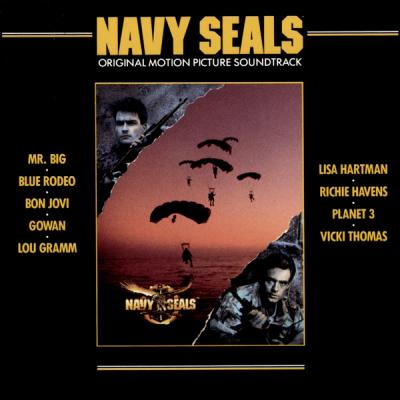
"Navy Seals" Soundtrack Lyrics
Movie • 1990
Track Listing
Mr. Big
Bon Jovi
Richie Havens
Mr. Big
Gowan
Lou Gramm
Planet 3
Vicki Thomas
Lisa Hartman
Blue Rodeo
"Navy SEALs (Original Motion Picture Soundtrack)" – Album Guide to Tracks and Key Scenes
Overview
Can a guilty-pleasure military action movie really justify two separate soundtrack identities — glossy rock songs and a brooding orchestral score? Navy SEALs
quietly answers yes. On one side you have the Atlantic Records song album packed with radio-ready rock and AOR; on the other, Sylvester Levay’s muscular orchestral score, later expanded by specialty labels. Together they turn a straightforward rescue-and-revenge story into something that feels like recruitment ad, beer commercial and war drama at once.
The film follows a SEAL team led by Lt. James Curran and the more impulsive Dale Hawkins as they bounce from botched hostage extraction to Beirut street fighting over stolen Stinger missiles. Big rock cues slam in whenever the guys are off duty or breaking rules, while Levay’s score carries the missions, HALO jump, funeral and final underwater showdown. The result is blunt but effective: songs sell swagger and camaraderie; score sells danger, guilt and loss.
What makes this soundtrack distinct is how nakedly it plays to two audiences. The song album feels aimed at rock fans who might barely remember the movie — Mr. Big, Bon Jovi, Lou Gramm, Blue Rodeo, Gowan, Richie Havens, Lisa Hartman — all on one disc. Meanwhile, the score album, especially in its Intrada and La-La Land expansions, targets collectors of late-80s/early-90s action music: big brass, busy percussion, tense synth pads under orchestra. The film itself may be uneven, but its music is surprisingly curated.
Across the runtime you can hear a rough phase structure. Off-duty antics lean on slick AOR and pop-rock: mid-tempo power ballads and driving guitars underline the “indestructible frat house” vibe of the team. Training and insertion sequences pivot to hard-edged orchestral action — snare drums, low brass ostinatos, and Middle-Eastern-flavored motifs when the story reaches Beirut. The final act folds in more dissonance and minor-key writing, subtly acknowledging that the gung-ho attitude has consequences, even if the film itself doesn’t dwell on them for long.
How It Was Made
The film’s score is by Sylvester Levay, a composer already associated with high-energy action and synth-orchestral hybrids by 1990. The original score album came out in 2010 via Intrada as part of its Special Collection series and was later re-issued and rearranged chronologically by La-La Land Records in 2024, running over an hour with additional mono cues and source music. Both labels emphasize that the new presentations are sourced from studio elements with restored sound and detailed liner notes.
Parallel to the score, Orion and Atlantic Records built a classic “various artists” tie-in. The 10-track Navy SEALs (Original Motion Picture Soundtrack) compilation features Mr. Big, Bon Jovi, Richie Havens, Gowan, Lou Gramm, Planet 3, Vicki Thomas, Lisa Hartman and Blue Rodeo. The track list aligns across SoundtrackCollector, streaming services and label catalogs, confirming that the album is the canonical rock companion rather than a later re-branded compilation.
The song choices lean heavily on Atlantic’s artist roster of the era. Mr. Big contributed two exclusive tracks, Strike Like Lightning
and Shadows
, both co-written with Giorgio Moroder and Tom Whitlock. Lou Gramm’s Hangin’ On My Hip
comes from his solo work but is repeatedly referenced as being featured in the film. Blue Rodeo’s ballad Try
predates the movie but gained extra life through its placement in a bar scene; the band’s own history notes this specifically. Gowan’s The Dragon
likewise is documented as appearing on a car radio within the film.
On the score side, the modern La-La Land / Intrada editions rearrange Levay’s cues into narrative order: Main Title – Navy SEALs
, The First Mission
,
Tracks & Scenes
Below are key songs and cues with scene-level context. For some songs, exact timestamps are not well documented in public sources; where that’s the case, I’ll flag the uncertainty instead of pretending otherwise.
“Strike Like Lightning” — Mr. Big
Where it plays: A chase sequence on the streets of Norfolk, when Hawkins spots his beloved car being towed and grabs a bicycle to pursue it. The song kicks in as he launches into the chase, giving the whole sequence an almost music-video energy: quick cuts, wide shots of the bike weaving through traffic, and reaction shots from pedestrians. He eventually drives the car off a ramp to reclaim it, still underscored by the track. Commentators specifically note the 80s-style absurdity of a serious action film dropping a glam-metal anthem over a bike vs. tow-truck gag.
Why it matters: It’s the defining “rock moment” of the film. The song captures Hawkins’ reckless streak and the movie’s willingness to treat SEALs as overgrown teenagers when they’re off duty. It also turned into a cult favorite for Mr. Big fans because, for years, this soundtrack was one of the only places to find the track.
“Shadows” — Mr. Big
Where it plays: The exact placement is less widely documented, but the song is confirmed as used in the film and is tightly associated with Navy SEALs in fan discussions and later Mr. Big reissues. Most reports link it to off-duty or driving sequences rather than combat action, essentially as an extension of the “cool guys in motion” vibe established by Strike Like Lightning
.
Why it matters: Together, the two Mr. Big tracks define the album’s hard-rock edge and tie the film into a late-80s / early-90s AOR lineage. They also deepen the Moroder/Whitlock connection to the project, since those songwriters sit at the intersection of arena rock and film music.
“Try” — Blue Rodeo
Where it plays: Heard as background music in a bar scene, documented in the band’s own filmography. The placement comes in a quieter off-duty stretch, with the SEALs hanging out in a bar that feels more small-town than war zone. The song drifts in on the jukebox or house system — vocals slightly muffled, but the melody is recognizable. It plays under dialogue and bar chatter, softening the edges of the macho banter and flirting happening at the tables.
Why it matters: This is one of the few moments where the film lets vulnerability leak in. Try
is a gentle country-rock ballad about emotional uncertainty; placed under a bar scene full of bravado, it subtly undercuts what we’re seeing. It also gave the song a modest boost outside Canada, helping cement its status as a cross-border cult favorite.
“The Dragon” — Gowan
Where it plays: A few bars are heard on a car radio, according to the artist’s own biographical notes. It’s a quick, diegetic use: a vehicle cruising with the radio on, the song poking through between lines of dialogue or engine noise before the character changes station or the mix drops it down.
Why it matters: It’s a small moment, but it shows how the film uses real commercial tracks as sonic wallpaper to sketch everyday life between missions. For Gowan, the placement helped position The Dragon
alongside bigger rock names on the same album, even though the scene itself is blink-and-you-miss-it.
“Hangin’ On My Hip” — Lou Gramm
Where it plays: Multiple biographical notes about Gramm’s solo career mention this track being featured in Navy SEALs. Public documentation doesn’t pin down a precise scene, but its swaggering, riff-driven feel fits the movie’s training or locker-room sequences — places where weapons, gear and ego all share the frame.
Why it matters: The song brings a Foreigner-adjacent voice into the mix and reinforces the idea that this soundtrack is a mini-sampler of late-80s rock royalty. Lyrically and tonally it meshes with the film’s gun-slinging bravado; even without a precisely documented scene, it feels integral to the album’s character.
“Tempt Me (If You Want To)” — Lisa Hartman
Where it plays: Originally a standalone single from Hartman’s own work, later folded into the Navy SEALs soundtrack. Sources confirm its inclusion but do not agree on an exact scene. Given its polished AOR ballad style, it likely underscores one of the film’s romantic or quieter domestic beats, such as Curran’s time with journalist Claire Varrens, playing either on radio or over montage.
Why it matters: Sonically, this track is pure high-gloss 80s: shimmering keyboards, big chorus, session-player guitar work. Dropped into a grittier military story, it pushes the soundtrack toward soap-opera melodrama in a way that many fans find charming rather than jarring.
“Wounded Warrior” — Vicki Thomas
Where it plays: Firmly associated with the movie by discographies and fan recollections, often remembered as a power ballad that plays in a more reflective stretch. Some viewers specifically recall it in connection with the film’s emotional beats — likely around Graham’s death and the funeral sequence — but open, on-the-record scene descriptions stay vague.
Why it matters: The title alone telegraphs the film’s attempt to acknowledge sacrifice behind the macho veneer. Musically it sits closer to adult-contemporary rock than hard rock, giving the soundtrack a more openly sentimental axis.
“The Boys Are Back In Town” — Bon Jovi
Where it plays: A cover of the Thin Lizzy classic, credited to the film and album. While the exact scene isn’t officially broken down, its theme — rowdy camaraderie and returning troublemakers — makes it an obvious fit for sequences where the team reunites or rolls into town between missions.
Why it matters: This is the soundtrack’s clearest statement of intent: the SEALs are framed less like haunted soldiers and more like a rock band on tour. That marketing angle shows how aggressively the movie leans into 80s action-hero mythology rather than realism.
Key score cue: “Main Title – Navy SEALs” — Sylvester Levay
Where it plays: Over the opening titles and into early mission material. The cue combines militaristic snare patterns, bold brass figures and moody synth pads, setting up both professionalism and impending danger. In the film it’s edited tightly against shots of ships, helicopters and the carrier deck — classic “hardware porn” with an anthemic theme on top.
Why it matters: This theme becomes the score’s backbone. Variants surface in The First Mission
, Going To Beirut
and the end title, often reshaped harmonically to match the team’s fortunes. If you only hear one piece of Levay’s work from this film, this is the one that sticks.
Key score cue: “High Jumpers” — Sylvester Levay
Where it plays: During the HALO jump and infiltration sequence, one of the film’s visual centerpieces. The cue tracks the whole operation: aircraft interior tension, jump into night sky, free-fall shots, then parachute deployment and ocean landing. The music ramps from suspenseful ostinatos to broad, soaring statements of the main motif as the jump succeeds.
Why it matters: This is Levay in full action mode — rhythmically propulsive, with just enough harmonic darkness to keep it from feeling like pure triumph. It’s also a favorite among score collectors, frequently singled out in reviews of the Intrada and La-La Land albums.
Notes & Trivia
- Two separate soundtracks exist: a rock compilation (Atlantic / Warner) and a full score album centered on Sylvester Levay.
- Mr. Big’s
Strike Like Lightning
andShadows
were first issued on this soundtrack before later reappearances on compilations and reissues. - Several songs (
Try
,Tempt Me
) pre-date the film but were re-marketed through it, giving them a second commercial life. - The modern La-La Land reissue of Levay’s score is a limited pressing (1,000 copies) and re-orders cues into film sequence.
- Collectors note that early CDs of the song album can be surprisingly cheap despite the strong artist lineup.
- The rock soundtrack’s running time (around 40 minutes) contrasts sharply with the expanded 60-minute score album, reflecting how much underscore the movie actually uses.
- Blue Rodeo’s official history explicitly calls out the Navy SEALs bar placement for
Try
, which is unusual detail for a one-scene needle drop. - The Intrada score release was part of a wave of 80s/90s action rescues, sharing shelf space with titles like
Delta Force 2
and similar canon.
Music–Story Links
The soundtrack often treats the SEAL team less like soldiers and more like the world’s loudest bachelor party. Every big rock track maps onto Hawkins’ arc in particular. Strike Like Lightning
scores his impulsive, reckless pursuit of a car that matters more to him than orders; the sequence crystalizes the character in three minutes: brave, childish, addicted to adrenaline. The song’s lyrics about sudden, overwhelming force mirror how he likes to “solve” problems — charge in and hope the pieces land well.
By contrast, the use of Try
in the bar puts a tender, almost embarrassed light on the ensemble. It’s playing while SEALs flirt, joke and posture, but the song’s plea about emotional honesty points toward the cracks: Graham’s doubts about marriage, Curran’s position between command and friendship, Hawkins’ fear of commitment. The film never verbalizes that subtext; the needle drop does the work quietly in the background.
Levay’s score steps in whenever the film wants to be taken seriously. The main title and High Jumpers
frame the SEALs as elite professionals; harmonic choices stay mostly heroic, but minor-key detours and brief dissonances hint at the cost underneath. After Graham’s death, cues like Funeral
and The Flag
strip away rock swagger entirely: slow, mournful brass, restrained strings, and careful pacing create the one stretch where the movie fully acknowledges grief.
During the Beirut operation, music and story lock together tightly. Going To Beirut
uses low, suspenseful writing to carry the boat insertion and urban approach. As the mission unravels, action cues fragment the main motif, suggesting loss of control. By the time we reach the underwater fight with Shaheed, the score has shifted from patriotic surge to more claustrophobic writing — still action-driven but with harmony that feels more desperate than victorious.
Smaller details connect songs to world-building. The Dragon
playing on a car radio places the characters firmly in a late-80s/early-90s pop-rock soundscape. Lou Gramm’s Hangin’ On My Hip
doubles the film’s obsession with gear; musically and lyrically it treats weapons as extensions of identity, matching the repeated close-ups of rifles and harnesses. The overall effect is that the soundtrack doesn’t just decorate the story; it encodes how the film wants the audience to feel about these men — half rock gods, half warriors.
Reception & Quotes
Critical reception of the film itself was mostly negative, with aggregated scores in the mid-teens and reviewers calling it simplistic and jingoistic. However, both home-video reviewers and fans often separate the movie’s thin script from its energetic music and action staging. A 4K Blu-ray review in 2024, for example, openly described the film as “glorious throwback trash” while still praising its pace and nostalgia factor.
The rock soundtrack tends to be discussed in fan spaces and retailer reviews rather than in mainstream music criticism. AllMusic lists the album and emphasizes its roster of artists; user reviews on sites like Amazon frequently call it a “surprisingly strong” collection even for listeners who barely recall the film. For Mr. Big fans in particular, this disc became a de facto source for Strike Like Lightning
and Shadows
before later boxed sets made them easier to find.
Among score collectors, Levay’s work has a modest but loyal following. Specialty sites and label blurbs highlight its muscular orchestration, well-developed main theme and the rarity of early 90s action scores getting full archival treatment. The La-La Land reissue’s liner notes, produced with fresh comments from Levay, are often cited by collectors as a key reference for understanding the music’s structure and recording history.
“Jingoistic, simplistic, idiotic — but for a nostalgia rush, there can be nothing better.”
Modern 4K Blu-ray review summarizing the film’s appeal.
“Only in the 80s would there be a chase scene with a guy on a bike and a song called ‘Strike Like Lightning’ playing.”
A fan-critic on the film’s most infamous music cue.
“This movie is terrific but wait until you hear the soundtrack — a great selection of tracks.”
Retail listener review of the song album.
Interesting Facts
- The song album runs about 40–42 minutes, while the expanded score album runs just over an hour; the film itself is around 113 minutes.
- Levay’s score exists in at least three distinct commercial configurations: the original Intrada CD, the later Intrada/La-La Land chronological re-edit, and the remastered 2024 limited edition.
- Mr. Big’s “Strike Like Lightning” later appeared on the band’s greatest-hits packages, but is still closely branded as a Navy SEALs track in liner notes.
- Blue Rodeo’s filmography explicitly calls out the Navy SEALs bar placement for “Try” — something many bands never bother to document for single-scene uses.
- Gowan’s biography notes “The Dragon” as appearing in the film, making the soundtrack a crossing point between Canadian pop-rock and U.S. military cinema.
- Bon Jovi’s “The Boys Are Back In Town” cover ties the film into a wider late-80s trend of hard-rock bands covering classic 70s hits for movie albums.
- The score’s cue titles (“High Jumpers”, “The Missiles”, “Going To Beirut”) mirror specific mission beats, making the album a rough map of the plot order.
- Later 4K and Blu-ray editions keep the original stereo mix, so the balance between rock songs and score remains close to the 1990 theatrical experience.
- Levay’s name sits in an interesting lineage: his film work overlaps stylistically with Harold Faltermeyer and other synth-friendly action composers of the era.
- The soundtrack’s rights web involves Orion Pictures, Atlantic Records, Warner Music, Mercury/PolyGram and various publishing arms — typical for star-heavy compilations of the period.
Technical Info
- Title (song album): Navy SEALs (Original Motion Picture Soundtrack)
- Title (score album): Navy Seals – Original MGM Motion Picture Soundtrack
- Year of film: 1990
- Film type: Feature film, military action
- Film composer: Sylvester Levay
- Song album artists: Various Artists (Mr. Big, Bon Jovi, Richie Havens, Gowan, Lou Gramm, Planet 3, Vicki Thomas, Lisa Hartman, Blue Rodeo)
- Song album label: Atlantic Records / Warner Music Group (original 1990 release; later digital via Rhino/Atlantic)
- Song album length: Approx. 40–42 minutes, 10 tracks
- Score album labels: Intrada Records (2010, Special Collection Vol. 150); La-La Land Records (2024 reissue, LLLCD 1644, limited to 1,000 units)
- Score album length: Around 55 minutes (Intrada), about 61 minutes (La-La Land expanded chronology)
- Score highlights: “Main Title – Navy SEALs”, “The First Mission”, “High Jumpers”, “Going To Beirut”, “End Title – Navy SEALs”
- Notable song placements: “Strike Like Lightning”, “Shadows”, “The Boys Are Back In Town”, “Hangin’ On My Hip”, “Try”, “The Dragon”, “Tempt Me (If You Want To)”, “Wounded Warrior”
- Original film studio: Orion Pictures
- Modern availability (songs): Streaming services (Spotify, Apple Music) and digital download stores carry the 10-track compilation.
- Modern availability (score): Physical CDs via Intrada/La-La Land (some out of print; secondary market), occasional digital tracks on label platforms.
Questions & Answers
- Is there a difference between the Navy SEALs rock soundtrack and the score album?
- Yes. The rock soundtrack is a 10-track various-artists compilation on Atlantic, while the score album (Intrada / La-La Land) is pure Sylvester Levay orchestral music, expanded and sequenced to follow the film.
- Where does “Strike Like Lightning” actually play in the movie?
- It plays over a comic-action chase where Hawkins spots his beloved car being towed, grabs a bicycle and launches into a reckless pursuit, treating the moment like his own music video.
- Is Blue Rodeo’s “Try” really in Navy SEALs or just on the album?
- It is in the film — the band’s own history notes it playing in the background of a bar scene, and it also appears on the official song compilation tied to the movie.
- What’s special about the 2024 La-La Land score reissue?
- It rebuilds the score in near-chronological order, adds bonus mono film-mix cues and source music like “Tears of Rage”, and is a limited 1,000-copy pressing with new liner notes and remastering.
- Is the Navy SEALs soundtrack worth hearing if I don’t like the movie?
- If you enjoy late-80s AOR and film-score action writing, yes. The film is divisive, but the mix of Mr. Big, Lou Gramm, Bon Jovi and Levay’s driving orchestral cues stands up surprisingly well on its own.
Canonical Entities & Relations
| Subject | Relation | Object |
|---|---|---|
| Navy SEALs (film) | directed by | Lewis Teague |
| Navy SEALs (film) | music by (score) | Sylvester Levay |
| Navy SEALs (Original Motion Picture Soundtrack) | is soundtrack to | Navy SEALs (film) |
| Navy SEALs (Original Motion Picture Soundtrack) | released by | Atlantic Records |
| Mr. Big | performs | “Strike Like Lightning” and “Shadows” |
| Bon Jovi | performs | “The Boys Are Back In Town” (cover) |
| Lou Gramm | performs | “Hangin’ On My Hip” |
| Blue Rodeo | performs | “Try” |
| Lawrence Gowan | performs | “The Dragon” |
| Lisa Hartman | performs | “Tempt Me (If You Want To)” |
| Vicki Thomas | performs | “Wounded Warrior” |
| Navy Seals – Original MGM Motion Picture Soundtrack | composed by | Sylvester Levay |
| Navy Seals – Original MGM Motion Picture Soundtrack | released by | Intrada Records, La-La Land Records |
| Orion Pictures | produced and distributed | Navy SEALs (film) |
Sources: Wikipedia (film, artists), SoundtrackCollector, Intrada & La-La Land Records, AllMusic, Muziekweb, label and streaming credits, AFI Catalog, Blue Rodeo and Gowan biographies, fan and review sites discussing specific scenes and cues.
November, 16th 2025
Read about 'Navy Seals', an American military action film: IMDb, WikipediaA-Z Lyrics Universe
Cynthia Erivo Popular
Ariana Grande Horsepower
Post Malone Ain't No Love in Oklahoma
Luke Combs Good Riddance (Time of Your Life)
Green Day Bye Bye Bye
*NSYNC You're the One That I Wan
John Travolta & Olivia Newton-John I Always Wanted a Brother
Braelyn Rankins, Theo Somolu, Kelvin Harrison Jr. and Aaron Pierre The Power of Love
Frankie Goes to Hollywood Beyond
Auli’i Cravalho feat. Rachel House MORE ›