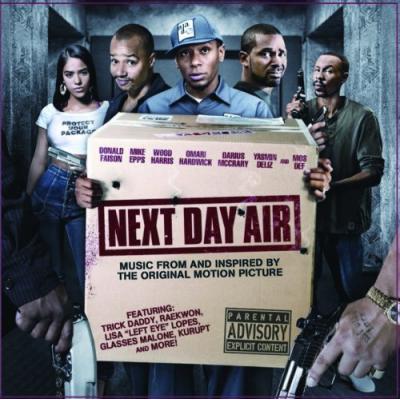
"Next Day Air" Soundtrack Lyrics
Movie • 2009
Track Listing
Trick Daddy
Raekwon the Chef
Glasses Malone
Kurupt
Lisa Left Eye Lopes f/ Bobby Valentino
Penuckle
Martin Buscaglia
Spider Loc
Darius McCrary
C Dash
5 Grand
Meek Mill
Prophet
"Next Day Air (Original Motion Picture Soundtrack)" – Album Guide to Tracks and Key Scenes
Overview
How do you score a story where a misdelivered box of cocaine turns a lazy workday into a bloodbath, yet most of the scenes still feel like a hang-out comedy? Next Day Air answers with a soundtrack that flips constantly between dusty blaxploitation textures, Latin salsa classics and 2000s rap bravado. The music keeps reminding you that these idiots with guns live in a very real, very dangerous world.
The film follows Leo, a perpetually high courier for the NDA delivery service, who drops a cartel shipment at the wrong apartment. That one mistake pulls in small-time crooks Guch and Brody, brutal enforcer Rhino, dealer Bodega and terrified middlemen like Jesus and Chita. The score by The Elements leans on gritty funk, low brass and chopped drum loops, giving Philly’s rowhouses and corridors a humid, lived-in atmosphere while rap cuts and Latin tracks crash in whenever the characters chase money or try to look tougher than they are.
The soundtrack’s arc mirrors the story: arrival, adaptation, rebellion, collapse. Early cues sketch the city and Leo’s stoned routine. Mid-film, as everyone adapts to the missing shipment, the selections tilt toward hustle anthems and tense underscoring. In the apartment showdown, aggressive hip-hop and sleek R&B about cocaine and cash slam against the on-screen carnage. The end credits slide out on a left-field Uruguayan track, like a crooked little smile after the bodies hit the floor.
Stylistically, the album lives at the junction of stage-and-screen score, West Coast–flavoured rap compilation and Latin-soul crate dig. The Elements’ cues carry the plot; hardcore and gangsta rap cuts project aspiration and menace; salsa staples like “Aguanile” and “El Dia de Mi Suerte” frame Bodega’s world with fatalism and swagger. It plays like a mixtape of how these characters imagine themselves — and how the film quietly undercuts those fantasies.
How It Was Made
Director Benny Boom came to Next Day Air from music videos, and you can feel it in how tightly picture and beats are cut together. The story unfolds almost entirely in Philadelphia apartments, alleys and storage garages, but the pacing and musical punctuation borrow more from hip-hop videos than from standard studio comedies. Production histories note that Boom shot the film in about three weeks, with a lot of coverage already “edited in his head,” which helps explain why musical hits line up so cleanly with door slams, gun cocks and punchlines.
The score is credited to The Elements, a production team that tracked cues in Miami, Philadelphia and Atlanta studios. Short instrumentals like “Philly Cityscape,” “Get the Tapes,” “Videogame” and “Ave” behave like stingers and mini-themes rather than big, developing orchestral pieces. They drop in for under a minute, colour a beat of business — Leo fighting a broken elevator, Brody and Guch gaming and arguing, Shavoo moving money — and drop out again, leaving space for dialogue and licensed songs.
On the business side, the album Next Day Air (Original Motion Picture Soundtrack) was put together as a hybrid: score snippets by The Elements plus rap and R&B tracks from Trick Daddy, Raekwon, Glasses Malone, Kurupt, Lisa “Left Eye” Lopes, Spider Loc, Penuckle, Meek Mill, C-Dash, 5 Grand, Prophet and others. It dropped in early May 2009, just before the film’s theatrical release, with a 17-track, roughly 52-minute running time. A physical CD edition circulated through Wild Pitch–branded releases, while digital distribution used a Melee/Fontana imprint.
Where the making-of story gets messy is the gap between what you hear in the film and what ended up on the album. A detailed breakdown on a soundtrack blog pointed out that only one of the six high-profile songs actually heard in the movie (“Cerebro Orgasmo Envidia & Sofia”) appears on the CD, while several prominent on-screen cues — notably Marc Anthony’s “Aguanile,” “El Dia de Mi Suerte,” 50 Cent’s “I Get Money” and Robin Thicke’s “Cocaine” — are missing. According to that piece, the album is padded with tracks that never appear in any cut of the film, likely because their label affiliations made them easier and cheaper to include on a commercial release than the salsa catalogue and A-list singles.
The result is a slightly schizophrenic package: one disc trying to represent a film that was cut like a long, grimy music video, but constrained by licensing realities. Fans who discovered “Aguanile” or “Cocaine” in the theatre found themselves hunting those tracks separately instead of getting a clean, one-stop soundtrack purchase.
Tracks & Scenes
“Philly Cityscape” — The Elements
Where it plays: A compact, under-two-minute cue built for establishing shots, used early in the film to glide over Philadelphia exteriors and NDA trucks. It lays down a hazy, loop-driven groove beneath Leo’s introduction, giving the sense of a city waking up while he sleepwalks through his route. The cue stays non-diegetic, tucked under ambient sound and dialogue rather than foregrounded like a song.
Why it matters: It sets the mood: urban, slightly worn-down, but not yet lethal. The music frames Leo as a small piece of a much bigger, indifferent machine.
“Cerebro Orgasmo Envidia & Sofia” — Martín Buscaglia
Where it plays: Used prominently over the early end credits, after the apartment shootout resolves and the surviving characters limp or stroll away from the building. The track’s playful, off-kilter groove floats over images of a crime scene that still smells of smoke, functioning as a decompressing coda. Viewers have long pointed to this as “the weird song at the end” that sticks in your head once the guns go quiet.
Why it matters: The song’s light, almost whimsical feel clashes with the violence we just saw. That contrast underlines the film’s black-comedy stance: nobody here is noble, and the universe shrugs.
“Aguanile” — Marc Anthony (composed by Willie Colón & Héctor Lavoe)
Where it plays: A percussive salsa blast tied to Bodega’s orbit. The track drops in during one of the sequences where Jesus and Chita are wrapped up in his business — a mix of driving, arguing and chasing down leads on the missing package. It plays diegetically from speakers, flooding a cramped space with horns and chants while characters shout over the music.
Why it matters: “Aguanile” brings in the Afro-Caribbean roots of the drug pipeline feeding the plot. Musically, it marks scenes tied to Bodega and Jesus as more dangerous and more organised than Leo’s bumbling delivery-guy chaos.
“El Dia de Mi Suerte” — Marc Anthony (composed by Willie Colón & Héctor Lavoe)
Where it plays: Slotted into another Jesus-centric sequence, this time with slightly more melancholy. The song, all about waiting for a lucky break, plays in the background while Jesus realises how bad his situation is — the coke is missing, his boss is furious and the clock is ticking. The cue reads as diegetic, like a radio or stereo cut bleeding into the scene.
Why it matters: The lyrics talk about fate, bad luck and the hope of one big win. That’s the whole movie in miniature: every character chasing a payday that might get them killed.
“I Get Money” — 50 Cent
Where it plays: An aggressive, mid-2000s brag-rap track, used in the film’s climactic stretch. Over the build-up to and/or fallout from the apartment shootout, the hook pounds while characters point guns, grab duffel bags and argue over who owns the bricks and the cash. Contemporary reviewers singled out how the cue energises the final action and leans into the greed driving every decision.
Why it matters: The song is literally about monetising everything, including your own image. Dropping it into a scene where everyone is willing to die over misplaced cocaine makes the obsession with money feel absurd and frightening at once.
“Cocaine” — Robin Thicke
Where it plays: Another cue used around the climactic action, with smooth R&B vocals gliding over a beat that’s more seductive than frantic. It underscores the montage of coke-fueled ambition and bad decisions paying off badly — characters loading weapons, counting money, bargaining with Bodega and stepping into the apartment for what they think is a quick score.
Why it matters: The song personifies cocaine as a toxic love interest. Heard while people literally risk their lives over ten bricks, it makes the addiction metaphor painfully literal.
“In the Life” — Lisa “Left Eye” Lopes (feat. Bobby Valentino)
Where it plays: Despite being heavily promoted on the album, this smooth, reflective R&B track does not appear in the finished film. There is no diegetic club scene or montage built around it; it lives entirely on the soundtrack release.
Why it matters: On the album, it adds a reflective, almost confessional voice that the movie itself rarely gives its characters. It feels like an internal monologue the hustlers never get to speak on screen.
“Blunts & Roses” — Penuckle
Where it plays: Another album-only track, a wordplay spin on “Guns N’ Roses.” It doesn’t show up in any documented cut of the movie. Instead it functions as an extra-textual extension of the stoner vibe surrounding Brody, Guch and their perpetually confused roommate Hassie.
Why it matters: As a listening experience, it crystallises the film’s weed-soaked tone — love songs to blunts instead of people — which fits Leo and the apartment crew even if the song never plays in their scenes.
“Count My Money” — Trick Daddy
Where it plays: Not heard in the film, despite its perfect title. It appears only on the commercial soundtrack. No on-screen montage uses it for a counting-cash sequence; viewers looking for it have confirmed that it’s a “paper” track, not a “picture” track.
Why it matters: The title actually became a sort of phantom quote associated with the movie — fans remember lines about counting money and partying, then assume the Trick Daddy song must be playing. The mismatch shows how strongly the film’s dialogue echoes rap language even when a given song is absent.
“Sixty Million Dollar Flow” — Glasses Malone
Where it plays: Also album-only. Its big-money bravado aligns thematically with Guch and Brody’s fantasy of flipping the bricks and retiring, but no documented scene syncs it to their daydreams or hustles.
Why it matters: On the CD, it makes the project feel more like a stand-alone rap compilation. For a listener who hasn’t seen the film, it sells Next Day Air as a world of larger-than-life street legends, even though the movie repeatedly shows these guys are anything but.
“Gone Get It” — C-Dash
Where it plays: Hard-charging street rap used in marketing tie-ins and on the album, with some releases and online clips explicitly tagging it “from Next Day Air.” Precise scene placement in the film print is poorly documented; it may be tied to promotional spots rather than a specific moment in the theatrical cut.
Why it matters: Its hook (“gone get it”) echoes what every character is trying to do with the misplaced shipment. Even if you only meet it on the album or in trailers, it tags the movie as a story about hustlers chasing something that might kill them.
“So Fly” — Meek Mill
Where it plays: Despite being prominently listed near the end of the album, this early Meek Mill track is not heard in the film. There is no verifiable scene where its hook blasts from a car system or club PA; it exists entirely as bonus flavour on the CD and digital releases.
Why it matters: For Meek Mill, it’s an early soundtrack placement attached to a theatrically released film. For listeners, it nudges the album closer to a regional Philly rap sampler, strengthening the connection between the movie’s setting and its off-screen music ecology.
“Next Day Air” — Prophet
Where it plays: Title track for the album, built to reference the film’s premise directly. Its documented life is mostly on the soundtrack rather than as a featured cue in the film; any usage in the movie is subtle enough that fan lists don’t flag a big “title song” moment.
Why it matters: It functions like end-credits branding on the record: if you buy the disc, this is the track that literally says the film’s name and ties the compilation together.
Notes & Trivia
- The film’s on-screen music credit goes to The Elements, whose cues sit right next to songs by very different artists — from Marc Anthony to 50 Cent.
- The commercial soundtrack’s release date (early May 2009) actually precedes the U.S. theatrical opening by a few days, a classic cross-promotion move.
- Several salsa tracks used in the film trace back to the Willie Colón / Héctor Lavoe songbook; Marc Anthony’s recordings carry those compositions into the 2000s.
- Fans spent years on forums asking “what’s that reggae song near the end?”, suggesting at least one late-film needle drop still isn’t fully identified in public tracklists.
- Because there are two well-known hip-hop tracks titled “I Get Money” (50 Cent and Audio Two), some online databases incorrectly suggest both are used in the film.
- The soundtrack CD’s UPC is often cited in collector circles because it marks one of the few late-2000s street-rap film compilations to get a wide physical release.
- Recording-location notes mention Miami, Philly and Atlanta studios, pointing to a geographically scattered production that mirrors the cross-regional artist lineup.
Music–Story Links
The simplest mapping is this: Latin tracks belong to the cartel world; rap bangers belong to the hustlers; The Elements’ score belongs to Leo and the system he works inside. Whenever Jesus, Chita or Bodega are on screen, you’re more likely to hear Spanish-language salsa or its echoes. Whenever Guch and Brody talk about flipping the bricks, the sound tilts toward mixtape-ready hip-hop.
When “Cocaine” slides under the climactic build-up, the movie suddenly sounds like an R&B romance, but the object of desire is a drug shipment. The smoothness of the track softens how ugly the on-screen behaviour is, which is exactly the point: everyone here has rationalised violence as part of their “relationship” with money and product.
“I Get Money” pushes that same idea even harder. Over shots of guns, duffel bags and frantic negotiations, the hook about monetising everything makes the characters feel like they’re auditioning for a music video rather than living in reality. The film quietly undercuts them: most of these men end the day broke, dead or both.
By contrast, The Elements’ short cues — “Philly Cityscape,” “Get the Tapes,” “Videogame,” “Ave” — underscore the machinery of the plot: trucks moving, boxes scanned, corridors patrolled. The music here doesn’t brag; it hums. That difference marks the gap between Leo’s clock-punching life and the fantasy of criminal luxury sold by the bigger songs.
Finally, closing with “Cerebro Orgasmo Envidia & Sofia” lets the film leave its story world on something that doesn’t belong to any one character. It’s not Leo’s theme, not Bodega’s anthem, not a hustler brag. It’s an outside voice saying: that was all a little ridiculous, wasn’t it?
Reception & Quotes
Critically, Next Day Air landed in the “mixed” zone: praised for energy, dinged for uneven plotting. The soundtrack followed the same pattern. Reviewers liked the idea — a grimy comedy laced with salsa deep cuts and hard rap — but some saw the commercial album as a missed opportunity because it fails to collect the most memorable on-screen songs in one place.
The Elements’ contribution fared better. One major outlet described the film as having a sleazy ’70s blaxploitation look, explicitly crediting the funky score and grainy visuals for that texture. In other words: when you remember the movie feeling like an old exploitation joint, that’s the music doing a lot of heavy lifting.
Another review of the film’s theatrical release pointed out that the climactic scenes are driven by “Cocaine” and “I Get Money,” calling out how well those choices fit the chaos. A soundtrack-specialist blog, meanwhile, criticised the album for stuffing in tracks unrelated to the film while leaving off most of its own head-turning needle drops.
“A bloody screwball comedy, a film of high spirits.” Roger Ebert, reviewing the film
“Rife with half-baked jokes and excessive violence … an uninspired stoner comedy.” Rotten Tomatoes consensus summary
“The music selections during the climactic scenes were also fitting: ‘Cocaine’ and ‘I Get Money’ stood out the most.” Chicago Defender review
“Five songs are in the movie, but only one of these made it to the soundtrack album.” Reelsoundtrack blog on the CD
In practice, the album is easier to stream in 2025 than the film is to find on disc in some regions: it sits on the major music platforms, while physical copies of the DVD and CD drift in and out of print.
Interesting Facts
- The album’s genre tags in databases straddle “Stage & Screen” and “Rap,” reflecting its split personality as both score document and street-rap sampler.
- Recording-location credits name studios in Miami, Philadelphia and Atlanta, mirroring the East Coast/Southern mix of the artist lineup.
- Lisa “Left Eye” Lopes’ “In the Life” is a posthumous appearance; her verses were compiled into projects years after her death, and this soundtrack repurposes one of them.
- “Cerebro Orgasmo Envidia & Sofia” introduced many U.S. viewers to Martín Buscaglia; searches for the track spiked around the film’s home-video window.
- Marc Anthony’s performances of “Aguanile” and “El Dia de Mi Suerte” in the film helped re-circulate classic Fania material to a younger, non-salsa-specialist audience.
- Collectors distinguish between Wild Pitch–branded physical copies and later digital releases credited to Melee/Fontana, though the audio content is effectively the same.
- Online soundtrack sites disagree over whether the older Audio Two “I Get Money” appears; the credits and contemporary coverage point squarely to the 50 Cent track instead.
- The official tracklist puts “Next Day Air” by Prophet last, framing it as a curtain-call even though the film itself doesn’t stage a big sing-along or performance moment.
- Streaming services sometimes mis-file the album under individual contributing artists rather than “Various Artists,” making it harder to find unless you search by title.
- Because several key on-screen songs aren’t on the album, fan-made playlists often add the missing salsa and R&B cuts to create a “complete” version of the soundtrack.
Technical Info
- Title: Next Day Air (Original Motion Picture Soundtrack)
- Year: 2009
- Type: Film soundtrack album (various artists, score plus songs)
- Associated work: Next Day Air (U.S. theatrical release 8 May 2009)
- Primary composer: The Elements (original score cues)
- Featured artists (selected): Trick Daddy, Raekwon, Glasses Malone, Kurupt, Lisa “Left Eye” Lopes, Penuckle, Martín Buscaglia, Spider Loc, Darius McCrary, C-Dash, 5 Grand, Meek Mill, Prophet
- Key film-used songs not fully represented on album: “Aguanile,” “El Dia de Mi Suerte” (Marc Anthony); “I Get Money” (50 Cent); “Cocaine” (Robin Thicke)
- Album-only tracks (no confirmed use in film print): “Count My Money,” “Sixty Million Dollar Flow,” “In the Life,” “Blunts & Roses,” “Day Ago,” “So Fly” (and possibly others)
- Release date (album): 5 May 2009 (approximate worldwide digital date)
- Approximate duration: ~52 minutes for 17 tracks
- Labels: Melee/Fontana (digital/streaming); Wild Pitch–associated physical CD editions
- Studios for score recording: Dunk Ryder Studio (Miami, FL); Global Estates Studios (Philadelphia, PA); Hot Beats Recording (Atlanta, GA)
- Formats: CD, digital download, major streaming services
- Chart performance: No widely reported mainstream chart impact; the album functions more as a companion piece than a hit generator.
Questions & Answers
- Why do most of the songs that play in Next Day Air not appear on the official soundtrack album?
- The film mixes salsa classics, big-name singles and original score. The album leans toward tracks controlled by the releasing labels, so higher-cost or differently owned songs — especially the Marc Anthony recordings and some singles like “Cocaine” — were cleared only for use in the film, not for inclusion on the CD and digital compilation.
- Is “Cerebro Orgasmo Envidia & Sofia” actually in the movie or only on the album?
- It’s in both. The song is heard over the early portion of the end credits in the film and is also one of the best-known tracks on the official soundtrack release, making it the most direct bridge between what you hear in the theatre and what you get on the disc.
- Does Meek Mill’s “So Fly” ever play in the film itself?
- No reliable breakdown of the movie’s audio lists a scene for “So Fly.” It appears to be strictly an album track — effectively an early Meek Mill placement tied to the project’s branding rather than to a specific moment in the story.
- Where can I listen to the Next Day Air soundtrack today?
- The 17-track album is available on the major streaming platforms and digital stores, usually filed under “Various Artists.” Physical CDs surface on resale sites. The missing film-only songs like “Aguanile” and “Cocaine” can be found on their respective artists’ catalog albums and playlists.
- How does this soundtrack compare to other late-2000s hip-hop movie albums?
- Unlike cohesive rap-drama albums such as Hustle & Flow, Next Day Air feels more like two projects stapled together: a funky, blaxploitation-leaning score on one side and a loosely curated street-rap compilation on the other. It’s less unified, but that fragmentation matches the film’s chaotic tone.
Canonical Entities & Relations
| Type | Subject | Verb | Object | Notes |
|---|---|---|---|---|
| Work → Work | Next Day Air (Original Motion Picture Soundtrack) | is soundtrack to | Next Day Air (2009 film) | Album collects score cues and songs tied to the movie. |
| Person → Work | Benny Boom | directed | Next Day Air | Feature debut for the music-video veteran. |
| Person → Work | Blair Cobbs | wrote | Next Day Air screenplay | Original script about a misdelivered cocaine shipment. |
| MusicGroup → Work | The Elements | composed | original score for Next Day Air | Also credited on cues like “Philly Cityscape.” |
| Person → Recording | Martín Buscaglia | performed | “Cerebro Orgasmo Envidia & Sofia” | Song is used in the film and appears on the album. |
| Person → Recording | Marc Anthony | performed | “Aguanile”, “El Dia de Mi Suerte” | Recordings of compositions by Willie Colón and Héctor Lavoe. |
| Person → Recording | 50 Cent (Curtis Jackson) | performed | “I Get Money” | Used in the film’s climactic stretch, not on the official album. |
| Person → Recording | Robin Thicke | performed | “Cocaine” | Featured in late-film scenes tied to the coke deal. |
| Organization → Work | Summit Entertainment | distributed | Next Day Air | Handled the 2009 U.S. theatrical release. |
| Organization → Work | Melee Entertainment | produced | Next Day Air | One of the primary production companies. |
| Organization → Album | Melee / Fontana | released | Next Day Air (Original Motion Picture Soundtrack) | Credited on digital and streaming versions. |
| Organization → Album | Wild Pitch Records | issued | CD edition of the soundtrack | Associated with the 17-track 2009 compact disc. |
| Work → Place | Next Day Air | is set in | Philadelphia, Pennsylvania | City setting echoed in cue titles like “Philly Cityscape.” |
| Work → Organization | Fictional NDA courier company | employs | Leo Jackson (character) | His careless delivery sets the soundtrack and plot in motion. |
Sources: Wikipedia entry for the film and soundtrack; AllMusic album page; Apple Music and Spotify album listings; Discogs and retail listings for the CD edition; Reelsoundtrack Blog feature on the film’s music; Chicago Defender and other 2009 reviews; AV Club and Roger Ebert reviews; international soundtrack databases (Ringostrack, Banda-Sonora) for song credits.
November, 17th 2025
A-Z Lyrics Universe
Cynthia Erivo Popular
Ariana Grande Horsepower
Post Malone Ain't No Love in Oklahoma
Luke Combs Good Riddance (Time of Your Life)
Green Day Bye Bye Bye
*NSYNC You're the One That I Wan
John Travolta & Olivia Newton-John I Always Wanted a Brother
Braelyn Rankins, Theo Somolu, Kelvin Harrison Jr. and Aaron Pierre The Power of Love
Frankie Goes to Hollywood Beyond
Auli’i Cravalho feat. Rachel House MORE ›