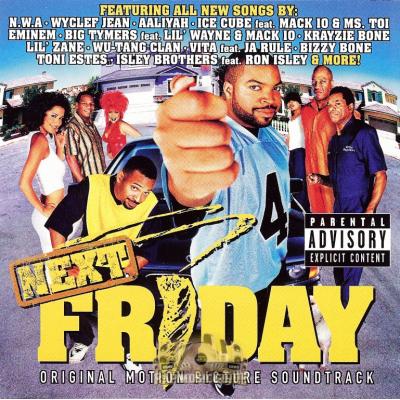
"Next Friday" Soundtrack Lyrics
Movie • 2000
Track Listing
Ice Cube f/ Mack 10, Ms. Toi
N.W.A.
Vita f/ Ja Rule
Toni Estes
Pharoahe Monch
Bizzy Bone
Aaliyah
Wyclef Jean
Wu-Tang Clan
Big Tymers f/ Wayne, Mack 10
Krayzie Bone
Frost f/ Don Cisco, Kurupt, Soopafly
Isley Brothers f/ Ron Isley
Eminem
Lil' Zane
"Next Friday (Original Motion Picture Soundtrack)" – Album Guide to Tracks and Key Scenes
Overview
How do you move your stoner hero from South Central to a pastel Rancho Cucamonga cul-de-sac and still keep the hood’s soundtrack rattling every scene? Next Friday answers by turning its music into a running commentary on Craig Jones’ exile: arrival, adaptation, rebellion, collapse. Every cue either drags a little bit of the old block into suburbia or mocks the fantasy that a lottery win fixes anything.
The film follows Craig (Ice Cube) as he hides out with his freshly rich Uncle Elroy and cousin Day-Day, dodging escaped bully Deebo and a trio of Joker brothers next door. On paper it is a loud, cartoonish escalation of the first Friday. On record, the soundtrack doubles down on late-90s West Coast bravado, New York boom-bap edges, and deep-crate 70s funk and soul, all stitched together so the jokes land with a beat already in motion.
What makes the album stand out is how aggressively it refuses to be background. Tracks like Ice Cube’s “You Can Do It”, N.W.A’s reunion cut “Chin Check” and Eminem’s “Murder Murder” were built to live on radio and club systems, not just under dialogue. In the film, needle drops are rarely subtle: the camera glides, the joke hits, and the music all but elbows its way into the punchline. Pinky’s record store, Uncle Elroy’s sex-toy-filled bedroom, the Jokers’ wild house party — all become excuses to blast full songs in-world.
Across the movie’s loose “day in the life” structure you can feel four musical phases. Arrival: hard, triumphant late-90s hip hop tracks sell Craig’s escape and Deebo’s looming threat. Adaptation: silky R&B and slow funk ride through hangouts at Elroy’s place, hinting at comfort and complacency. Rebellion: aggressive cuts from Wu-Tang affiliates, N.W.A. and Big Tymers take over when Craig decides to rob the Jokers and fight back. Collapse: vintage soul, “Movin’ On Up”-style TV nostalgia and ironic party bangers underline how the fantasy of suburban safety cracks, even as everyone dances it off.
How It Was Made
Next Friday (Original Motion Picture Soundtrack) landed in December 1999 as the second entry in the Friday soundtrack trilogy, assembled around the same time Steve Carr was directing the film for Ice Cube’s Cube Vision. Recording sessions scattered across major studios — The Hit Factory and Sony Music Studios in New York, Encore and Record One in California, Noontime in Atlanta, Ruthless Records and more — giving the compilation a genuinely bi-coastal feel rather than a strictly West Coast cipher.
Ice Cube acted as compilation producer, pulling in an overstuffed roster of hip hop and R&B names: Aaliyah, Wu-Tang Clan, Wyclef Jean, N.W.A with Snoop Dogg, Eminem, Krayzie Bone, Bizzy Bone, Toni Estes, The Isley Brothers and others. Behind the boards, the credits read like a late-90s rap telephone book: Dr. Dre, Mannie Fresh, Irv Gotti, Wyclef, Angela Winbush, Fredwreck, Mathematics and more, all under the Priority Records umbrella.
The film itself splits its music duties. Jazz composer Terence Blanchard supplies score cues that sneak in around the big songs, usually during tension beats with the Jokers or quieter father-son moments for Craig and Willie. Music supervision on the film side is credited to Spring Aspers, with additional music supervision and production from Teddy Alexander Bishop — their job was to clear classics like David Bowie’s “Fame”, Harold Melvin & the Blue Notes’ “Bad Luck”, Rufus & Chaka Khan’s “Tell Me Something Good” and Roy Ayers’ “Don’t Stop the Feeling” while keeping the new rap cuts front and center.
The headline production story is the partial reunion of N.W.A on “Chin Check,” a track that finally put Ice Cube, Dr. Dre and MC Ren back together on record with Snoop Dogg filling in the missing pieces. One classic-album write-up later called it a “historic moment in hip-hop” and argued that it almost overpowers the rest of the disc. According to Wikipedia, the album still played well as a whole, reaching number 19 on the Billboard 200 and number 5 on the Top R&B/Hip-Hop Albums chart before going gold in mid-2000.
Tracks & Scenes – Key Needle Drops
The film uses almost 40 songs when you count album cuts, deep funk placements and TV themes. Below are some of the most important drops and how they play against the scenes.
“You Can Do It” — Ice Cube feat. Mack 10 & Ms. Toi
Where it plays: Kicks in over the main titles and early montage as Craig catches us up on life since the first film and Deebo’s escape. The track rides the opening credits, tying the sequel directly to Cube’s own discography and selling the idea that Craig is still hustling his way through problems rather than magically “fixed” by the move.
Why it matters: It immediately sets a club-ready energy and tells the audience this is a party soundtrack first, plot second. It also anchors the album’s identity — this is the song that broke out far beyond the movie.
“Chase Me” — Con Funk Shun
Where it plays: Slides in as a second opener when Craig and Willie are on the road out of South Central toward Rancho Cucamonga. The music coasts over highway shots, Willie’s nervous driving and Craig’s mixed feelings about leaving home.
Why it matters: A late-70s funk groove under a 2000 stoner comedy instantly announces that this isn’t just a rap mixtape. It nods to the older generation’s taste while Craig is literally stuck riding along with his father’s decisions.
“You Dropped a Bomb on Me” — The Gap Band
Where it plays: Underscores Craig and Willie’s car conversation as they approach Uncle Elroy’s new house, the camera lingering on suburban lawns and Elroy’s gaudy winnings. The title doubles as commentary on the news that taxes have gutted the lottery payout.
Why it matters: The song turns Elroy’s “dream come true” into something unstable, hinting that the real bomb is the flimsy financial reality under this whole move.
“Bad Luck” — Harold Melvin & the Blue Notes
Where it plays: During a highway stretch where the mood swings between optimism and dread, Craig and Willie banter while traffic rolls by. The lush Philly soul sound clashes with Willie’s constant complaints and Deebo’s off-screen pursuit.
Why it matters: It’s on-the-nose in title, but the arrangement adds warmth, reminding us that despite the scheming and threats, this is a family story built on affection and bad decisions.
“In the Mood” — Tyrone Davis
Where it plays: Inside Elroy’s house as Craig first settles in, lounging with Uncle Elroy and Auntie Suga on the couch. The track oozes through the living room while Suga flirts and the camera takes in the slightly tacky new-money decor.
Why it matters: The slow-jam vibe underlines Suga’s over-the-top sexuality and Elroy’s mid-life fantasy of comfort. According to an old Q&A archived on SoundtrackINFO, this is the song viewers kept asking about after seeing Auntie Suga’s entrance.
“Sex-O-Matic Venus Freak” — Macy Gray
Where it plays: In Uncle Elroy’s infamous bedroom full of sex toys and adult gadgets. As Craig stumbles through the room and Suga performs for him and Elroy, the song’s off-kilter neo-soul groove keeps everything playful rather than sinister.
Why it matters: It modernizes the throwback soul palette, representing how late-90s R&B and neo-soul sit alongside 70s funk in the film’s version of Black desire and spectacle.
“Fried Day” — Bizzy Bone
Where it plays: Over a chill-out sequence where Craig, Day-Day and Roach finally get a moment to smoke and decompress. The camera hangs on their haze-filled hangout, with the Jokers still plotting next door.
Why it matters: The song ties the sequel back to the original Friday’s weed-soaked lethargy, but now the mood is more anxious; getting high is a temporary escape from grown-up financial trouble, not just boredom on the porch.
“Livin’ It Up” — Pharoahe Monch
Where it plays: When Mrs. Ho-Kym calls Day-Day over to check out Craig, surveillance-style. The cut bounces under neighborhood chatter, lawn-chair gossip and the awkward introduction between Craig and his new Korean neighbor.
Why it matters: Monch’s elastic flow and the track’s swagger undercut the supposedly safe, gated-community vibe. It’s a reminder that Craig is still being watched and judged, just by a different set of neighbors.
“Mamacita” — Frost, Kurupt, Soopafly & Don Cisco
Where it plays: When the Joker brothers roll back to their own house, lowrider style. The song bumps as they cruise into the driveway, surrounded by friends and family, before the plot tightens around their hidden cash.
Why it matters: This cut gives the Jokers their own musical identity — Latino-flavored West Coast rap — so they feel like more than cartoon villains. Musically, it broadens the film’s sense of who “the neighborhood” is.
“Chin Check” — N.W.A feat. Snoop Dogg
Where it plays: Inside Pinky’s record store, woven into the background when Craig first shows up to see Day-Day at work. The track hums through the speakers as customers browse, Pinky’s goons lurk, and Day-Day panics about his ex showing up.
Why it matters: It turns the store into a shrine to gangsta rap history — you’re literally hearing a new N.W.A track while working in a suburban music shop. The scene becomes a meta joke about how the genre’s rebellion has been packaged and sold.
“Fame” — David Bowie
Where it plays: Over Pinky’s big entrance as he steps out of his pink limousine, slow-motion, flanked by a chauffeur. The riff hits as he walks toward the store, dripping attitude and gold jewelry.
Why it matters: A glam-rock classic blasting for a flamboyant, Black record-store owner is a perfect character cue. His entire persona is built on performance and image; the song makes the gag explicit without a word of dialogue.
“We Murderers Baby” — Ja Rule & Vita
Where it plays: When Day-Day’s “babe” shows up at the CD shop, stirring chaos in the aisles. The track plays as she browses, confronts Day-Day and turns the store into a stage for their argument.
Why it matters: Its aggressive tone mirrors the way personal drama crashes into Day-Day’s already shaky job situation. The murder-talk title parodies how overblown the confrontation feels compared to the actual stakes.
“Hot” — Toni Estes
Where it plays: As D’Wana and Baby D march into the shop, hunting Day-Day. The song rides the moment they hit the doorway, weaving around insults, side-eye and Day-Day’s terrified attempts to hide behind displays.
Why it matters: This is pure attitude music — exactly the kind of late-90s R&B/hip hop hybrid that paints Baby D as unstoppable. The cue tells you she’s the real threat long before the chase.
“Low Income” — Wyclef Jean feat. Beast & 718 Crew
Where it plays: During the backyard parking-lot chase when Baby D corners Day-Day behind the strip mall. Speakers from nearby cars bleed the track into the space as they run between dumpsters and parked rides.
Why it matters: The title sums up the movie’s central anxiety: Elroy’s lottery win didn’t actually free anyone from money trouble. While they argue over relationships, the soundtrack reminds us their house is one repossession notice away from gone.
“Don’t Stop the Feeling” — Roy Ayers
Where it plays: In the car as Willie’s stomach starts to rebel from bad Mexican food and too much stress. The sunny jazz-funk groove keeps rolling while he sweats, squirms and finally begs for a bathroom stop.
Why it matters: It’s a classic comedy contrast: ultra-smooth music over bodily panic. The cue lets the joke run longer without feeling mean; you’re half listening to the groove, half watching Willie fall apart.
“Let It Whip” — Dazz Band
Where it plays: In the aftermath of Pinky firing Day-Day, when Uncle Elroy finds out about the lost job and lashes out with a belt. The song punches in as he literally “whips” Day-Day on the lawn.
Why it matters: It turns a moment of family discipline into a music-video gag. The irony of the lyric and the slap-happy funk beat keeps the scene comic rather than grim.
“Good Friday” — Big Tymers feat. Lil Wayne & Mack 10
Where it plays: At the Joker brothers’ house party, where the stolen hydraulic pump money is hidden. As neighbors dance, drink and flirt, the camera cuts between Craig’s heist upstairs and the oblivious party downstairs.
Why it matters: The song’s celebratory bounce hides the crime thriller undercurrent — nobody at the party knows their hosts are about to lose their stash. It’s rebellion disguised as a neighborhood function.
“I Don’t Wanna” — Aaliyah
Where it plays: When Craig sneaks into Karla’s bedroom and the tone briefly shifts from broad comedy to something softer. The track slides under their conversation about family and being stuck with the Joker brothers.
Why it matters: It’s one of the few moments where the movie lets a full R&B ballad breathe. Aaliyah’s vocal softens Craig, showing a more vulnerable side and hinting that he wants out of the endless beef cycle too.
Notes & Trivia
- The soundtrack is technically a pre-millennium release: the album dropped in December 1999 even though the film opened in January 2000.
- Terence Blanchard, better known for serious dramas and Spike Lee joints, quietly scores much of the tension around Deebo and the Jokers.
- N.W.A’s “Chin Check” on this album predates “Hello” on Ice Cube’s War & Peace Vol. 2, making the soundtrack the first place fans heard the reunion.
- Several heavily featured songs — “Chase Me”, “You Dropped a Bomb on Me”, “Bad Luck”, “Tell Me Something Good”, “Fame” — never appeared on the official 15-track CD.
- The film leans so heavily on record-store scenes that Pinky’s shop feels like a second home base; it is also where many of the most expensive needle drops sit.
- A lot of viewers first hunted down Tyrone Davis’ “In the Mood” only after seeing Auntie Suga’s stairway entrance and couch scene.
- Day-Day’s parking-lot chase with Baby D layers “Low Income” over jokes about unpaid bills — one of the more pointed class gags in the film.
Music–Story Links
The soundtrack doesn’t just decorate the film; it maps onto Craig’s emotional arc. “You Can Do It” and “Chase Me” are arrival songs — they pump confidence into Craig’s reluctant move, insisting he can handle this next chapter even as the narration admits he’d rather stay home. When Deebo and the Jokers become real threats instead of background worries, harder cuts like “Chin Check”, “Good Friday” and “Murder Murder” creep in around the edges, marking the rebellion phase where Craig chooses to strike first.
The adaptation phase belongs to Uncle Elroy and Auntie Suga. Their house is scored with old-school soul and satin-slick R&B: Tyrone Davis, Macy Gray, classic funk bands. Those cues sell the fantasy that Elroy has escaped the struggle — hot tub, toys, a house with a gate. But when the repossession notice shows up and Craig realizes how fragile the lottery money is, that same smooth music starts to feel like denial, not comfort.
Pinky’s storyline is almost entirely musical. “Chin Check” turns his record store into a monument to gangsta rap history, while Bowie’s “Fame” turns his limo arrival into a joke about image and ego. The fact that Pinky mistakes Craig for a robber while standing in a shop full of “street” records is the film’s most obvious gag about how hip hop has been commercialized.
By the time we reach the heist and rescue at the Jokers’ house, the music and story collapse together. Party bangers like “Good Friday” and neighborhood anthems play downstairs while Craig and Roach are literally stealing survival money upstairs. When Aaliyah’s “I Don’t Wanna” scores Craig and Karla’s quiet talk, it briefly suspends the comedy and shows that everyone in this cul-de-sac is tired of living at the edge of eviction and violence. The film may end with laughs, but the soundtrack remembers what’s at stake.
Reception & Quotes
Commercially, the album was a solid hit. According to Wikipedia and chart archives, it peaked at number 19 on the Billboard 200, hit number 5 on the Top R&B/Hip-Hop Albums chart, and was certified gold by the RIAA not long after the film’s release.
Critically, reactions split. Some writers saw just another tie-in compilation stuffed with names; others heard a snapshot of mainstream hip hop at the turn of the millennium with real replay value. A long-running hip hop review site summed up the pro side neatly:
“If you’re looking to pick up a great hip hop soundtrack, then look no further than the Next Friday soundtrack.” — early online review, December 1999
A more skeptical AV-style review pushed back on the star power approach:
“Elsewhere, Next Friday is the standard mishmash of big names, trend-chasing, and unremarkable collaborations.” — contemporary review of the soundtrack
Recent retrospective pieces have been kinder. One classic-album column argued that the disc “does more than just capture the spirit of the film — it offers fine music that can be appreciated on its own,” while also framing “Chin Check” as the historic draw. And in fan spaces — forums, Facebook anniversary posts, Reddit threads — you still see variations on the same line: people spun this CD “to death” regardless of how they felt about the movie’s jokes.
Availability is straightforward in the streaming era. The core 15-track album is on the major platforms (Apple Music, Spotify, YouTube Music and others), while several deep-cut placements live on separate artist albums or compilations. Blackfilm’s original coverage already noted that the soundtrack “makes this movie more” than a simple sequel; streaming just makes that argument easier to test now.
Interesting Facts
- The album was released by Priority Records as part of an informal “Friday” soundtrack trilogy, sitting between the Friday (1995) and Friday After Next albums.
- A number of the film’s funk classics — including cuts by The Gap Band, Harold Melvin & the Blue Notes and Rufus & Chaka Khan — appear only as film placements, not on the official soundtrack CD.
- “You Can Do It” became a hit again years later when it was re-released in the UK and climbed as high as number two on the singles chart there.
- Eminem’s “Murder Murder” on this soundtrack shows up in different mixes across various releases; the version here is one of the earliest widely distributed ones.
- The soundtrack has seen multiple vinyl lives, including 2xLP pressings that collectors trade as much for the cover art as for the tracklist.
- DVD editions of the film include music videos for “You Can Do It” and Lil’ Zane’s “Money Stretch,” effectively turning the disc into a mini music-video compilation.
- Wu-Tang Clan’s contribution, “Shaolin Worldwide,” helps connect the soundtrack to New York’s underground even though the film is firmly West Coast in story.
- Several songs, like “Movin’ On Up (Theme from The Jeffersons)”, work as meta-jokes about Black upward mobility, mirroring Elroy’s sudden lottery fortune.
- Engineer Richard Huredia, who worked on Dr. Dre’s 2001 and Eminem’s The Slim Shady LP, also handled engineering and mixing duties on this soundtrack.
- Some fans still complain there is no “complete” edition that gathers every cue used in the film — a frustration even older Q&A sites acknowledged at the time.
Technical Info
- Title: Next Friday (Original Motion Picture Soundtrack)
- Film: Next Friday (2000 American stoner comedy film)
- Year of film / album: Film released January 12, 2000; soundtrack released December 1999 (commonly cited as December 14).
- Type: Feature-film soundtrack / compilation album.
- Primary genres: Hip hop, R&B, funk, soul, TV theme music.
- Key song artists: Ice Cube, Mack 10, Ms. Toi, N.W.A with Snoop Dogg, Aaliyah, Wyclef Jean, Bizzy Bone, Krayzie Bone, Wu-Tang Clan, Big Tymers, The Isley Brothers, Frost/Kid Frost, Toni Estes, Eminem.
- Score composer (film): Terence Blanchard.
- Producers (album, selection): Ice Cube (compilation), Dr. Dre, Wyclef Jean, Mannie Fresh, Angela Winbush, Fredwreck, Irv Gotti, Mathematics and others.
- Music supervision (film): Spring Aspers (music supervisor); Teddy Alexander Bishop credited on some materials for music supervision/production.
- Label: Priority Records.
- Recording locations: The Hit Factory (New York), Sony Music Studios, 36 Chambers Studio, Encore Studios (Burbank), Record One and The Village Recorder (Los Angeles), Noontime (Atlanta), Ruthless Records and others.
- Chart performance: US Billboard 200 peak #19; US Top R&B/Hip-Hop Albums peak #5; year-end placements on both charts in 2000.
- Certification: RIAA gold in the United States (over 500,000 units shipped).
- Notable singles: “You Can Do It”, “Money Stretch”, “I Don’t Wanna”, “Low Income”, “Chin Check”, “Hot”.
- Original formats: CD and cassette; later 2xLP vinyl issues and digital distribution.
- Current availability: Widely available on major streaming platforms; physical copies circulate as catalog reissues and collector’s vinyl.
Questions & Answers
- Is the Next Friday soundtrack mostly songs or score?
- It is overwhelmingly a song-driven album. Terence Blanchard’s score lives mainly in the film; almost all of the official soundtrack tracks are rap or R&B cuts.
- Which big songs from the movie are missing from the official soundtrack album?
- Funk and soul staples like “Chase Me”, “You Dropped a Bomb on Me”, “Bad Luck”, “Tell Me Something Good”, “Don’t Stop the Feeling”, “Fame” and “Let It Whip” all feature in the film but not on the 15-track CD.
- Where can I listen to the Next Friday soundtrack today?
- The core album streams on major services like Apple Music, Spotify and YouTube Music. Some extra film-only songs appear on the original artists’ own albums or best-of compilations.
- Why is N.W.A’s “Chin Check” considered such a big deal?
- It marked the first time key N.W.A members — Ice Cube, Dr. Dre and MC Ren — recorded together again in about a decade, with Snoop Dogg filling the missing spots. For many fans, that reunion is the soundtrack’s main historic hook.
- Does the soundtrack work if you have never seen the movie?
- Yes, but in a specific way. It plays like a turn-of-the-millennium hip hop compilation: uneven in places, stacked with heavyweights, and strongest when you enjoy it as a loose party mix rather than a concept album.
Canonical Entities & Relations
| Subject | Relation | Object |
|---|---|---|
| Next Friday (2000 film) | features soundtrack | Next Friday (Original Motion Picture Soundtrack) |
| Next Friday (Original Motion Picture Soundtrack) | released by | Priority Records |
| Next Friday (Original Motion Picture Soundtrack) | includes music by | Ice Cube |
| Next Friday (Original Motion Picture Soundtrack) | includes music by | N.W.A |
| Next Friday (Original Motion Picture Soundtrack) | includes music by | Aaliyah |
| Next Friday (Original Motion Picture Soundtrack) | includes music by | Wyclef Jean |
| Next Friday (Original Motion Picture Soundtrack) | includes music by | Wu-Tang Clan |
| Next Friday (Original Motion Picture Soundtrack) | includes music by | Eminem |
| Ice Cube (O’Shea Jackson) | produced | Next Friday (Original Motion Picture Soundtrack) |
| Ice Cube (O’Shea Jackson) | stars in | Next Friday (2000 film) |
| Ice Cube (O’Shea Jackson) | wrote | Next Friday (2000 film) |
| Steve Carr | directed | Next Friday (2000 film) |
| Terence Blanchard | composed score for | Next Friday (2000 film) |
| Spring Aspers | served as music supervisor on | Next Friday (2000 film) |
| New Line Cinema | produced | Next Friday (2000 film) |
| Cube Vision | produced | Next Friday (2000 film) |
| Rancho Cucamonga, California | serves as primary setting for | Next Friday (2000 film) |
Sources: Wikipedia; MoviesOST; SoundtrackINFO; AllMusic; Apple Music; Discogs; Tinnitist; AV Club; Blackfilm; RIAA and chart archives; fan forums and Q&A sites.
November, 17th 2025
A-Z Lyrics Universe
Cynthia Erivo Popular
Ariana Grande Horsepower
Post Malone Ain't No Love in Oklahoma
Luke Combs Good Riddance (Time of Your Life)
Green Day Bye Bye Bye
*NSYNC You're the One That I Wan
John Travolta & Olivia Newton-John I Always Wanted a Brother
Braelyn Rankins, Theo Somolu, Kelvin Harrison Jr. and Aaron Pierre The Power of Love
Frankie Goes to Hollywood Beyond
Auli’i Cravalho feat. Rachel House MORE ›