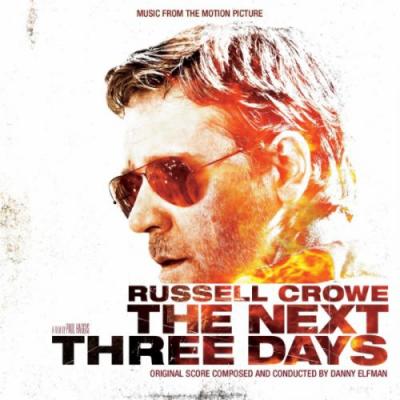
"Next Three Days, The" Soundtrack Lyrics
Movie • 2010
Track Listing
Danny Elfman
Danny Elfman
Danny Elfman
Danny Elfman
Danny Elfman
Danny Elfman
Danny Elfman
Danny Elfman
Danny Elfman
Danny Elfman
Danny Elfman
Danny Elfman
Danny Elfman
Danny Elfman
Danny Elfman
Danny Elfman
Danny Elfman
Danny Elfman
Danny Elfman
Danny Elfman
Danny Elfman
Danny Elfman
Danny Elfman
Moby
Moby
Moby
Allen Maldonado
Andres Ayrado
The Like
Moby
Hemys
P Live
The Like
Lost In The Trees
"The Next Three Days (Original Motion Picture Soundtrack)" – Album Guide to Tracks and Key Scenes
Overview
Can a prison-break thriller about an “ordinary” teacher survive on hushed piano and small, aching motifs instead of wall-to-wall bombast? The Next Three Days (Original Motion Picture Soundtrack) answers by shrinking the music down to the scale of one family’s panic. The film follows John Brennan, a Pittsburgh community college professor, as he moves through arrival, adaptation, rebellion and collapse: first accepting his wife’s life sentence, then quietly learning the system, then planning a breakout that may destroy everything he has left.
Danny Elfman’s score largely refuses the obvious action template. Instead of big superhero brass, you get close-miked piano, thin but agile strings and light electronics that feel like nervous thoughts rather than “hero themes.” Melodies circle around fragments of a family motif, often half-buried under rhythmic string patterns. When John tries to function as a father and teacher, the music stays small, almost domestic. When he starts reading prison-escape manuals and scouting routes, the patterns tighten, the pulse gets insistent, but Elfman still holds back until the later reels.
The non-score cues are surgically placed. Indie rock and Moby’s electronica arrive in short, sharp bursts: John’s dive into Pittsburgh’s underworld, rare moments of intimacy with Lara, and the long, nerve-shredding escape where zoo rides and highway ramps share the same timeline. Each needle drop is a little reality check: the outside world keeps spinning — bars, clubs, radio — while John is ripping his life apart to free one person.
Across the full film you can hear distinct musical “phases.” Arrival: low-key, piano-led score cues like “Prologue” and “A Way In” outline a modest life that has already cracked. Adaptation: slightly warmer strings, domestic textures and the occasional jazz “Waltz Trio Session” try to make a prison marriage feel liveable. Rebellion: longer, more muscular cues such as “Breakout,” “It’s On” and “They’re Off” finally let percussion and guitar drive, mirroring John’s escalating crimes. Collapse and release: “The Truth,” Moby’s “Mistake” and “Be The One” sit on the edge between dread and fragile hope, playing over goodbyes, highway chases and that last, quiet hotel room in Caracas.
How It Was Made
The film itself is a 2010 remake of the French thriller Pour elle, written and directed by Paul Haggis and shot on location in Pittsburgh with Russell Crowe and Elizabeth Banks as John and Lara Brennan. Danny Elfman was brought in after Haggis’s long run with Mark Isham on projects like Crash, partly to give this more intimate thriller a different flavour while still staying in the low-key suspense territory Haggis liked. On paper that looks like classic Elfman — he had already scored Crowe in Proof of Life — but here he leans much closer to Isham-style restrained tension than to his gothic or superhero work.
According to Filmtracks’ review, Elfman builds the score from a minimal palette: a compact string section, piano at the emotional centre, small splashes of electric and acoustic guitar, light percussion and, in a few cues, wordless vocals from Ayana Haviv. The electronics are largely background colour rather than set pieces; the music is designed to sit under dialogue and slow planning rather than overtake it.
The album itself appears under two slightly different subtitles — Music from the Motion Picture and Original Motion Picture Soundtrack — but the contents match. Lionsgate Records released the score digitally and on CD in November 2010 in North America, with Silva Screen handling a near-identical CD for Europe in early 2011. The program runs a little over 71 minutes: about twenty-three cues of score plus two Moby songs, “Mistake” and “Be The One”, which close the album and mirror their late-film placements.
AllMusic and Apple Music file the album under “Stage & Screen” and “Soundtrack,” while Silva Screen’s own notes stress that this is a “piano-led score” for a “tense thriller.” That framing is important. Elfman isn’t asked to reinvent himself here; he is asked to make suspense music that never tips the film into action-movie fantasy. The one big concession to his more extrovert side is the extended escape cue “Breakout,” which even the more cautious reviewers single out as the standout set piece.
Tracks & Scenes – Key Needle Drops
The film uses a mix of Elfman’s score and a small, carefully chosen set of source songs. Below are the best-documented placements, including non-album cues and the Moby tracks that also appear on the CD.
“Waltz Trio Session” — Giorgio Rosciglione, Cinzia Gizzi & Gegè Munari
Where it plays: During an early dinner date that turns into one of the film’s few genuinely relaxed moments, John and Lara sit in their car after the meal. The city hums outside, restaurant lights reflected on the windshield. This jazz waltz slips in on the radio as their conversation softens and they finally lean into each other, the camera staying close as they move from tension to intimacy in the front seat.
Why it matters: It’s the clearest glimpse of the marriage they are both trying to remember. The old-fashioned, small-ensemble waltz contrasts with the cold, modern sounds of the prison later, underscoring how far they fall.
“In The End” — The Like
Where it plays: Roughly half an hour in, John goes looking for forged documents and passports. He finds Harv in a bar that looks like any other neighbourhood joint — neon beer signs, low light, a sports game forgotten on a TV. “In The End” plays over the speakers as John pushes through the crowd toward Harv, already out of his depth in a world of petty criminals and hustlers.
Why it matters: The retro girl-group guitar tone softens the scene at first, but the title feels pointed: this is the moment where John crosses the line from fantasising about escape to actively enlisting criminals to make it happen.
“Mistake” — Moby
Where it plays: Around 1h19 into the film, John quietly prepares for a point of no return. We see him moving through his house packing bags, shuffling through forged plane tickets, checking details. In the doorway, his father stands and watches, realising what this means without saying a word. “Mistake” flows under the whole sequence, its distant vocals and steady pulse echoing the weight of what John is about to do.
Why it matters: The song’s title and mood speak for the entire family. No one can quite say out loud that this might be madness, but the music frames the preparations as a tragic necessity, not a cool heist.
“Be The One” — Moby
Where it plays: At roughly 1h40, the breakout is in motion and John and Lara have realised their son Luke is at the zoo, not where John left him. As they race through the zoo grounds, weaving through a children’s party, panicked crowds and animal enclosures, “Be The One” underpins the chaos. The cue stretches across wide shots of the family finally reuniting and tighter ones of John scanning for police at every corner.
Why it matters: After so much restrained score, dropping a full Moby track over this sequence turns it into the emotional centre of the film: this isn’t just an escape, it is the last grab at being a family unit.
“Don’t Make A Sound” — The Like
Where it plays: First song over the end credits, starting a little after 2h06 once the Caracas hotel epilogue fades out. The camera has just settled on John’s photo of Lara and Luke asleep, and then the film cuts to black. “Don’t Make A Sound” comes in on the cut, swaying over the credit crawl while viewers are still processing the moral cost of everything John has done.
Why it matters: Coming from The Like’s 60s-inspired album Release Me, its polished indie-rock gloss contrasts sharply with the raw choices we’ve just watched. It’s almost too neat as a title: the world doesn’t know what really happened, and the Brennans can never really tell.
“Walk Around the Lake” — Lost In The Trees
Where it plays: The second song in the end credits, following The Like. Where “Don’t Make A Sound” still has forward motion, “Walk Around the Lake” is slower and more introspective, playing as the names of smaller crew and music departments roll by.
Why it matters: It acts as a decompressing coda. The song’s folk-orchestral mix and meditative lyrics offer a gentle release valve after ninety minutes of often suffocating tension.
“Get It Cheap” — DawOne & Skee
Where it plays: Official credits list this hip hop track among the film’s songs, most likely in one of John’s dives into criminal spaces while he searches for forged documents and guns. Public scene guides don’t pin down a precise timestamp, but it almost certainly surfaces as background source music in a bar or street setting.
Why it matters: Even without an exact placement, the title and style fit John’s arc: he is trying to buy his way out of an impossible situation using the cheapest, dirtiest routes he can find.
“The Clue” — P-Live
Where it plays: Listed in song credits without a widely-documented scene description. The track’s presence in the official materials suggests it appears briefly as diegetic music, probably during the investigative stretches where John tests the case evidence himself.
Why it matters: It’s a reminder that not every musical moment in the film is big or foregrounded; some tracks just tint the edges of the procedural work John does away from the prison-break spectacle.
“Sweet Dreams” — Moby
Where it plays: Confirmed in the soundtrack listings but not tied by public guides to a precise moment. It likely appears as background source music along with Moby’s better-documented cues, shading one of John’s transitions between family life and criminal planning.
Why it matters: As with “Mistake,” the title feels pointed in context. The entire prison-break scheme is John’s desperate attempt to reclaim a dream of family life that may never have been real.
“Division” — Moby
Where it plays: Credited to the film but not well documented shot-for-shot; it may be used under more introspective moments in the second half, where John’s double life — teacher by day, planner by night — becomes unsustainable.
Why it matters: The track’s name lines up almost too neatly with the way the film splits John in two. Even if viewers don’t consciously clock it, the cue helps keep that fracture in the air.
“No Nadie” — Andreas Ayrado
Where it plays: Listed in song credits and likely tied to Spanish-language ambience later in the film, possibly around the Venezuelan epilogue or in locations connected to John’s chosen escape route. Exact usage isn’t pinned down in open scene guides.
Why it matters: As the family reaches South America, the soundscape subtly shifts. A Spanish-language track like this reinforces that they have left Pittsburgh’s world behind for good, even if the film doesn’t linger on the new life.
Score cue: “Breakout” — Danny Elfman
Where it plays: The long, eight-minute centrepiece that scores Lara’s hospital transfer and the escape itself. From the moment John sabotages the blood work and intercepts the prison van to the sequence where he crashes through traffic, ducks into a crowd of Penguins fans and races for the train, “Breakout” is almost continuous — strings in constant motion, guitars and percussion slowly building, then dropping away as police close in.
Why it matters: Reviewers regularly single this out as the album’s showpiece. It’s the one time Elfman lets the music take over as a full action engine, and it transforms what could be a functional chase into a sustained piece of nail-biting.
Score cue: “The Truth” — Danny Elfman
Where it plays: Near the end, as the film flashes back to the night of the murder and quietly reveals what really happened, and then into the aftermath of the escape. The cue grows from soft piano into fuller strings and voice, finally giving emotional release to motifs that have circled coldly for an hour.
Why it matters: Filmtracks calls this the album’s “lovely and redemptive” highlight. It is where Elfman stops merely shading John’s anxiety and lets the score openly mourn the years the family has lost.
Trailer music
Where it plays: The main theatrical trailers cut mostly to tense, percussive score cues rather than a standalone pop song — a mix of Elfman’s suspense writing and trailer-house sound design. There is no widely cited, separate “trailer song” attached to this campaign the way later thrillers used slowed-down covers.
Why it matters: Marketing leans into the score’s mood: grounded, procedural, more about dread than spectacle. That choice sets expectations correctly for the album you get.
Notes & Trivia
- The film credits also list Alberto Iglesias alongside Danny Elfman, although the commercial album itself contains only Elfman’s score plus two Moby songs.
- “Don’t Make A Sound” and “Walk Around the Lake” are both album tracks by indie acts; their use in the end credits pushed some listeners to those artists for the first time.
- The Like’s album Release Me specifically notes that “Don’t Make A Sound” appears in the closing credits of The Next Three Days.
- Ayana Haviv’s ethereal vocals in cues like “The Truth” are the same voice many TV viewers recognise from other film and TV scores in the 2010s.
- Lionsgate’s North American release and Silva Screen’s European disc use different cover art crops but identical track sequences.
- Silva Screen’s marketing emphasised that “Mistake” and “Be The One” were early peeks at material from Moby’s then-forthcoming album cycle.
- Contemporary reviews often compare the score’s mood to Mark Isham’s Crash and Elfman’s own The Kingdom, rather than to his more famous fantasy work.
- On streaming platforms the album is filed under “Various Artists” in some territories because of the Moby tracks, even though the bulk is Elfman’s score.
Music–Story Links
Story-wise, the soundtrack tracks John’s transformation more than Lara’s. Early on, cues like “A Way In” and “Pittsburgh’s Tough” keep the piano small and repetitive, mirroring how John keeps cycling through the same court visits and prison routines without any progress. The harmony rarely resolves; it just turns over on itself.
When John starts researching escapes and meets Damon Pennington, the music doesn’t suddenly become macho. Instead, Elfman narrows the focus even more. Short, nervous figures in the strings and piano underline John’s obsessive late-night reading and amateur surveillance. You can hear the character grinding his life down into checklists and contingency plans.
The source songs usually appear at pressure points where John’s family and criminal plans collide. “In The End” scores his first serious step into the underworld. “Mistake” covers the quiet goodbye between father and son when words fail. “Be The One” attaches itself to Luke’s rescue at the zoo so firmly that the moment feels like a music video about choosing family over self-preservation.
By the time “Breakout” and “They’re Off” kick in, the score and story are moving in lockstep. Every new barrier — traffic, police, a panicking Lara, the lost child — triggers a new layer in the cue. When “The Truth” finally plays over the flashback and the family’s escape to Caracas, the music admits something the plot never quite says aloud: the plan has “worked,” but the damage to everyone’s lives is permanent.
Reception & Quotes
The film itself landed with mixed reviews and modest box office; the soundtrack’s reception has been more quietly positive. AllMusic files the album under “Stage & Screen / Classical,” with a brief but favourable note on Elfman’s restraint. Filmtracks offers a cooler three-star take, calling it “a conservatively somber exercise in ambience” with one “strikingly beautiful” climax cue in “The Truth.”
AssignmentX went the other way entirely, giving the album an A and praising how Elfman scores “a uniquely human drama” rather than a generic action picture. That review leans hard on “Breakout” as the template for how to keep an eight-minute suspense cue engaging without resorting to over-the-top heroics.
“Lightly rhythmic suspense with a tender personality, led by piano and strings.” — Filmtracks on the album’s overall feel
“Elfman’s style has rarely sounded so effectively normal, combining an emotional heartbeat with gripping suspense rhythms.” — AssignmentX on the score’s balance
Among film-music fans, the album sits in a comfortable middle tier of Elfman’s 2010s work. Message boards and review aggregators tend to describe it as “underrated” or “pleasant but not essential,” with recurring praise for “Breakout,” “All Is Lost” and “The Truth.” Even less enthusiastic listeners usually concede that it does exactly what Haggis wanted: keep the tension simmering while letting the actors carry most of the drama.
Interesting Facts
- The North American digital release date — mid-November 2010 — lined up almost exactly with the film’s US theatrical opening weekend.
- European physical copies often carry the subtitle Music from the Motion Picture, while US listings favour Original Motion Picture Soundtrack; the audio is the same.
- Silva Screen’s catalogue entry gives the total running time as roughly 71 minutes and 27 seconds, longer than many modern thriller albums.
- Moby’s “Be The One” was a then-new track; the soundtrack effectively previewed his 2011 material for some listeners.
- The album credits Rick Wentworth as conductor and frequent Elfman collaborator Steve Bartek as one of the orchestrators, continuing a partnership going back to the 1980s.
- Online track lists list 25 cuts, but several film-used songs (like “Waltz Trio Session” and “Don’t Make A Sound”) only appear because the labels licensed them separately; they’re not Elfman compositions.
- Some European library and public-media catalogues file the CD under “Film theatre & television / Soundtrack,” which is why it occasionally shows up next to classical discs instead of pop OSTs.
- Streaming services sometimes relabel the album simply as The Next Three Days under Danny Elfman’s discography, which makes it easy to miss that two tracks are Moby songs.
- Despite general critical indifference to the film, the score has quietly picked up a small following among fans of more restrained, piano-driven thriller music.
Technical Info
- Title: The Next Three Days (Original Motion Picture Soundtrack) / The Next Three Days: Music from the Motion Picture
- Film: The Next Three Days (2010 American crime thriller)
- Director: Paul Haggis
- Composer: Danny Elfman (with additional film music contributions credited to Alberto Iglesias in some territories)
- Primary performers: Orchestra conducted by Rick Wentworth; orchestrations by Steve Bartek and colleagues; featured vocals by Ayana Haviv; songs by Moby, The Like, Lost In The Trees and others.
- Key score cues (selection): “Prologue,” “A Way In,” “All Is Lost,” “Last Three Months,” “Breakout,” “They’re Off,” “Got ’Em,” “The Truth.”
- Songs on album: “Mistake” and “Be The One” by Moby, alongside the Elfman score.
- Other notable film-only songs: “Waltz Trio Session” (Giorgio Rosciglione, Cinzia Gizzi & Gegè Munari), “In The End” / “Don’t Make A Sound” (The Like), “Walk Around the Lake” (Lost In The Trees), “Get It Cheap” (DawOne & Skee), “No Nadie” (Andreas Ayrado), “Division” and “Sweet Dreams” (Moby).
- Label(s): Lions Gate Records (North America); Silva Screen Records (Europe).
- Release dates: Digital/CD in the US around November 16, 2010; European CD in January 2011.
- Format: Digital download and CD; standard single-disc album around 71 minutes in length.
- Genre tags: Film score, soundtrack, suspense, piano-led orchestral.
- Availability: Widely available on major streaming services (Spotify, Apple Music, YouTube Music, etc.) and as catalogue CD editions.
Questions & Answers
- Is the soundtrack mostly score or songs?
- Mostly score. The album is dominated by Danny Elfman’s instrumental cues, with only two Moby songs included as closing tracks.
- Are all the songs heard in the film on the official album?
- No. Several credited songs — such as “Waltz Trio Session,” “In The End,” “Don’t Make A Sound” and “Walk Around the Lake” — appear in the movie but not on the core score release.
- What kind of sound does Elfman use here compared to his bigger scores?
- It’s a restrained, piano-led thriller sound: small ensemble strings, gentle guitars and subtle electronics, closer to The Kingdom than to Batman or Edward Scissorhands.
- Which cues are essential if I just want a taste of the album?
- Most listeners highlight “Breakout” for the escape sequence and “The Truth” for the emotional climax, with “All Is Lost” and “A Way In” as good mood-setters.
- Does the trailer use a special pop or rock song?
- Not in the way more recent thrillers do. The main trailers cut largely to tense score-style cues and sound design, without a single, heavily marketed “trailer song.”
Canonical Entities & Relations
| Subject | Relation | Object |
|---|---|---|
| The Next Three Days (2010 film) | directed by | Paul Haggis |
| The Next Three Days (2010 film) | stars | Russell Crowe as John Brennan |
| The Next Three Days (2010 film) | stars | Elizabeth Banks as Lara Brennan |
| The Next Three Days (2010 film) | music by | Danny Elfman |
| The Next Three Days (2010 film) | produced by | Lionsgate and Highway 61 Films |
| The Next Three Days (Original Motion Picture Soundtrack) | is soundtrack to | The Next Three Days (2010 film) |
| The Next Three Days (Original Motion Picture Soundtrack) | released by | Lions Gate Records (North America) |
| The Next Three Days (Original Motion Picture Soundtrack) | released by | Silva Screen Records (Europe) |
| Danny Elfman | composed | The Next Three Days (Original Motion Picture Soundtrack) |
| Danny Elfman | previously scored | Proof of Life (2000 film starring Russell Crowe) |
| Moby | performed songs on | The Next Three Days (Original Motion Picture Soundtrack) |
| The Like | performed | “In The End” and “Don’t Make A Sound” for The Next Three Days |
| Lost In The Trees | performed | “Walk Around the Lake” used in The Next Three Days |
| Ayana Haviv | provided vocals for | The Next Three Days (Original Motion Picture Soundtrack) |
| Pittsburgh, Pennsylvania | serves as primary setting for | The Next Three Days (2010 film) |
Sources: Wikipedia; German Wikipedia; Filmtracks; AllMusic; Apple Music; Spotify; Silva Screen Records; Muziekweb; Soundtrakd; Release Me (The Like album) notes; AssignmentX; various fan and review sites.
November, 17th 2025
A-Z Lyrics Universe
Cynthia Erivo Popular
Ariana Grande Horsepower
Post Malone Ain't No Love in Oklahoma
Luke Combs Good Riddance (Time of Your Life)
Green Day Bye Bye Bye
*NSYNC You're the One That I Wan
John Travolta & Olivia Newton-John I Always Wanted a Brother
Braelyn Rankins, Theo Somolu, Kelvin Harrison Jr. and Aaron Pierre The Power of Love
Frankie Goes to Hollywood Beyond
Auli’i Cravalho feat. Rachel House MORE ›