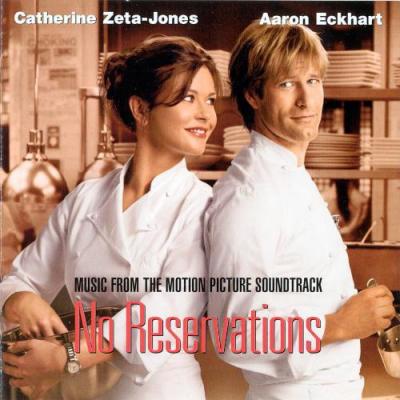
"No Reservations" Soundtrack Lyrics
Movie • 2007
Track Listing
Conrad Pope
Michael Buble
Luciano Pavarotti
Renata Tebaldi
Phillip Glass
Joan Sutherland
Paolo Conte
Joseph Calleja
Renata Tebaldi
Phillip Glass
Luciano Pavarotti
Ray Gelato
Luciano Pavarotti
Liz Phair
“No Reservations (Music From the Motion Picture Soundtrack)” – Album Guide to Tracks and Key Scenes
Overview
What happens when a rom-com about chefs is powered less by radio hits and more by Puccini and Verdi — arrival → adaptation → rebellion → collapse? No Reservations builds its mood around operatic arias that Nick (the new sous-chef) blasts in the kitchen, then cools the mix with a few urbane selections and two tender score cues by Philip Glass. The result is a soundtrack that treats love and food like slow-building arias rather than fast cuts.
The album leans into classics (Pavarotti’s “Celeste Aida,” “Nessun Dorma”; Renata Tebaldi’s “O mio babbino caro,” “Un bel dì vedremo”), bar-room charm (“Sway” by Michael Bublé), and a wink of Italian jazz (“Via con me” by Paolo Conte). Between them sit Glass’s brief cues — lyrical, restrained — that keep the story grounded in Kate and Zoe’s private world.
Distinctive move: the movie uses opera as character language. Nick cooks to it, jokes with it, courts with it. The album mirrors that, sequencing arias like a tasting menu around tiny, modern score interludes and a couple of light palate-cleansers.
Genres & themes (phases): opera (Verdi/Puccini) — bravado and release; light jazz/pop — flirtation, city glow; minimalist score — family and healing; novelty/lounge — kitchen playfulness.
How It Was Made
Composer: Philip Glass supplies the original score (compact cues; he even makes a cameo in the final bistro scene). Additional selections: the soundtrack is a curated various-artists blend with operatic recordings and a few contemporary pieces. Music supervision: John Bissell shepherded the film’s needle-drops and classical choices; the official album was issued by Decca in July 2007.
Why so much opera? It’s character logic. Nick’s presence literally changes the room tone — when Kate first hears him, it’s through an aria drifting out of the kitchen doors. The album honors that on-screen reality by putting arias front and center, then threading Glass’s warm, domestic motifs between them.
Tracks & Scenes
“Nessun dorma” — Luciano Pavarotti (Puccini)
Where it plays: Kate approaches her kitchen and hears Nick before she sees him; he’s mock-singing along to Pavarotti’s recording, the aria rising as she pushes through the doors. Diegetic source that blooms in the room.
Why it matters: A tonal shift and a meet-cute: bravado, humor, and immediate friction — opera as courtship.
“O mio babbino caro” — Renata Tebaldi (Puccini)
Where it plays: Dining room/kitchen transition as Nick’s taste for lush arias colors prep; strings and voice pour like sauce over montage. Diegetic → non-diegetic drift.
Why it matters: Romantic warmth sneaks into a precision kitchen — the film’s vibe in miniature.
“Celeste Aida” — Luciano Pavarotti (Verdi)
Where it plays: Service rush; Nick’s playlist keeps the line buoyant while Kate bristles. Mostly diegetic.
Why it matters: Heroic tenor energy equals Nick’s buoyant leadership style — the room breathes differently under him.
“Libiamo ne’ lieti calici” — Joan Sutherland & Carlo Bergonzi (Verdi)
Where it plays: An after-hours reset — the staff exhales as glasses clink and the night loosens. Source music on the restaurant system.
Why it matters: A literal drinking song — conviviality as strategy.
“La donna è mobile” — Joseph Calleja (Verdi)
Where it plays: Mid-film kitchen play; Nick leans into the swagger while Kate pretends not to smile. Diegetic.
Why it matters: The aria’s strut makes the flirtation obvious without a word.
“Un bel dì vedremo” — Renata Tebaldi (Puccini)
Where it plays: Planning sequence with Zoe; the music’s longing shadows the new family’s tentative rhythm. Non-diegetic scene glue.
Why it matters: A promise song reframed as domestic hope.
“Sway” — Michael Bublé
Where it plays: Flirty city-night interlude; a brief needle-drop during a date/drive sequence. Non-diegetic.
Why it matters: A breezy counterpoint to the high-drama arias — a wink of Sinatra-style charm.
“Via con me” — Paolo Conte
Where it plays: Light market/cooking montage; the famous “It’s wonderful” hook sells ease and play. Source-like needle-drop that often bridges scenes.
Why it matters: Italian swing that feels like an espresso shot for the film.
“Zoe & Kate Watch Video” — Philip Glass (score)
Where it plays: A quiet bonding beat: Zoe and Kate cue a home video and let grief breathe. Non-diegetic cue with piano/strings pulse.
Why it matters: The album’s emotional anchor — spacious, humane, intimate.
“Zoe Goes to the Restaurant” — Philip Glass (score)
Where it plays: Zoe’s first steps into Kate’s world; a gentle ostinato walks with her through clatter and steam. Non-diegetic.
Why it matters: Minimalism as empathy — tiny cells, big feelings.
Also heard / trailer cuts (not all on album): “Cielo e mar” (Pavarotti) and “Libiamo” recur across service scenes; marketing used Liz Phair’s “Count on My Love” and Chantal Kreviazuk’s “Time,” plus the instrumental “Building a Family” (Mark Isham) that fans associate with promo clips.
Notes & Trivia
- Philip Glass is credited for the score; the album itself is a various-artists release with two brief Glass cues woven among arias and lounge picks.
- Music supervisor John Bissell handled the film’s selections and clearances — a big job when most cues are iconic opera recordings.
- The soundtrack’s operatic spine echoes Nick’s on-screen habit: he cooks to Puccini and Verdi at full volume.
- “Building a Family,” widely recognized from trailers, actually originates from Mark Isham’s Life as a House — a cross-film needle that fans clocked quickly.
- Decca’s commercial release arrived in July 2007; runtime ~41 minutes across ~14 tracks.
Music–Story Links
Opera = Nick’s energy and confidence; minimalism = Kate/Zoe’s healing; swing/jazz = the city exhale between services. When Kate first hears “Nessun dorma,” she hears the man who will upend her routine — music as foreshadow. Glass’s cues land only when the plot closes the kitchen door: private moments, fewer ornaments, more breath. By the time “Via con me” and “Sway” appear, the soundtrack has earned its smiles — the kitchen has learned to play.
Reception & Quotes
Critics were mixed on the film, but many singled out the luxuriant food photography and the warm, classy soundtrack approach — arias instead of pop wall-paper. Reviewers also noted the tidy, modest Glass score that leaves space for the singers.
“Pavarotti in a rom-com kitchen shouldn’t work — here it sings.” classical-film write-ups
“Glass’s quiet cues are the movie’s heartbeat.” album roundups
Interesting Facts
- The director, Scott Hicks, previously worked with classical-leaning scores; this film doubles down by putting arias on camera.
- Two Glass cues on album (“Zoe & Kate Watch Video,” “Zoe Goes to the Restaurant”) together run under four minutes — tiny, but pivotal.
- Paolo Conte’s “Via con me” (“It’s wonderful…”) has a long sync history; here it functions like a palate cleanser between big arias.
- The album sequencing mirrors a service: house pick (“Truffles and Quail”), bold flavors (opera), lighter courses (swing/jazz), sweet finish (“Nessun dorma”).
- Yes, that is Philip Glass appearing briefly in the final bistro sequence — a sly cameo from the composer.
Technical Info
- Title: No Reservations — Music From the Motion Picture Soundtrack
- Year / Type: 2007 — Various-artists soundtrack with original score cues
- Composer (score): Philip Glass
- Music Supervisor: John Bissell
- Selected album cuts: “Sway” (Michael Bublé); arias by Pavarotti, Tebaldi, Calleja; “Via con me” (Paolo Conte); “Zoe & Kate Watch Video” / “Zoe Goes to the Restaurant” (Philip Glass)
- Label: Decca
- Release window: late July 2007 (theatrical week)
- Availability: Streaming (Decca compilation, ~41 min, ~14 tracks); physical CD issued 2007
Questions & Answers
- Is this mostly opera or score?
- Mostly opera and classic vocal selections, with a couple of short Philip Glass cues and a handful of lounge/swing pieces.
- Who picked the songs?
- Music supervisor John Bissell guided selections and clearances; the album was released by Decca.
- What’s the piece when Nick is first introduced?
- Pavarotti’s “Nessun dorma” from Puccini’s Turandot — Nick is literally singing along as Kate walks in.
- Are the trailer songs on the album?
- Promos used Liz Phair’s “Count on My Love” and Chantal Kreviazuk’s “Time,” plus the instrumental “Building a Family.” They’re referenced with the film but not core to the Decca album.
- Where can I hear the official sequence?
- On streaming services under No Reservations (Music From the Motion Picture Soundtrack) — look for the Decca release.
Canonical Entities & Relations
| Subject | Relation | Object |
|---|---|---|
| Scott Hicks | directed | No Reservations (2007) |
| Philip Glass | composed score for | No Reservations |
| John Bissell | music supervised | No Reservations |
| Decca | released | No Reservations — Music From the Motion Picture Soundtrack |
| Luciano Pavarotti | performed on | “Nessun dorma”, “Celeste Aida”, “Cielo e mar” (album) |
| Renata Tebaldi | performed on | “O mio babbino caro”, “Un bel dì vedremo” (album) |
| Joseph Calleja | performed on | “La donna è mobile” (album) |
| Paolo Conte | performed | “Via con me” (album) |
| Michael Bublé | performed | “Sway” (album) |
| Warner Bros. Pictures | distributed | No Reservations theatrically (2007) |
Sources: AllMusic album page; Decca/Apple Music listing; Variety crew listing; Philip Glass filmography; soundtrack databases (track list & runtimes); OperaWire scene analysis; SoundtrackINFO trailer/song notes; Rotten Tomatoes trailer hub.
November, 18th 2025
A-Z Lyrics Universe
Cynthia Erivo Popular
Ariana Grande Horsepower
Post Malone Ain't No Love in Oklahoma
Luke Combs Good Riddance (Time of Your Life)
Green Day Bye Bye Bye
*NSYNC You're the One That I Wan
John Travolta & Olivia Newton-John I Always Wanted a Brother
Braelyn Rankins, Theo Somolu, Kelvin Harrison Jr. and Aaron Pierre The Power of Love
Frankie Goes to Hollywood Beyond
Auli’i Cravalho feat. Rachel House MORE ›