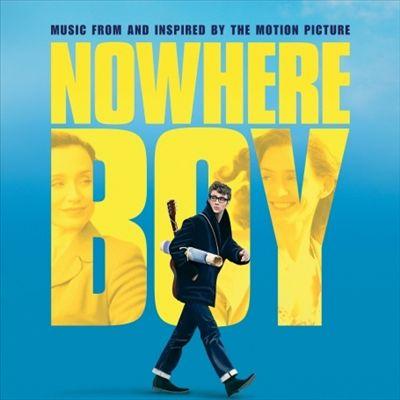
"Nowhere Boy" Soundtrack Lyrics
Movie • 2009
Track Listing
Jerry Lee Lewis
Dickie Valentine
Jackie Brenston & His Delta Cats
Elvis Presley
Wanda Jackson
Screamin' Jay Hawkins
The Nowhere Boys
The Nowhere Boys
Eddie Bond & The Stompers
Eddie Cochran
The Nowhere Boys
The Nowhere Boys
The Nowhere Boys
Big Mama Thornton
Gene Vincent And The Blue Caps
Aaron Johnson
The Nowhere Boys
John Lennon
Chuck Berry
Bill Haley & His Comets
Little Richard
Elvis Presley
Buddy Holly
Buddy Knox
Bobby Fuller Four
Vince Taylor & His Playboys
Dale Hawkins
Shirley & Lee
Barrett Strong
Fats Domino
Lloyd Price
Frankie Vaughan
The Del-Vikings
“Nowhere Boy (Music From and Inspired by the Motion Picture)” – Album Guide to Tracks and Key Scenes
Overview
What do you score first: the myth or the boy? Nowhere Boy chooses the boy — a restless Liverpool teen whose soundtrack swings from jukebox rock ’n’ roll to a hushed, modern score. The album pairs 1950s staples and Quarrymen-era cuts with new cast performances, then lets a shimmering, restrained instrumental palette glue it together.
The arc is simple and tough: arrival (music as escape), adaptation (forming the Quarrymen), rebellion (pushing against family rules), collapse (personal loss) — all heard through needles dropping in cafés, bus roofs and school halls. Period sides bring swagger; intimate instrumentals hold the shock and grief.
Genres & phases: early rock and R&B — bravado and appetite; skiffle/folk — DIY beginnings; rockabilly — speed and risk; chamber-electronica score — memory and aftermath.
How It Was Made
Score by Goldfrapp (Alison Goldfrapp & Will Gregory). Strings/orchestra were recorded at Abbey Road; the writing keeps to elegant, unshowy cues that sit under dialogue and teen discovery. According to the film’s credits and trade reporting, music supervision is by Ian Neil; Ben Parker handled additional music/arranging and on-set music tutoring for the young cast.
The two-disc commercial album (Sony Music) mirrors the film’s design: Disc 1 gathers featured film songs and cast performances credited to “The Nowhere Boys”; Disc 2 compiles era sources that informed Lennon’s palate. Rights clearances included Lennon’s “Mother” over the end section — a hard, autobiographical needle-drop that reframes the closing minutes.
Tracks & Scenes
“Wild One” — Jerry Lee Lewis
Where it plays: ~00:01 — John bikes to school; wind, laughter, and a first punch of swagger. Non-diegetic.
Why it matters: Stakes the summer tempo and announces rock ’n’ roll as propulsion.
“Mr. Sandman” — Dickie Valentine
Where it plays: ~00:12 — On the boardwalk with Julia; kisses and giddy rule-breaking. Source bleeding into non-diegetic.
Why it matters: Sugar on the surface; complications underneath.
“Rocket 88” — Jackie Brenston & His Delta Cats
Where it plays: ~00:13 — Coffee-shop jukebox as Julia shepherds John into a bigger sonic world. Diegetic.
Why it matters: Canon moment: one of the “first rock” records, now re-framed as mother-son bonding.
“Shake, Rattle and Roll” — Elvis Presley
Where it plays: ~00:18 — After an Elvis reel at the pictures, John copies the quiff and swipes records. Montage, non-diegetic.
Why it matters: Imitation as ignition.
“Hard Headed Woman” — Wanda Jackson
Where it plays: ~00:20 — John and Pete ride the top deck, smoking in the wind; cutaways to Liverpool grit. Non-diegetic.
Why it matters: Rockabilly bite for cheek and speed.
“That’ll Be the Day” — Aaron Johnson (as John)
Where it plays: ~00:31 — Julia coaxes a duet; Mimi breaks in, furious. Diegetic at home.
Why it matters: The music literally sits between two mothers.
“Rockin’ Daddy” — Eddie Bond
Where it plays: ~00:38 — Mimi marches John into a guitar shop; chrome and promise. Source in-store.
Why it matters: The tool is chosen; the path narrows.
“That’s All Right” — The Nowhere Boys
Where it plays: ~00:50 — First stage outing; thin amps, big nerves. Diegetic performance.
Why it matters: The band becomes a band — in public.
“Moovin’ and Groovin’” — Duane Eddy
Where it plays: ~00:51 — Second number after Paul joins; camera rides the crowd. Diegetic performance.
Why it matters: Momentum — the groove thickens with each recruit.
“Raunchy” — The Nowhere Boys
Where it plays: ~00:53 — After George shows his bus-top licks and earns a spot. Diegetic performance.
Why it matters: Entrance exam passed; the trio locks.
“Hound Dog” — Big Mama Thornton
Where it plays: ~00:56 — A compact influence montage — dirty, laughing, alive. Non-diegetic.
Why it matters: Rawer than the Elvis cover; it re-centers the lineage.
“Maggie May” — The Nowhere Boys / (scene: Julia & John)
Where it plays: Early lesson at Julia’s (banjo), and later as a Quarrymen staple. Mostly diegetic.
Why it matters: A Liverpool folk song becomes Lennon’s first “home” repertoire — roots before stardom.
“Hello Little Girl” — Aaron Johnson
Where it plays: After the accident, John faces a tape machine and the first Lennon–McCartney composition. Quiet, diegetic performance to recorder.
Why it matters: Grief re-wired into authorship; the boy starts writing his way out.
“In Spite of All the Danger” — The Nowhere Boys
Where it plays: Band-building sequence; dramatized studio take echoes the real Quarrymen acetate. Diegetic.
Why it matters: The first recorded step for the real group, re-lived by the cast.
“Mother” — John Lennon
Where it plays: Final scene into end credits — tolling bells, then the plea. Non-diegetic.
Why it matters: The film’s thesis, stated by the adult voice it helped shape.
Notes & Trivia
- Cast performances are credited to The Nowhere Boys; Aaron Johnson (Lennon) sings on several cues.
- Thomas Brodie-Sangster learned to play left-handed for McCartney authenticity.
- Yoko Ono approved the use of “Mother” after a private screening.
- Goldfrapp’s score is sparse by design — memory cues between loud records.
- Disc edition: one disc “in the film,” one disc “inspiration” cuts.
Music–Story Links
When Julia opens doors, songs are sugary and airborne (“Mr. Sandman,” “Rocket 88”). When Mimi pushes back, music turns interior — small rooms, practice takes, first anxious gigs. The trio’s formation is literalized by diegetic performances: Paul adds precision, George adds finesse, and the sound tightens cue by cue. The final handoff to “Mother” is deliberate: the grown Lennon names the wound the teen can’t.
Reception & Quotes
Reviews praised the period needle-drops and the restraint of the score; the soundtrack release was singled out for thoughtful casting performances among canonical sides.
“A creation story lifted by rocking tunes.” The New York Times (capsule)
“‘Mother’ over the end credits lands like a thesis.” Film Comment
Interesting Facts
- Label: Sony Music (UK). Digital street ~11 Dec 2009; two-disc CD followed late December.
- Goldfrapp’s orchestral parts were tracked at Abbey Road.
- “Maggie May” appears twice — first as Julia’s party piece, later as a Quarrymen number.
- Some film-used classics aren’t on every regional issue; the cast cuts fill those gaps.
- Collectors note tidy mastering differences between UK CD and some later digital versions.
Technical Info
- Title: Nowhere Boy (Music From and Inspired by the Motion Picture)
- Year / Type: 2009 — film soundtrack (various artists + cast) with original score
- Score: Goldfrapp (Alison Goldfrapp & Will Gregory)
- Music Supervision: Ian Neil; additional music/arranging & on-set music: Ben Parker
- Label / Release: Sony Music (UK) — digital 2009-12-11; 2xCD in stores 2009-12-29
- Key placements: “Wild One” (opening ride); “Mr. Sandman” (boardwalk); “Rocket 88” (jukebox); “That’s All Right” / “Raunchy” (Quarrymen shows); “Hello Little Girl” (post-accident tape); “Mother” (finale/credits)
- Availability: Streaming (expanded 33-track digital), CD; region metadata varies
Questions & Answers
- Who composed the score?
- Goldfrapp (Alison Goldfrapp & Will Gregory) wrote the instrumental score; it’s sparse and memory-driven.
- Are the Quarrymen songs the original 1950s recordings?
- No. Many are re-performed by the cast as “The Nowhere Boys,” cut to match on-screen staging.
- Does the film use Lennon’s solo work?
- Yes. “Mother” closes the film (final scene into credits).
- Is there a separate score album?
- No standalone commercial score in 2009; Goldfrapp’s cues sit between licensed/cast tracks on releases.
- What’s unique about the physical edition?
- A two-disc design: Disc 1 (featured songs/cast), Disc 2 (inspirations and era staples).
Canonical Entities & Relations
| Subject | Verb | Object |
|---|---|---|
| Sam Taylor-Johnson | directed | Nowhere Boy (2009) |
| Alison Goldfrapp | composed (with) | Will Gregory — original score |
| Ian Neil | supervised | music clearances and placement |
| Ben Parker | arranged & tutored | cast performances for on-screen music |
| The Nowhere Boys | performed | film versions of Quarrymen numbers |
| Yoko Ono | granted rights to | use John Lennon’s “Mother” |
| Sony Music Entertainment UK | released | commercial soundtrack |
| Abbey Road Studios | hosted | orchestral sessions for the score |
Sources: film credits; soundtrack album (Sony); Soundtrakd scene index; Wikipedia (film & soundtrack); The Guardian; Pitchfork; Metacritic credits; SoundtrackCollector; Discogs; Film Comment.
November, 17th 2025
A-Z Lyrics Universe
Cynthia Erivo Popular
Ariana Grande Horsepower
Post Malone Ain't No Love in Oklahoma
Luke Combs Good Riddance (Time of Your Life)
Green Day Bye Bye Bye
*NSYNC You're the One That I Wan
John Travolta & Olivia Newton-John I Always Wanted a Brother
Braelyn Rankins, Theo Somolu, Kelvin Harrison Jr. and Aaron Pierre The Power of Love
Frankie Goes to Hollywood Beyond
Auli’i Cravalho feat. Rachel House MORE ›