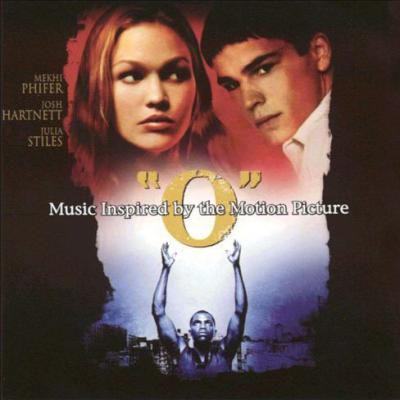
"O" Soundtrack Lyrics
Movie • 2001
Track Listing
The DJ Ran Project (featuring Meko)
Deep 6ix
Borealis
Swerve (featuring Christina Boyd)
Kurupt (featuring Noriega)
Dyshon (featuring Squabble)
Tene
Spooks
Kurupt (featuring Daz)
Crush
Dyshon
Kurupt & Roscoe
Smooth Kat
“O (Original Motion Picture Score)” – Album Guide to Tracks and Key Scenes
Overview
Can a prep-school tragedy carry Verdi’s prayers and late-90s hip-hop in the same breath? O answers with a tightrope: aria-tinted strings for intimacy and suspicion; club-born grooves for swagger and peer heat. The score album credited to Jeff Danna frames jealousy as a slow choke rather than a sudden stab, favoring lean motifs, bowed pressure, and pulses that step in and out of the foreground.
Protagonist Odin (Othello) is tracked by music that avoids obvious heroics. Instead, cues dwell on aftermaths — locker-room silence after victory, motel air that won’t clear, the too-bright echo of gym lights. The sound world gives Hugo’s manipulation space to operate; silence is a weapon, then the strings close in.
Functionally, the score plays referee between two aesthetics: the classical spine (including a mournful “Ave Maria” connection to Verdi’s Otello) and campus sound — rap/R&B textures that signal social gravity and status. The official score album is sparse and psychological; a separate “music inspired by” release captures the era’s street-level surface.
Genres & themes in phases: chamber-lean orchestral tension — paranoia; opera-derived lament — doomed intimacy; head-nodding hip-hop/R&B accents — bravado, peer pressure; percussive ostinati — plans set in motion; elegiac strings — moral collapse.
How It Was Made
Composer Jeff Danna’s score is the film’s spine, with focused, economical cues that underline manipulation and fallout rather than action for its own sake. The album issued by Varèse Sarabande foregrounds string writing and a restrained color palette; it opens with an “Ave Maria” selection tied intertextually to Verdi’s Otello. The companion commercial release is a separate compilation branded “Music Inspired by the Motion Picture” featuring hip-hop/R&B cuts from the same era — useful context but not a 1:1 mirror of on-screen placements.
Music supervision on the film is credited to Barry Cole, a choice that fits the project’s dual identity: keep period-appropriate rap cuts in the mix while letting Danna’s classical threads speak during the most intimate scenes. According to MusicWeb International’s contemporary review, Danna even colors the score with early-music timbres to sharpen the tragedy’s lineage.
Tracks & Scenes
“Ave Maria (from ‘Otello’)” — arrangement/album opener
Where it plays: Used as an elegiac thread around Desi/Odin intimacy and the story’s moral twilight; in the film’s end stretch, the association with Verdi’s Otello lands like a benediction turned requiem. Non-diegetic; short, prayer-like statements recur.
Why it matters: Bridges Shakespeare’s opera lineage to a modern campus. It frames jealousy not as noise but as a terrible stillness.
“Hawks vs. Bulldogs” — Jeff Danna
Where it plays: Game-day montage energy: whistles, sneaker squeaks, scoreboard pressure. The cue tracks momentum swings more than heroics — it tightens after big plays and breathes between free throws.
Why it matters: Athletics as a stage for status anxiety; the music keeps the camera on consequences instead of celebration.
“The Scarf” — Jeff Danna
Where it plays: The scarf plot device moves hand to hand; strings hover under whispered doubts. Non-diegetic, close-miked tension, under two minutes, placed around the handoff and discovery beats.
Why it matters: A small object becomes a character. The cue’s tight harmony makes accusation feel inevitable.
“Odin’s Rage” — Jeff Danna
Where it plays: Late escalation. Short, pressurized statements, rhythmic surges that pull back before they explode. Non-diegetic; mixed to sit under breathing and fragmentary dialogue.
Why it matters: Refuses catharsis, emphasizing damage rather than release.
“Aquemini” — OutKast
Where it plays: Reported by soundtrack sleuths for the motel bedroom sequence; non-album placement, needle-drop feel against a fraught intimate scene.
Why it matters: Hip-hop confidence laid over failing trust makes the moment sting twice — image vs. reality.
Notes on availability: the official score album covers Danna’s cues (e.g., “Hawks vs. Bulldogs,” “Odin’s Rage,” “The Scarf”). The music-inspired compilation features rap/R&B cuts (Kurupt, Spooks, etc.) and is not a complete reflection of in-film needle-drops.
Notes & Trivia
- The project carries two different albums: a Jeff Danna score, and a separate music-inspired compilation released near the U.S. theatrical date.
- “Ave Maria” links the film directly back to Verdi’s Otello — a conscious lineage cue, not a random classical drop.
- Varèse Sarabande handled the score release, consistent with their early-2000s slate of indie/arthouse scores.
- Release delays after Columbine pushed the film to late summer 2001; the albums reflect a finished score from earlier in the rollout.
- Reviewers at the time noted Danna’s restrained palette — intimacy over bombast, tension over pyrotechnics.
Music–Story Links
When Odin owns the court, “Hawks vs. Bulldogs” marks momentum but dodges triumphal brass — the point is how quickly the locker room goes quiet. When Hugo seeds doubt, “The Scarf” narrows harmony like a noose; the object is small, the sound claustrophobic. In the motel, a hip-hop needle-drop sets a mood at odds with consent and trust — that dissonance is the scene. And in the end, “Ave Maria” puts the tragedy in a centuries-long echo chamber, turning a single dorm into a stage the size of an opera house.
Reception & Quotes
Contemporary critics gave the film mixed notices while often praising its final act; the score drew low-key admiration in specialist outlets. The companion “inspired by” album played to the market — accessible, radio-ready — while the score album stayed austere.
“A good film for most of the way, and then a powerful film at the end.” — Roger Ebert
“A wonderful, heartfelt score… Danna utilising a number of early musical instruments.” — MusicWeb International
Interesting Facts
- Two covers, two cuts: the score exists in 9-track and 15-track editions depending on territory/issue.
- Catalogue spot: Varèse’s listing places the album alongside other 2001 indie scores — a snapshot of the label’s A&R at the time.
- Opera throughline: crediting “Ave Maria” ties O not just to Shakespeare but to Verdi’s stage tradition.
- Supervisor fingerprint: Barry Cole’s credit tracks with the film’s blend of rap cues and a restrained score.
- Not 1:1: the “music-inspired” disc includes artists not audibly present in the final cut — common for early-2000s releases.
- Streaming split: today, the score and the compilation live on separate artist/label pages; searching both is required.
Technical Info
- Title: O (Original Motion Picture Score)
- Year / Type: 2001 — Film score
- Composer: Jeff Danna
- Music Supervision (film): Barry Cole
- Label: Varèse Sarabande (score)
- Companion release: “O (Music Inspired by the Motion Picture)” — various artists
- Notable placements (album cues): “Hawks vs. Bulldogs,” “The Scarf,” “Odin’s Rage,” “Ave Maria (from ‘Otello’)”
- Release context: film delayed; U.S. theatrical Aug 31, 2001; score issued earlier that year; compilation streeted close to release.
- Availability: score and compilation on major streamers; CD issues circulate on secondary markets.
Questions & Answers
- What’s the difference between the score and the “music-inspired” album?
- The score is Jeff Danna’s on-screen instrumental music; the “inspired” disc is a separate hip-hop/R&B compilation marketed with the film.
- Is “Ave Maria” really part of the soundtrack?
- Yes — the score album includes an “Ave Maria” selection referencing Verdi’s Otello, aligning the film with its opera lineage.
- Who supervised the film’s music choices?
- Barry Cole is credited as music supervisor; the blend of rap cues and a restrained score reflects that brief.
- Which track underscores the basketball rivalry?
- “Hawks vs. Bulldogs” is the album’s game-energy cue; it emphasizes momentum and pressure over highlight-reel heroics.
- Is OutKast’s “Aquemini” in the movie?
- Fans report it under a motel-room sequence; it’s not on the official score album and may not appear on the compilation.
Canonical Entities & Relations
| Subject | Verb | Object |
|---|---|---|
| Jeff Danna | composed | O (Original Motion Picture Score) |
| Varèse Sarabande | released | O (Original Motion Picture Score) (CD/digital) |
| Barry Cole | supervised music for | O (2001 film) |
| OutKast | performed | “Aquemini” (reportedly used as needle-drop in film) |
| Giuseppe Verdi | composed | Otello (source of “Ave Maria” reference) |
| Lions Gate Films | distributed | O (United States/Canada) |
| Tim Blake Nelson | directed | O (2001 film) |
Sources: AllMusic; Apple Music; SoundtrackCollector; Discogs; Roger Ebert; MusicWeb International; Salisbury University’s Literature/Film Quarterly; ShotOnWhat; Wikipedia; MovieMusic.com; SoundtrackINFO.
November, 17th 2025
A-Z Lyrics Universe
Cynthia Erivo Popular
Ariana Grande Horsepower
Post Malone Ain't No Love in Oklahoma
Luke Combs Good Riddance (Time of Your Life)
Green Day Bye Bye Bye
*NSYNC You're the One That I Wan
John Travolta & Olivia Newton-John I Always Wanted a Brother
Braelyn Rankins, Theo Somolu, Kelvin Harrison Jr. and Aaron Pierre The Power of Love
Frankie Goes to Hollywood Beyond
Auli’i Cravalho feat. Rachel House MORE ›