Soundtracks:  A B C D E F G H I J K L M N O P Q R S T U V W X Y Z #


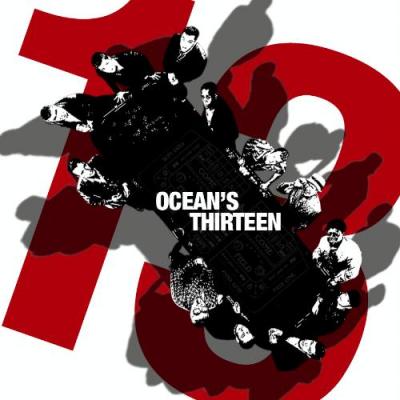
Ocean's Thirteen Album Cover

"Ocean's Thirteen" Soundtrack Lyrics

Movie • 2007

Track Listing


"Music from the Motion Picture Ocean's Thirteen" – Album Guide to Tracks and Key Scenes

Ocean's Thirteen trailer frame showing the Las Vegas strip and Willy Bank's new casino
Ocean's Thirteen returns the crew to Las Vegas, with David Holmes giving the city its sly, swaggering soundtrack.

Overview

What does revenge in Las Vegas sound like when it is not about the money anymore, but about humiliating the man who broke your friend? Ocean's Thirteen answers with a soundtrack that feels both vintage and surgically modern: David Holmes’ jazz-funk caper grooves, a synth-washed Debussy quote, a library-music deep cut, and Frank Sinatra closing the curtain.

The film’s story is simple: casino mogul Willy Bank squeezes Reuben Tishkoff out of a new hotel deal and sends him into a heart attack. Danny Ocean and the crew swear it is “not their fight” but take it anyway, plotting to ruin Bank’s opening night by bankrupting his casino floor and stealing his coveted “Five Diamond” reputation. The music turns that grudge into a full arc — from the old Vegas ghosts Reuben represents to the hyper-designed cruelty of Bank’s new tower.

Holmes keeps building the trilogy’s sonic identity: drums with a dry snap, Hammond organs, woozy electric pianos, brass that struts more than it shouts. According to one AllMusic review, the album sticks to a focused 44-minute run of mostly score cues instead of the more collage-like approach of Ocean’s Eleven and Twelve. The result is a cleaner listen that still leaves room for a handful of needle-drops: Puccio Roelens’ “Caravan” during a contamination gag, Isao Tomita’s electronic Debussy, and Sinatra’s “This Town” for the final walk-off.

You can divide the soundtrack’s role into phases. Arrival: “The Riviera Affair” and “Not Their Fight” set up that this is still a heist film with a 1960s TV-movie grin. Adaptation: planning montages and tech briefings ride Holmes’ rhythm-section tricks — bass ostinatos, clipped guitar, little analog squelches. Rebellion: “Earthquake”, “Snake Eyes”, “The Nose” and company drive the sabotage of Bank’s casino. Collapse: Debussy’s “Clair de Lune” and Sinatra’s “This Town” bring in a different kind of nostalgia, reminding us that Las Vegas, and Reuben’s era, existed before Bank and will outlast him.

How It Was Made

Composer and DJ David Holmes returned for his third collaboration with director Steven Soderbergh after Out of Sight, Ocean’s Eleven and Twelve. He recorded the score at Ocean Way Recording in Hollywood with a tight group of players: strings, jazz percussion, Hammond organs, bass woodwinds, electric guitars and layered keyboards. According to a MoviemusicUK review, Holmes deliberately chases “loungy 1960s rhythms with a heavy dose of 1970s funk” to keep the trilogy’s caper tone intact.

The album “Music from the Motion Picture Ocean’s Thirteen” came out 5 June 2007 on Warner Sunset / Warner Bros as a 20-track, 44-minute set. Unlike the first two films, this disc is largely original score, with only a few non-Holmes inclusions such as Puccio Roelens’ “Caravan” and Tomita’s electro-version of Debussy’s “Clair de Lune”. A digital “standard version” with the same core program followed on major platforms.

Holmes and the music team also wove in older library and pop sources that sit outside the album. The film opens with Neil Richardson’s “The Riviera Affair”, a KPM library cue that old TV viewers knew as The 4 O’Clock Movie theme; it does not appear on the soundtrack CD. Soundtrack reference sites and a Guardian piece later highlighted how that track became a cult favorite again because of the film. The trailer, meanwhile, stacks up several tracks by Shawn Lee’s Ping Pong Orchestra, ending with “Theme From Andrex” — again, trailer-only, not on the album.

Holmes treated this score as the trilogy’s capstone. According to one IGN write-up, he leaned into a more cohesive album structure, cutting down on needle-drop chaos and letting recurring bass lines and drum patterns unify the various cons: the loaded dice, the malfunctioning slot machines, the faux “earthquake” that sends Bank’s tower into chaos. It is less a mixtape and more a single long, sly groove.

Ocean's Thirteen trailer shot of Danny Ocean and Rusty Ryan planning in a Las Vegas suite
Holmes recorded at Ocean Way with a small band, chasing 60s caper cool with 21st-century studio polish.

Tracks & Scenes

“The Riviera Affair” — Neil Richardson
Where it plays: Over the film’s opening logos and first images, this KPM library cue kicks in with brass and strings that sound like a lost 1960s TV caper theme. We see the Warner Bros and Village Roadshow idents, then glide into Vegas imagery and the setup of Reuben’s ill-fated deal with Willy Bank. The music plays non-diegetically, signalling that whatever happens here will be treated like a stylish game, not a grim tragedy.
Why it matters: It is not on the official album, but it sets the tone better than almost anything else. As one soundtrack Q&A notes, fans spent years hunting it down by ear before learning the title.

“Suite Bergamasque, Clair de Lune, No. 3” — Isao Tomita
Where it plays: Early in the film, after Reuben’s collapse, the crew gathers around his hospital bed. The room is washed in fluorescent light, machines beep softly, and for once the dialogue slows down. Tomita’s electronic take on Debussy’s “Clair de Lune” swells in, turning the heart-monitor glow into something almost lunar. Later, a softened, synth-tinted version plays again when Danny and Rusty stand outside the Bellagio at dawn, talking quietly about the old days and how Vegas has changed.
Why it matters: According to SoundtrackINFO and several trivia sites, this is a deliberate echo of Ocean’s Eleven, where “Clair de Lune” underscored the Bellagio fountains. Here, it marks both an ailing friend and a city that has moved on.

“Caravan” — Puccio Roelens
Where it plays: In one of the film’s best staging gags, Danny and Rusty sneak into a high-roller suite to “infect” it with bedbugs and chemicals so the room will fail inspection. As they work with masks and sprayers, the suave, slightly sinister groove of “Caravan” plays, either as a source on the suite’s sound system or as a stylised overlay; the camera tracks their precise movements around furniture and vents while the track’s brass and percussion circle like conspirators.
Why it matters: A SoundtrackINFO answer identifies “Caravan” as the cue for this scene. The choice links the trilogy back to earlier jazz-infused heist scores and, as some fans have noted, anticipates the tune’s later visibility in films like Whiplash (different arrangement, same standard).

“Not Their Fight” — David Holmes
Where it plays: This track opens the official album and appears near the top of the film as Danny and Rusty debate whether to get involved. Over shots of them visiting Reuben, talking on a bench and quietly resolving to destroy Willy Bank, the cue offers clipped drums, organ stabs and a bass line that never quite settles. The music stays non-diegetic, sitting just under their dry banter.
Why it matters: It announces the score’s thesis: the crew can pretend it is not their fight, but the groove says otherwise. Critics often single it out as a perfect album opener.

“11, 12 & 13” — David Holmes
Where it plays: Used over an early planning montage and on the album’s second slot, this cue stitches together images of the crew arriving in Vegas, scouting Bank’s casino floor, and re-establishing their old dynamics. The rhythm section sits in a hip mid-tempo pocket while guitar and keyboards trade little riffs, cutting on sharp edits between characters and locations.
Why it matters: The title nods to the trilogy itself, and the track plays like a mini-summary of Holmes’ Ocean’s sound — part lounge, part funk, part electronic.

“The Nose” — David Holmes
Where it plays: Around the point where Linus is forced to wear a ridiculous prosthetic nose to pose as a high-roller and seduce Bank’s right-hand woman Abigail Sponder, “The Nose” rides under the briefing and some of the casino-floor footage. The cue mixes sneaky flutes, muted brass and a slightly comic rhythmic bounce, matching the absurdity of Matt Damon trying to act suave while the rest of the team mocks him through earpieces.
Why it matters: It shows Holmes’ knack for light comic scoring without dropping the “cool” factor — important for a film that never wants to feel like broad farce.

“Lara’s Theme” — James Last Band
Where it plays: When Linus, in full prosthetic disguise, finally gets a one-on-one with Abigail in a private lounge to secure the diamond access, a lush, slightly kitschy arrangement of “Lara’s Theme” from Doctor Zhivago starts up. The melody, performed by the James Last Band, floats over their flirtation as Linus leans hard into melodrama and tragic-romantic lines about fate and destiny, all while the team feeds him prompts.
Why it matters: SoundtrackINFO identifies this cue for the seduction scene. It is a meta-joke — using a classic sweeping romance theme under what is essentially a con artist doing bad method acting.

“Earthquake” — David Holmes
Where it plays: During the climactic “earthquake” sequence, where the team tricks Bank and his guests into believing his brand-new tower is structurally unsound, Holmes’ “Earthquake” punches in with sharper drums and more aggressive brass swells. As building systems go haywire and high-rollers panic at the gaming tables, the cue tracks the rising chaos: rhythmic hits line up with slot-machine failures, falling chandeliers and Bank’s dawning horror in the surveillance room.
Why it matters: This is one of the pure action cues on a mostly laid-back album, and reviewers often cite it as proof that Holmes can dial up tension without abandoning his groove-based approach.

“Fender Roads” — David Holmes
Where it plays: Used in slick mid-film sequences of elevator hacks, drilled dice and behind-the-scenes sabotage, “Fender Roads” is built around electric piano figures and a relaxed but insistent drum pattern. The camera floats through back corridors and service shafts while the cue keeps everything feeling effortless, even as the logistics grow insane.
Why it matters: A lot of caper scores fall apart in the middle; this track is one of the reasons the Ocean’s Thirteen album plays so smoothly front to back.

“Don’t You Want Me” — The Human League
Where it plays: Rusty Ryan’s phone goes off several times in the movie, and every time the ringtone is the unmistakable synth hook from “Don’t You Want Me”. It rings during key planning conversations, including one scene where he is trying to keep a straight face in front of Willy Bank while Danny calls with bad news. The song is never heard in full; just enough of the chorus riff leaks out to get a laugh.
Why it matters: Trivia sites and retrospectives point out that this use turned an already classic track into a running character joke. It also underlines Rusty’s mix of 80s nostalgia and deadpan humour.

“This Town” — Frank Sinatra
Where it plays: After the heist succeeds and Willy Bank’s Five Diamond dream collapses, the crew gathers to watch him lose his last sliver of dignity. As they peel off one by one into the night — Basher on a plane, Livingston at the blackjack table, Linus noodling with his new nose — Frank Sinatra’s “This Town” kicks in. We see Benedict at a roulette wheel, Reuben revived, and finally Danny watching a quietly satisfied Rusty take in the Bellagio fountains.
Why it matters: According to SoundtrackINFO and multiple trivia features, this was chosen as a direct nod to Sinatra’s role in the 1960 Ocean’s Eleven. It is the series tipping its hat back to the Rat Pack while saying goodbye to its own trilogy.

Trailer cue: “Theme From Andrex” — Shawn Lee’s Ping Pong Orchestra
Where it plays: In at least one widely circulated trailer, a funky instrumental kicks in about two-thirds of the way through, as voice-over promises “the most dazzling heist yet” and quick cuts flash through the cast. That track is “Theme From Andrex” by Shawn Lee’s Ping Pong Orchestra, as the composer himself later confirmed. It occupies the final stretch of the trailer, not the film itself.
Why it matters: This is one of those classic “trailer only” cases: fans hunted the cue expecting it on the album, but had to go to Lee’s catalog instead.

Ocean's Thirteen trailer montage of the crew walking through Bank's casino to a cool groove
Library cues, classic standards and Holmes’ groove-based score all get precise placements in key heist and character moments.

Notes & Trivia

  • “The Riviera Affair” that opens the movie is a 1970 KPM library track by Neil Richardson, used for decades as TV bumper music before Ocean’s Thirteen revived it.
  • Tomita’s “Clair de Lune” connects this film back to Ocean’s Eleven and its Bellagio finale, but here it scores both a hospital scene and a dawn reminiscence.
  • Rusty’s “Don’t You Want Me” ringtone is widely cited in articles about the song’s pop-culture afterlife; it is never on the official soundtrack album.
  • Trivia lists repeatedly point out that the line “You shook Sinatra’s hand” and the closing use of “This Town” are the film’s most direct nods to the 1960 original.
  • Holmes’ score cues like “Not Their Fight” and “Earthquake” are on the album, but several pieces of source music (including “The Riviera Affair”) are not.
  • “Caravan”, which scores the contamination of the suite, later gained a separate cult following thanks to its appearance in jazz-drumming circles and other films.

Music–Story Links

The revenge plot in Ocean’s Thirteen works because the music keeps telling you this is about Las Vegas itself, not just about money. “The Riviera Affair” and “Not Their Fight” make the opening feel like the start of an old syndicated movie, with Reuben cast as the guy who “shook Sinatra’s hand”. When Bank betrays him, the music does not switch to tragedy; it stays in caper mode, implying that the city has seen worse and that the crew will answer in kind.

“Clair de Lune” becomes Reuben’s theme and a symbol for old Vegas. Hearing it over the hospital bed frames the crew’s anger as grief for a disappearing era. When a version resurfaces at the Bellagio, Danny and Rusty talk softly about what the town used to be like. The cue reminds us that their bond predates this specific job; they are survivors of several casino cycles.

Bank’s world, by contrast, gets Holmes’ tightest, most mechanical grooves. Tracks like “11, 12 & 13”, “Fender Roads” and “Snake Eyes” power the rigged dice, magnetised slots and fake seismic events that will ruin his opening night. The music here emphasises design: we hear small repeating figures as the crew installs hidden devices, then bigger hits when those devices trigger and Bank’s luck turns.

The source songs sit at key pressure points. “Caravan” emphasizes how invasive the contamination of a luxury suite really is, even as the crew treats it as a prank. “Lara’s Theme” mocks Linus’s over-wrought seduction as he plays a role he does not quite understand. And “This Town” closes the loop: Sinatra’s voice plays out over images of a humbled Bank and a gently satisfied Reuben, making it clear that Vegas has room for schemers like Danny but not for those who disrespect its old guard.

Reception & Quotes

The score album drew strong praise on release. According to one MoviemusicUK review, Holmes’ ensemble of strings, jazz percussion, organs and electric guitars “encompasses perfectly the permeating feel of Vegas cool” across the trilogy. Time Out dubbed it an “impeccable retro-chic score”, while CNN highlighted how the “retro musical cues” helped propel the film’s breezy momentum.

AllMusic and other outlets noted that Music from the Motion Picture Ocean’s Thirteen is more cohesive than the previous two albums, partly because Holmes dominates the tracklist. Treblezine’s piece on the soundtrack argued that each cue works both in and out of context, saying in essence that the music can stand alone as a stylish listen for people who have never seen the movie.

Within fan circles, the trilogy’s scores now get mentioned alongside more obvious franchises. A long-running film-music blog once suggested that, for some listeners, the Ocean’s scores rival Star Wars or The Lord of the Rings as a favourite trilogy set — not because of symphonic weight, but because these albums are perfect “get things done” background records.

The film itself received mixed-positive reviews and solid box office, and its reputation has improved slightly over time as the neat closer to the Clooney/Pitt era. With George Clooney recently talking about a new Ocean’s 14 with much of the original cast, soundtrack discussions keep circling back to Holmes’ work as the sonic glue that holds the trilogy together.

“A hip, retro score that lets Vegas strut again without ever sounding like pastiche.” – summary of AllMusic and Time Out reactions
“From the punch of the opening number to the progressive ‘Benedict Returns’, Holmes’ music is simply incredible.” – paraphrased from regional press review
“Music that transcends the filmgoing experience and stands on its own merits.” – paraphrased from IGN’s soundtrack coverage
Ocean's Thirteen trailer shot of Willy Bank surveying his casino floor under warm golden lights
Critical consensus: even if you only half-remember the plot, the Ocean’s Thirteen soundtrack still works as a self-contained caper album.

Interesting Facts

  • Album vs. film: The CD and digital album are mostly Holmes cues; some memorable pieces heard in the film (like “The Riviera Affair”) are missing and live on via library-music reissues.
  • Standard vs. “various artists” billing: Some retailers list the album under David Holmes alone, others under “Various Artists”, reflecting the inclusion of Puccio Roelens, Tomita and Sinatra.
  • Library-music deep cut: “The Riviera Affair” was originally just KPM library stock music; a Guardian column later joked that it became “the best thing about Ocean’s Thirteen” for some listeners.
  • Compilation appearance: A performance of “Clair de Lune” associated with the film shows up on the compilation Film Music 2007, alongside cues from There Will Be Blood and Atonement.
  • Trailer syndrome: Shawn Lee’s trailer cue “Theme From Andrex” prompted a wave of questions on soundtrack forums, since it was never included on the main album.
  • Format and availability: Original 2007 CDs still circulate on Discogs and similar markets, while the full 20-track album remains widely available on Apple Music, Spotify and other services.
  • Genre mix on paper: Discographic entries list the album under rock, jazz, funk/soul, downtempo and easy listening — which is a pretty accurate description of the Holmes toolkit here.
  • Franchise context: With a new Ocean’s 14 now in active development, several recent think-pieces namecheck the Holmes scores as a big reason the original trilogy still feels cohesive.

Technical Info

  • Title: Music from the Motion Picture Ocean’s Thirteen
  • Year: 2007 (album and film)
  • Type: Feature-film soundtrack (primarily original score with select songs)
  • Film: Ocean’s Thirteen (dir. Steven Soderbergh)
  • Composer / producer: David Holmes
  • Recorded at: Ocean Way Recording, Hollywood
  • Core ensemble: Strings; jazz percussion; Hammond organs; bass woodwinds; electric guitars; electric piano; assorted keyboards and percussion
  • Label: Warner Sunset Records / Warner Bros. Records
  • Length: approx. 44½ minutes (20 tracks on standard edition)
  • Key score cues (selection): “Not Their Fight”, “11, 12 & 13”, “Benedict Returns”, “The Nose”, “Earthquake”, “Fender Roads”, “Snake Eyes”, “All Sewn Up”
  • Key songs on album: “Caravan” (Puccio Roelens), “Suite Bergamasque, Clair de Lune, No. 3” (Tomita / Debussy), “This Town” (Frank Sinatra)
  • Notable music not on album: “The Riviera Affair” (Neil Richardson, opening cue); multiple trailer tracks by Shawn Lee’s Ping Pong Orchestra
  • Trailer highlight: “Theme From Andrex” by Shawn Lee’s Ping Pong Orchestra plays in at least one official trailer but not in the feature.
  • Availability: In print on CD and widely available on major streaming services; used copies are common in online marketplaces.

Questions & Answers

Is there more than one Ocean’s Thirteen soundtrack edition?
Practically, no. There is one main 20-track album released on CD and digital; retailers sometimes label it as “Standard Version”, but the core program is the same.
What song plays when the cast appears at the end of Ocean’s Thirteen?
That is “This Town” performed by Frank Sinatra. It starts as the crew’s victory becomes clear and carries into the end credits.
What is the first piece of music in the film that is not on the album?
The opening track over the logos and early Vegas shots is “The Riviera Affair” by Neil Richardson, a KPM library cue; it does not appear on the official soundtrack CD.
What music plays when Danny and Rusty contaminate the hotel room?
The jazzy track over that sequence is “Caravan” as performed by Puccio Roelens. Soundtrack reference sites identify it specifically for the contamination scene.
What ringtone does Rusty Ryan use in Ocean’s Thirteen?
Rusty’s phone ringtone is “Don’t You Want Me” by The Human League — just the iconic synth riff, heard several times when his phone rings.

Canonical Entities & Relations

Steven SoderberghdirectsOcean’s Thirteen (2007 film)
Brian Koppelman & David LevienwriteOcean’s Thirteen screenplay
David Holmescomposes score forOcean’s Thirteen (2007 film)
David HolmescreatesMusic from the Motion Picture Ocean’s Thirteen (album)
Warner Sunset Records / Warner Bros. RecordsreleaseMusic from the Motion Picture Ocean’s Thirteen
George ClooneyplaysDanny Ocean in Ocean’s Thirteen
Brad PittplaysRusty Ryan in Ocean’s Thirteen
Matt DamonplaysLinus Caldwell in Ocean’s Thirteen
Al PacinoplaysWilly Bank in Ocean’s Thirteen
Elliott GouldplaysReuben Tishkoff in Ocean’s Thirteen
Frank Sinatraperforms“This Town” used over the final montage and credits
Puccio Roelensperforms“Caravan” featured in the contamination-room sequence
Isao Tomitaperforms“Suite Bergamasque, Clair de Lune, No. 3” used in hospital and Bellagio scenes
Claude Debussycomposesoriginal “Clair de Lune” used via Tomita’s version
Neil Richardsoncomposes“The Riviera Affair” opening cue for Ocean’s Thirteen
The Human Leagueperform“Don’t You Want Me” used as Rusty’s ringtone
Shawn Lee’s Ping Pong Orchestraperform“Theme From Andrex” used in an Ocean’s Thirteen trailer
Warner Bros. PicturesdistributesOcean’s Thirteen (2007 film)

Sources: official soundtrack album credits and digital booklets; soundtrack databases and Q&A pages (SoundtrackINFO, Soundtrakd, Moviexclusive); reviews from MoviemusicUK, AllMusic, Treblezine, Silent Uproar and regional press; Guardian feature on Neil Richardson’s “The Riviera Affair”; trivia and production notes from major film reference sites; Shawn Lee’s statements about the trailer music; recent coverage on the Ocean’s trilogy and in-development Ocean’s 14 reports.

November, 18th 2025


A-Z Lyrics Universe

Lyrics / song texts are property and copyright of their owners and provided for educational purposes only.