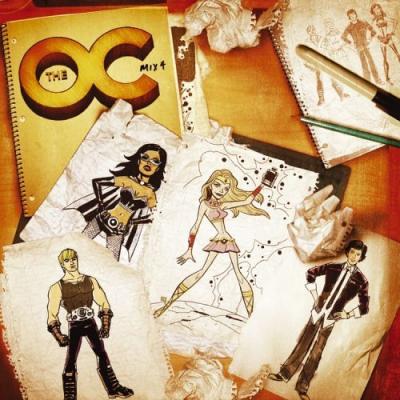
"O.C. Mix 4, The" Soundtrack Lyrics
TV • 2005
Track Listing
The Futureheads
Imogen Heap
Pinback
A.C. Newman
Sufjan Stevens
Flunk
Beck
Modest Mouse
Aqueduct
The Reindeer Section
Bell X1
Matt Pond PA
"Music from The O.C.: Mix 4" – Album Guide to Tracks and Key Scenes
Overview
What happens when a teen soap’s soundtrack stops chasing “big moments” and leans into everyday melancholy instead? Music from The O.C.: Mix 4 is pretty much that pivot. Where the first two mixes shadowed Ryan’s arrival in Newport and his adaptation to Cohen life, Mix 4 lives inside the smaller rebellions and quiet collapses of season two.
By this point in the series, the show has expanded: new couples, the Bait Shop as a permanent venue, Seth’s status as a full-blown indie evangelist. The track list mirrors that sprawl. Instead of one or two obvious show-defining cues, the album collects songs that score hangovers, car rides, messy talks on the pier and late-night walks through strip malls. It is less about fireworks and more about the long emotional hangover that follows them.
The arc across the episodes is still familiar: arrival, adaptation, rebellion, collapse. Sufjan Stevens and The Reindeer Section sit in the arrival space – vulnerable, slightly stunned characters trying to belong. Imogen Heap, Modest Mouse and Aqueduct score the adaptation and rebellion stages, all nervous energy and impulsive decisions at the Bait Shop. Beck, Bell X1 and Matt Pond PA handle the collapse, wrapping heartbreak and reconciliation in reverb, strings and slow builds.
What makes the compilation distinct is how inward it feels. A lot of the songs are mid-tempo and introspective, even when the scenes are outwardly dramatic: jealousy at a club, a school-morning check-in, a chaotic formal. As one later ranking of the six mixes pointed out, Mix 4 does not always summon immediate images the way “Paint the Silence” or “Hide and Seek” do; its impact comes from how often it underpins smaller character beats rather than headline plot twists.
Stylistically, you can hear three clear phases. Jagged post-punk and nervy indie rock (The Futureheads, Modest Mouse, Aqueduct) cover the social performance side of Newport – the parties, the Bait Shop, the carefully curated cool. Soft-focus indie-pop and chamber-folk (Sufjan Stevens, The Reindeer Section, Bell X1, Matt Pond PA) expose the fragile interior. Electronica-tinged tracks and downtempo imports (Flunk, Imogen Heap) sit in between as bridges, soundtracking liminal spaces: drives, walks home, end-of-the-night confessions.
How It Was Made
Mix 4 arrived in spring 2005, compiled from music used mostly in the middle stretch of season two. The core idea behind all of the O.C. mixes stayed the same: build a disc that works on its own but also sketches the emotional map of recent episodes. According to the broader Music on The O.C. notes, the soundtrack CDs were treated as companions rather than simple “best-of” samplers, which explains why some choices feel quietly crucial rather than instantly famous.
Series creator Josh Schwartz often scripted specific songs into drafts, especially once the show had enough clout to clear bigger names. The most famous example here is the commissioned “Champagne Supernova” cover: Schwartz wanted that Oasis song for a romantic set-piece, secured permission and then worked with Matt Pond PA on a gentler version that could sit comfortably inside the show’s indie-leaning palette.
Music supervisor Alexandra Patsavas continued to anchor the curation. New tracks poured in weekly from labels and publicists; she and the producers assembled internal compilations from hundreds of CDs, then filtered them down to final episode cues and, later, to soundtrack albums. By the time Mix 4 was locked, it pulled material from a dense run of season two episodes: “The Way We Were,” “The New Kids on the Block,” “The New Era,” “The Family Ties,” “The SnO.C.,” “The Second Chance,” “The Lonely Hearts Club,” “The Rainy Day Women,” “The Mallpisode” and “The Rager.”
Most of the songs were pre-existing, licensed from indie labels in North America and Europe. That licensing strategy doubled as A&R: the show boosted artists like Imogen Heap, Sufjan Stevens, The Reindeer Section and Aqueduct in the U.S. market, while the album gave them a compact, retail-friendly showcase. In parallel, the Modest Mouse Bait Shop performance episode tied TV exposure to a live-appearance boost – a promotional loop that became part of the show’s legend.

Tracks & Scenes
Below are some of the most important songs from Music from The O.C.: Mix 4, plus how they line up with specific scenes. Descriptions assume the original broadcast/streaming cuts; timestamps are approximate.
“Decent Days and Nights” — The Futureheads
Where it plays: Season 2, Episode 19, “The Rager.” At Caleb’s ill-fated birthday party, the song kicks in as the crowd fills out and the night starts tipping from sophisticated to chaotic. Ryan, Seth, Marissa and Summer thread their way through the guests, cutting between private arguments and public toasts while the sharp, stop–start guitars bounce in the background.
Why it matters: The song’s clipped energy matches the episode’s escalation: everyone is pretending they are having “decent days and nights,” but the seams – Caleb’s secrets, Ryan’s anger, Marissa’s volatility – are already visible.
“Goodnight and Go” — Imogen Heap
Where it plays: Season 2, Episode 5, “The SnO.C.” Near the end of the episode at the Bait Shop, after the Killers’ performance, the room has thinned out and the lighting softens. Seth lingers with Alex while the last bits of the dance fall apart around them. Heap’s track floats over the scene as Alex leans in and kisses him, reframing her from “cool boss” to romantic complication.
Why it matters: The song’s mix of shyness and fixation tracks Seth’s mindset perfectly. It is also one of the first times the show uses Heap’s intricate production to make a relatively small moment feel huge.
“Fortress” — Pinback
Where it plays: Season 2, Episode 4, “The New Era.” Morning in Newport: we are in familiar Cohen territory as Seth and Ryan talk in the kitchen before school, sifting through fallout from Caleb’s arrest and the tangled web of new relationships. “Fortress” plays under their conversation and continues as they head out, a low-key soundtrack to their attempts to pretend everything is normal.
Why it matters: The looping bass line and slightly anxious vocal give the scene a subtle tension. The title itself – “Fortress” – nods to the emotional walls both boys are still maintaining despite all the supposed fresh starts.
“On the Table” — A.C. Newman
Where it plays: Season 2, Episode 3, “The New Kids on the Block.” After Seth finally confronts his own self-absorption and Ryan calls him on it, the two debrief about Caleb’s legal trouble and the general mess of their lives. The song slides in as they talk, giving a brisk, jangly propulsion to a conversation that has real stakes for their friendship.
Why it matters: Newman’s melodic density mirrors how many problems are “on the table” at once: legal, romantic, familial. It is upbeat enough to keep the tone light, but the lyrics hint that there is only so long you can avoid dealing with what is right in front of you.
“To Be Alone With You” — Sufjan Stevens
Where it plays: Season 2, Episode 2, “The Way We Were.” In Seth’s bedroom, post-fallout, he spirals over Summer and Zach. Ryan sits on the bed, trying to cut through the self-pity and urge him to simply call her. Sufjan’s hushed vocal and fingerpicked guitar roll underneath, almost like a private prayer loop only Seth can hear.
Why it matters: It is one of the purest “interior” cues in the season. The delicate, devotional tone ironically underscores how self-involved Seth still is, even when he thinks he is talking about grand love.
“The View” — Modest Mouse
Where it plays: Season 2, Episode 7, “The Family Ties.” At the Bait Shop, Modest Mouse take the stage. As they launch into “The View,” Seth – drunk, jealous and unable to read the room – stumbles into the middle of a Zach/Summer moment and torpedoes it with babbling and bravado. The camera cuts between the band’s tight performance and Seth’s loose grasp on dignity.
Why it matters: The song’s off-kilter groove and muttered lines mirror the chaos Seth is creating. It is also a literal “view” of him from outside his own head: the audience sees clearly what he cannot.
“Hardcore Days & Softcore Nights” — Aqueduct
Where it plays: Season 2, Episode 9, “The Ex-Factor.” Back at the Bait Shop, the track plays in the background while Alex tells Seth that her ex is in town. The room is busy but the focus is tight on their conversation; the song’s tumbling piano and synth line keep the energy nervous but playful while Seth realises he is dramatically out of his depth.
Why it matters: The title alone sums up Seth’s problem: he loves the image of “hardcore days,” but emotionally he is still all “softcore nights.” The cue underlines how immature his idea of risk really is compared to Alex’s past.
“Play” — Flunk
Where it plays: Season 2, Episode 9, “The Ex-Factor.” Later that night, Marissa, Summer and Lindsay arrive at the club. “Play” drifts through the speakers as they cross the Bait Shop floor, neon and shadows flickering across their faces. It continues while they navigate shots, gossip and a fragile attempt at bonding between Lindsay and Marissa.
Why it matters: The track’s downtempo, slightly detached feel makes the whole outing seem more fragile than fun. It is less “big night out” and more three people pretending they are comfortable in the same space.
“Cartwheels” — The Reindeer Section
Where it plays: Season 2, Episode 11, “The Second Chance.” In Summer’s bedroom, she poses for Seth as he sketches her for his comic. The scene is intimate but not quite sexual; there is joking, some awkwardness, and a sense that they are building something together. “Cartwheels” plays as a warm, slightly sad cushion underneath the banter.
Why it matters: It is one of the rare sequences in the season where Seth and Summer are allowed to enjoy each other without catastrophe immediately following. The song’s lyric about being tied in knots hints at the complications still to come.
“Eve, The Apple of My Eye” — Bell X1
Where it plays: Season 2, Episode 12, “The Lonely Hearts Club.” The song threads through a multi-part sequence: Kirsten closes the door on Sandy after he misses their Valentine’s dinner; Ryan and Seth walk along the docks talking about how badly their love lives are going; on the beach, Marissa and Alex sit together, trade confessions and finally kiss on the shore.
Why it matters: This is the album’s most controversial placement in hindsight, because of later discussions about the band and the same-sex kiss it underscored. In the moment, though, the track’s slow build and slightly woozy romance make the whole montage feel both dangerous and tender.
“Champagne Supernova” — Matt Pond PA
Where it plays: Season 2, Episode 14, “The Rainy Day Women.” This is the Spider-Man moment. In a rain-soaked homage, Summer climbs a ladder to kiss an upside-down Seth under the pier as Matt Pond PA’s cover of Oasis’s song swells. The music starts earlier, during the airport dash and aborted departures, then crests at the kiss before fading into the episode’s emotional aftermath.
Why it matters: The cue takes a Britpop anthem about disorientation and turns it into orchestral, string-laden TV romance. It is also arguably the single most important Mix 4 track in terms of iconic O.C. imagery.
“Scarecrow” — Beck
Where it plays: Season 2, Episode 15, “The Mallpisode.” Later in the hour, at the pier arcade, Sandy and Caleb play with the claw machine, trying to win Kirsten a ring. “Scarecrow” plays over their awkward bonding and scheming; neon lights flicker, the Pacific hums in the background and the two men circle around their real grievances without naming them.
Why it matters: The track, part of a mini “Beckisode,” keeps the focus on relational strain rather than slapstick. Its resigned tone hints that some family problems cannot be gamed away with a prize and a joke.
Notes & Trivia
• The album is noticeably short: around twenty-five minutes over twelve tracks, making it the leanest of the six official O.C. mixes.
• Almost every song originates from season two episodes, which makes Mix 4 feel like a tightly focused snapshot of that year’s emotional tone.
• Sufjan Stevens’s “To Be Alone With You” and The Reindeer Section’s “Cartwheels” were not huge mainstream hits, but they became gateway tracks to deeper catalogues for a lot of viewers.
• “Goodnight and Go” later found a second life through a high-profile pop interpolation; many younger listeners only discovered the original thanks to its O.C. placement.
• All three Beck songs used in “The Mallpisode” surround “Scarecrow,” effectively turning that episode into a mini-tribute to his 2005 era and giving Mix 4 one of its darker emotional peaks.
Music–Story Links
Mix 4 is less about stand-alone singles and more about how songs braid into character arcs. Ryan’s season-two journey – trying to be stable for Lindsay while old patterns cling to him – maps neatly onto the shift from “To Be Alone With You” to “Decent Days and Nights.” The former scores him as the cautious, almost reverent partner; the latter catches him at a party where anger and protectiveness keep boiling over.
Seth’s growth (or lack of it) is basically scored in real time. “On the Table” and “Fortress” sit under conversations where Ryan calls him on selfishness. “Hardcore Days & Softcore Nights” and “Goodnight and Go” soundtrack his fumbling flirtation with Alex, exposing his fantasy of being edgier than he really is. By the time “The View” plays, the audience understands that his taste in music has matured faster than his emotional intelligence.
Marissa’s transitions are even more tightly tied to music. “Cartwheels” catches her at one remove, as Seth and Summer negotiate their relationship; “Eve, The Apple of My Eye” pulls the camera directly onto Marissa and Alex as they cross into new territory. That same track also frames Kirsten and Sandy’s marital strain, underscoring how one romantic shift can destabilize multiple relationships at once.
The adults are not exempt. Beck’s “Scarecrow” and the other “Mallpisode” cues fold Sandy, Caleb and Julie into the same musical universe as the kids, suggesting that their compromises and evasions are just older versions of the same patterns. Meanwhile, Matt Pond PA’s “Champagne Supernova” works like a pressure release valve: after episodes of tension, it lets Seth and Summer step into a pure fantasy moment before the story throws more problems at them.
Reception & Quotes
Critically, Mix 4 landed in a strange middle ground. It was praised for consistency and taste but sometimes dismissed as the point where the O.C. soundtrack machine started to feel more like a brand than a surprise. One pop-culture site later ranked it near the bottom of the six official mixes, arguing that – strong as the songs were – they did not instantly trigger memories of specific, seminal scenes aside from the “Champagne Supernova” sequence.
At the same time, the record has aged well among fans. On forums and rewatch podcasts, people routinely single out Sufjan Stevens, Imogen Heap and The Reindeer Section as artists they discovered solely because of this disc. For plenty of listeners, Mix 4 plays like a compact primer in early-2000s indie melancholy rather than just a TV tie-in.
Opinion from professional reviewers was mixed. One IGN write-up liked the song selection but noted that the disc was “shorter than the rest” of the O.C. compilations, which left some buyers wanting more. A Pitchfork review, by contrast, treated it as a thoughtful but disposable object, dwelling on how many of the songs seemed designed for “montages of people walking alone on the beach and tearfully looking through shoeboxes.” A later Vulture ranking pointed out that the compilation’s most crucial track for the show’s narrative is a cover rather than an original – Matt Pond PA’s “Champagne Supernova.”
Shorter than the rest of the series, but almost all of the tracks deliver.
— IGN review summary (archived)
Most of the tracks are from the glummer territories of indie rock, perfect for sad walks on the beach.
— Pitchfork on Mix 4’s tone
Sure, Mix 4’s got the Futureheads, A.C. Newman, Modest Mouse, and Beck – but it doesn’t feel particularly O.C.-y anymore.
— Vulture’s ranking of the six mixes
Interesting Facts
- The album was released in late March/early April 2005, with slightly different dates between UK digital releases and the U.S. CD rollout.
- On streaming services today, the running order and track timings are very close to the original CD, but regional metadata sometimes lists different release years.
- The same Bait Shop episode that features “The View” also includes another Modest Mouse song, “The World at Large,” effectively turning it into a mini-showcase for the band.
- “Play” by Flunk first appeared on the band’s own material, but O.C. exposure became a key line in later bios and press blurbs.
- “Cartwheels” predates the show by several years; band histories now routinely mention its placement in “The Second Chance” alongside more traditional career milestones.
- Imogen Heap has spoken about “Goodnight and Go” being one of her early high-profile TV syncs, long before later fame spikes.
- Official chart records list THE OC – MIX 4 as a charting compilation in the UK, reflecting how seriously the soundtrack CDs were marketed there.
- Because Mix 4 leans so heavily on existing album cuts, it is effectively a lightly curated best-of from early-2000s indie releases rather than a collection of rarities.
- The CD artwork continues the orange-and-blue visual language of earlier mixes, but with a slightly cooler, more muted tone that fits the music’s mood.
- The disc often turns up in second-hand shops and online marketplaces as “Original TV Soundtrack – The O.C. Mix 4,” underlining how strongly the brand overshadowed individual artists for casual buyers.
Technical Info
- Title: Music from The O.C.: Mix 4
- Year: 2005 (material largely from 2003–2005 sessions and releases)
- Type: Television soundtrack / compilation album
- Show: The O.C. – Fox teen drama, Season 2 focus
- Core episodes referenced: S2E2, 2E3, 2E4, 2E5, 2E7, 2E9, 2E11, 2E12, 2E14, 2E15, 2E19
- Key artists: The Futureheads, Imogen Heap, Pinback, A.C. Newman, Sufjan Stevens, Flunk, Modest Mouse, Aqueduct, The Reindeer Section, Bell X1, Matt Pond PA, Beck
- Label: Warner Bros. / WEA (Warner Sunset/Warner Records imprints used on physical and digital editions)
- Original release window: late March–early April 2005, depending on territory
- Approximate length: ~25 minutes over 12 tracks
- Format history: CD and digital download at launch; later made available on major streaming platforms (Apple Music, Spotify, YouTube Music) as a catalog title.
- Notable placements: “Champagne Supernova” cover for Seth/Summer reunion; “Eve, The Apple of My Eye” for the Marissa/Alex kiss; “The View” and “Hardcore Days & Softcore Nights” for key Bait Shop drama.
- Chart notes: Registered as a charting TV soundtrack in UK industry records, though detailed positions vary by chart and territory.
- Production roles: Music supervision by Alexandra Patsavas; overall show score by Christopher Tyng; compilation sequencing coordinated with the series’ producers.
Questions & Answers
- How is Music from The O.C.: Mix 4 different from the earlier O.C. soundtracks?
- It focuses almost entirely on mid-season-two material and leans hard into subdued indie and chamber-folk, with fewer obvious “theme moment” songs than Mix 1 or 2.
- Which episodes contribute most heavily to the songs on Mix 4?
- Most tracks come from season two episodes like “The Way We Were,” “The New Kids on the Block,” “The New Era,” “The SnO.C.,” “The Second Chance,” “The Lonely Hearts Club,” “The Rainy Day Women,” “The Mallpisode” and “The Rager.”
- Why is Matt Pond PA’s “Champagne Supernova” cover considered such a big deal?
- It was specifically commissioned for the show, cleared with Oasis, and used in the iconic rainy Spider-Man kiss between Seth and Summer, making it Mix 4’s standout narrative cue.
- Does Mix 4 mark a shift in the show’s musical identity?
- Yes. Critics and fans often see it as the point where The O.C. moved from introducing “wow” moments to curating a steady, moody indie atmosphere episode after episode.
- Is Music from The O.C.: Mix 4 still easy to hear today?
- It is widely available on major streaming platforms and digital music stores; used CDs are also common, so it is one of the easier TV soundtracks of its era to track down.
Canonical Entities & Relations
| Subject | Relation | Object |
|---|---|---|
| Josh Schwartz | created | TV series The O.C. |
| Alexandra Patsavas | supervised music for | The O.C. and its soundtrack mixes |
| Christopher Tyng | composed score for | The O.C. |
| Warner Bros. / WEA | released | Music from The O.C.: Mix 4 |
| Various artists | performed tracks on | Music from The O.C.: Mix 4 |
| Imogen Heap | performed | “Goodnight and Go” featured on Mix 4 and in Season 2 |
| Matt Pond PA | covered | “Champagne Supernova” for a key Seth/Summer scene |
| Fox | broadcast | The O.C. in the United States |
| Newport Beach, California | served as setting for | the fictional world of The O.C. |
Sources: Wikipedia – Music on The O.C.; The O.C. Wiki (Fandom) – Music from The O.C.: Mix 4; MoviesOST episode song guides; TheOCPMusic/TheOCMusic UK guide; NME soundtrack overview; Vulture ranking of the six O.C. mixes; Pitchfork album review; IGN archived review; Apple Music and Spotify album pages; Official Charts Company listing; artist discographies and label notes.
November, 17th 2025
A-Z Lyrics Universe
Cynthia Erivo Popular
Ariana Grande Horsepower
Post Malone Ain't No Love in Oklahoma
Luke Combs Good Riddance (Time of Your Life)
Green Day Bye Bye Bye
*NSYNC You're the One That I Wan
John Travolta & Olivia Newton-John I Always Wanted a Brother
Braelyn Rankins, Theo Somolu, Kelvin Harrison Jr. and Aaron Pierre The Power of Love
Frankie Goes to Hollywood Beyond
Auli’i Cravalho feat. Rachel House MORE ›