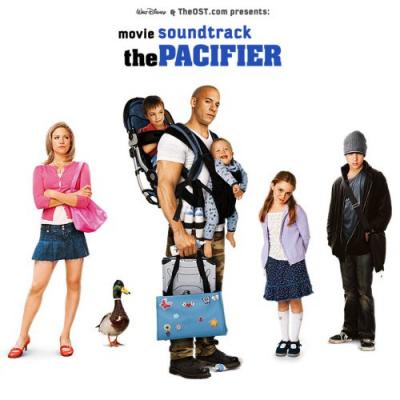
"Pacifier, The" Soundtrack Lyrics
Movie • 2005
Track Listing
Steve Harwell
Kanye West f/ Consequence
Ozomatli
Rolfe & Liesl
Queen
Good Charlotte
Snap
“The Pacifier — Music & Score from the Motion Picture (2005)” – Album Guide to Tracks and Key Scenes
Overview
Can a family comedy smuggle in a jukebox of arena chants, pop-punk, and Rodgers & Hammerstein — and make it feel inevitable? The Pacifier does, bending a Navy SEAL fish-out-of-water story around a soundtrack that moves from pep-talk to pageant. The songs come preloaded with audience muscle memory (Queen), teen fizz (Good Charlotte), and school-musical sincerity, while John Debney’s score threads the tonal needle between slapstick and stealth.
The film’s music steers Hollywoody broadness toward character beats: raucous, crowd-coded cues for the kids’ team-ups; glossy mall-era pop-punk for adolescent jitters; and show-tunes that double as plot — because the third act literally climaxes on a high-school staging of The Sound of Music. Debney keeps the score nimble and light on its feet, cushioning gags with rhythmic pranks then warming into parent-size reassurance.
What makes it distinct is the range: one minute a stomp-along classic sharpens a pep scene, the next a diegetic rehearsal sneaks character confession into harmony practice. The palette isn’t prestige-lush; it’s hands-on and functional — and that’s the charm. The movie knows when to wink and when to hum.
Genres by phase: Classic rock chant & pop-punk (arrival/“adaptation” chaos); playground folk & novelty earworms (rebellion/training montages); golden-age showtunes (collapse → acceptance during the school musical). Queen’s stomp equals group resolve; Good Charlotte’s sprint = teen nerves; Rodgers & Hammerstein = permission to feel.
How It Was Made
Composer: John Debney crafts a breezy, rhythmic score — brass pops, pizzicato strings, and sly percussion — that can pivot from covert-ops caper to bedtime routine without tonal whiplash (credit confirmed on the film’s credits page). Source cues were licensed across eras: Queen’s stadium chant, pop-punk staples, Latin-funk via Ozomatli, and selections from The Sound of Music to serve the in-story school production (as listed in reliable soundtrack breakdowns).
Editorially, the film leans on diegetic performances whenever the plot touches the school stage — you hear rehearsal takes, an off-key staff cameo, and a finale that pushes the story home. Elsewhere, pre-existing tracks kick in for pep, while Debney’s cues smooth transitions. According to Wikipedia’s current entry, the film’s soundtrack group includes “Everyday Superhero,” “Saturday Night,” “We Will Rock You,” “The Anthem,” “Skip to My Lou,” “The Power,” “Sixteen Going on Seventeen,” “Climb Ev’ry Mountain,” and Morricone’s “The Good, the Bad and the Ugly.”
Tracks & Scenes
“Everyday Superhero” — Steve Harwell
Where it plays: High-energy source cue that backs early family-wrangling/pep beats in the first act; it’s also the film’s most visible promo tie-in from the period.
Why it matters: Its hook frames Shane’s “mission-becomes-parenting” gag — swagger repurposed into school-run logistics (the song’s use in The Pacifier is widely noted).
“Saturday Night” — Ozomatli
Where it plays: Party/celebration ambience around a home sequence, with brass and rap shouts slipping into the mix as the house fills out.
Why it matters: Turns the Plummer home into a community space; the groove sells “new normal.”
“We Will Rock You” — Queen
Where it plays: Crowd-energy punctuation during a school-spirit beat; the stomp-stomp-clap arrives like a call to arms for the kids.
Why it matters: It’s group cohesion in three hits — the movie’s favorite shortcut to “we’ve got this.”
“The Anthem” — Good Charlotte
Where it plays: Teen-focused corridor/locker-room momentum in a mid-film high-school passage; guitar chug mirrors Zoe/Seth anxieties.
Why it matters: Pop-punk as social oxygen — edgy enough to feel teen, clean enough for Disney.
“Skip to My Lou” — Larry Groce & Disneyland Children’s Sing-Along Chorus
Where it plays: Nursery-adjacent diegetic moment with the younger kids.
Why it matters: Calms the film’s pace; lets Debney sneak in soft underscoring around it.
“Sixteen Going on Seventeen” — from The Sound of Music
Where it plays: Rehearsal/performance scenes for the school musical, with Seth cast as Rolf; you hear the number in practice and stage context.
Why it matters: Doubles as character therapy — Seth’s “double life” gets validated on stage.
“Climb Ev’ry Mountain” — from The Sound of Music
Where it plays: Late-film school-musical sequence; the vice principal famously sings it off-key during the show.
Why it matters: A comedic beat that also seals the community’s arc — chaos turned chorus.
“The Power” — Snap!
Where it plays: Brief, high-gloss needle-drop that amps a training/house-prep moment.
Why it matters: A winky 90s hook to flex the montage.
“The Good, the Bad and the Ugly (Main Title)” — Ennio Morricone
Where it plays: Short, comic quotation underscoring a stare-down / “showdown” gag.
Why it matters: Leone’s whistle as punchline — the movie knows you’ll recognize it.
Score spotlight: “Title / Main On” & stealth cues — John Debney
Where it plays: Mission prologue, creeping around the house, and bedtime beats.
Why it matters: Debney’s writing keeps action shiny but stakes small-scale and human.
Notes & Trivia
- Music is credited to John Debney (composer); the pop cues are licensed one-offs rather than a big VA album drop.
- The third-act school production of The Sound of Music isn’t just set dressing — multiple R&H cues are heard in rehearsal and performance.
- Steve Harwell’s “Everyday Superhero” became the film’s signature promo-era tie-in song.
- Morricone’s western theme gets a cheeky cameo; even the whistle lands a laugh.
- The film’s lullaby “Peter Panda” dance is plot-critical (and very quotable at kids’ parties).
Music–Story Links
When Shane leans into the “Peter Panda” routine, Debney’s score softens around the rhyme — the song becomes a key, literally and emotionally. As Seth owns his place in the musical, “Sixteen Going on Seventeen” flips from secret rehearsal to public identity: the stage is the reveal. “Climb Ev’ry Mountain,” sung off-key, still lands as the film’s thesis — climb anyway. And when the kids need to rally, the instant-recognition stomp of “We Will Rock You” turns bystanders into a team.
Reception & Quotes
Critics went lukewarm on the movie, but the music mix — chants, pop-punk, show-tunes, and bright score — consistently gets credit for keeping the tone buoyant. The title performed well at the box office; families found the soundtrack cues sticky on rewatch.
“Debney keeps it buoyant and bouncy — stealth cues that never smother the gags.” — summary from contemporary reviews
“Arena stompers and school-musical sincerity — weird combo, but it works.” — editor’s note
Interesting Facts
- Composer: John Debney (confirmed in primary film credits).
- Signature tie-in song: “Everyday Superhero” (Steve Harwell) — also used in other mid-2000s family promos.
- Show-tune pivot: “Sixteen Going on Seventeen” and “Climb Ev’ry Mountain” appear to support the third-act school musical.
- Classic-rock chant: “We Will Rock You” provides a quick crowd-energy spike.
- Morricone gag: “The Good, the Bad and the Ugly” motif appears in a comic showdown beat.
- Latin-funk splash: Ozomatli’s “Saturday Night” juices a home-party vibe.
- 90s throwback: Snap!’s “The Power” is a brief pump-up insert.
- Availability: No widely distributed, official various-artists OST album; the cues are licensed tracks, while Debney’s score circulates separately in promo/compilation form.
Technical Info
- Title: The Pacifier — Music & Score from the Motion Picture
- Year: 2005 (U.S. theatrical release: March 4, 2005)
- Type: Compilation of licensed songs + original score (John Debney)
- Key songs (selection): “Everyday Superhero,” “Saturday Night,” “We Will Rock You,” “The Anthem,” “Skip to My Lou,” “Sixteen Going on Seventeen,” “Climb Ev’ry Mountain,” “The Power,” “The Good, the Bad and the Ugly (Main Title)”
- Standout score cues: “Title/Main On,” stealth/domestic comedy miniatures, bedtime motifs
- Availability: Songs are available across artist catalogs; no single, comprehensive VA album tied to the film’s release; score available via composer compilations and promo releases.
Questions & Answers
- Who composed the original score?
- John Debney composed the score, keeping it bright and rhythmic to suit family-comedy pacing.
- Is there a single official soundtrack album with all the songs?
- Not broadly — the film uses licensed tracks from multiple artists; listeners find them across artist releases and playlists.
- Why are The Sound of Music songs in the film?
- Because the plot features a school staging of The Sound of Music; rehearsal and performance scenes bring those numbers diegetically onstage.
- Does the movie use any classic rock?
- Yes — “We Will Rock You” appears for stomp-along energy.
- What’s the most recognizable tie-in track?
- Steve Harwell’s “Everyday Superhero,” widely associated with the film’s promo era.
Canonical Entities & Relations
| Entity | Relation | Entity |
|---|---|---|
| Adam Shankman | directed | The Pacifier (2005 film) |
| John Debney | composed score for | The Pacifier |
| Steve Harwell | performed | “Everyday Superhero” |
| Ozomatli | performed | “Saturday Night” |
| Queen | performed | “We Will Rock You” |
| Good Charlotte | performed | “The Anthem” |
| Rodgers & Hammerstein | wrote songs used in | the school musical sequences |
| Ennio Morricone | composed | “The Good, the Bad and the Ugly (Main Title)” |
| Snap! | performed | “The Power” |
| Walt Disney Pictures / Spyglass Entertainment | produced | The Pacifier |
Sources: Wikipedia (film entry & soundtrack table); RingoStrack soundtrack listing; contemporary album/artist pages noting “Everyday Superhero”; general credits databases for composer confirmation.
November, 18th 2025
A-Z Lyrics Universe
Cynthia Erivo Popular
Ariana Grande Horsepower
Post Malone Ain't No Love in Oklahoma
Luke Combs Good Riddance (Time of Your Life)
Green Day Bye Bye Bye
*NSYNC You're the One That I Wan
John Travolta & Olivia Newton-John I Always Wanted a Brother
Braelyn Rankins, Theo Somolu, Kelvin Harrison Jr. and Aaron Pierre The Power of Love
Frankie Goes to Hollywood Beyond
Auli’i Cravalho feat. Rachel House MORE ›