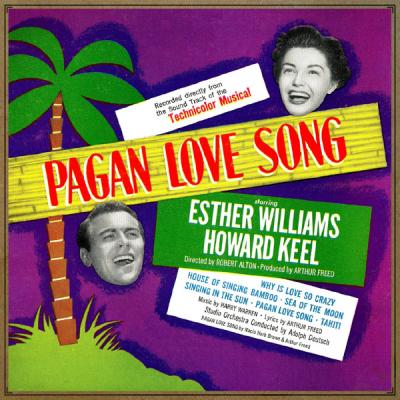
"Pagan Love Song" Soundtrack Lyrics
Movie • 1950
Track Listing
“Pagan Love Song (MGM Musical Soundtrack)” – Album Guide to Tracks and Key Scenes
Overview
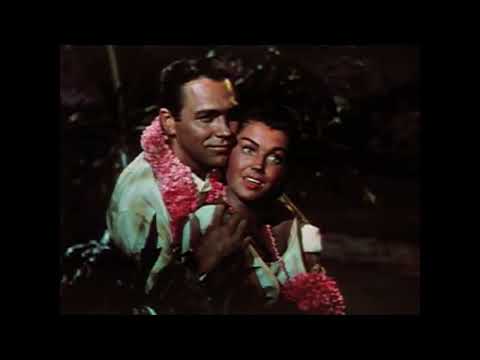
How do you make a lagoon sing? Pagan Love Song does it with island romance, Hollywood pageant, and a set of melodies that move like warm tidewater. The soundtrack balances vintage MGM songwriting with location color: one foot in the Arthur Freed/Nacio Herb Brown songbook, the other in freshly written Harry Warren numbers for a Tahitian daydream.
Esther Williams’ aquatic sequences glide on lyrical waltzes and gentle fox-trots; Howard Keel’s baritone anchors the film’s romantic declarations. The title tune returns as a calling card — first as an opening-credits choral welcome, then as a serenade that seems to carry the trade winds. Studio chorus, native children’s voices, and the MGM orchestra make the island feel communal rather than solitary.
Across the story the palette shifts: moonlit ballads (arrival), playful serenades and work-songs (adaptation), hammock-sway duets and bamboo-rhythm novelties (rebellion), then a reprise of the title song that ties the bow (collapse → acceptance). It’s a compact, 76-minute musical that treats songs like postcards — bright, short, and scented with salt air.
How It Was Made
Songwriters & score: Producer Arthur Freed drew on MGM’s in-house giants. The 1929 standard “Pagan Love Song” (music by Nacio Herb Brown, lyrics by Freed) anchors the film, while Harry Warren and Freed supplied new songs (“Sea of the Moon,” “Singing in the Sun,” “Why Is Love So Crazy?,” “House of Singing Bamboo,” “Tahiti”). Veteran music director Adolph Deutsch conducted the MGM Studio Orchestra; lush orchestration keeps the numbers plush but breezy.
Recording & releases: Studio singles/EPs followed the film, with Howard Keel and Esther Williams on 78s/EPs, and later multi-title reissues bundling selections with other MGM musicals. You’ll also find compact reissues on modern services (short 6-track EPs) that mirror the original shellac/EP programs of the era.
Tracks & Scenes
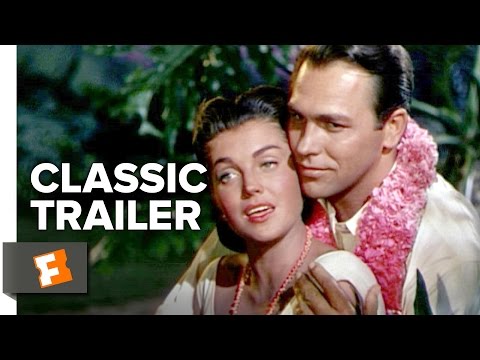
“Pagan Love Song” — Howard Keel; chorus reprise
Where it plays: First, as a welcoming chorus over credits; later as Keel’s baritone serenade with Tahitian children echoing the refrain on shore. Non-diegetic opening, then diegetic within the island setting.
Why it matters: A 1929 standard reborn as a film’s thesis: belonging as melody.
“Sea of the Moon” — Esther Williams
Where it plays: A twilight stand-still: Williams’ Mimi drifts into a reflective vocal against a silvery lagoon tableau; orchestra hushes to strings and harp while the camera lingers on water. Diegetic performance shifting to underscoring.
Why it matters: Gives the swimmer-star a lyrical identity beyond spectacle.
“Why Is Love So Crazy?” — Howard Keel
Where it plays: A swaggering solo mid-film, voiced like a question to the palms — Keel sells the comic-romantic dilemma while locals listen in. Mostly diegetic, then reprises instrumentally beneath dialogue.
Why it matters: The “baritone confessional,” equal parts grin and sigh.
“Singing in the Sun” — Esther Williams & Howard Keel
Where it plays: A buoyant duet staged among beach work and play — baskets, boats, and background chorus stitching the community into the melody. Diegetic/train-song energy with choral replies.
Why it matters: Turns daily life into musical theatre — the Freed unit specialty.
“House of Singing Bamboo” — Howard Keel
Where it plays: A gently rhythmic courtyard serenade with bamboo-percussion accents and backing chorus; later quoted in underscoring as a love-theme variant.
Why it matters: The “domestic fantasy” number — home imagined in sound.
“Tahiti” — Howard Keel
Where it plays: A postcard-bright booster for island life — staged as a cheerful address to the audience and the locals alike.
Why it matters: Pure Technicolor travel-song — and an efficient mood-setter.
Notes & Trivia
- The title song predates the film by two decades — written in 1929 for The Pagan — and repurposed here as the main theme.
- Freed produced the picture and co-wrote lyrics throughout; Warren supplied most of the new melodies.
- Adolph Deutsch, later famed for noir and comedy scoring, conducts the musical forces here.
- Howard Keel’s singles/EPs from the film circulated on MGM 78s and early 45s; later anthologies pair these tracks with Show Boat and Annie Get Your Gun.
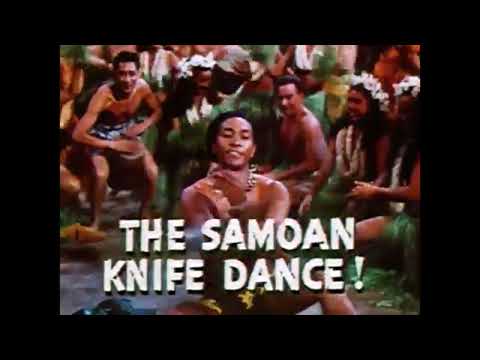
- Location vistas were shot in Hawaii standing in for Tahiti — the music leans into the fantasy rather than strict ethnography.
Music–Story Links
When Keel reprises Pagan Love Song with children’s voices, the lyric literally expands from “I” to “we,” marking the shift from visitor to neighbor. Williams’ “Sea of the Moon” slows the plot to let longing speak — after spectacle, sincerity. The work-song bounce of “Singing in the Sun” turns chores into community, so later conflicts land softer. And “House of Singing Bamboo” is the blueprint for the couple’s future — the arrangement mimics a heartbeat under the lilt.
Reception & Quotes
Contemporary reviews were cool on the plot but appreciative of the scenery and music’s easy charm; modern collectors treat the songs as prime mid-century MGM craft. The score’s job is modest — decorate, nudge, delight — and it does that consistently.
“A series of incidents, some eye-filling and some amusing.” — The New York Times (on the film)
“Keel’s baritone and Williams’ lagoon tableaux carry the day.” — archivist notes

Interesting Facts
- Song lineage: The 1929 “Pagan Love Song” (Freed/Brown) becomes the 1950 film’s signature.
- New numbers: Warren/Freed collaborations supply the fresh material heard on screen.
- Conductor credit: Adolph Deutsch leads the MGM Studio Orchestra on the soundtrack recordings.
- EP life: A 6-track EP program circulated (Keel/Williams features); modern reissues mirror that format.
- Anthologies: 1990s CD sets group the film’s tracks with other MGM musicals for catalog continuity.
Technical Info
- Title: Pagan Love Song (MGM musical)
- Year: 1950
- Type: Studio musical — original songs + revived standard; orchestral underscoring
- Primary songwriters: Nacio Herb Brown & Arthur Freed (“Pagan Love Song”); Harry Warren & Arthur Freed (new songs)
- Music direction/conductor: Adolph Deutsch
- Key on-screen numbers: “Pagan Love Song” • “Sea of the Moon” • “Why Is Love So Crazy?” • “Singing in the Sun” • “House of Singing Bamboo” • “Tahiti”
- Original releases: MGM 78/EP singles (Keel/Williams); later compilations and short digital EPs
- Availability: Select tracks on streaming via vintage anthologies and EP reissues
Questions & Answers
- Is the title song original to the 1950 film?
- No. It’s a 1929 Freed/Brown standard repurposed here as the movie’s theme.
- Who wrote the new songs created for the film?
- Harry Warren composed the music with Arthur Freed supplying lyrics for numbers like “Sea of the Moon” and “House of Singing Bamboo.”
- Does Esther Williams sing on the soundtrack?
- Yes — notably “Sea of the Moon,” plus duet moments like “Singing in the Sun.” (Standard studio practices of the era sometimes used dubbing.)
- Who conducts the orchestra?
- Adolph Deutsch conducts the MGM Studio Orchestra.
- Can I find an official album?
- There wasn’t a single long-play album in 1950; contemporaneous MGM 78s/EPs and later CD/digital anthologies carry the songs.
Canonical Entities & Relations
| Entity | Relation | Entity |
|---|---|---|
| Robert Alton | directed | Pagan Love Song (1950) |
| Arthur Freed | produced / co-wrote lyrics for | Pagan Love Song (songs) |
| Nacio Herb Brown | composed | “Pagan Love Song” (1929) |
| Harry Warren | composed | new songs for the 1950 film |
| Adolph Deutsch | conducted | MGM Studio Orchestra |
| Esther Williams | performed | “Sea of the Moon”; duets incl. “Singing in the Sun” |
| Howard Keel | performed | “Pagan Love Song,” “Why Is Love So Crazy?,” “House of Singing Bamboo,” “Tahiti” |
| MGM Records | issued | contemporaneous 78s/EPs with film selections |
Sources: studio credits and song lists, album/EP listings, soundtrack anthologies, and contemporary reviews.
November, 18th 2025
A-Z Lyrics Universe
Cynthia Erivo Popular
Ariana Grande Horsepower
Post Malone Ain't No Love in Oklahoma
Luke Combs Good Riddance (Time of Your Life)
Green Day Bye Bye Bye
*NSYNC You're the One That I Wan
John Travolta & Olivia Newton-John I Always Wanted a Brother
Braelyn Rankins, Theo Somolu, Kelvin Harrison Jr. and Aaron Pierre The Power of Love
Frankie Goes to Hollywood Beyond
Auli’i Cravalho feat. Rachel House MORE ›