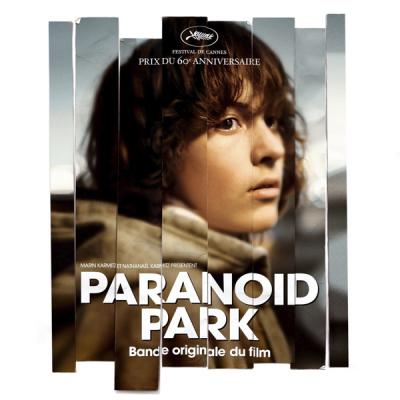
"Paranoid Park" Soundtrack Lyrics
Movie • 2008
Track Listing
Nino Rota
Elliott Smith
Elliott Smith
Nino Rota
Billy Swan
Henry Davies
Cast King
Menomena
Cool Nutz
Nino Rota
José Ramires
Nino Rota
Beethoven
Ethan Rose
Robert Normandeau
Frances White
"Paranoid Park (Original Motion Picture Soundtrack)" – Album Guide to Tracks and Key Scenes
Overview
What happens when a skate film refuses adrenaline and chases a feeling instead? Paranoid Park answers with a collage soundtrack — whispery electronics, Italian cinema romance, bedroom folk, and mall-pop nostalgia — that makes Portland feel like a memory you can hear. The story follows Alex, a quiet skater who carries a terrible accident in secret; the music lets us sit inside that secret without demanding explanations.
Gus Van Sant leans on experimental soundscapes by Ethan Rose — vaporous, time-stretched textures — alongside crate-dug cues by Nino Rota, Elliott Smith, Menomena, Billy Swan, Cool Nutz, and even a burst of Beethoven. According to contemporary coverage, many selections arrived during the edit — songs swapped in from personal iTunes libraries as scenes found their shape; Rose’s pieces were built as intricate “wash of foreign noise” around them.
The arc plays like: arrival → rupture → avoidance → confession. Styles map to states: Rota’s Fellini waltzes (wistful denial), Elliott Smith (interior drift), vintage pop (teen theater), Rose’s drones (memory fog), and a bracing classical jolt (moral shock). It’s a soundtrack that never “tells you how to feel”; it just lets the feeling ring out.
How It Was Made
Van Sant edited the film himself and, as reported at the time, invited music into the cutting room: he and the team tried tracks on picture until something clicked. The sound-world coalesced around Ethan Rose’s pieces (“Song One,” “Song Two/Three”), with additional electroacoustic works by Robert Normandeau and Frances White used as textural counterpoints. Licensed cuts span decades and sensibilities — Rota from Giulietta degli spiriti and Amarcord, Pacific Northwest indie (Menomena), Portland hip-hop (Cool Nutz), and singer-songwriter staples (Elliott Smith).
The official album first appeared in France (Uncivilized World/MK2), then rolled into U.S. availability the following spring to match the movie’s release. Track sequencing preserves the film’s tonal swing: Rota and Smith set the bookends; Rose and company provide the dream-logic midair.
Tracks & Scenes
“Angeles” — Elliott Smith
Where it plays: A slow-motion school-hallway glide early in Alex’s spiral. The camera floats as faces blur; the fingerpicked guitar narrows the world to a private ache. The cue functions non-diegetically, folding memory into present-tense images.
Why it matters: Turns the high school into headspace — the first clear window into Alex’s interior.
“I Can Help” — Billy Swan
Where it plays: Alex is called out of class and walks toward the office to meet Detective Lu. The jaunty, retro groove rubs against the dread of being singled out; the bubblegum smile doesn’t fit the room.
Why it matters: Irony, loud and bright — teen pop as social mask while the stakes rise.
“Strongest Man in the World” — Menomena
Where it plays: A kinetic interlude that rides skate motion into restless montage. Percussion skitters and loops while camera and board carve negative space; it’s velocity without destination.
Why it matters: Gives the film its pulse of escape — speed that can’t out-skate consequence.
“I Heard That” — Cool Nutz (feat. Six & Aniece)
Where it plays: Night-drive fragments and bedroom resets cut together; the bassline thumps like anxious blood. It feels source-adjacent, as if the city itself is leaking into the track.
Why it matters: Local voice, local pressure — Portland hip-hop rooting the abstraction in place.
“La Porticina Segreta” — Nino Rota
Where it plays: In one of the film’s gentler pivots, Rota’s whimsical melody drapes over images that shouldn’t feel whimsical at all — a pocket of denial framed like a Fellini daydream.
Why it matters: Sweetness as shield; cinema history floats into a teenager’s crisis.
“L’Arcobaleno per Giulietta” — Nino Rota
Where it plays: A wistful connective passage, like breath between confessions. Strings and celesta twirl while Alex rewinds the story on paper.
Why it matters: Storybook tone vs. blunt handwriting — the contrast hurts in the right way.
“Outlaw” — Cast King
Where it plays: Americana on the car stereo as Alex tries on different faces in the rear-view. The song’s outlaw myth rubs off for a second, then slides off again.
Why it matters: A tiny portrait of how media gives teens borrowed attitudes.
“Tunnelmouth Blues” — Henry Davies
Where it plays: A low-slung city passage underscores late-night limbo — bridges, tracks, and the wrong part of town. Harmonica and shuffle — the movie lets the cliché talk for once.
Why it matters: A mood postcard; it colors the geography without comment.
“Song One / Song Three” — Ethan Rose
Where it plays: Slow, mesmeric skating and interior monologue sequences; a wash of voices, bells, and stretched harmonium-like tones. One cue is layered with found French voice, blurring documentary and dream.
Why it matters: The film’s memory cloud — time dilates, guilt echoes.
“Symphony No. 9, 4. (excerpt)” — Ludwig van Beethoven
Where it plays: A sharp, almost alien classical burst against otherwise hazy textures — a moral alarm bell that cuts through fog for a few stark bars.
Why it matters: A jolt of order in a disordered head; it startles by design.
“The White Lady Loves You More” — Elliott Smith
Where it plays: Late-night quiet — aftershocks and avoidance. The lyric folds around Alex like a blanket he can’t sleep in.
Why it matters: Closes the loop on the film’s most intimate voice.
Also heard around the margins: “Gradisca e il Principe” (Rota), “Il Giardino delle fate” (Rota), “We Will Revolt” (The Revolts/José Ramires), electroacoustic textures by Robert Normandeau and Frances White. The marketing and international trailers also lean on Ethan Rose and local cuts.
Notes & Trivia
- The soundtrack album first released in France (late 2007) on Uncivilized World/MK2 before a U.S. issue in March 2008.
- Ethan Rose’s cues were built as intricate soundscapes — the director called them “very complicated.”
- Several Rota selections are from Juliet of the Spirits and Amarcord, giving the film a Fellini haze.
- Portland artists (Menomena, Cool Nutz) sit alongside Elliott Smith — a deliberate local texture.
- The official CD clocks just over 51 minutes; sequencing mirrors the film’s drift-and-jolt rhythm.
Music–Story Links
When Alex slips into slow motion, “Angeles” turns the hallway into a confessional booth; guitars replace dialogue. Minutes later, Swan’s “I Can Help” does the opposite — it’s cheerful camouflage as authority closes in. Rose’s “Song One/Three” run like memory fog under skating images; they’re how avoidance sounds. And when a Rota waltz floats in, the movie tries on a sweeter world — just long enough for the sweetness to feel false.
Reception & Quotes
Critics repeatedly singled out the music’s range and function — pop, classical, electroacoustic — as the film’s second narrative. One regional piece even framed it as a local-scene showcase (Cool Nutz, Menomena), while another praised how the soundtrack changes how you see skateboarders on screen.
“A wash of foreign noise… the soundscapes are mostly made by Ethan Rose.” — Los Angeles Times
“It’s also larded with Elliott Smith on the soundtrack.” — Slant Magazine
“High school… posturing walks down the hallway to Billy Swan’s ‘I Can Help.’” — The Brooklyn Rail
“Cool Nutz, Ethan Rose, Menomena on the Paranoid Park soundtrack.” — Willamette Week
Interesting Facts
- The U.S. album rollout tied to the film’s limited release, after a France-first issue.
- Not every film cue made the retail track list; some electroacoustic textures circulate mainly via credits and specialist catalogs.
- Beethoven in a skate drama? The jolt works — a tiny essay about guilt via orchestration.
- Several Rota tracks carry whimsical titles that play as counterpoint (“Little Secret Door,” “Rainbow for Giulietta”).
- The AV Club explicitly calls out the “Angeles” hallway passage — one reason that cue became the film’s calling card.
Technical Info
- Title: Paranoid Park (Original Motion Picture Soundtrack)
- Year: 2007 (France); 2008 (U.S. availability)
- Type: Compilation + experimental sound design
- Key contributors: Ethan Rose (soundscapes); Nino Rota (selections); Elliott Smith; Menomena; Cool Nutz; Billy Swan; Robert Normandeau; Frances White
- Label/Release: Uncivilized World / MK2 (CD); duration ~51:13; sequencing aligned to the film’s tone arc
- Standout placements: “Angeles,” “I Can Help,” “Strongest Man in the World,” “I Heard That,” “La Porticina Segreta,” “Song One/Three”
- Film credits: Written/directed/edited by Gus Van Sant; Portland, Oregon setting; premiered Cannes 2007
- Availability: CD (import) and digital listings; select tracks on artist catalogs/streaming
Questions & Answers
- Who created the film’s original soundscapes?
- Portland musician Ethan Rose — his pieces (“Song One/Two/Three”) are the vaporous backbone of the score-like material.
- Why the Nino Rota cues?
- They lend Fellini-esque wistfulness — a dreamy counterpoint to Alex’s guilt — and were embraced in the edit as tone shifters.
- Which needle-drops define key beats?
- Elliott Smith’s “Angeles” (interior drift), Billy Swan’s “I Can Help” (ironic school-walk), Menomena’s “Strongest Man in the World” (motion), Cool Nutz’s “I Heard That” (place and pressure).
- Is there an official, single-CD soundtrack?
- Yes — a 2007/2008 release on Uncivilized World/MK2; not every film cue is included, but the spine is there.
- What’s the overall vibe of the album?
- Hushed and haunted, with odd bursts of sweetness and noise — a mixtape of memory and denial.
Canonical Entities & Relations
| Subject | Verb | Object |
|---|---|---|
| Gus Van Sant | wrote/directed/edited | Paranoid Park (2007) |
| Ethan Rose | composed/performed | “Song One,” “Song Two,” “Song Three” (soundscapes) |
| Nino Rota | composed | “La Porticina Segreta,” “L’Arcobaleno per Giulietta,” other selections (licensed) |
| Elliott Smith | performed | “Angeles,” “The White Lady Loves You More” |
| Menomena | performed | “Strongest Man in the World” |
| Cool Nutz | performed | “I Heard That” |
| Billy Swan | performed | “I Can Help” |
| Uncivilized World / MK2 | released | Paranoid Park soundtrack album (France-first) |
Sources: Los Angeles Times; LA Weekly; The Playlist (track list); Willamette Week; AllMusic album page; SoundtrackCollector; AV Club review; The Brooklyn Rail; Wikipedia (film & soundtrack notes).
November, 18th 2025
A-Z Lyrics Universe
Cynthia Erivo Popular
Ariana Grande Horsepower
Post Malone Ain't No Love in Oklahoma
Luke Combs Good Riddance (Time of Your Life)
Green Day Bye Bye Bye
*NSYNC You're the One That I Wan
John Travolta & Olivia Newton-John I Always Wanted a Brother
Braelyn Rankins, Theo Somolu, Kelvin Harrison Jr. and Aaron Pierre The Power of Love
Frankie Goes to Hollywood Beyond
Auli’i Cravalho feat. Rachel House MORE ›